


Newslifestyleevents‘Food Is Not The Enemy’: Dr Ridhima Khamesra’s New Book Tackles Food Myths And Nutrition Misinformation
‘Food Is Not The Enemy’: Dr Ridhima Khamesra’s New Book Tackles Food Myths And Nutrition Misinformation
Reported By :
- Swati Chaturvedi
- ,News18.com
Last Updated:August 24, 2026, 12:26 IST
Dr Ridhima Khamesra’s Delhi book launch explored why we fear foods like rice, ghee and dal and how to build a healthier relationship with food

Rapid Read
Summarized by AI.
+
More Rapid Read
Like this summary?
Share Your Feedback
Got Question about the News?
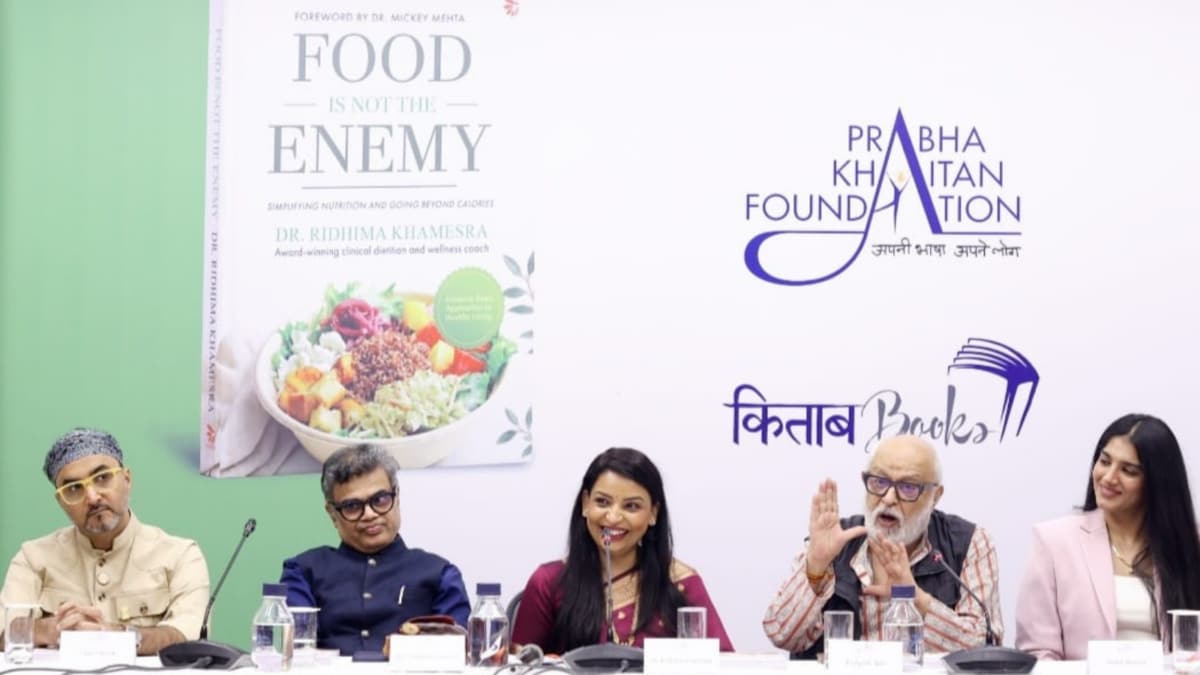
At her Delhi book launch, Dr Ridhima Khamesra brought together food historian Pushpesh Pant, chef Vikas Chawla, surgeon Dr Anshuman Kaushal and boxer Nupur Sheoran to discuss nutrition, food myths and why we need to stop fearing food.
There are few subjects that have become as confusing as food. One day rice is the villain, the next day ghee is. Fruit is questioned for its sugar, potatoes are treated with suspicion, and social media is full of advice telling us what to eliminate, what to detox and what to never eat again
That is precisely the anxiety that Dr Ridhima Khamesra wants to challenge with her new book, Food Is Not The Enemy, launched at the India International Centre in New Delhi
Recommended Stories
I attended the launch, and what stayed with me was that the evening wasn’t really about another nutrition book telling people what they should and shouldn’t eat. If anything, it was about trying to make people less afraid of food
A clinical dietitian, nutritionist and wellness professional, Dr Khamesra has built her practice around personalised nutrition and sustainable lifestyle changes. Her work spans areas including weight management and therapeutic nutrition
The book, which carries a foreword by Dr Mickey Mehta, brings together 30 chapters covering nutrition basics, everyday eating habits, weight management, diabetes, heart health, gut health, PCOS and perimenopause, before moving into diet trends, supplements and the misinformation surrounding food on social media
But the larger message of the evening was captured in the title itself
The Real Problem May Be Our Fear Of Food
In her opening remarks, Dr Khamesra spoke about a shift she has noticed in her clinical practice. She said, “Patients are increasingly asking not just, ‘What should I eat?’ but whether ordinary foods are safe to eat at all.”
That distinction is important. Because somewhere between Instagram reels, celebrity diets, calorie-counting apps and an endless stream of conflicting nutrition advice, food has become something many people approach with suspicion
Dr Khamesra put it simply, “The problem isn’t necessarily the dal, rice, roti, potato or mango sitting on the plate. It is fear, misinformation and extremes.”
Her book attempts to bring the conversation back to a more balanced understanding of food, one that considers nourishment, lifestyle and individual needs rather than treating individual ingredients as either completely good or completely bad
That idea felt particularly relevant in a room where almost every panelist approached food from a completely different discipline
Five Perspectives, One Question: Why Have We Started Fearing Food?
What made the evening particularly interesting was the panel itself. It brought together people who could hardly have approached food from more different directions, food historian and Padma Shri awardee Pushpesh Pant, millet chef Vikas Chawla, robotic and bariatric surgeon Dr Anshuman Kaushal, boxer Nupur Sheoran, and Dr Ridhima Khamesra
And yet, listening to them, there was a common thread: our relationship with food has become far more complicated than it needs to be
Pant brought a lighter moment to the discussion when he told the audience that he had just had aloo puris, halwa and kheer for lunch. The admission drew laughter from the room and perhaps explained why he was giving the samosas at the IIC event a miss
His perspective brought the conversation back to a time when food wasn’t divided into Instagram-friendly categories of good and bad. Seasonal eating, fermentation, spices and regional ingredients were simply part of everyday Indian food culture
Chef Vikas Chawla, known as the Millet Chef of India, brought the conversation into the modern kitchen, making the case for looking again at India’s own grains and ingredients. The discussion around ragi, jowar, bajra, kangni and kodo was particularly relevant at a time when imported ingredients can become fashionable while traditional Indian foods are suddenly treated as old-fashioned
Dr Anshuman Kaushal brought the medical perspective, and perhaps the question that most needs asking in the age of Instagram nutrition: how much of the health advice we consume online is actually backed by science? A robotic, GI, minimal-access and bariatric surgeon at CK Birla Hospital, Gurugram, Dr Kaushal has extensive experience across gastrointestinal, bariatric and minimally invasive surgery. His contribution was particularly relevant at a time when health information is increasingly consumed through short videos, reels and social-media posts.
Then there was Nupur Sheoran, bringing the perspective of an elite athlete. A heavyweight boxer and five-time national champion, Sheoran is also the granddaughter of legendary Indian boxer Captain Hawa Singh. Her contribution shifted the conversation from simply eating well to eating for performance, discipline and consistency
And at the centre of it all was Khamesra herself, whose clinical experience has brought her face-to-face with the growing anxiety people have around eating
It wasn’t five people giving five versions of a diet plan. It was a historian talking about where our food traditions came from, a chef asking why we’ve stopped valuing what grows here, a surgeon questioning what we believe online, an athlete discussing discipline and performance, and a nutritionist asking us to reconsider why we have become afraid of food in the first place
India’s Traditional Foods And The New ‘Superfood’ Culture
One of the ideas that stayed with me was the contrast between India’s traditional food wisdom and today’s aspirational food culture
There is something slightly ironic about the way urban Indians can enthusiastically embrace quinoa, kale and imported “superfoods” while ingredients such as millets, regional grains and traditional preparations are often treated as old-fashioned
The conversation around millets therefore wasn’t simply about nutrition. It was also about food memory, accessibility and reclaiming ingredients that were once ordinary rather than fashionable
The larger point was not that imported foods are inherently bad. It was that we shouldn’t have to look outside our own food traditions to discover ingredients that have been part of Indian diets for generations
The Internet Has Made Everyone A Nutrition Expert
This was perhaps one of the most relevant parts of the discussion. Every day, millions of people encounter nutrition advice online. Carbohydrates are demonised in one video, fats are celebrated in another. Someone declares that a particular fruit is “toxic”, another promises that a particular ingredient will “detox” the body, while yet another recommends eliminating an entire food group
The problem is that confidence is not the same thing as scientific evidence. Dr Kaushal’s contribution brought that distinction into sharp focus. The audience was reminded to question where health claims come from, particularly when they are presented without context or evidence
Nutrition rarely works in absolutes
Dr Kaushal put it another way, “The right question isn’t always, ‘Is this food good or bad?’ It can be, ‘Is this food appropriate for me, in this quantity, prepared this way, as part of my overall diet and lifestyle?”
That is a much less dramatic answer, but probably a much more useful one
An Athlete’s Take: Discipline Doesn’t Mean Perfection
Nupur Sheoran brought another interesting dimension to the conversation. For an elite athlete, food isn’t merely about weight or appearance. It can influence training, recovery, energy and performance
“Half my time goes in weighing my food,” Nupur said, giving the audience a glimpse into just how closely an elite athlete has to think about food. Her perspective on discipline also offered a useful counter to the perfectionism that often surrounds diet culture
Discipline doesn’t necessarily mean never breaking a routine. It can also mean knowing how to return to it
That is an idea that extends beyond sport. A healthy relationship with food cannot realistically mean eating perfectly every single day. There will be celebrations, travel, restaurant meals, cravings and desserts
The important thing is what happens over time, not whether one meal was perfect
And Then Came The ‘Khalnayak’ Round
Perhaps the most entertaining part of the evening was the ‘Khalnayak’ round. Panelists were asked to give quick verdicts on foods that have become regular villains in modern diet culture, including rice, ghee, potato, milk, fruit and dal
It was lively precisely because there wasn’t complete agreement. And that, in many ways, was the most useful part of the conversation. There was no single food that could simply be stamped good or bad
Instead, the discussion kept returning to context: how much, how often, what else is on the plate, how the food is prepared, and who is eating it
That is considerably less exciting than a headline saying “Never Eat Rice Again”, but it is also far more useful
The Conversation Was Bigger Than A Book Launch
What I found particularly refreshing about the evening was that it didn’t feel like a conventional book launch where the author speaks about the book and the audience listens
The book became a starting point for a much larger conversation, about how we eat, how we think about food and how easily we allow social media to turn individual ingredients into villains or miracles
Food historian, chef, surgeon and athlete may seem like an unusual combination for a nutrition conversation. But perhaps that was precisely why it worked
Food isn’t just nutrition. It is culture, memory, agriculture, medicine, performance, family and pleasure
Trying to understand it through only one of those lenses is inevitably limiting
‘Don’t Just Count Calories. Count Nourishment.’
Towards the end of the discussion, Dr Khamesra returned to the question with which she had begun. Has the way we think about food changed?
Her answer was a reminder that nutrition cannot be reduced to a number on a food label or a calorie counter
She urged the audience to think beyond calories and towards nourishment, while also acknowledging the role of sleep, movement and stress in overall health
Dr Khamesra’s closing message was simple, “Health does not come from fearing food. It comes from understanding it.”
Watch more videos
And perhaps that was what made the evening particularly refreshing. In a culture increasingly obsessed with eliminating foods, counting calories and searching for the next miracle ingredient, Food Is Not the Enemy makes a less glamorous but more sustainable argument
Understand what you eat. Understand your body. Understand your lifestyle. And stop being afraid of the food on your plate. Because the more we understand food, the less likely we are to fear it, and the less likely we are to fall for every new food villain that the internet produces
Key Questions Answered
Powered by
Ask News18
Social media can influence food choices by turning individual ingredients into perceived villains or miracles, and by presenting food content that exploits our natural visual response to food. It also features health and wellness advice, though not all influencers have medical credentials
Powered byAsk News18
About the Author
Swati ChaturvediSwati Chaturvedi is a seasoned media professional with over 13 years of experience in journalism, digital content strategy, and editorial leadership across top national media houses. An alumna of Lady…Read More
Click here to add News18 as your preferred news source on Google.Check RBI MPC Meeting 2026 Live Updates, Repo Rate Today.
Location :New Delhi, India, India
First Published:August 24, 2026, 11:45 IST
Disclaimer: Comments reflect users’ views, not News18’s. Please keep discussions respectful and constructive. Abusive, defamatory, or illegal comments will be removed. News18 may disable any comment at its discretion. By posting, you agree to our Terms of Use and Privacy Policy.
Loading comments…
