


Download PDF
Abstract
Digital technologies are integral to daily life, with individuals spending substantial time in digital environments. Evidence increasingly links this exposure to adverse health outcomes, but research remains fragmented and relies largely on “screen time” as a crude proxy. The full spectrum of these health outcomes and the metrics needed to assess them remain poorly defined. In this systematic scoping review of 389 studies, we mapped reported associations between digital exposure and health outcomes spanning across mental, behavioural, visual, musculoskeletal, and metabolic systems, which we conceptualise as ‘cyber-diseases’. Screen time, assessed in 83% of clinical studies, was the most commonly used exposure metric but is likely an inadequate proxy. These findings highlight gaps in the conceptualisation and measurement of digital exposure. Based on these findings, we propose, as a possible direction for future work, a multi-dimensional digital biomarker framework—encompassing exposure time, device type, interaction mode, and content.
Subjects
Introduction
Human health is shaped by environmental determinants, including biological, psychological, and social factors. Increasingly, these environments are becoming digital. Average daily screen time has risen steadily since the 1960s, accelerating sharply with the advent of smartphones in 2007. Today, digital exposure is nearly universal1,2,3, with more than five billion internet users worldwide. Digital devices have become integral to education, work, and leisure. Globally, 68% of the population uses the internet. In high-income countries, the internet is used by 93% of the population4. Smartphones are used by ~70% of the global population5. The World Economic Forum reports that the number of mobile phones has already exceeded the global population6.
This pervasive digital exposure has raised significant public health concern, as even modest individual risks, when multiplied across billions of users, may translate into substantial population burdens. Research across public health, medicine, and psychology has linked excessive digital technology use to a broad spectrum of outcomes, including behavioural addictions7, sleep disturbance8, mood and anxiety disorders9, visual strain10, musculoskeletal pain11, and cardiometabolic disease12. Novel syndromes such as digital dementia13, cyberchondria14, and technostress15 have been described, yet most remain absent from international disease classifications, including ICD-1116. Importantly, these outcomes are thought to arise through multiple mechanisms: sedentary behaviour, circadian rhythm disruption from light exposure, cognitive overload17, harmful online interactions (e.g., cyberbullying, social comparison18), and even potential effects of electromagnetic radiation19. However, the evidence remains fragmented across disciplines, often focusing on isolated conditions, and struggling to keep pace with rapid technological change. Previous reviews have been limited to specific disorders (e.g., gaming20, myopia21, or sleep disturbances22), leaving no unified synthesis across diseases, mechanisms, and preventive strategies.
Although hundreds of studies have examined associations between digital exposure and health, no comprehensive mapping has identified the full spectrum of diseases attributable to digital technology use. Critical uncertainties remain regarding the breadth of affected organ systems and the mechanisms linking exposure to disease. Moreover, research has relied almost exclusively on “screen time” as a crude proxy for digital exposure, neglecting more nuanced dimensions such as device type, interaction mode, and content characteristics12.
Emerging evidence suggests that excessive digital exposure may contribute not only to new symptomatic syndromes, but also to established diseases, including cardiovascular disorders12, myopia21, and dry eye syndrome23. Rising global incidence of depression24, anxiety25, sleep disorders26, addiction syndromes27, and obesity28 since the 1990s may in part reflect the role of digital technologies as lifestyle determinants, although causal links remain debated. For instance, longitudinal cohort data clearly demonstrate that higher screen time from adolescence to middle adulthood is associated with adverse health effects such as obesity or diabetes29.
A substantial proportion of the included evidence was generated during the COVID-19 pandemic (2020–2024), a period of both sharply elevated screen use and concurrent stressors—social isolation, heightened anxiety, reduced physical activity and disrupted routines—that independently affect many of the outcomes documented here. Disentangling digital exposure from these co-occurring factors is methodologically challenging, and observed associations may partly reflect the broader burden of the pandemic. At the same time, the pandemic generated an unprecedented volume of research on digital exposure and health; the 2019–2024 search window was selected precisely to capture this formative period.
To address these gaps, we conducted a systematic scoping review of 389 peer-reviewed studies to map diseases and disorders associated with digital technology exposure. Beyond describing the evidence, our work introduces a conceptual framework for digital biomarkers—covering exposure time, device type, interaction type, and content—which can capture the complexity of digital environments more accurately than screen time alone30,31. Such biomarkers, which have been successfully developed in other fields including neurology32,33, metabolic diseases34 and ophthalmology35, have the potential to advance the diagnosis, prevention, and treatment of what we define as emerging “cyber-diseases.” By positioning digital technologies as both a potential source of harm and a tool for solutions, this review provides a foundation for shaping a clinical and public health agenda in digital medicine.
Results
Study characteristics
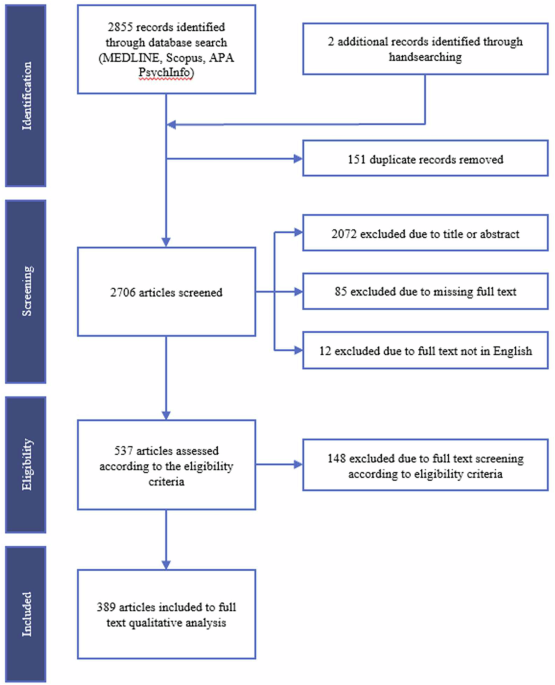
We retrieved 2857 articles from the MEDLINE, Scopus and APA PsycInfo databases. After deduplication, 2706 articles underwent title and abstract screening (see Fig. 1 for the PRISMA flow diagram). The final sample comprised 389 peer-reviewed articles and is characterised in Table 1 (the full list is provided in Supplementary Data). Clinical studies accounted for the vast majority of all publications included in this review (n = 323, 83%), with a large number of cross-sectional studies (n = 243, 62%), followed by cohort studies (n = 74, 19%). The majority of clinical studies (n = 206, accounting for more than 63% of all clinical studies) had a sample size exceeding 500 people. Asia accounted for the largest number of studies (n = 176, 45%), followed by Europe (n = 100, 25%) and North America (n = 71, 18%). The majority of the included studies involved children and adolescents (n = 128, 33% and n = 135, 35%, respectively); 26% (n = 102) of the analysed studies involved adults and only 1% (n = 4) senior persons.
Preferred Reporting Items for Systematic Reviews and Meta-Analyses (PRISMA) flow diagram showing search process overview
Exposure assessment
Our analysis found that screen time was the most commonly used metric for assessing digital technology exposure, reported in 83% (n = 323) of the studies reviewed. The involved studies used this metric across leisure activities (e.g., gaming, social media, texting), educational settings (distant learning), and occupational exposure (telework, software-based work environments). Some studies also described the simultaneous use of multiple screens36. Consequently, the term “screen time” encompassed multiple distinct exposure constructs rather than a single standardised measure, limiting comparability across studies and complicating interpretation of exposure-response relationships.
Exposure in the included studies was assessed using self-reporting measures and objective measurements, namely:
Self-report measures were frequently used to assess digital exposure37,38,39
Objective measurements were reported to provide more reliable data40,41,42. These tools included smartphone applications that automatically record the time spent on a device41,43,44,45. Some of these applications provided detailed breakdowns, analytics, and data export functions46
Furthermore, some studies reported more granular measures including wearable eye-tracking tools designed to measure blink rate and interblink intervals during screen use47. Although such wearable sensors are expected to be used more systematically in the future, the literature notes that their deployment in large samples remains logistically challenging40
Mapping of health outcomes by disease category
To map the range of reported clinical outcomes, we assigned reported diseases and symptoms to the ICD-11 classification. Because individual studies could contribute outcomes to more than one chapter, counts are not mutually exclusive and percentages do not sum to 100%. Among the 389 included studies, the most frequently reported outcomes were in the mental and behavioural domain (n = 226, 58%). This was followed by sleep–wake disorders (n = 111, 28%), endocrine, nutritional, or metabolic diseases (n = 82, 21%), diseases of the visual system (n = 62, 16%), and diseases of the musculoskeletal system (n = 27, 7%) (Fig. 2).
Diseases reported across the 389 included studies were mapped to ICD-11 categories. Most outcomes clustered within the mental and behavioural disorders domain, with smaller numbers reported for sleep–wake disorders, endocrine, nutritional and metabolic diseases, visual system disorders, and musculoskeletal conditions. Beyond being the most frequently represented category, mental and behavioural disorders also showed the greatest diversity, encompassing 80 distinct conditions. In contrast, fewer unique conditions were identified in other domains, including diseases of the visual system (n = 22), musculoskeletal system (n = 12), and digestive system (n = 12). In addition, the analysis identified 37 terms referring to emerging clinical conditions. These terms appear in the peer-reviewed literature but are not currently captured in ICD-11 or SNOMED CT. Most were again concentrated within the mental and behavioural disorders domain.
The mental and behavioural domain also contained the largest number of distinct reported diseases and symptoms (n = 80), followed by diseases of the visual system (n = 22), diseases of the musculoskeletal system (n = 12), and diseases of the digestive system (n = 12) (Fig. 2, Supplementary Data). Within the mental and behavioural chapter, reported outcomes spanned neurodevelopmental, neurocognitive, obsessive-compulsive, anxiety- and fear-related, and stress-related conditions. For example, studies reported that prolonged screen time negatively impacts academic performance and learning ability48. Exposure to smartphones and media multitasking was reported to be positively associated with cognitive inflexibility49, as well as other cognitive issues involving concentration, memory, and thinking15,50. Specific exposures, such as video conferencing, were reported to be linked to obsessive-compulsive-related disorders such as body dysmorphia51.
The sleep–wake disturbances chapter was the second most represented (n = 111, 28%). However, many studies reported non-specific sleep disturbances that could not be assigned to specific ICD-11 codes13,19. Nonetheless, specific disorders such as obstructive sleep apnoea were identified in some reports52
Outcomes in the endocrine, nutritional, or metabolic domain were reported by 21% of the involved studies (n = 82, 21%). Researchers reported an increased risk of another group of diseases reported in the context of digital exposure were12,48,53. Specific conditions identified in this domain included hypertension12,45
A wide range of illnesses of the visual system was reported (n = 62, 16%), including disorders of the anterior segment of the eye, such as keratoconjunctivitis sicca (dry eye disease)3,54, disorders of refraction or accommodation, like asthenopia (eye strain)55, as well as visual discomfort or photophobia54,56,57,58. Finally, several musculoskeletal system disorders were reported (n = 27, 7%), including lower back pain59, cervical spine pain, wrist joint pain60, elbow pain39 as well as issues with bone health in children and adolescents61.
In addition to diseases defined in the ICD-11, the analysis identified a set of new terms used to describe clinical phenomena indicated to be associated with extensive digital exposure
Emerging terminology not directly mapped to ICD-11 or SNOMED CT
In addition to outcomes that could be mapped to ICD-11, we identified in the included literature 37 terms absent in the ICD-11 or SNOMED CT, which could not be directly mapped during our classification step (see Fig. 2). These terms were reported in 116 articles (30%)
Most of these new terms (n = 33, 89%) were mapped to the mental and behavioural disorders domain. Two terms, “digital vision syndrome” and “digital eye strain,” were related to the visual domain. One new concept concerned diseases of the nervous system, and “text neck syndrome” was reported in the musculoskeletal domain. All identified terms are detailed in Supplementary Data, and a selection is presented in Table 2
Discussion
This scoping review indicates that screen time remains the most common exposure metric used in the literature. Yet the reviewed evidence also suggests that duration alone is an incomplete proxy for digital exposure and offers limited support for any single clinically meaningful threshold for excessive screen time. This limitation is also reflected in current public health guidelines, which, built upon this crude metric, are consequently inconsistent and highly variable. For example, the American Academy of Child and Adolescent Psychiatry (AACP) recommends 1 hour per weekday and 3 hours per weekend day for children aged 2–562. In contrast, the WHO recommends no screen exposure below age one, <1 hour per day for children up to age four, and <2 hours per day for minors aged 5–1763.
Importantly, our review showed that the studies grouped under the label “screen time” did not measure a uniform exposure. The 323 studies using screen time operationalized this construct across markedly different contexts, including recreational, educational, and occupational use, and employed both self-reported and objective measurement approaches. These differences are likely to represent distinct behavioural and environmental exposures with potentially different health consequences. For example, time spent in educational activities, remote work, social media use, or gaming may involve different cognitive, psychosocial, ergonomic, and physiological pathways. This heterogeneity may partly explain the inconsistent findings and variable exposure thresholds reported across the literature and further supports the need for multi-dimensional exposure assessment frameworks. Taken together, these observations suggest that screen time is a useful but incomplete exposure measure and support the development of more multi-dimensional approaches to digital exposure assessment, including device type, interaction mode, and content.
Our review mapped the mechanisms proposed in the literature to explain adverse health outcomes associated with digital technology exposure. The findings of the scoping review suggest that the conditions associated with digital technology use may arise from multiple and diverse mechanisms, rather than a single common pathway. The most consistently reported of these are indirect mechanisms, where digital technology use exacerbates known risk factors. For instance, the high prevalence of musculoskeletal, cardiometabolic, and metabolic syndrome findings is reported to be linked to sedentary lifestyles and prolonged static postures, which are well-established risk factors. Sedentary behaviour from excessive screen time was reported to contribute to musculoskeletal diseases64, cardiometabolic risk12, metabolic syndrome65, and obesity development66.
A second set of mechanisms involves the direct physiological impact of device use. In the visual system, prolonged screen time is thought to cause tear film instability (via reduced blink rate57,67 and increased tear film evaporation68) and sustained ocular accommodation when viewing screens at close distances40. This prolonged near work has been implicated in myopic progression54,69 or esotropia70. Similarly, studies suggest that exposure to blue light, particularly around bedtime, may inhibit melatonin release and potentially disrupt circadian rhythms46,71,72. The literature also mentioned mechanisms related to electromagnetic radiation in the radiofrequency (RF) spectrum (30 KHz–300 GHz), emitted by digital devices such as mobile phones and Wi-Fi routers. This exposure was classified by the WHO’s International Agency for Research on Cancer (IARC) as a ‘Group 2B’ agent—‘possibly carcinogenic to humans’—based on limited evidence of a link to glioma and acoustic neuroma in adolescents19. This designation indicates that while a causal link is considered credible, chance, bias, or other confounding factors cannot be ruled out with reasonable confidence19,73.
A third set of mechanisms involves neurobiological and psychological pathways. Internet addiction disorder and internet gaming disorder are conceptualised by some studies as being driven by impaired inhibitory control and heightened reward system reactivity, analogous to substance use disorders74,75. Indeed, the ICD-11 includes Gaming disorder, predominantly online, as a formal diagnosis, reflecting growing recognition of digital behavioural addictions 16
Critically, this group of diseases is not linked to exposure time per se, but to specific activities (e.g., gaming, gambling), which is not sufficiently captured by the crude screen time metric. The noted proliferation of new addiction-related terms (see Supplementary Data and Fig. 2) may signal that this topic may become an area of future consideration of official classifications76
Finally, our review identified mechanisms tied to the digital environment itself. Use of digital devices can reduce face-to-face interactions, increase social isolation and exacerbate mental health issues7. Specific technologies have been indicated here: social media platforms displaying idealised body images are linked to body dissatisfaction41, video conferencing is suggested to pose a risk for body dysmorphia51, and repetitive attentional shifts from multitasking may impair executive functioning77. These hypothesised exposure-specific mechanisms, while mentioned in the literature, warrant further investigation. Such research, however, may depend on the development of more precise tools and metrics.
The rapid emergence of these novel phenomena requires further research and gathering sufficient clinical evidence before new terms can be incorporated as new terms into the WHO’s ICD and Snomed CT classifications78. Some new terms, like Internet gaming disorder, describe concepts already captured in ICD-11 (“Gaming disorder, predominantly online”), others, like Problematic Internet Use (PIU), although explicitly absent from recognised diseases’ classifications, have been mentioned in medical literature already for decades, others, such as digital dementia, FOMO (fear of missing out), or cyberchondria, represent novel clinical phenomena typical of digital environments. It is possible that selected terms from these latter groups may eventually be incorporated into internationally recognised classifications.
A core challenge for international classifications is determining the appropriate level of abstraction for these new terms. Some phenomena are tied to specific applications (e.g., “Zoom dysmorphia”), while others describe broader, more established categories of exposure (e.g., “social media addiction”). This creates a dilemma: adopting platform-specific terms risks rapid obsolescence as technologies evolve, while overly general terms may lack clinical utility. While this tension is a classic challenge for any ontology, the dynamic trends and rapid technological progress of the digital era place classifications under unique pressure.
If classifications do not incorporate emerging terms, they risk failing to describe clinical reality and may become irrelevant. Conversely, if they incorporate terms too quickly, they bypass the need for sufficient clinical evidence. This dual challenge—a rapidly evolving exposure landscape and a reliance on crude metrics – necessitates new solutions. Developing tools to gather precise clinical evidence more rapidly could help keep classifications up to date without compromising evidence-based standards.
In light of the limitations of crude screen time metrics, this review highlights the potential value of exploring digital biomarkers and structured ontologies to better capture digital technology-related adverse health impacts. Digital biomarkers—which are objective, quantifiable data collected through digital devices—have been proposed in the literature to predict or explain health outcomes.30 Based on i) the standard data processing and analysis flow79 (in its data analysis path—see Fig. 3a) adapted to the specific needs of the framework, and ii) the gaps identified in this scoping review (e.g. lack of nuanced exposure measures) as well as, iii) the digital technology types and ways of use enumerated during the scoping review (see the Supplementary Data), we outline a possible framework. Conceptually, this framework has two core parts: what to measure and how to validate it.
a Suggests a data analysis path based on a standard data processing and analysis flow, adapted to the specific needs of the framework. b Contains the proposal of digital measures and biomarkers developed based on gaps in current guidelines and exposure assessment, as well as digital technology types and ways of digital technology use, both identified during the scoping review. Thus, altogether, the framework includes both what to measure (b) and how to validate it (a)
The proposed framework (see Fig. 3b) was developed directly in response to the heterogeneity observed in the reviewed literature. While most studies relied on screen time, the underlying exposure constructs varied substantially with respect to duration, device type, interaction mode and use context content. The framework therefore separates digital exposure into four domains: (1) duration of exposure, (2) type of device, (3) nature of interaction (user–environment), and (4) content characteristics—to capture dimensions that were frequently conflated under the single label of “screen time”. Rather than replacing screen time, this approach situates it as one component of a broader exposure characterisation strategy.
Any proposed digital biomarkers would need rigorous evaluation before clinical use. A standard validation process might include: (see Fig. 3a): (1) Data collection: data; (2) Validation: multimodal analysis following data preprocessing and integration; (3) Implementation: embedding validated biomarkers into clinical systems, with attention to privacy, data ownership, and algorithmic bias
AI/ML technologies could play a role in content analysis, integrating and interpreting data across, potentially enabling diagnostic, predictive, and personalised therapeutic applications, but only after thorough testing and validation
Addressing digital technology use by patients31 will likely require more reliable assessment methods and tools80. For example, one future direction could be to design EHR systems to incorporate validated biomarker data (such as applications usage metrics) to be integrated directly into the patient record, replacing subjective self-reports with reliable, objective metrics and empowering physicians and patients in diagnostics, personalised treatment, and preventive care. However, implementing these solutions would require rigorous validation and interoperability standards.
Our scoping review highlights that vulnerable populations, particularly children and adolescents, are frequently the focus of research (almost 70% of studies focused on this group) as heavy digital technology users81. A well-defined biomarker framework could contribute to tailoring prevention efforts, particularly in these groups (see Supplementary Table 1 for current prevention strategies). Conversely, we found very few studies (1%, n = 4) which were focused on older adults – thus any generalisation regarding this part of the population should be approached with caution.82
The uneven distribution of risk and evidence also applies to low- and middle-income countries (LMIC) populations. While 80% of the global population lives in LMICs80 and has growing access to mobile technology83, only 24% of the articles in our review addressed this population (see Fig. 4). This suggests that research and guidance may need to be adapted for LMIC contexts
Despite the ubiquitous use of digital technologies, the distribution of studies in the analysed domain was uneven across the globe, with the highest number of studies in the analysed domain published in the USA and China, followed mostly by Europe, India, Australia, Brazil, Saudi Arabia and Canada
We suggest some future steps are worth to be considered by policy makers and researchers: (i) regular updating of public health guidance on digital technology use following technological development; (ii) incorporating digital literacy and ergonomic education into curricula; (iii) integrating screen-use assessment into clinical practice, in both paediatric and adult preventive care; (iv) directing research funding towards robust intervention studies and digital “biomarker” development, as well as (v) conducting longitudinal and interventional studies in this domain.84
The presented study has a number of further limitations. Consistent with the scoping review methodology used, we did not undertake a formal critical appraisal of included studies. The included studies described disorders with varying levels of scientific rigour and granularity, and the analysis involved a heuristic approach based on expert judgement and use of exploratory measures. Identified health outcomes range from clinically recognised disorders to symptoms, syndromes, behavioural constructs, and emerging labels, with ICD-11 mapping based on heuristic expert judgement. The current evidence base did not permit a more detailed analysis of the dose–response relationship or the differential impact of specific types of screen activities72. The underlying evidence base is heavily observational, dominated by cross-sectional studies (83%) and involving a substantial portion of review papers (17%) (Table 1). This limits, among other things, the assessment of dose–response relationships. Causative links and pathogenesis also require further investigation. This analysis represents a preliminary step to map existing research, identify gaps, signalling trends and draw attention to the field. Deeper understanding will require more rigorous study designs, such as longitudinal cohort studies, and the use of advanced tools such as digital phenotyping and the digital biomarkers we propose. The selected search time window may overrepresent pandemic-era patterns of digital exposure, a period of markedly elevated, yet atypical, patterns of screen exposure that coincided with concurrent stressors, including social isolation, increased anxiety, and reduced physical activity, which may be independently associated with many of the outcomes documented here and were rarely adjusted for in the included studies. Observed associations may therefore partly reflect the broader burden of the pandemic rather than digital exposure per se, and findings should be interpreted with caution when generalising to non-pandemic conditions. Additionally, the search strategy was not uniform across databases: while MEDLINE was searched comprehensively, Scopus was searched by title only. Studies in which key terms appeared exclusively in abstracts or keywords—but not titles—may therefore have been missed, potentially underrepresenting research in which the digital exposure or health outcome of interest was not highlighted in the title. Finally, we use ‘cyber-diseases’ and the digital biomarker framework as organising concepts, not as validated clinical or disease-classification tools.
This scoping review mapped a broad and heterogeneous literature reporting associations between digital technology exposure and numerous adverse health effects across multiple ICD-11 domains, with mental/behavioural, sleep–wake, visual, musculoskeletal, and metabolic systems being most mentioned. We observed a proliferation of novel terms to describe these emerging cyber-diseases, which are described in the involved literature as driven by a variety of mechanisms, from sedentary behaviour to complex psychosocial pathways.
Altogether, the findings highlight the need for more standardised exposure assessment and for longitudinal and interventional studies before firmer causal or clinical inferences can be drawn, as the existing research remains fragmented and relies largely on screen time as a crude proxy. A dedicated biomedical ontology of this domain may further help to align terminology and relationships within this new and rapidly evolving knowledge domain
Methods
We selected a systematic scoping review, an approach well-suited for broadly mapping a heterogeneous field, to accomplish our research objectives: mapping the full spectrum of diseases associated with digital technology use and identifying opportunities for improved measurement.85 We performed the review in accordance with the five-step methodological framework outlined by Aksey and O’Malley85 and updated by Levac et al.86
We reported the review findings in line with the Preferred Reporting Items for Systematic Reviews and Meta-Analysis–Scoping Review framework87. The protocol for this scoping review was not registered or published
Databases searched
Our literature search included three electronic databases: MEDLINE, Scopus and APA PsycInfo. A search strategy for each database was developed to identify relevant studies (see Supplementary Table 2 for search terms used)
We selected Medline/PubMed database as the core database due to its central role and universal use in medical and disease-focused research88. Furthermore, to safeguard sufficient search coverage, we performed additional searches across the Scopus and APA PsycInfo databases. We also conducted a hand search of peer-reviewed journal papers discussing diseases resulting from exposure to digital technologies. Overall, we only included peer-reviewed literature noted in internationally recognised databases.
Search criteria
We systematically searched the MEDLINE/PubMed database between 10 and 29 June 2024, using a variety of search terms to identify a broad range of peer-reviewed articles concerning adverse health outcomes of digital exposure. Our literature search included records published between 1st January 2019 and 29th June 2024. We limited our search to literature published after 2019, due to the increase in digital acceleration during COVID-19-related lockdowns, including a substantial increase in exposure to digital technologies, wide deployment of digital technologies and technological development89,90,91. We acknowledge that this search window encompasses the COVID-19 pandemic—a period of atypically elevated digital exposure coinciding with psychosocial stressors that may confound exposure-health associations. We used the PICOS framework to develop inclusion and exclusion criteria that also steered the screening process92. We included only studies addressing diseases or disorders resulting from exposure to digital environments or digital technologies. In order to ensure that the included records were conducted with sufficient scientific rigour and quality assurance as well as that their content was accepted by the medical scientific community, we included only publications in peer-reviewed journals indexed in internationally recognised databases such as PubMed/Medline as well as Scopus and APA PsycInfo. We excluded peer-reviewed papers published in languages other than English, editorials, letters to the editor, commentaries and press articles, grey literature as well as records without full-text. We decided to introduce these strict limitations to ensure that the novel terms and concepts, like new diseases’ names, expected as a result of the scoping review, would be backed by recognised, peer-reviewed publications, both performed with scientific rigour and widely accepted by the medical and scientific community.
As this is a scoping review, we did not conduct a critical appraisal of the included records
Study screening and selection
Records identified by the above database searches were entered into the data screening form developed in MS Office Excel format (see Supplementary Table 3) for further title and abstract review. Inclusion and exclusion criteria were identified following the PICOS (population, intervention, comparison, outcome, study design) framework (see Supplementary Table 4 for details)92. The review team was composed of 12 researchers (MG, TW, MT, JW, KK, JS, HM, JJ, JB, DD, AK, IR) working in pairs. Each record was screened independently by two reviewers. Each group was randomly assigned 16.5% of the papers. Discrepancies amongst reviewing researchers were resolved through brief discussions. Once relevant articles had been identified, the reviewers screened full texts to exclude those articles which did not meet inclusion criteria based on full-text review.
We used a data extraction form to chart characteristics and map main findings from the final set of articles (see Supplementary Table 3). We extracted descriptive and methodological characteristics of each reviewed study. Key characteristics included (i) digital technology and digital environment analysed in the article, (ii) clinical settings addressed in a paper, which were mapped across the ICD-11 classification based on informed expert judgement and a heuristic approach, as well as (iii) major findings concerning diseases resulting from the use of digital technologies.
Data availability
All data generated and analysed during this study are included in the article and its supplementary information files
References
Rideout, V. J., Foehr, U. G., & Roberts, D. F. Generation M2: Media in the Lives of 8- to 18-Year-Olds. Kaiser Family Foundation: https://files.eric.ed.gov/fulltext/ED527859.pdf. (2025)
Merchant, B. The One Device: The Secret History of the iPhone (Little, Brown and Company, 2017)
Craig, J. P. et al. TFOS lifestyle report executive summary: a lifestyle epidemic – ocular surface disease. Ocul. Surf.30, 240–253 (2023)
UN International Telecommunication Union. Global Internet use continues to rise but disparities remain, especially in low-income regions. https://www.itu.int/en/mediacentre/Pages/PR-2024-11-27-facts-and-figures.aspx (2025)
Statista. Smartphones-statistics & factshttps://www.statista.com/topics/840/smartphones/ (2025)
World Economic Forum. Charted: There are more mobile phones than people in the worldhttps://www.weforum.org/stories/2023/04/charted-there-are-more-phones-than-people-in-the-world/ (2025)
Meng, S.-Q. et al. Global prevalence of digital addiction in general population: a systematic review and meta-analysis. Clin. Psychol. Rev.92, 102128 (2022)
Hale, L. & Guan, S. Screen time and sleep among school-aged children and adolescents: a systematic literature review. Sleep. Med. Rev.21, 50–58 (2015)
Boers, E., Afzali, M. H., Newton, N. & Conrod, P. Association of screen time and depression in adolescence. JAMA Pediatr.173, 853–859 (2019)
March de Ribot, F., Salgado-Borges, J. & Benitez Del Castillo, J. Visual complaints during the COVID-19 pandemic in Spain and Portugal. Arch. Soc. Esp. Oftalmol.98, 325–328 (2023)
Stiglic, N. & Viner, R. M. Effects of screentime on the health and well-being of children and adolescents: a systematic review of reviews. BMJ Open9, e023191 (2019)
Jahangiry, L., Aune, D. & Farhangi, M. A. Screen time and the risk of metabolic syndrome among children and adolescents: a systematic review and dose-response meta-analysis. Nutr. Metab. Cardiovasc. Dis.32, 2483–2492 (2022)
Manwell, L. A., Tadros, M., Ciccarelli, T. M. & Eikelboom, R. Digital dementia in the internet generation: excessive screen time during brain development will increase the risk of Alzheimer’s disease and related dementias in adulthood. J. Integr. Neurosci.21, 28 (2022)
Starcevic, V., Berle, D. & Arnáez, S. Recent insights into cyberchondria. Curr. Psychiatry Rep.22, 56 (2020)
Dragano, N. & Lunau, T. Technostress at work and mental health: concepts and research results. Curr. Opin. Psychiatry33, 407–413 (2020)
WHO. International Classification of Diseases 11th Revision. The global standard for diagnostic health information. https://icd.who.int/en (2025)
Wang, X., Li, Y. & Fan, H. The associations between screen time-based sedentary behavior and depression: a systematic review and meta-analysis. BMC Public Health14, 1524 (2019)
Chen, Z. et al. Association of screen-based activities and risk of self-harm and suicidal behaviors among young people: a systematic review and meta-analysis of longitudinal studies. Psychiatry Res.338, 115991. https://doi.org/10.1016/j.psychres.2024.115991 (2024)
Limone, P. & Toto, G. A. Psychological and emotional effects of digital technology on children in COVID-19 pandemic. Brain Sci.11, 1126 (2021)
King, D. L., Delfabbro, P. H., Billieux, J. & Potenza, M. N. Problematic online gaming and the COVID-19 pandemic. J. Behav. Addict.9, 184–186 (2020)
Lanca, C. & Saw, S. M. The association between digital screen time and myopia: a systematic review. Ophthalmic Physiol. Opt.40, 216–229 (2020)
Dresp-Langley, B. & Hutt, A. Digital addiction and sleep. Int. J. Environ. Res. Public Health19, 6910 (2022)
Gupta, P. C. et al. Association of screen time, quality of sleep and dry eye in college-going women of Northern India. Indian J. Ophthalmol.70, 51–58 (2022)
Chen, X., Li, F., Zuo, H. & Zhu, F. Trends in prevalent cases and disability-adjusted life-years of depressive disorders worldwide: findings from the global burden of disease study from 1990 to 2021. Depress. Anxiety2025, 5553491 (2025)
GBD 2019 Mental Disorders Collaborators. Global, regional, and national burden of 12 mental disorders in 204 countries and territories, 1990–2019: a systematic analysis for the Global Burden of Disease Study 2019. Lancet Psychiatry9, 137–150. (2022)
Stranges, S. et al. Sleep problems: an emerging global epidemic? Findings from the INDEPTH WHO-SAGE study among more than 40,000 older adults from 8 countries across Africa and Asia. Sleep35, 1173–1181 (2012)
Zongyi, Y. et al. Global burden on drug use disorders from 1990 to 2021 and projections to 2046. Front. Public Health13, 1550518. (2025)
GBD 2021 Adult BMI Collaborators. Global, regional, and national prevalence of adult overweight and obesity, 1990–2021, with forecasts to 2050: a forecasting study for the Global Burden of Disease Study 2021. Lancet405, 813–838 (2025)
Nagata, J. M. et al. Screen time from adolescence to adulthood and cardiometabolic disease: a prospective cohort study. J. Gen. Intern. Med.38, 1821–1827 (2023)
Macias Alonso, A. K. et al. Definitions of digital biomarkers: a systematic mapping of the biomedical literature. BMJ Health Care Inf.31, e100914 (2024)
Rifkin-Zybutz, R. et al. Digital technology use and mental health consultations: survey of the views and experiences of clinicians and young people. JMIR Ment. Health10, e44064 (2023)
Sahandi Far, M., Eickhoff, S. B., Goni, M. & Dukart, J. Exploring test-retest reliability and longitudinal stability of digital biomarkers for Parkinson disease in the m-Power data set: Cohort study. J. Med. Internet Res.23, e26608 (2021)
Li, Z. et al. Toward reagent-free discrimination of Alzheimer’s disease using blood plasma spectral digital biomarkers and machine learning. J. Alzheimer’s. Dis.95, 1175–1188 (2023)
Avram, R. et al. A digital biomarker of diabetes from smartphone-based vascular signals. Nat. Med.26, 1576–1582 (2020)
Fhima, J. et al. Computerized analysis of the eye vasculature in a mass dataset of digital fundus images: the example of age, sex, and primary open-angle glaucoma. Ophthalmol. Sci.5, 100778 (2025)
Zdanowicz, N., Reynaert, C., Jacques, D., Lepiece, B. & Dubois, T. Screen time and (Belgian) teenagers. Psychiatr. Danub.32, 36–41 (2020)
Dondzilo, L., Rodgers, R. F. & Dietel, F. A. Association between engagement with appearance and eating related TikTok content and eating disorder symptoms Disord.57, 458–462 (2024)
Hjetland, G. J., Skogen, J. C., Hysing, M. & Sivertsen, B. The association between self-reported screen time, social media addiction, and sleep among Norwegian university students. Front. Public Health9, 794307 (2021)
Tang, S., Liu, Y., Gu, Y., Yang, Q. & Wang, Q. Effects of electronic screen exposure time on hypertensive disorders in pregnancy: a retrospective cohort study. BMC Public Health24, 1367 (2024)
Morgan, I. G. et al. IMI risk factors for myopia. Invest. Ophthalmol. Vis. Sci.62, 3 (2021)
Rozgonjuk, D. et al. Smartphone and instagram use, body dissatisfaction, and eating disorders: investigating the associations using self-report and tracked data. J. Eat. Disord.11, 149 (2023)
Sa’ari, A. S., Hamid, M. R. A., Azizan, N. A. & Ismail, N. H. Examining the evidence between screen time and night eating behaviour with dietary intake related to metabolic syndrome: A narrative review. Physiol. Behav.280, 114562 (2024)
Gansner, M. et al. Problematic internet use before and during the COVID-19 pandemic in youth in outpatient mental health treatment: app-based ecological momentary assessment study. JMIR Ment. Health9, e33114 (2022)
Lee, D., Jiang, T., Crocker, J. & Way, B. Social media use and its concurrent and subsequent relation to a biological marker of inflammation: short-term longitudinal study. J. Med. Internet Res.25, e46309 (2023)
Alhaque Roomi, M. H. A., Srivastava, A., Girdhar, N., Jha, C. & Thakur, S. A study of the correlation between screen time and hypertension among young adults in North India: a cross-sectional analysis. Cureus16, e51667 (2024)
Arshad, D. et al. The adverse impact of excessive smartphone screen-time on sleep quality among young adults: a prospective cohort. Sleep. Sci.14, 337–341 (2021)
Chidi-Egboka, N. C., Jalbert, I., Wagner, P. & Golebiowski, B. Blinking and normal ocular surface in school-aged children and the effects of age and screen time. Br. J. Ophthalmol.107, 1613–1620 (2023)
Priftis, N. & Panagiotakos, D. Screen time and its health consequences in children and adolescents. Children10, 1665 (2023)
Sina, E. et al. Digital media exposure and cognitive functioning in European children and adolescents of the I. Family study. Sci. Rep.13, 18855 (2023)
Toh, W. X. et al. Disentangling the effects of smartphone screen time, checking frequency, and problematic use on executive function: a structural equation modelling analysis. Curr. Psychol.42, 4225–4242 (2023)
Sarangi, A., Yadav, S., Gude, J. & Amor, W. Video conferencing dysmorphia: assessment of pandemic-related body dysmorphia and implications for the post-lockdown era. Cureus14, e22965 (2022)
Pitta, R. M. et al. Are physical inactivity, sitting time and screen time associated with obstructive sleep apnea in adults? A cross-sectional study. Sao Paulo Med. J.140, 171–181 (2022)
Barboza, L. L. S., Werneck, A. O., Araujo, R. H. O., Porto, L. G. G. & Silva, D. R. Multimorbidity is associated with TV-viewing, but not with other types of screen-based behaviors in Brazilian adults. BMC Public Health22, 1991 (2022)
Wolffsohn, J. S. et al. TFOS Lifestyle: impact of the digital environment on the ocular surface. Ocul. Surf.28, 213–252 (2023)
Ding, Y. et al. Asthenopia prevalence and vision impairment severity among students attending online classes in low-income areas of western China during the COVID-19 pandemic. Hong Kong Med. J.29, 150–157 (2023)
Masini, M. et al. Impact of screen exposure on pediatric vernal keratoconjunctivitis: a survey during the COVID-19 pandemic in Italy. Ital. J. Pediatr.48, 74 (2022)
Alnahdi, W. et al. Relationship between screen time and dry eye symptoms during the COVID-19 pandemic in the pediatric population of the western region of Saudi Arabia. Cureus14, e31015 (2022)
Sterczewska, A., Wojtyniak, A. & Mrukwa-Kominek, E. Ocular complaints from students during COVID-19 pandemic. Adv. Clin. Exp. Med.31, 197–202 (2022)
Joergensen, A. C., Strandberg-Larsen, K., Andersen, P. K., Hestbaek, L. & Andersen, A. N. Spinal pain in pre-adolescence and the relation with screen time and physical activity behaviour. BMC Musculoskelet. Disord.22, 393 (2021)
Rozgonjuk, D., Sindermann, C., Elhai, J. D., Christensen, A. P. & Montag, C. Associations between symptoms of problematic smartphone, Facebook, WhatsApp, and Instagram use: an item-level exploratory graph analysis perspective. J. Behav. Addict.9, 686–697 (2020)
de Lamas, C. et al. Screen time and bone status in children and adolescents: a systematic review. Front. Pediatr.9, 675214 (2021)
American Academy of Child and Adolescent Psychiatry. Screen time and children. https://www.aacap.org/AACAP/Families_and_Youth/Facts_for_Families/FFF-Guide/Children-And-Watching-TV-054.aspx (2020)
World Health Organization. Guidelines on Physical Activity, Sedentary Behaviour and Sleep for Children under 5 Years of Age (World Health Organization, 2019)
Zhang, Y., Tian, S., Zou, D., Zhang, H. & Pan, C. W. Screen time and health issues in Chinese school-aged children and adolescents: a systematic review and meta-analysis. BMC Public Health22, 810 (2022)
Musa, S., Elyamani, R. & Dergaa, I. COVID-19 and screen-based sedentary behaviour: Systematic review of digital screen time and metabolic syndrome in adolescents. PLoS ONE17, e0265560 (2022)
Ghasemirad, H. et al. The association between screen use and central obesity among children and adolescents: a systematic review and meta-analysis. J. Health Popul. Nutr.42, 61 (2023)
Kamøy, B. et al. Video display terminal use and dry eye: preventive measures and future perspectives. Acta Ophthalmol.100, e1397–e1408 (2022)
Mineshita, Y. et al. Screen time duration and timing: effects on obesity, physical activity, dry eyes, and learning ability in elementary school children. BMC Public Health21, 422 (2021)
AlShamlan, F. T. et al. Myopia progression in school children with prolonged screen time during the coronavirus disease confinement. Med. Hypothesis Discov. Innov. Ophthalmol.12, 90–97 (2023)
Vagge, A. et al. Acute acquired concomitant esotropia from excessive application of near vision during the COVID-19 lockdown. J. Pediatr. Ophthalmol. Strabismus57, e88–e91 (2020)
Liu, W. et al. Screen media overuse and associated physical, cognitive, and emotional/behavioral outcomes in children and adolescents: an integrative review. J. Pediatr. Health Care36, 310–321 (2022)
Chen, Y. et al. When and what: a longitudinal study on the role of screen time and activities in adolescent sleep. Sleep. Med.117, 33–39 (2024)
WHO IARC Working Group on the Evaluation of Carcinogenic Risks to Humans. Non-Ionizing Radiation, Part 2: Radiofrequency Electromagnetic Fields (International Agency for Research on Cancer, 2013)
Sharifat, H. & Suppiah, S. Electroencephalography-detected neurophysiology of internet addiction disorder and internet gaming disorder in adolescents – a review. Med. J. Malays.76, 401–413 (2021)
CAS
Google ScholarDi Carlo, F. et al. Connected minds in disconnected bodies: exploring the role of interoceptive sensibility and alexithymia in problematic use of the internet. Compr. Psychiatry129, 152446 (2024)
Taheri, E. et al. Association of physical activity and screen time with psychiatric distress in children and adolescents: CASPIAN-IV study. J. Trop. Pediatr.65, 361–372 (2019)
Zhou, Y. et al. The relationship between screen time and attention deficit/hyperactivity disorder in Chinese preschool children under the multichild policy: a cross-sectional survey. BMC Pediatr.23, 361 (2023)
WHO ICD Proposal Platform. https://www.who.int/standards/classifications/frequently-asked-questions/proposal-platform (2025)
Kubben, P., Dumontier, M. & Dekker, A. Fundamentals of Clinical Data Science. https://doi.org/10.1007/978-3-319-99713-1 (Springer Cham, 2019)
World Bank. Population, total. World Development Indicators. https://data.worldbank.org/indicator/SP.POP.TOTL?locations=XO (2025)
Hołyst, J. A. et al. Protect our environment from information overload. Nat. Hum. Behav.8, 402–403 (2024)
Orben, A., Przybylski, A. K., Blakemore, S.-J. & Kievit, R. A. Windows of developmental sensitivity to social media. Nat. Commun.13, 1649 (2022)
McCool, J., Dobson, R., Whittaker, R. & Paton, C. Mobile Health (mHealth) in low- and middle-income countries. Annu. Rev. Public Health43, 525–539 (2022)
Munn, Z. et al. Systematic review or scoping review? Guidance for authors when choosing between a systematic or scoping review approach. BMC Med. Res. Methodol.18, 143 (2018)
Arksey, H. & O’Malley, L. Scoping studies: towards a methodological framework. Int. J. Soc. Res. Methodol.8, 19–32 (2005)
Levac, D., Colquhoun, H. & O’Brien, K. Scoping studies: advancing the methodology. Implement. Sci.5, 69 (2010)
PRISMA-Scoping: https://www.prisma-statement.org/scoping (2024)
Nick, J. N. & Sarpy, N. L. An analysis of datas Evid. Based Nurs.19, 450–457 (2022)
Feldmann, A. et al. The Lockdown Effect: Implications of the COVID-19 Pandemic on Internet Traffic. In IMC ’20 Proceedings of the ACM Internet Measurement Conference 1–18 (2020)
Trott, M., Driscoll, R., Irlado, R. & Pardhan, S. Changes and correlates of screen time in adults and children during the COVID-19 pandemic: a systematic review and meta-analysis. EClinicalMedicine48, 101452 (2022)
De, R., Pandey, N. & Pal, A. Impact of digital surge during Covid-19 pandemic: a viewpoint on research and practice. Int. J. Inf. Manag.55, 102171. https://doi.org/10.1016/j.ijinfomgt.2020.102171 (2020)
Methley, A. M., Campbell, S., Chew-Graham, C., McNally, R. & Cheraghi-Sohi, S. PICO, PICOS and SPIDER: a comparison study of specificity and sensitivity in three search tools for qualitative systematic reviews. BMC Health Serv.14, 579 (2014)
Acknowledgements
The studies were supported by the Heidelberg Institute of Global Health—for which we would like to express our gratitude. For the publication fee, we acknowledge financial support by Deutsche Forschungsgemeinschaft within the funding programme “Open Access Publikationskosten” as well as by Heidelberg University
Funding
Open Access funding enabled and organized by Projekt DEAL
Author information
Authors and Affiliations
Heidelberg Institute of Global Health (HIGH), Faculty of Medicine and University Hospital, Heidelberg University, Heidelberg, Germany
Marcin Golec & Sandra Barteit
Interdisciplinary Society for Prevention of Lifestyle Diseases, Wroclaw, Poland
Tomasz Wieczorek, Marek Tomaszewski, Kamil Kogut, Julia Suchcicka, Cezary Dmowski, Patryk Banski, Hanna Mycka, Julia Janas, Julia Bogucka, Dominika Dachnij, Amelia Kolomanska, Izabela Rosinska & Jan Wieczorek
Faculty of Chemistry, Wrocław University of Science and Technology, Wroclaw, Poland
Julia Janas, Julia Bogucka, Dominika Dachnij, Amelia Kolomanska & Katarzyna Matczyszyn
WPI-SKCM2, Hiroshima University, 2-313 Kagamiyama, Higashi-Hiroshima City, Hiroshima, Japan
Katarzyna Matczyszyn
Authors
- Marcin GolecView author publications
Search author on:PubMed Google Scholar
- Tomasz WieczorekView author publications
Search author on:PubMed Google Scholar
- Marek TomaszewskiView author publications
Search author on:PubMed Google Scholar
- Kamil KogutView author publications
Search author on:PubMed Google Scholar
- Julia SuchcickaView author publications
Search author on:PubMed Google Scholar
- Cezary DmowskiView author publications
Search author on:PubMed Google Scholar
- Patryk BanskiView author publications
Search author on:PubMed Google Scholar
- Hanna MyckaView author publications
Search author on:PubMed Google Scholar
- Julia JanasView author publications
Search author on:PubMed Google Scholar
- Julia BoguckaView author publications
Search author on:PubMed Google Scholar
- Dominika DachnijView author publications
Search author on:PubMed Google Scholar
- Amelia KolomanskaView author publications
Search author on:PubMed Google Scholar
- Izabela RosinskaView author publications
Search author on:PubMed Google Scholar
- Jan WieczorekView author publications
Search author on:PubMed Google Scholar
- Katarzyna MatczyszynView author publications
Search author on:PubMed Google Scholar
- Sandra BarteitView author publications
Search author on:PubMed Google Scholar
Contributions
The authors confirm contribution to the paper as follows: conceptualisation: M.G., S.B., T.W., M.T., J.W., K.M., K.K.; methodology: M.G., S.B., T.W.; investigation: M.G., T.W., M.T., J.W., K.K., J.S., H.M., J.J., J.B., D.D., A.K., I.R.; data curation: M.G., C.D., P.B.; I.R., H.M., D.D.; formal analysis: M.G., T.W., M.T., A.K.; funding acquisition: not applicable; software: not applicable; visualisation: M.G., C.D., P.B.; I.R., J.J., J.B.; writing—original draft: M.G., T.W., M.T.; project administration: M.G., J.W., K. M.; supervision: M.G., S.B., K.M.; writing—review & editing: M.G., J.S., S.B. All authors reviewed the results and approved the final version of the manuscript.
Ethics declarations
Competing interests
The authors declare no competing interests. The funders had no role in the design of the study; in the collection, analyses, or interpretation of data; in the writing of the manuscript; or in the decision to publish the results
Additional information
Publisher’s note Springer Nature remains neutral with regard to jurisdictional claims in published maps and institutional affiliations
Supplementary information
Supplementary Information (download PDF )
Supplementary Data (download XLSX )
Rights and permissions
Open Access This article is licensed under a Creative Commons Attribution 4.0 International License, which permits use, sharing, adaptation, distribution and reproduction in any medium or format, as long as you give appropriate credit to the original author(s) and the source, provide a link to the Creative Commons licence, and indicate if changes were made. The images or other third party material in this article are included in the article’s Creative Commons licence, unless indicated otherwise in a credit line to the material. If material is not included in the article’s Creative Commons licence and your intended use is not permitted by statutory regulation or exceeds the permitted use, you will need to obtain permission directly from the copyright holder. To view a copy of this licence, visit http://creativecommons.org/licenses/by/4.0/.
About this article
Cite this article
Golec, M., Wieczorek, T., Tomaszewski, M. et al. From screen time to cyberdiseases: a systematic scoping review of health outcomes from digital technology exposure, 2019–2024.
npj Digit. Public Health1, 28 (2026). https://doi.org/10.1038/s44482-026-00034-6
Received:14 November 2025
Accepted:08 July 2026
Published:14 August 2026
Version of record:14 August 2026
DOI
:https://doi.org/10.1038/s44482-026-00034-6
