


Ho-Chunk chef promotes healing through traditional diets at Milwaukee Indian Health Center fair
By Amelia Schafer, ICT
Monday, Aug 10, 2026 1:17 PMUpdated Monday, Aug. 10, 2026 1:17 PM
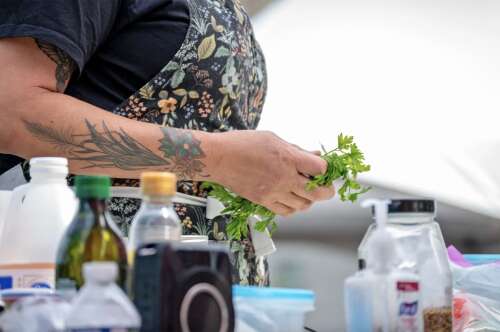
Chef Elena Terry prepares cilantro for her Hominy Harvest Salad during a cooking demonstration in Milwaukee on Aug. 6. Amelia Schafer/ICT
‘It’s an incredibly exciting time’
MILWAUKEE, Wisconsin – Ho-Chunk Chef Elena Terry says she’s living proof of the benefits of eating a healthy Indigenous diet
“A few years ago (my family) decided we’re just going to make a change of (adding) one Indigenous ingredient to one meal a week,” Terry said. “So instead of white rice we’re going to have wild rice or instead of hamburgers we’re going to have bison burgers. That change started shifting in our family and it ended up taking me out of pre-diabetes and borderline high blood pressure. All of these things just by making one small shift.”
Last week Terry took to the stage at Milwaukee’s Gerald L. Ignace Indian Health Center’s Community Health Fair to share insights about her food sovereignty journey and demonstrate a simple, healthy Indigenous dish
Speaking to a group of roughly 20 community members, Terry recounted stories of the lengths that Indigenous people went through to preserve their traditional foods following the Indian Removal Act. Ho-Chunk people were displaced approximately 16 times as a result of the 1830 act
Elena Terry, Ho-Chunk, poses for a photo outside of the Gerald L. Ignace Indian Health Center in Milwaukee prior to her cooking demonstration on Aug. 6. Amelia Schafer/ICT
Showcasing a bowl of traditional Ho-Chunk heirloom corn, Terry explained how Ho-Chunk women sewed seeds into the hems of their clothing, their moccasins and even their hair during the thousand mile journey from their homelands in Wisconsin to the Crow Creek Reservation in South Dakota. These women continued to protect those seeds as they were again relocated to Nebraska, where the Winnebago Tribe of Nebraska is headquartered today
These seeds have since been critical to the ongoing food sovereignty movement, which aims to reclaim and increase the accessibility and availability of traditional Indigenous foods to Indigenous people. The food sovereignty movement and reclamation of healthy foods is something the health center aimed to highlight through Terry’s presentation on Aug. 6
Forced relocations, like what the Ho-Chunk people experienced, had a profound effect on access to traditional foods, as did the rations given to Indigenous people during the reservation era, resulting in chronic health disparities today
American Indian and Alaska Native people face disproportionate rates of Type II Diabetes and are three times more likely to develop the disease than white adults, according to the Centers for Disease Control and Prevention. Much of this links back to the removal of the traditional Indigenous diet
Government sponsored food programs like the Food Distribution Program on Indian Reservations did not always provide healthy Indigenous foods like bison or wild rice. For decades, the rations or “commodities” provided to the Native communities consisted of heavily processed foods, which dramatically altered the detriment of Native peoples’ health, according to the First Nations Development Institute
“Going back to our ancestral foods helps eliminate some of what we have to process from the contemporary world,” Terry said. “Plus it’s just good for your spirit.”
Indigenous Chef Elena Terry speaks to a group of community members on Aug. 6 at the Gerald L. Ignace Indian Health Center’s annual Community Health Fair in Milwaukee. Amelia Schafer/ICT
Urban Indigenous populations are just as susceptible to diabetes and negative health outcomes as those on reservations. Terry herself grew up in Chicago and said she knows how hard it is to find healthy food
“In our zip code, which is 53204, diabetes is very high, high blood pressure is very high,” said Lisa Albright, a citizen of the Oneida Nation of Wisconsin and the community health outreach coordinator for the health center. “Many times those are both unregulated in our patients.”
But accessing healthy food isn’t always easy or affordable
Fast food restaurants or gas stations serve as the primary available foodalth Center provides fresh produce weekly from its garden as an alternative, and Albright said the center wanted to bring Terry in to help showcase how to incorporate Indigenous foods into everyday meals
“Her food beliefs dovetail with how we feel food is for your health,” Albright said. “We really feel like food is medicine and your health really comes down to your diet. … So having Elena here I think will help show people that healthy food isn’t a treat. It’s something that you can have all the time, you just need to know where to look for it.”
Terry, executive chef and founder of the Madison, Wisconsin, based kitchen Wild Bearies, demonstrated how to make her Hominy Harvest Salad, which includes the tree sisters: beans, corn and squash, and shared with the audience how she came to acquire the ancestral seeds used to make the dish
A participant reads a recipe for Hominy Harvest Salad by Ho-Chunk Chef Elena Terry during the 2026 Milwaukee Indian Health Center’s Community Health Fair. Amelia Schafer/ICT
Terry said she chose to demonstrate a recipe involving the three sisters as those foods are about to hit their harvest season
“One of our core teachings is that if you don’t use it, it could take itself away,” Terry said. “The more we’re able to celebrate the bounty this time of year and something as simple as a salad, it’s about utilizing what you have available – the freshest and the readiest in this moment.”
Terry has worked in the restaurant industry for over a decade and plans to launch a brick-and-mortar Indigenous-focused restaurant called “Tall Grass” in the near future at the Madison Museum of Contemporary Art
“I think there is not only an interest in renewed ancestral recipes, but also there’s been this wonderful uptick in people figuring out their own way,” Terry said. “You know, I don’t just have to eat wild rice with berries and maple syrup. I am capable of like elevating this or transforming it or there’s so much food science to be relearned about all of these ingredients. It’s actually an incredibly exciting time.”
The Indigenous food sovereignty movement has helped elevate awareness of the benefits and importance of traditional foods, Terry said
“When you look at what ‘Food is Medicine’ means, it’s undeniable (that) our food has medicinal properties and nutritional properties,” Terry said. “But it’s (also) the medicine we create when we’re together in these spaces.”
The movement is also, in turn, helping to encourage the traditional production and cultivation of endangered Indigenous foods like wild rice, a staple for Great Lakes communities
“Wild rice that’s actually wild and harvested that way, it’s a limited supply,” Terry said. “Being able to increase production means that we can increase how much we send out to our tribal communities. There’s people in our communities who don’t have access to this food but when they do, beautiful things start to happen.”
It’s more than just food, Terry said, these diets promote a deeper connection to ancestors, the land and the responsibilities Indigenous people have as caretakers of the land
“It changes more than, say, our blood sugar levels when we start consuming our ancestral foods,” Terry said
Sharing her story and different avenues for embracing food sovereignty is critical to not just her mission as a chef, but the effort to expose others to changes they can make, Terry said
“These are the days that I work for, the days that I get to have interactions with people who are on this journey,” Terry said. “Maybe we can walk away as a stronger community together.”
ICT is an independent, nonprofit, multimedia news enterprise is owned by IndiJ Public Media, a 501 (c)(3) public charity under federal law that sustains itself with funding from members, donors, foundations and supporters
