


Health
Follow ZDNET: Add us as a preferred
ZDNET’s key takeaways
- My Apple Watch and a $110 scale did the real work.
- I found a lot of apps useful, and some that weren’t.
- My scales helped me keep an eye out for muscle loss.
Last year, on April 1 of all days, I started a weight-loss journey. I needed to shed over 100 pounds. Part of the reason was health — I’m a 50+ year-old man who wanted to keep doing the things I enjoy without various parts of me complaining too much. Part of it was pride — I’d promised a friend I’d walk a section of the Camino Francés, from Sarria to Santiago de Compostela, with them that November
While my work involves a fair bit of sitting, I’m an avid hiker who spends a lot of my spare time outdoors, but covering about 80 miles in a week would be a lot easier without 100 extra pounds of timber strapped to my frame
Also: Best blood pressure watches: I tested the top models that actually work
When it came to the weight loss itself, I chose the GLP-1 Mounjaro route. (Technically, Mounjaro is a dual GIP/GLP-1 receptor agonist, not a pure GLP-1 semaglutide like Ozempic and Wegovy, but even medical professionals call it a GLP-1.) The relatively constant side effects of that — from indigestion, nausea, and gastric upsets to lethargy and weird things that I’d never heard of before, like allodynia — meant that it wasn’t a particularly easy route. However, it was incredibly efficient and allowed me to shift the bulk of the weight in 7 months at about 14 pounds per month.
I’ll leave discussion related to the specifics of GLP-1 medications out of this — that’s a conversation for you and your doctor — but I will say that I’m glad I did it, and I’d do it again if I had to
I am going to talk about the gadgets and apps I used to monitor this weight-loss process, and to keep an eye on other metrics, and watch them change
Apple Watch Ultra (and Android alternatives)
Core to everything for me was my iPhone 17 Pro and Apple Watch Ultra. I found the Apple Watch to be amazing at collecting not only workout data — I’m a bit of a nerd and love looking back over hikes — but it also collected a huge number of health metrics, including:
- VO2Max: This is the maximum amount of oxygen your body can use during exercise and is one of the strongest predictors of cardiovascular fitness and long-term mortality risk, with higher VO2max correlating with lower all-cause death rates in studies. A 2018 study by Mandsager et al., looking at cardiorespiratory fitness and mortality among 122,000+ patients, supports this claim. Higher numbers are better.
- HRV (Heart rate variability): The variation in time between consecutive heartbeats, reflecting autonomic nervous system balance between sympathetic and parasympathetic activity. Used as a marker of recovery and stress load, this figure varies over time, with peaks associated with periods of calm and rest, and troughs with stress and fatigue.
- Resting heart rate: A simple and well-validated marker of cardiovascular fitness. A normal healthy range is 60 – 100 bpm for adults. Lower numbers are better.
- Lean body mass: Your total body weight minus fat mass, so this is everything else combined (muscle, bone, organs, water, connective tissue).
The Apple Watch Ultra also has great battery life, making it perfectly suited to long days on the trail. I’ve used the original Ultra, as well as the later Ultra 2 and Ultra 3 smartwatches, and they have not disappointed.
If I was an Android user looking for a smart watch with similar features to the Apple Watch, I’d be taking a look at something from Garmin (such as the Forerunner 165 or 970, Venu 4, or Fēnix 8), Amazfit (Active Max, Balance 3, Cheetah 2 Ultra), a Samsung Galaxy Watch Ultra, or Polar (Vantage V3, Pacer Pro).
I don’t want to get too caught up in the weeds of the various specs and capabilities because the data to be collected, the look and style, and how much to spend are all matters of your personal preference. I’ve included links above for you to explore some of the options
The scale that told me more than my weight
I also invested in some scales
I could have used a set of manual scales, but not only do I like the convenience of smart scales that automatically log my weight, but they can also track more than just my weight. This is why I went for the Withings Body Smart, which could record body weight, fat percentage, body composition, muscle mass, water percentage, and visceral fat, and it costs only $110
A big concern among users of GLP-1 drugs is whether their weight loss is actual fat loss, or whether they’re losing muscle too. For some, muscle mass loss can account for up to 39% of the weight lost
This is serious enough that Samsung has launched a formal study with the Massachusetts General Hospital’s Diabetes Research Center and is putting 100 GLP-1 patients on the Galaxy Watch 8 to see whether bioelectrical impedance tracking plus exercise guidance can prevent it
The Withings Body Smart has built-in bioelectrical impedance analysis, which can provide muscle mass percentage data. It’s not as accurate as a DEXA scan, but it’s good enough for this sort of use
Personally, I kept my protein intake up, swung kettlebells, and lifted weights. I saw no drop in lean body mass
Your mileage may vary
Withings has also just released the Body Scan 2 scales that do a lot more, but at the same time cost a lot more — this one is $600! The company calls it the “world’s first longevity station,” but I’ve not had a chance to test this flagship unit yet, so I can’t comment on it
Also: Whoop vs. Fitbit Air: I used both to track my health and fitness for a month – this one’s better
I deliberately weighed myself every day (at least every day I was home — I’m not carrying scales around with me) at the same time of day for three reasons. First, it conditioned me to get on the scales and not fear the numbers; it meant I didn’t have to wait a week to see whether I was losing weight, and it smoothed out the ups and downs a lot better than weekly or monthly weigh-ins. This worked for me, but you’re not me
I know some people dislike looking at the scales, and Withings scales have the option to not show the reading but make it available in the app
The apps that kept me honest
The Withings scales came with a pretty decent app for weight tracking, but all health-related data is also stored in the Health app
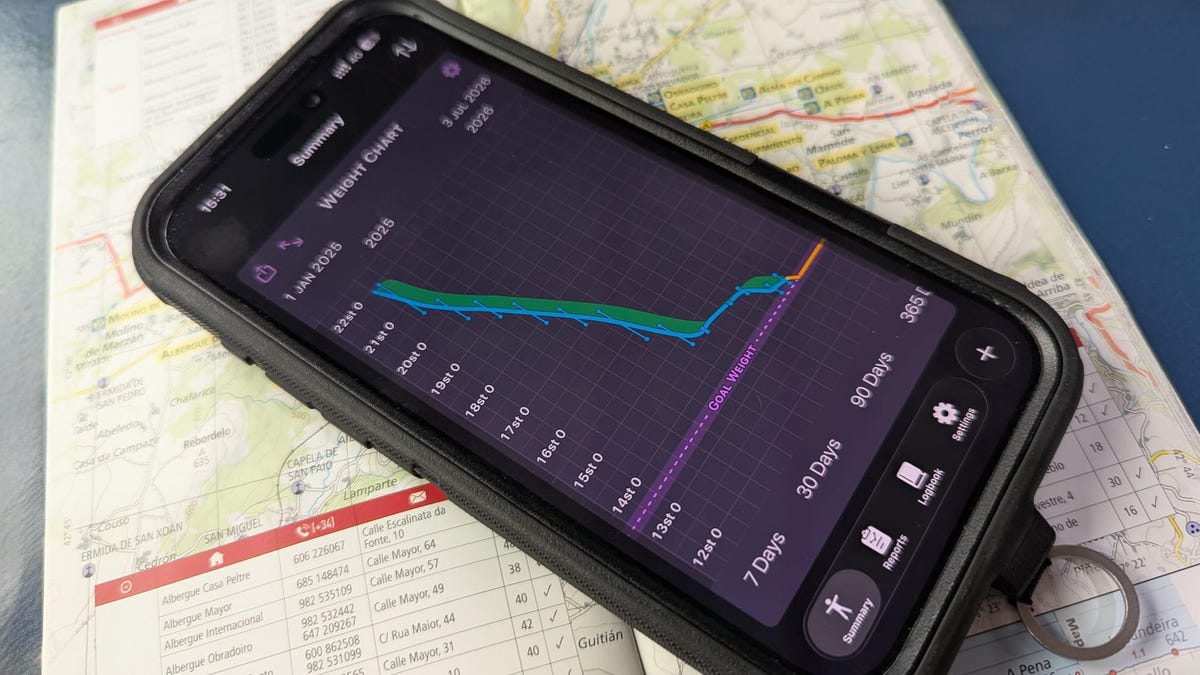
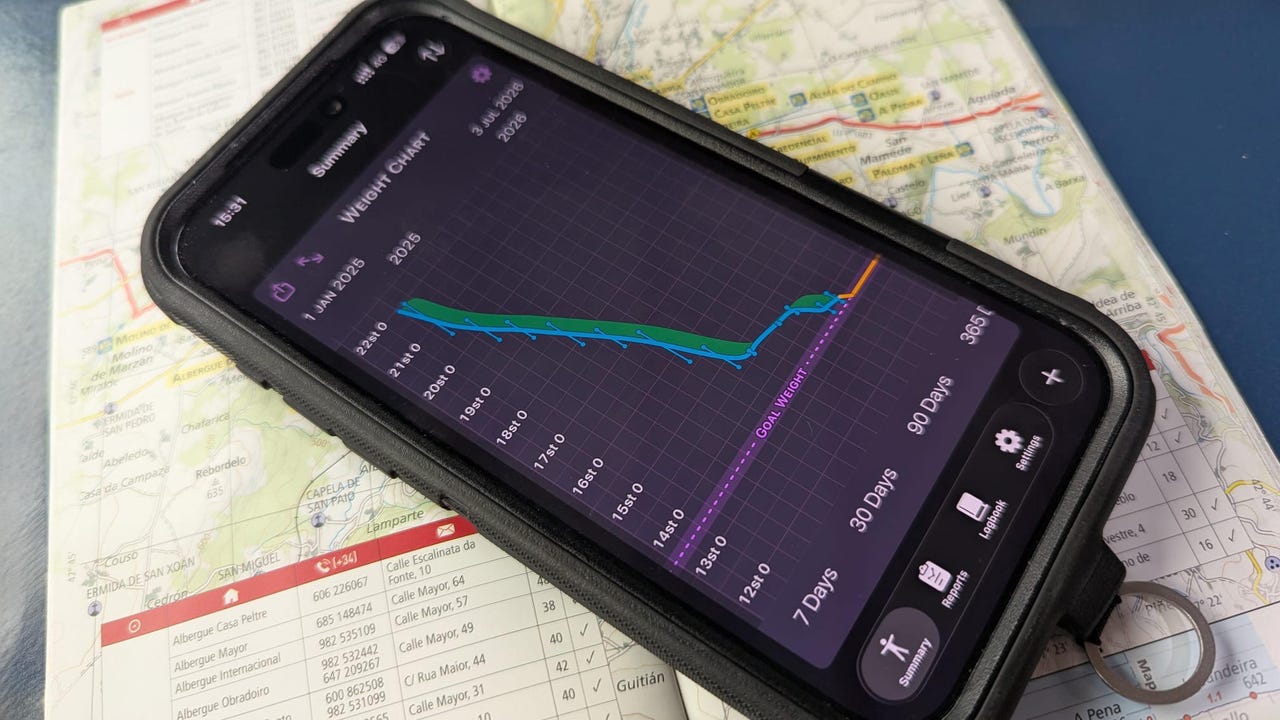
However, since weight loss was my primary goal, and I like deep diving into the data, getting predictions based on weight loss trends, the best app I’ve come across for that is called Happy Scales (there’s no Android version, but the closest alternative I’ve seen is Libra Weight Manager). Because this app focused on moving trends rather than individual weight readings, it did a wonderful job of smoothing out the ups and downs associated with weight loss. I found its predictions realistic and very accurate, and the way the app was put together fun and motivational.
And it kept me on track. I had a target date for when I’d set off to Spain for the Camino, and I set a big yet realistic weight loss target for myself, and it worked
I’m not much of a calorie counter, but I have on occasion used a few apps, and I found MyFitnessPal (iOS/Android) to be the best, despite the fact that the food database has a lot of dupes and inaccuracies, and if you’re using the free app, get ready to be blasted with ads and nags to subscribe
Also: My Fitbit Air test revealed the flaws of calorie counting with a health tracker – here’s why
If you want to keep a closer eye on your Heart Rate Variability, a good app for the Apple Watch is StressWatch. This app can use the Apple Watch to keep an eye on you throughout the day, and you can even get it to pop up a notification when you seem stressed
A good app that’s come out recently for those on weight loss drugs — too late for me, but might be useful for those starting out — is a GLP-1 dose tracker called Glapp (iOS/Android). This allows you to set reminders and log your dose, weight, side effect symptoms, and more. I had calendar reminders set for my jab days, but I would have loved to have all my data in one place, and it might have let me uncover trends associated with things like food noise and mood
What didn’t work for me
Not much.
While a lot of things helped me on my weight loss journey, a few things didn’t. For me, monitoring my HRV was one of those things. Maybe it’s useful looking at it over weeks or months, but I don’t really need to know my HRV levels throughout the day.
Also: The best smart rings: Expert tested
Another thing that I’ve never really managed to make much out of is sleep tracking. Maybe this is because I sleep darn well anyway, and I can tell if I’ve had a bad night’s sleep. I know some people swear by sleep tracking, so it’s another of those things where you might get more out of it than I did
Did this effort pay off?
In a word, yes.
I was training the whole time during the weight-loss months, getting in at least 100 miles a month, but since I knew I’d be carrying a pack every day, I had to add that. My daily carry on the Camino was going to be about 25 pounds, so during training, I used a weighted rucksack from Goruck and some weighted plates, and worked up to carrying 45 pounds for 10 miles and more.
At that point, I knew I was ready
Also: Before you buy a smartwatch or smart ring, consider what you’re giving up
Train hard, hike easy! And despite the long days, a lot of rain (and, to be honest, nice weather, considering it was November into December), it was incredibly enjoyable and rewarding.
And a whole lot easier having taken the time to lose the weight and improve my fitness
For me, weight loss wasn’t about looking better or getting my life back or anything like that, and I wasn’t worried about “Ozempic face.” It was about being able to keep doing the things I enjoy as I get older.
Mission accomplished
Ah, but has the weight stayed off?
Yup.
I had to make a few changes to what and how I’m eating — less junk and carbohydrates, and more healthy options and protein — but I’m more than happy with how my weight has been since coming off the active weight loss part of my journey six months ago. I still jump on the scales every day I’m home — it’s a habit now, and I don’t really have to think about it — and this gives me confidence that the weight isn’t going to creep back on.
I also still log all my walks, hikes, and rucking sessions — I’m at over 650 miles so far this year — and doing that lets me keep an eye on metrics such as VO2Max and how much effort I’m putting into my workouts.
And as for the Camino Francés, it was an amazing experience. So much so that I’ve now got plans to do the entire 500-mile journey starting at St Jean Pied de Port in 2027
Featured
How a virtual LAN can better protect your home network – and the best way to get started
Why I’m using wired Android Auto when all the cool kids are switching to wireless
Want to add Android Auto to your old car? Here are two ways – including one that’s under $20
73% of tech job listings require AI skills now: How to show off yours
- How a virtual LAN can better protect your home network – and the best way to get started
- Why I’m using wired Android Auto when all the cool kids are switching to wireless
- Want to add Android Auto to your old car? Here are two ways – including one that’s under $20
- 73% of tech job listings require AI skills now: How to show off yours
Editorial standards
