


When I retired 18 months ago, I had two clear goals: to get fitter and healthier
The first proved achievable, despite the interruption of a total hip replacement. Walking and yoga saw to that, and the hip, once recovered, became an unexpected asset in keeping me active
The second goal proved more elusive
Over several years, my glucose levelshad been creeping upward. I assumed – somewhat naively, as it turned out – that dietary adjustments and a little more exercise would easily correct the problem. Six months of well-intentioned effort later, my biannual blood tests delivered unwelcome news: my levels were still rising and were now approaching the threshold of the diabetic range. My GP rang to ask what my plan was. In a burst of innocent overconfidence, I told him I intended to fix it
Three problems I hadn’t anticipated
I soon realised that my confidence had outpaced my understanding. Looking back, I faced three distinct challenges
The first was physiological: I simply did not understand the mechanisms driving my rising glucose levels
The second was nutritional: even as my understanding began to improve, I lacked the dietary knowledge to translate it into practical change
The third was motivational – and here, at least, my background as a psychologist gave me some purchase
I had spent much of my career studying how people sustain behavioural change – and, more often, why they do not. I knew that good intentions, however sincere, are rarely sufficient on their own. What distinguishes successful behaviour change is rarely willpower or knowledge alone, but the quality of the feedback loop – whether a person can see, in a tangible and timely way, the consequences of their choices. In psychological terms, this is what enables self-regulated behaviour – the ability to adjust one’s actions in response to clear, immediate feedback. Abstract goals – “eat more healthily”, “get more exercise” – tend to erode in the face of daily life. Concrete, visible feedback keeps them alive.
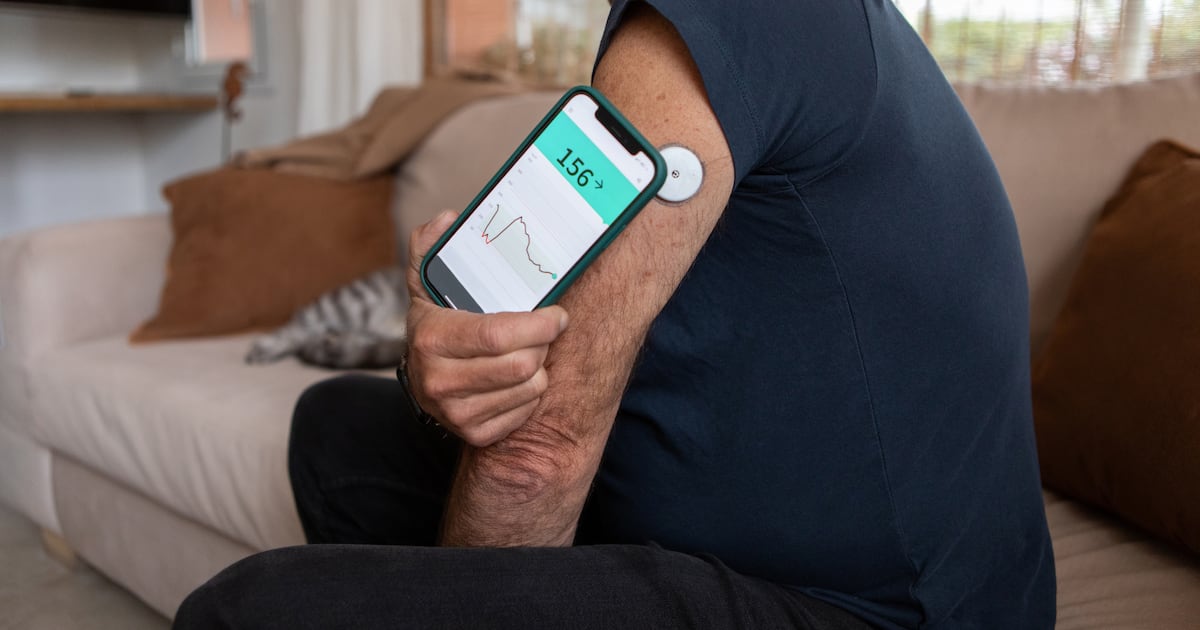
I also knew what worked for me: wearables. My phone and fitness apps had long been effective motivators precisely because they provided data, feedback, and visible progress towards achievable targets. So when my daughter-in-law, a GP specialising in lifestyle medicine, suggested that I try a continuous glucose monitor for a short period, the idea had immediate appeal. It was exactly the kind of feedback mechanism I knew, professionally, could make the difference between sustained change and good intentions that quietly fade.
What a continuous glucose monitor does
A continuous glucose monitor is a tiny wearable sensor placed just beneath the skin. It measures glucose in interstitial fluid – the fluid surrounding the body’s cells – and transmits readings to a smartphone app every few minutes, giving a near-continuous picture of glucose dynamics: how levels respond to a meal, a walk, a poor night’s sleep, or a moment of stress. The readings lag slightly behind actual blood glucose, particularly when levels are changing quickly, but for observing patterns and trends, the data is remarkably revealing.
Making sense of the data
I wore my continuous glucose monitor for 30 days – what I came to think of as my experiment. I did not set out to run a digital health project. I simply wanted to understand what my glucose monitor was trying to tell me
Once the data began flowing in, I quickly recognised the scale of my ignorance. I had no real understanding of glycaemic index, let alone glycaemic load – which takes account not only of the amount of carbohydrate in a serving, but also of how quickly a food raises blood sugar. I did not understand how carbohydrate interacts with fibre, fat, and protein, or why one meal might produce a sharp spike while another, superficially similar, did not. I was in no position to make informed dietary changes.
Given how much I already relied on artificial intelligence (AI) for research and analysis, it was perhaps inevitable that I would turn there for help. Over the course of the experiment, I used several AI platforms to understand glucose curves, post-meal spikes, plateaus, and the factors that shape them. I learned about the glycaemic load of everyday foods and eventually reached the point where I could photograph many of my meals and receive a reasonable estimate of their likely effects on my glucose levels, along with practical suggestions for modifying them. My favourite breakfasts – porridge and açaí bowls – turned out to be less benign than I had assumed, but both proved easy to adapt.
It is worth being clear about the role AI played. I did not use it as a diagnostic authority or as a substitute for medical advice. Its function was narrower and more practical: it served as a just-in-time explanatory guide, helping me interpret continuous glucose monitor patterns, grasp concepts such as glycaemic load and post-meal glucose dynamics, and design small, reversible dietary adjustments. The changes I made were conventional and low-risk – moderating carbohydrate intake, pairing foods more thoughtfully, and using walking strategically after meals. In my case, AI reduced ignorance rather than introduced risk.
AI also helped make sense of the sheer volume of data. Continuous monitors generate dense streams of readings that are not always easy to interpret in real time. By identifying patterns and linking observed changes to plausible physiological mechanisms, it made those data more intelligible and more actionable
What the data revealed – phase one
Without following any particular dietary plan, I found myself gravitating towards lower-carbohydrate choices – not through deprivation, but through substitution. I never aimed to reduce my overall calorie intake, and I never felt that I was “on a diet”. I was simply choosing differently and enjoying what I ate just as much, if not more so
From a psychological standpoint, this matters. Deprivation-based approaches tend to fail because they rely on sustained willpower – a resource that is finite and context-dependent. Substitution, by contrast, works with the grain of habit rather than against it. The continuous glucose monitor reinforced this by providing immediate, concrete feedback: choosing differently produced a visible reward within hours, in the form of a steadier glucose curve. That kind of rapid, tangible reinforcement is precisely what behavioural psychology identifies as most effective in building and sustaining new habits.
The picture that emerged was clear and encouraging. My glucose levels became steadier, with fewer sharp rises and falls that often manifest as an energy slump or sudden hunger. Walking after meals proved particularly effective. A walk following a higher-carbohydrate meal brought my glucose level down noticeably, and on several occasions it stayed low right through the night
Over successive days, even the underlying baseline began to fall – not dramatically after any single intervention, but quietly and consistently. It took continuous monitoring, supported by careful interpretation, to detect this gradual drift, because day-to-day variation could easily have masked it. What had initially looked like a lack of progress turned out to be real change unfolding on a slower timescale
Watching my average glucose level inch downward was, as I had anticipated, a powerful motivator. Research consistently shows that people are more likely to persist when they can credibly believe a goal is attainable. The continuous glucose monitor provided exactly that: continuous, personalised evidence that meaningful change was within reach. So too was watching it spike from 5.9 to 12.5 mmol/L after a chocolate indulgence. That particular graph was more persuasive than any advice could have been.
Thirty days later
After 30 days, I returned for follow-up blood tests, reasonably confident the news would be good. It was. My HbA1c – the standard marker of longer-term glucose control – had fallen from the upper end of the prediabetic range to within the normal range. As an unplanned bonus, I had lost 20lb (9kg), arriving at a weight I had not seen in years
The second experiment – and a harder lesson
I assumed that was largely the end of the story. It was not
Seven months later, as always intended, I arranged a further round of blood tests. My weight had stabilised in the intervening period, and I made the mistake of treating this as a reliable signal that my metabolic health was holding steady. It is a common error. Weight and blood glucose are related, but they are not the same thing, and one does not reliably stand in for the other
Reflecting on this as a psychologist, the relapse followed a familiar pattern. Initial success bred overconfidence – the sense that the problem had been solved and the effort could be relaxed. The absence of continuous feedback removed the very mechanism that had made change visible and sustainable. Without that feedback loop, old habits quietly reasserted themselves. I knew this pattern from decades of professional study. Knowing it did not make me immune to it
Over those months, I had gradually reintroduced more carbohydrates into my diet, confident that I understood my own limits well enough to manage them. I had overshot the mark. When the results returned, my HbA1c had risen back into the prediabetic range
I returned to the continuous glucose monitor. This time, replicating my earlier results proved more difficult. Where the first experiment had followed a relatively clear trajectory, the second was more resistant and more puzzling
Reverting to my earlier dietary approach did help manage post-meal spikes. However, even with dietary changes and post-meal exercise, my glucose levels frequently remained at a higher baseline than expected – sometimes for hours, sometimes overnight. It was possible to smooth the curve without necessarily lowering it
While I was already keenly aware of the beneficial health effects of exercise, it gradually became clear to me, through careful analysis with AI, that its precise effect on glucose is context-dependent. It depends not only on the activity itself, but on the metabolic state into which it is introduced – what has been eaten, when it was eaten, and what level the body is already maintaining. This did not diminish the value of exercise; if anything, it deepened my appreciation of it. But it did mean that the same walk could produce different outcomes on different days, and that understanding those variations became part of the experiment.
The contrast between the two phases illustrates something important: metabolic regulation is not static, and progress is not always linear. The same interventions can produce different effects at different times. Understanding and responding to that variability – rather than assuming that what worked once will always work – became the central challenge
Yet, the second, more difficult phase reinforced the central lesson of the first. Continuous data, on its own, is not enough. It must be interpreted – and that interpretation must be grounded in an understanding of physiological and behavioural processes. In my case, that understanding came through a combination of continuous feedback, AI-assisted analysis, and access to expert guidance. The result was not a replacement for professional care, but something more modest and more useful: an augmentation of personal agency – a way of narrowing the gap between data and understanding, and between understanding and action.
At the end of this second phase, my HbA1c came in at 41 mmol/mol – just within the normal range. What had felt like a less successful period, marked by variability and uncertainty, had nonetheless produced a meaningful improvement in the underlying measure
A final note
None of this is intended to suggest that professional dietary care is unnecessary, still less that one person’s experience should serve as a template for others
Many people will benefit greatly from structured clinical support, and some will require it. Individual responses to diet and exercise vary considerably, and what worked for me may not work in the same way for someone else
What my experience does suggest is that motivated individuals, given access to personalised feedback and reliable explanatory tools, may sometimes be able to identify and begin to correct early metabolic drift more quickly than traditional referral pathways allow
That possibility deserves to be taken seriously – and tested rigorously
