


Inflation And Social Wellbeing Amid Geopolitical Tensions
Supply-side interventions can complement monetary policy by addressing the writes M. Venkateshwarlu
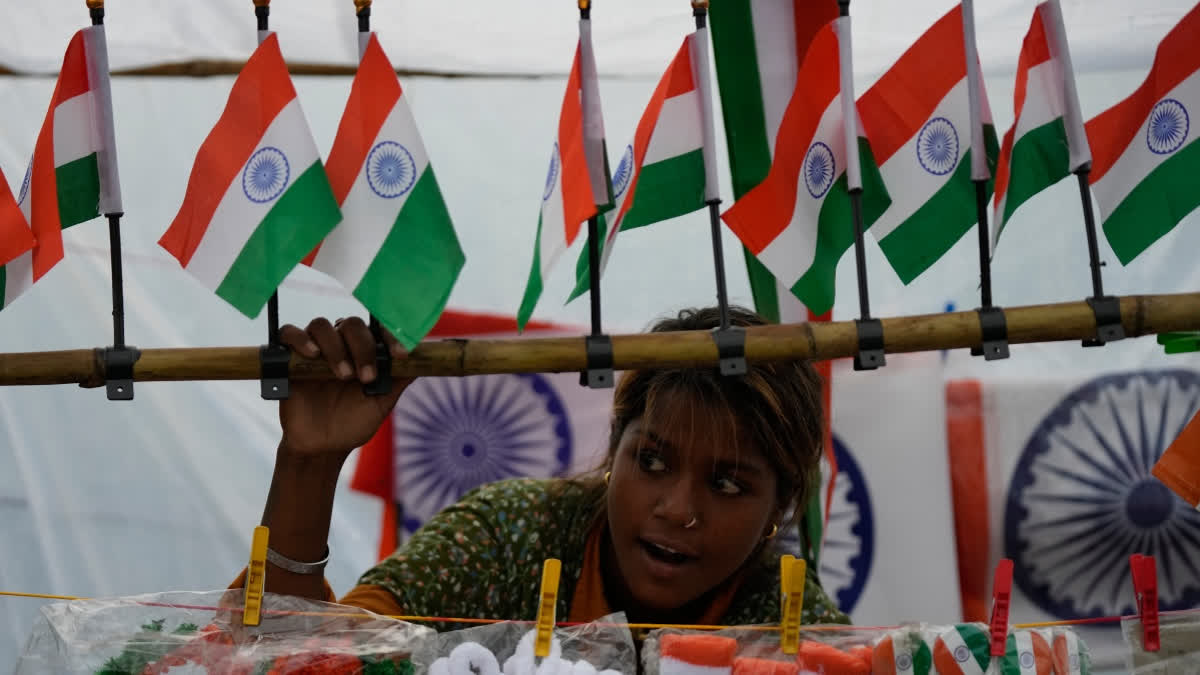
A vendor sits on her cart, covered with a plastic sheet to protect it from the rain, while waiting for customers to buy Indian tricolor flags ahead of Independence Day in Jammu, India, Tuesday, Aug. 11, 2026. (AP)
ByETV Bharat English Team
Published :August 11, 2026 at 8:43 PM IST

Geopolitical tensions and disruptions to global energy markets are creating a difficult economic trade-off for India: inflationary pressures are rising even as industrial activity and economic growth remain resilient. The burden, however, is not evenly distributed. Rising costs of essential goods and services are placing greater pressure on low- and middle-income households, while the Consumer Price Index may not fully capture the actual expenditure burden of education, healthcare and housing. This makes inflation not only a macroeconomic concern but also a question of household financial security and social inequality.
Since the outbreak of the Iran conflict in early 2026, disruptions in global energy markets have pushed crude oil prices higher, increasing fuel, transportation and production costs. These pressures have increasingly fed into India’s wholesale and consumer prices
The Wholesale Price Index (WPI), which had remained relatively stable in 2025, rose from 8.3% in January 2026 to 9.68% in May and 9.87% in June. Higher fuel and power prices were a major driver of the increase. Consumer Price Index (CPI) inflation also accelerated, rising from 0.71% in November 2025 to 2.74% in January and 4.38% in June
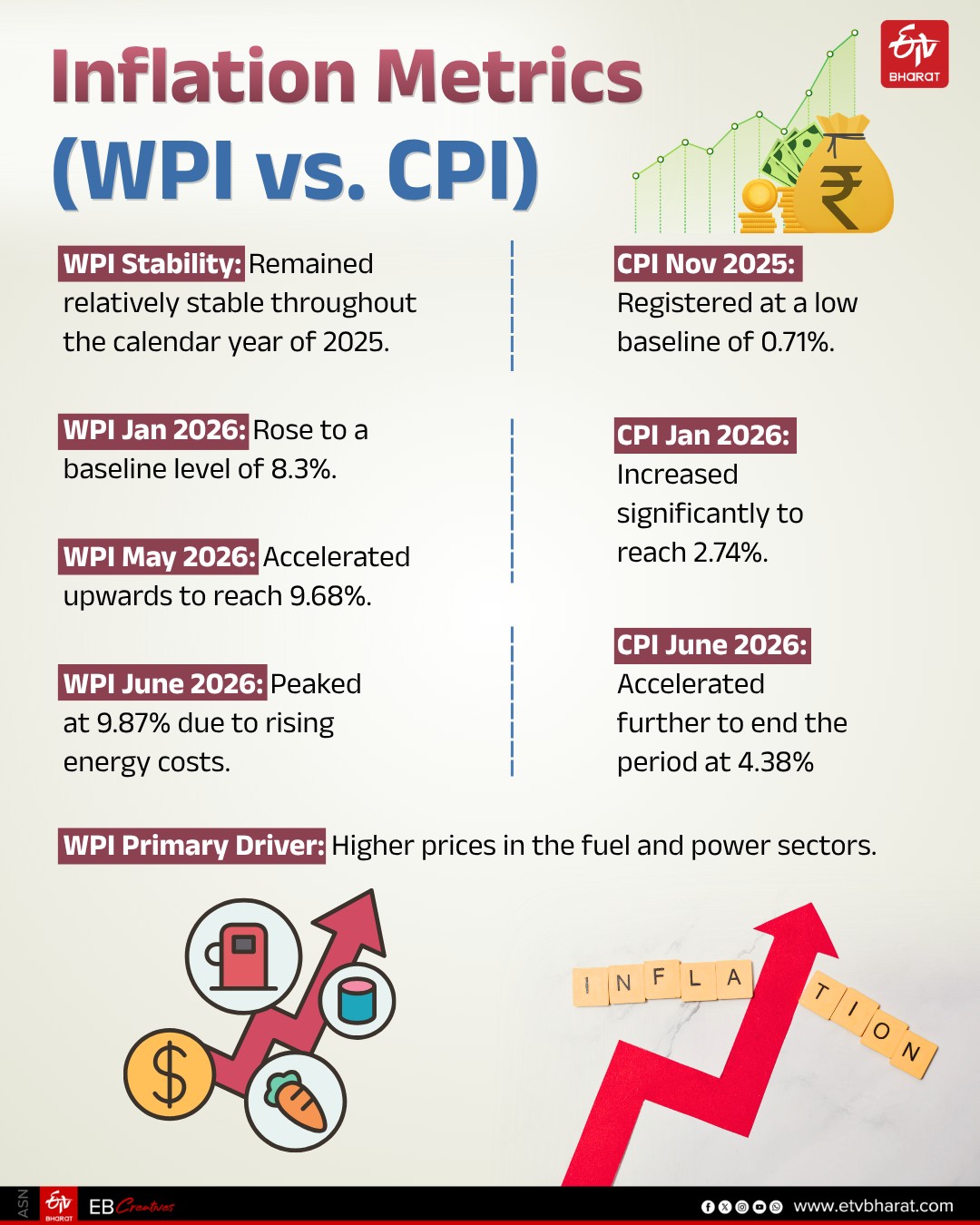
Inflation Metrics (ETV Bharat Graphics)
The increase in wholesale prices indicates that higher production costs are increasingly being passed on to consumers. If sustained, this can weaken purchasing power and increase pressure on household budgets
The impact of inflation cannot be assessed only through the headline CPI because household spending patterns vary. Consumer preferences have also shifted from low-cost products towards higher-quality, premium and value-added goods, allowing producers to pass a larger share of higher input costs on to consumers
Food and non-alcoholic beverages account for 36.75% of the CPI under the 2024 series. But households also face substantial expenses on education, healthcare and housing, which can place a much heavier burden on their incomes than their respective CPI weights suggest
Education accounts for 3.5% of the CPI, medical and health for 6.10%, and housing, including utilities, for 17.66%. Together, these categories account for 27.26% of the index
The relatively limited weight assigned to these categories may not correspond to what many households actually spend, particularly given the role of the private sector in education and healthcare. Consequently, increases in these costs can have a substantial effect on household finances without producing a proportionate increase in headline CPI
CPI weights are based on household expenditure patterns. Developed economies generally assign greater weight to housing and utilities, while developing economies tend to give greater weight to food and essential goods. This difference is important when assessing how inflation translates into lived experiences across different economies
Inflation also affects households differently depending on their income and consumption levels. The Household Consumption Expenditure Survey 2023-24 reported average monthly per capita consumption expenditure of about ₹4,122 in rural India and ₹6,996 in urban India
For households with limited incomes, even relatively small increases in the prices of essential goods and services can significantly affect disposable income. When rising living costs coincide with unemployment or stagnant earnings, the gap between income and expenditure can widen and push households towards debt
The rising cost of education, healthcare and housing is therefore particularly significant for the middle class and poorer households. Persistent increases in these expenses could deepen existing economic divisions, with rural and lower-income households potentially facing a greater financial burden
These inflationary pressures have emerged alongside continued industrial growth. India’s Index of Industrial Production (IIP) increased from 5.1% in January 2026 to 7.3% in June, supported by manufacturing activity and resilient domestic demand
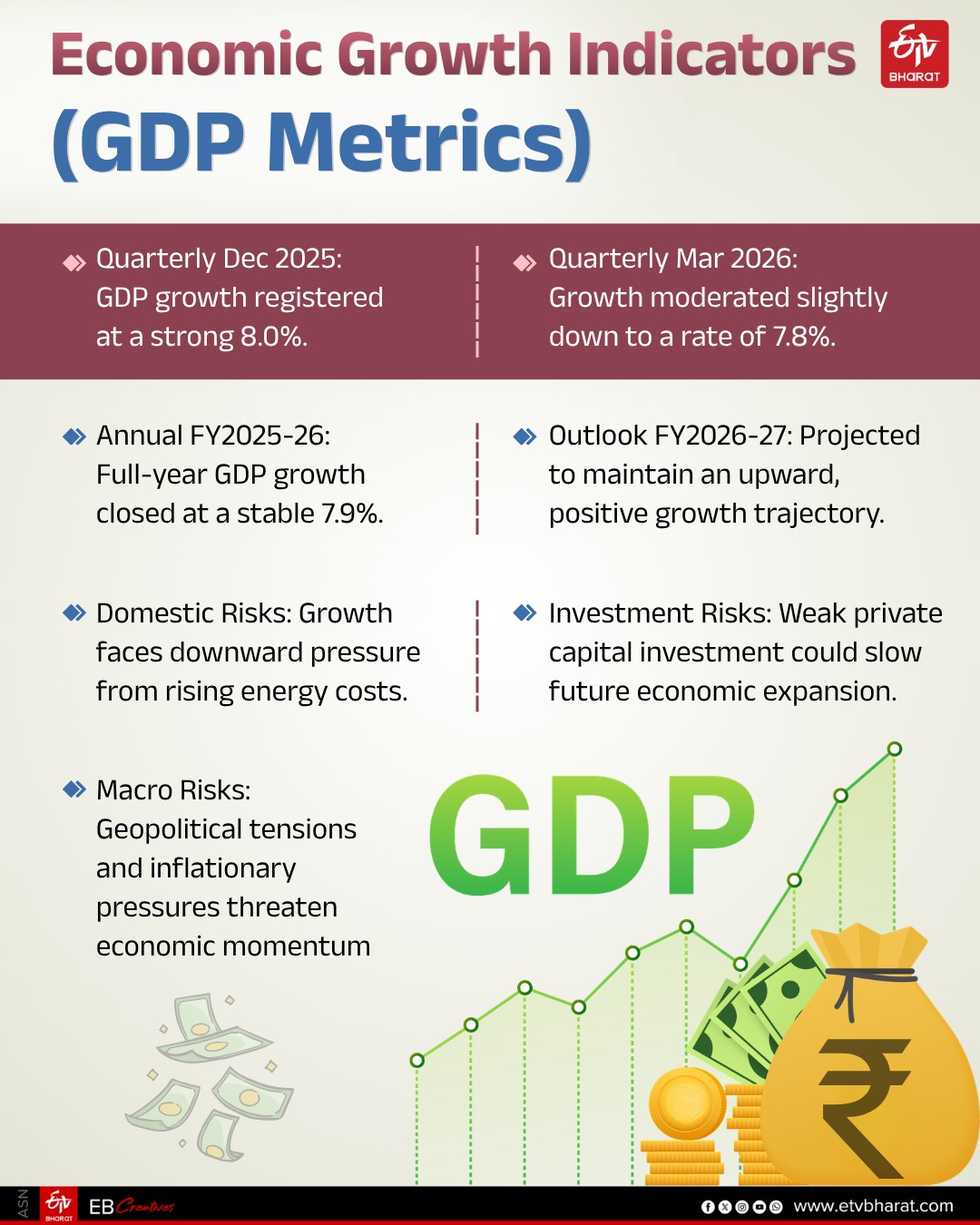
Economic Growth Indicators (ETV Bharat Graphics)
GDP growth moderated from 8% in October-December 2025 to 7.8% in January-March 2026. GDP growth for 2025-26 stood at 7.9% and is expected to remain on a growth trajectory in 2026-27. However, higher energy costs, geopolitical risks, inflationary pressures and weak private investment could weigh on future growth
The combination of rising production costs and expanding industrial output suggests that demand has remained sufficiently strong for industries to maintain production despite higher input costs. Yet higher output does not necessarily translate into immediate relief for households facing rising expenses
With geopolitical tensions and supply-chain disruptions likely to continue, containing the impact of inflation will require measures beyond monetary policy
The government could strengthen the Public Distribution System and expand the range of essential goods covered by it, while strengthening welfare programmes and providing targeted support for essential goods such as food, fuel, energy and fertilisers
At the macroeconomic level, diversifying import measures and improving infrastructure could reduce dependence on vulnerable supply chains and lower logistics costs
The Reserve Bank of India can use monetary policy to contain inflation while maintaining economic and financial stability. However, relying solely on higher interest rates could increase borrowing costs, discourage investment and adversely affect industrial production and economic growth
Supply-side interventions can therefore complement monetary policy by addressing the A combination of targeted welfare measures, stronger domestic supply chains and appropriate monetary policy could help India manage inflation while sustaining economic growth and reducing the social costs of geopolitical disruptions
The author, M. Venkateshwarlu, is Professor of Finance at the Indian Institute of Management Mumbai
(DISCLAIMER: The facts and opinions expressed in this article are those of the writer and do not reflect the views of ETV Bharat.)
Also Read
