


Involuntary Commitment: How forced hospitalization expands the criminal legal system | Prison Policy Initiative
HELP US END MASS INCARCERATIONThe Prison Policy Initiative uses research, advocacy, and organizing to dismantle mass incarceration. We’ve been in this movement for 24 years, thanks to individual donors like you.
Can you help us sustain this work?
Thank you,
Peter Wagner, Executive DirectorDonate
Involuntary Commitment: How forced hospitalization expands the criminal legal system
Civil and criminal courts both mandate the detention of people for extended — and often indefinite — periods of time in state hospitals, essentially extending the already-long arm of the criminal legal system
Hundreds of thousands of people are forced into psychiatric and substance use treatment every year in the United States under the umbrella term “civil commitment.” Proponents try to justify these forced hospitalizations as necessary to “help” people who are unable to help themselves despite little evidence to back their medical efficacy.1 In reality, this contact between the criminal legal and medical systems expands carceral control; as a legal tool for confinement on the basis of mental health conditions or substance use disorders, they effectively criminalize medical conditions. And, in keeping with both systems, forced treatment and hospitalizations are rife with racial disparities, and disproportionately impact people who are unhoused and living in poverty. 2
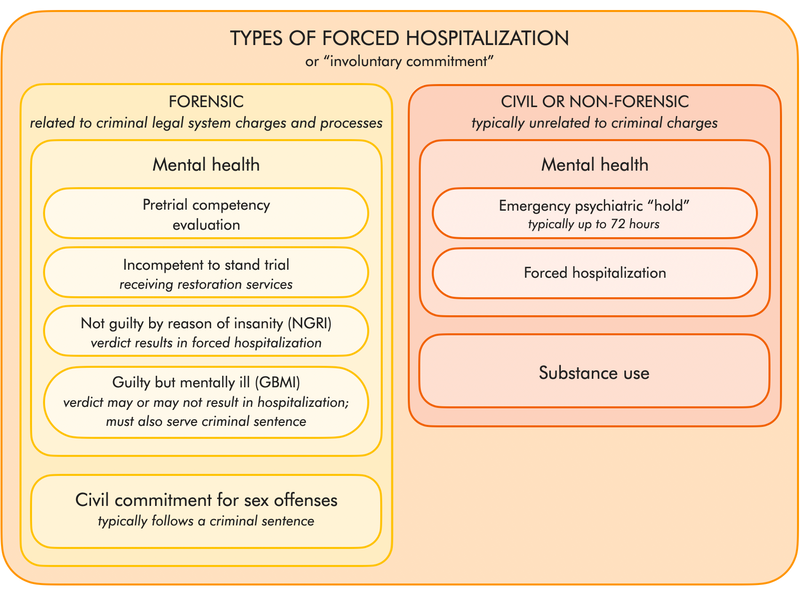
In this briefing, we catalogue the various forms of forced hospitalization, where they happen in the criminal legal system, and whom they impact. There are two broad types of forced hospitalizations, which we differentiate as non-forensic and forensic. The first type, non-forensic forced hospitalizations, are used for psychiatric and substance use disorders, and are the result of a civil court process unrelated to criminal charges. Even so, this process frequently involves the criminal legal system, as police often bring people to emergency rooms for psychiatric evaluations and can even petition the courts for forced hospitalizations. The second type, forensic forced hospitalizations, refer to the commitment of an individual to a psychiatric hospital because of their criminal legal system involvement. These hospitalizations are typically for (1) competency assessments and restoration services or treatment before trial, (2) the evaluation and treatment of people found “not guilty by reason of insanity” (NGRI) or “guilty but mentally ill” (GBMI), and (3) the commitment of people convicted of sex offenses after they have completed their prison sentences. Forensic forced hospitalizations can take place at any point throughout the criminal legal process. In essence, this fusion of the criminal legal and medical systems disguises the criminalization of mental illness and substance use as a benevolent act.
Civil courts forcibly hospitalize people for mental health and substance use disorders
In every state, civil courts can force individuals with symptoms of a serious mental condition into hospitals against their will if they are determined to be a danger to themselves or others, and/or are unable to provide for their “basic needs.”3 What exactly constitutes a person’s “basic needs” can vary by jurisdiction, but it’s typically understood to be food, clothing, and shelter. As of 2024, more than two-thirds of states have expanded these non-forensic hospitalization laws to target people with substance use disorders.
Psychiatric hospitalizations. The data on how many people are subject to forced psychiatric hospitalizations are sparse and suggest significant state variation.4 Still, even a rough, conservative estimate suggests hundreds of thousands of forced hospitalizations take place each year in the United States.5 People of color (particularly Black and Asian people) are disproportionately targeted and, across all categories of mental health conditions, people diagnosed with psychosis, schizophrenia, or bipolar disorder are among the most likely to be forced into mental health treatment.
Substance use disorder hospitalizations. Data about forced substance use treatment are even scarcer; there are no national estimates of how many people are court-ordered into treatment or how long they are typically confined.6 In Massachusetts — afrequent utilizer of laws to hospitalize people over substance use — more than 6,000 people are court-ordered into treatment each year. In 2018, there were more than 10,700 petitions and more than 7,000 evaluations for forced substance use treatment, and ultimately, nearly 6,000 treatment orders. A Massachusetts state commission found that people subjected to such treatment are frequently unhoused (24%) and unemployed (80%), and have no history of overdose (63%). While we cannot necessarily extrapolate estimates from Massachusetts to other states, we can see how involuntary treatment for substance use impacts unhoused people, people in poverty, and people of color disproportionately, mirroring disparities within the criminal legal system.
In general, non-forensic forced hospitalizations of both kinds follow a similar process: an individual is detained in a hospital or emergency room on an “emergency psychiatric hold” (typically a 72-hour detention) while a civil court determines whether they should be involuntarily hospitalized.7 In every jurisdiction, police can initiate an emergency hold, but beyond that, the rules vary about who can start the process.8 In some states, the court determination can proceed without an emergency hold while the individual remains in the community.9 In all cases, a judge ultimately determines whether an individual will be admitted to involuntary treatment in a state treatment facility.
In almost every state, law enforcement — not medical personnel — are responsible for transporting people to the facility once the court has committed them, even though they haven’t been criminally charged. Generally, people are hospitalized in state medical facilities, but it’s not uncommon for people to be held at other facilities (like private hospitals or emergency rooms) until a bed in a state facility becomes available.10 In Massachusetts, the court can confine people forced into substance use treatment within correctional facilities; in 2019, three in every four men forced into treatment in the state were in a jail or prison without any criminal charges or convictions. Scarce data exist regarding the actual length of time individuals spend in these settings, but state statutes cap the length of confinement (which varies by state from 14 days to one year) and civil courts can indefinitely renew the court orders.11
In most jurisdictions, civil courts also determine when someone can be released from involuntary psychiatric hospitalization, presumably with input from the treatment team. When it comes to substance use hospitalizations, the state health authority can typically discharge people.12 Individuals can also pursue their own discharge from either via civil court or “conditional release” programs that are contingent upon their participation in outpatient programs.13 Notably, “conditional release” from forced hospitalizations imitates probation and parole systems in the criminal legal context: people can be returned to confinement if they do not adequately adhere to a set of rules governing their behavior.
Forced hospitalizations are becoming more common in the criminal legal system
Forensic forced hospitalizations have been on the rise in recent years, and can occur at a number of points along a person’s route through the criminal legal system. Before or during a criminal trial, questions of defendants’ “competency” — that is, their ability to understand the charges and penalties they face, make decisions, and communicate with their legal representation during the trial — can result in forced hospitalizations. The verdict of the trial can also result in a forced hospitalization if the person is acquitted as “not guilty by reason of insanity” (NGRI) or, in some jurisdictions, convicted as “guilty but mentally ill” (GBMI). An acquittal as NGRI results in court-ordered psychiatric treatment, after which the individual is released and not subject to additional criminal penalties. In contrast, someone found GBMI and court-ordered to psychiatric treatment must serve their criminal sentence after completing treatment. It’s worth repeating that competency, NGRI, and GBMI are inherently legal concepts, not medical or clinical concepts or diagnoses, and are not based on best practices regarding mental illness and treatment.
Pretrial forced hospitalizations for competency evaluations and “restoration”
In criminal court, the defense, prosecution, or judge may question the defendant’s competency during pretrial hearings or at any point during the trial. In this scenario, “competency” is strictly limited to the defendant’s ability to participate in the trial and is unrelated to their mental state at the time of the alleged crime. The judge will order a competency assessment from the state mental health authority and if the individual is found “incompetent to stand trial,” the court will order competency “restoration services.”
An estimated 60,000 people are evaluated for competency each year in the United States, and about 20% of evaluations result in hospitalizations to “restore” competency. Based on data from the Treatment Advocacy Center (TAC) and NRI, we estimate that on any given day, nearly 3,000 people are in hospitals for competency evaluations, while over 8,000 people are in hospitals for competency restoration.15 The limited demographic research on competency finds that people of color are 1.4 times as likely to be found incompetent than white defendants,16 and suggests a statistically significant relationship between incompetency findings and defendants identified as female, minority race, or married.
The state mental health authority is responsible for the court-ordered assessment and subsequent competency restoration services or treatment. Such evaluations and restoration services are almost always provided in inpatient hospital settings, despite evidence that outpatient competency restoration programs in the community are effective. In a 2014 survey of officials in 43 states, respondents in nearly 80% of those states reported that courts can (and do) forcibly hospitalize people for competency assessments and, in most states, restoration services are exclusively provided in inpatient hospital settings.17
State statutes often limit how long a person can be hospitalized for an evaluation, typically ranging from 15 to 60 days.18 While most state mental health authorities agree that these evaluations can be completed in one or two interviews, people are often hospitalized for longer than is needed. The trial court then determines competency and can order forced hospitalization for “restoration services.” In every state, this can include medicating people against their will, even if they don’t meet the usual criteria (like danger to self or others due to mental disorders).19
Once the court determines that competency has been “restored,” the criminal trial proceeds.20 However, it is worth noting that in many states, people will remain hospitalized even after competency is “restored” if the hospital staff believe they will “decompensate” upon return to jail. If the court determines that someone is “unrestorable,” the individual must be referred to a civil court for a civil commitment hearing (i.e., non-forensic, non-criminal) or released. Most states limit the amount of time someone in this scenario can be hospitalized21 but the National Association of Mental Health Program Directors states that “several studies” have found that these defendants often remain hospitalized long after they are determined to be unrestorable.
Competency evaluations and restorations generate tension between jails and state hospitals, as there are too few hospital beds and too many people in jail awaiting evaluation or restoration, often for low-level offenses. Reports of lengthy waitlists for evaluations are common, as well as long wait times for competency hearings in court and delays for criminal trials to start after being found competent. Once a person is found incompetent, there are more waitlists for state psychiatric hospital beds. In other words, people who may be in psychological distress or in need of psychiatric treatment are left to languish in jails until a hospital bed becomes available. Even a day or two in pretrial detention can destabilize a person’s life for years to come, jeopardizing employment, health, housing, and more — effects that may be more acute for people with mental health conditions. Despite the high rates of mental health and substance use disorders among incarcerated people, jails rarely have adequate resources to care for them, and are inappropriate settings to house or treat people with mental health disorders.
Forced hospitalizations as sentencing outcomes
“Not guilty by reason of insanity” (NGRI) and “guilty but mentally ill” (GBMI) verdicts are typically the result of legal defense efforts to contextualize a crime, mitigate punishment, and ensure treatment is included in the case outcome. Once charged, the defendant, the defense attorney, or the judge may request a psychiatric evaluation, which can be conducted on an outpatient basis (in the community or the jail) or in a state psychiatric hospital.22In 2017, the New York Times estimated that nearly 90% of NGRI verdicts were the result of plea bargains based on the results of these evaluations. In other situations, the evaluation may be presented as part of the defense’s argument that the defendant is “not guilty by reason of insanity” or requires treatment.
“Not guilty by reason of insanity” (NGRI) is an acquittal based on the criminal court’s determination that the individual was unable to differentiate right from wrong due to their mental condition at the time of the offense. Usually, this is because they were experiencing severe symptoms of mental illness that gravely impaired their capacity to perceive reality or think clearly. The court typically determines a defendant is NGRI based on a psychological evaluation, a psychiatric diagnosis, and a “finding of dangerousness,” meaning the court believes them to be a danger to themselves or others. Unlike competency, a finding of NGRI reflects a decision about the person’s mental state at the time of the crimeand is unrelated to their mental state at the time of the criminal trial: NGRI verdicts result in automatic forced hospitalizations, even if the person is no longer in the same mental state as they were at the time of crime.
Alternatively, at least 13 states offer a verdict of “guilty but mentally ill” (GBMI), which is a criminal conviction that can result in forced hospitalization, but still requires a person to additionally serve whatever the typical sentence would be for the offense.23 The establishment of GBMI verdicts in a number of states was largely in reaction to public demands for fewer acquittals via NGRI.24 GBMI verdicts do not result in reduced sentences; people must serve the same sentence as anyone convicted of the same crime, with the difference being that they receive psychiatric treatment “if available” or “if necessary.”25 However, they must serve the full term of the sentence regardless of the outcome of the treatment. Under a GBMI conviction, a person can be incarcerated for the maximum prison term, even if they are no longer experiencing the symptoms of mental illness they had at the time of the offense.
An estimated 7,900 people are in hospitals following “not guilty by reason of insanity” or “guilty but mentally ill” verdicts on any given day.26 While this estimate combines NGRI and GBMI hospitalized populations, older research suggests that people found GBMI are no more likely to receive treatment for mental health disorders than any other person in prison. And while no nationally-representative data exist to show the demographics of people hospitalized due to NGRI or GBMI verdicts, an expansive analysis of NGRI acquittals in Missouri from 1980-2009 found an overrepresentation of Black people, men,27 and people with prior suicidal ideation or attempts.
Despite the reputation of the “insanity defense” as a “get out of jail free card,” NGRI and GBMI verdicts are actually pathways to a different — and often less accountable — system of punishment. An NGRI verdict most often results in automatic hospitalization, and a finding of GBMI may result in forced hospitalization and/or a sentence of incarceration. The average length of time someone is hospitalized after a NGRI verdict ranges from months to years, depending on the jurisdiction, and most often people are confined in the hospital until the court releases them. Some states offer “conditional release” provisions where people hospitalized as NGRI can be released into the community but remain under the jurisdiction of the court. Just like someone on probation or parole supervision in the criminal legal system, someone with this status can be re-hospitalized for a violation of any conditions of release. And most states do not have a specified limit for how long a person found NGRI may be subject to the terms of conditional release.
Little evidence supports the widespread use of forced hospitalizations in civil or criminal courts
Beyond their ethicalimplications — including the curtailment of civil liberties and patient rights — one of the most alarming aspects of all types of forced hospitalizations is how little information is available about who is confined in these settings, what kind of treatments they are subjected to, and the outcomes of forced treatment.33 What does exist, however, is some troubling evidence that forced hospitalizations are ineffective and even harmful. Research suggests the practice can actually raise the risk of suicide or overdose while failing to prevent relapses or future arrests: for example, in a study focused on Allegheny County, Pennsylvania, researchers found that forced hospitalizations double the risk of being charged with a crime and the risk of death by suicide or overdose in the three months following discharge.34 The implementation of laws allowing the forced hospitalization for substance use disorders has not helped with opioid overdose death rates: a2024 analysis actually found a significant rise in opioid overdose death rates in states with these laws (compared to those without such laws) in 2020-2021 compared to 2010-2019.35 And in Massachusetts, the risk of opioid overdose death was actually higher for people with a history of forced, court-ordered substance use treatment than those enrolled in other state-run substance use treatment services. Fewer than 1 in 10 people released from forced substance use treatment in Massachusetts actually attended their scheduled follow-up appointments, and more than one-third reported relapsing on the day of release.
Research also suggests that courts do not need to rely on forced hospitalizations. Many people subject to competency restoration or found to be “not guilty by reason of insanity” (NGRI) are able to remain in the community for treatment or safely return to their communities after a short period of treatment. And outpatient competency restoration, which is generally completed much faster than in a forced hospitalization setting, appears successful. In Washington, D.C., three-quarters of people referred to an outpatient program were “restored” in the initial 45 days, and in Virginia, over 80% of people found incompetent to stand trial had their competency “restored” via a jail-based program in an average of 77 days. People hospitalized for competency restoration typically take much longer: the median length of hospital stays for competency restoration was 147 days in a meta-analysis of more than 50 studies from 1975-2013.36 Similarly, studies indicate that longer hospitalizations seem to have little impact on the risk of re-arrest, and that the success of NGRI treatment is primarily contingent on housing and psychosocial support at the time of discharge or conditional release. The majority of people on conditional release from NGRI hospitalizations (76% in Virginia and 66% in Oregon) were able to safely remain in the community and participate in outpatient court-ordered treatment. With little support for forced hospitalizations, the available data seem to indicate that states can safely reduce their reliance on forensic hospitalizations and, more broadly, reconsider their use of forced psychiatric and substance use hospitalizations.
Conclusion
Civil and criminal court-ordered hospitalizations confine hundreds of thousands of people into a murky space between the legal system and the healthcare system. The sparse data landscape is particularly troubling given the growing reliance on, and growing political support for, forced mental health and substance use treatment in the United States. The expansion of carceral control over people who are not charged with criminal offenses and people who have already served their criminal sentences reveals yet another way the legal system seeks to criminalize mental illness and substance use. In addition, the rampant use of forced hospitalizations as a “solution” to crime — one which simultaneously expands the definition of “criminal behavior” to include homelessness, mental illness, and substance use — turns systemic outcomes into individual failings, and disregards the real root of the problem: an unequal society that relies on the carceral system to (poorly) address societal failings.
The best way to address this misdiagnosis of the problem would be to expand access to community-based mental health and substance use treatment. For example, investing in mental health crisis care instead of arrests, and utilizing community-based diversion programs instead of pursuing prosecution for nonviolent misdemeanors, could reduce the number of people hospitalized against their will for competency evaluations and NGRI verdicts. Community-based competency evaluations and restoration programs also reduce the number of people confined in jails, while simultaneously relieving the burden on state hospitals by shrinking the waitlists for inpatient beds. As the Substance Abuse and Mental Health Services Administration explains, prosecutors and judges “must exercise discretion to determine if prosecution and continued involvement in the criminal legal system is appropriate for individuals with serious mental illness” throughout the process.
Footnotes
“Civil commitment” typically refers to the civil court process by which people are admitted into a treatment facility or program against their wishes for any number of reasons. However, the phrase “civil commitment” is opaque and euphemistic, and obscures what these practices actually entail. Throughout this briefing, we try to use more transparent language, like “forced hospitalization” or “forced treatment.” We continue to refer to the involuntary commitment of people convicted of sex-related crimes after completing their prison sentences as “civil commitment for sex offenses” to remain consistent with our previous work on the subject. ↩
As of the publication of this briefing, there are at least two federal efforts targeting vulnerable populations for expanded forced hospitalization. In July 2025, the president released an executive order calling for the expansion of “civil commitment” criteria to include unhoused people found unable to “care for themselves” in addition to the existing criteria regarding mental illness and/or substance use. Despite evidence supporting “housing first” programs that prioritize access to safe and stable housing, the executive order attempts to criminalize mental illness and homelessness. Additionally, in March 2026, the federal government announced a joint effort between the Department of Justice and the Department of Veterans Affairs seeking legal guardianship over “vulnerable” veterans in acute-care facilities in an effort to transition them to “long-term” facilities. Guardianship strips an individual of the ability to make their own medical decisions, including decisions regarding hospitalization and treatment for medical conditions, mental health disorders, and substance use treatment, essentially echoing the system of civil commitment and forced hospitalizations, but with longer-lasting and broader powers. ↩
Criteria for forced psychiatric hospitalization vary by state, although most states (27 states in 2016) require at least two of the following criteria be met: danger to oneself or others due to mental illness, inability to provide for basic needs, and treatment is required to prevent further deterioration. In 16 states and the District of Columbia, the only criteria required is danger to oneself or others. ↩
There are very limited state-level data regarding forced psychiatric hospitalization, but in at least three states, we have recent, detailed estimates:
- California: There were approximately 81,000 forced psychiatric detentions (i.e., 72-hour detentions) and 42,000 forced psychiatric hospitalizations (i.e., initial 14-day “intensive treatment”) in 2023. Additionally, there were more than 4,000 30-day hospitalizations (Table 30), and 38 180-day hospitalizations — both of which serve as extensions of initial 14-day hospitalizations. See Tables 2, 9, 30, and 44 for these data.
- Oregon: There are typically 7,000 petitions for forced psychiatric hospitalizations filed each year. In 2023, 1,016 petitions resulted in 14-day forced hospitalizations and courts extended hospitalizations beyond the 180-day limit for 114 people.
- Arizona: As of July 13, 2026, there were 118 people in the state hospital under court orders for involuntary psychiatric treatment. (We could not locate numbers for the entire year, only a one-day snapshot.) Demographic data published by the state reveal an overrepresentation of both Hispanic/Latino people and American Indian/Alaska Native people.
↩
Between 2011 and 2018, there were over 3.4 million emergency psychiatric holds (initial involuntary hospitalizations, typically in emergency departments or traditional psychiatric units) across 11 states and at least 916,000 forced psychiatric hospitalizations (longer-term inpatient hospitalizations) across 18 states. ↩
State statutes specify the maximum duration of an initial substance use forced hospitalization, and as of 2021, these maximums vary greatly between states: 1 year (1 state) 180 days (7 states), 120 days (1 state), 90 days (12 states), 30 days (4 states), 21 days (1 state), 14 days (2 states), unspecified (3 states and the District of Columbia). However, courts can renew these orders as they see fit, thereby extending the length of time spent involuntarily hospitalized. ↩
As of January 2016, all 50 states and the District of Columbia have state laws regulating emergency psychiatric holds. A court order is required in most states as of 2014 (except for Georgia, Hawai’i, Iowa, Louisiana, New York, Tennessee, Vermont, and Washington). In some states, the psychiatric emergency hold automatically triggers an evaluation to determine if someone can be released or to initiate involuntary hospitalization proceedings. ↩
In 38 states, any adult can file a petition for psychiatric forced hospitalizations, and in 21 states, any “interested person” can file a petition for substance use forced hospitalizations. Other specified authorized petitioners can include parole officers, mental health practitioners, and any medical or law enforcement personnel, etc. ↩
As of November 2014, 14 states and the District of Columbia require emergency psychiatric holds before a person can be forcibly hospitalized for a longer term. ↩
For example, in Arizona, “civil adult patients” are involuntarily court-ordered to Arizona State Hospital if they have not responded to a minimum of 25 days in a community hospital setting. In Oregon, court-ordered hospitalizations result in placements at specific facilities determined by the state health authority, including the Oregon State Hospital, certified community hospitals, and secure (locked) residential treatment facilities. In Virginia, 5,000 people were admitted to state psychiatric hospitals in FY 2023, with the largest proportion under a “civil temporary detention order.” ↩
Almost all states (44 states and the District of Columbia) require a new court order to extend forced psychiatric hospitalization. ↩
In some states, the medical team has significant influence in the discharge process: in South Carolina, for example, the medical providers can determine when someone is ready for discharge, and in North Carolina, the medical team or a judge can order the release. ↩
In Washington, early conditional release from psychiatric treatment requires individuals to “continue any follow-up care requirements for the rest of their civil commitment period.” The National Alliance for Model State Drug Laws (NAMSDL), found that for substance use hospitalizations in some states, the “committing agency may require that the patient continue treatment on an outpatient basis and, if the individual fails to cooperate with outpatient treatment, he or she may be remanded to the custody of the treatment facility.” ↩
The legal concept of parens patriae refers to the ability of a state or court to exert a “paternal and protective role” over citizens within the jurisdiction. ↩
The Treatment Advocacy Center (TAC) estimated that on a single day in 2024, there were 18,948 people in forced forensic psychiatric hospitalizations for competency evaluations, restoration, NGRI, and GBMI. The organization NRI published a report with one-day census datafor 37 states for 2014 by legal status (competency evaluations, competency restoration, and combined NGRI/GBMI). That one-day census in 2014 included 2,267 people held for inpatient competency evaluation (15%), 6,809 people hospitalized as incompetent to stand trial (44%), and 6,438 people hospitalized as NGRI or GBMI (41%). Based on the estimate from TAC and ratios from NRI, we estimate that on any given day in 2024, there were about:
- 2,800 people hospitalized for competency evaluations;
- 8,300 people hospitalized for competency restoration; and,
- 7,900 people hospitalized as NGRI or GBMI.
↩
In this 2011 meta-analysis of nearly 70 studies, the researchers divided the studies’ samples into binary “white” and “non-white” race categories. ↩
In 2014, an assessment from the National Association of State Mental Health Program Directors found that at least three states reported using facilities operated by jail or prison systems as the “inpatient setting” for restoration services, but in all other states, state psychiatric hospitals are the most common site. Sometimes, if the charges are minor, the prosecution will drop charges as “time served” after the individual completes competency restoration services. In many states, people will remain hospitalized after competency restoration if the hospital staff believe they will “decompensate upon return to jail pretrial.” ↩
For example, Washington (RCW 10.77.400) and Wisconsin (WI Stat S 971.14) limit forced hospitalizations for competency evaluations to 15 days; Massachusetts to 20 days (MA Gen L ch 123 S 15); New York (NY Crim Pro L S 730.20), Hawai’i (HI Rev Stat S 704-404), Oregon (OR Rev Stat S 161.365), Arizona (AZ Rev Stat S 13-4507), and New Jersey (NJ Rev Stat S 2C:4-5) to 30 days; and Kansas (KS Stat S 22-3302) and North Carolina (NC Gen Stat S 15A-1002) to 60 days. ↩
Forced medication for forensic patients occurs even in situations where people in non-forensic forced hospitalizations cannot be forcibly medicated (e.g., not dangerous and/or able to make an informed choice) (Sell v. U.S., 2003). ↩
In only a handful of states, the state mental health authority can dischargesomeone committed as “incompetent to stand trial” if they find the defendant is competent to stand trial or no longer requires inpatient level of care. In other states, the hospital must request release from the court (which is typically supported by the court). ↩
The 2014 National Association of Mental Health Program Directors assessment found that the limits range from as little as 90 days to the full length of the maximum carceral sentence specified by law for the most serious offense. ↩
In the National Association of State Mental Health Program Directors’ 2014 survey, six states reported that more than three-quarters of all NGRI evaluations occurred in inpatient (i.e., state hospital) settings. ↩
In addition, Arizona (AZ Rev Stat S 13-502) and Oregon (OR Rev Stat S 161.295-328) have a “guilty except for insanity” verdict option, which allows for psychiatric treatment, restricted to the maximum sentence length for the relevant offense. ↩
Contemporary legal scholars explained that GBMI verdicts “allow juries to provide mentally ill defendants with mental health treatment while ensuring penal detention of defendants following their in-patient treatment for mental illnesses.” Recent legal scholarship describes GBMI verdicts as “intended to hold defendants with mental illness criminally responsible while ostensibly promising psychiatric care for their mental illness in prison.” Importantly, research in Michigan following the creation of the GBMI verdict found it did not reduce the frequency of NGRI verdicts. ↩
Most GBMI statutes defer to the correctional system or state mental health authority to determine whether treatment is necessary, meaning that in most states with GBMI verdicts, people who are sentenced as GBMI are not legally required to receive treatment. ↩
This estimate is based on the combined NGRI/GBMI hospitalized population reported by the Treatment Advocacy Center (TAC)in 2024 and NRI in 2014. For details, see footnote 15. Additionally, in the National Association of State Mental Health Program Directors’ 2014 survey, five (unnamed) states provided GBMI inpatient census data: across four states, there were a total of 121 inpatient GBMI forced hospitalizations and in the fifth state, there were a reported 150 people sentenced as GBMI in prison. ↩
The Missouri researchers found that less than 15% of people who received NGRI acquittals were women. Compared to men acquitted under NGRI, women were older at the time of acquittal, less likely to have never been married, less likely to be diagnosed with schizophrenia, less likely to have a substance use diagnosis, as well as various offense-specific gender differences. ↩
Some states also detain people in these facilities before they are ever committed there by a court. These states include (but are possibly not limited to) Florida, Illinois, Minnesota, Missouri, New York, Texas, Washington, and Wisconsin. ↩
Unlike non-forensic psychiatric forced hospitalizations, individuals subject to “sexual offender” civil commitment laws are typically diagnosed with a paraphilia rather than a nonsexual, major mental health disorder. ↩
In addition, at least some states appear to have forms of “civil commitment” for people convicted of sex-related offenses that do not always require physical confinement in a treatment setting. For example:
- Kansas: 56 of the 286 people (20%) civilly committed for sex offenses in the state are in community settings, Department of Corrections facilities, or jails, according to data provided by the Kansas Department for Aging and Disability Services inresponse to a February 2026 public records request.
- Massachusetts: 7 of the 107 people (7%) civilly committed are not at the Massachusetts Treatment Center but are housed at “other facilities,” according to data provided by the Massachusetts Department of Correction in response to a February 2026 public records request.
↩
For example, in some states, the civil commitment facilities for people convicted of sex offenses are in the same campus, building, or unit as the forensic services for competency restoration, NGRI, and GBMI:
- Arizona: The Arizona State Hospital consists of the Forensic Hospital and the separate Arizona Community Protection and Treatment Center (ACPTC). People receiving competency restoration services or those hospitalized as “guilty except insane” (Arizona’s version of GBMI) or NGRI are confined in the Forensic Hospital. The ACPTC is the “civil commitment program” for people “adjudicated as Sexually Violent Persons (SVP).”
- California: The statute governing civil commitment for sex offenses clearly states that commitment should be to “a state hospital under the direction of the State Department of State Hospitals” and that “if a state hospital is not used, the facility to be used shall be located on a site or sites determined by the Secretary of the Department of Corrections and Rehabilitation and the Director of State Hospitals”(CA Welfare & Institutions Code S 6600.05, 2025). Of course, state hospitals are also the site of forced hospitalizations for people found IST or NGRI.
- Iowa: In Iowa, people civilly committed to the state “Civil Commitment Unit for Sexual Offenders” program are confined in a facility on the campus of the Cherokee Mental Health Institute, which is also the location of the state’s competency restoration and NGRI inpatient units for men.
- Kansas: The state’s civil commitment for sex offense program is located at Larned State Hospital, which is also the hospital where people are held for IST evaluations, restoration services, and NGRI.
↩
Like other forms of involuntary hospitalization and treatment, policymakers focused on civil commitment for sex offenses have taken a page from probation and parole, and instituted conditional release programs in some states that “allow individuals the opportunity to work, live, and receive treatment in the community.” In many states, people civilly committed for sex-related convictions are subject to enhanced supervision and monitoring requirements when released into the community. Once granted a conditional release, individuals remain under the jurisdiction of the court. ↩
For example, in a 2015 survey of 20 state substance use treatment authorities, only seven had data available about how many people were in forced treatment for substance use disorders. ↩
The researchers point to evidence that forced hospitalizations cause significant destabilization in peoples’ lives, undoubtedly contributing to these negative outcomes. In particular, they highlight an increase in unemployment and a decrease in earnings, as well as an increase in use of homeless shelters for people who had not previously used a shelter. In addition, the researchers did not find that forced hospitalizations had any meaningful impact on continued outpatient care, like mental health services or prescription medication adherence. ↩
A 2022 study in Sweden found that among nearly 8,000 people “committed to compulsory care” for substance abuse (for 6 months) from 2000-2017, there was a threefold increased risk of dying immediately following their release. ↩
Most of the studies included in this metanalysis were correlational and missing information about the restoration procedures and assessment instruments, highlighting the utterly dismal lack of evidence supporting the widespread use of forced hospitalization for competency restoration. ↩
Emily Widra is a Senior Research Analyst at the Prison Policy Initiative. (Other articles | Full bio | Contact)
Share on 𝕏Donate
