


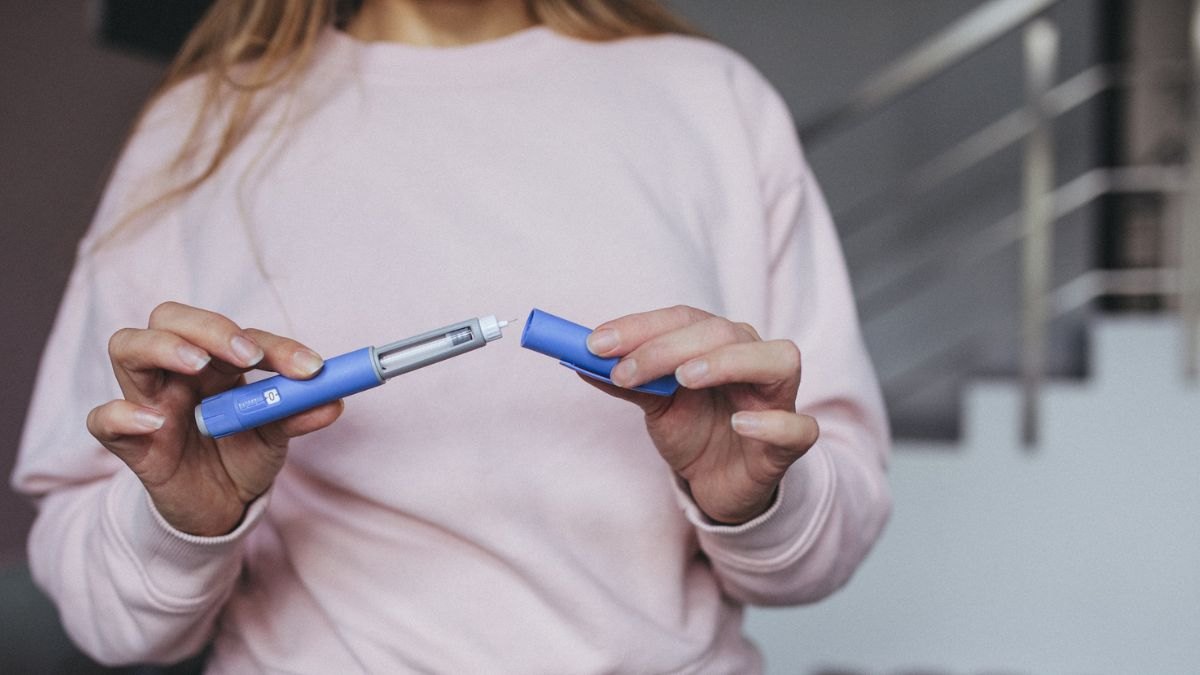
You love the idea of GLP-1s like Ozempic—getting to accomplish your weight-loss goals and reap surprising bonus benefits you’ve heard about, like a lower Alzheimer’s disease risk and less sleep apnea.—all with a weekly injection or a quick daily pill. But if the potential side effects have been holding you back, we’ve got good news. Recent research out of Stanford suggests a hormone that naturally occurs in the body could do the same work of helping you lose weight without some of the most annoying GLP-1 drug side effects. We spoke to an expert about what this GLP-1 alternative is, how it works, when it might be available and what you can do while we wait.
What is the GLP-1 alternative BRP?
“BRP, also known as BRINP2-related peptide, is a naturally occurring peptide, which means that BRP is a small group of amino acids,” explains Sadia Saeed, MD, physician and medical advisor with Welzo. “Research has shown that it exists in the cerebrospinal fluid found in the brain and spine. Initial research indicates that BRP can affect the way the brain processes hunger signals and fullness signals; however, much additional study is required to fully understand how BRP functions within the human body.”
New research on the BRP peptide
You may be thinking: We already have GLP-1s to help us with weight loss and managing high blood sugar levels. What’s so special about BRP? New research gives the answer. In a Nature animal study, Stanford researchers found that when mice and minipigs were given BRP, they ate less, achieved body weight loss and lost body fat loss—all without some of the most common side effects associated with GLP-1s, including nausea and food aversion. The peptide, which researchers dubbed an anti-obesity peptide, reduced food intake. The results suggest it works through a different brain signaling pathway than GLP-1s.
“BRP appears to suppress appetite through a different brain signaling pathway from GLP-1,” explains Cuilan Li, MD, PhD, a women’s health specialist for JustAnswer. “The study found that its effects did not depend on the GLP-1 receptor, leptin or MC4R, which are involved in appetite and weight regulation. That different mechanism may help explain why the animals ate less without showing the same nausea or food aversion.”
Could BRP be used like Ozempic and other GLP-1 drugs?
We get it. As exciting as this new research sounds, you’re really wondering if BRP can actually deliver the results of other weight-loss drugs like Ozempic and Wegovy, minus the queasiness.
Dr. Li says it’s possible, but making BRP an accessible GLP-1 alternative could take a while. “BRP would need further preclinical research followed by carefully controlled human clinical trials to establish safety and effectiveness,” she says. “If human studies eventually show that BRP reduces appetite and weight without significant nausea, it could offer another option for people who cannot tolerate GLP-1 medications. Because it appears to work through a different pathway, it might eventually complement GLP-1 therapy rather than simply replace it.”
“The time required to establish that BRP will be an effective weight-loss therapy could potentially be as long as five years,” adds Dr. Saeed. “The reason this may be so lengthy is due to the requirement of conducting a large number of clinical trials in humans.”
And while we have a few years before this Ozempic alternative for weight loss might be made available, it demonstrates an exciting future for combatting obesity. “What makes BRP exciting is not simply that it reduced food intake, but that it appears to do so through a different biological pathway without the same nausea and food aversion seen in the animal comparison,” says Dr. Li. “If that translates to humans, it could give us another way to treat obesity.”
Other natural GLP-1 alternatives
Although both Dr. Saeed and Dr. Li say the unique health benefits of GLP-1s can’t be replicated with food or supplements, there are methods that can help you feel more full and combat cravings like popular weight-loss medications. Per Dr. Li, these types of natural GLP-1 alternatives to support weight loss include:
Eating more protein and fiber: Protein-rich foods like poultry, eggs, Greek yogurt and tofu can help increase satiety for a longer amount of time, while fiber-rich foods like whole grains, beans, veggies and fruits boost fullness and slow digestion, says Dr. Li.
Staying hydrated: We can sometimes confuse thirst with hunger, and Dr. Li says staying hydrated helps avoid this issue.
Get enough sleep: Skipping out on getting enough sleep can increase cravings and hunger, but aiming for seven to nine hours a night can help, says Dr. Li.
The bottom line on GLP-1 alternatives like BRP
If GLP-1s work for you, they can be a great help in your health and weight-loss journey. But the same way every medication is not a great fit for every person, neither are GLP-1s. If you find they aren’t for you, talk to your doctor about other methods—including GLP-1 alternatives—to help you reach your goals. And give one (or more!) of our expert tips above a try, while knowing that new research continues to demonstrate new methods are on the horizon.
Ready for more inspiration? Subscribe to our YouTube channel for video podcasts, health tips and uplifting stories designed for women 40, 50, 60 and beyond.
