


Fact Check
Is US only country in 2026 World Cup without universal healthcare? We checked all 48 teams
The United States lacks universal healthcare, but it isn’t the only World Cup participant with incomplete coverage
Aleksandra Wrona
Published July 17, 2026
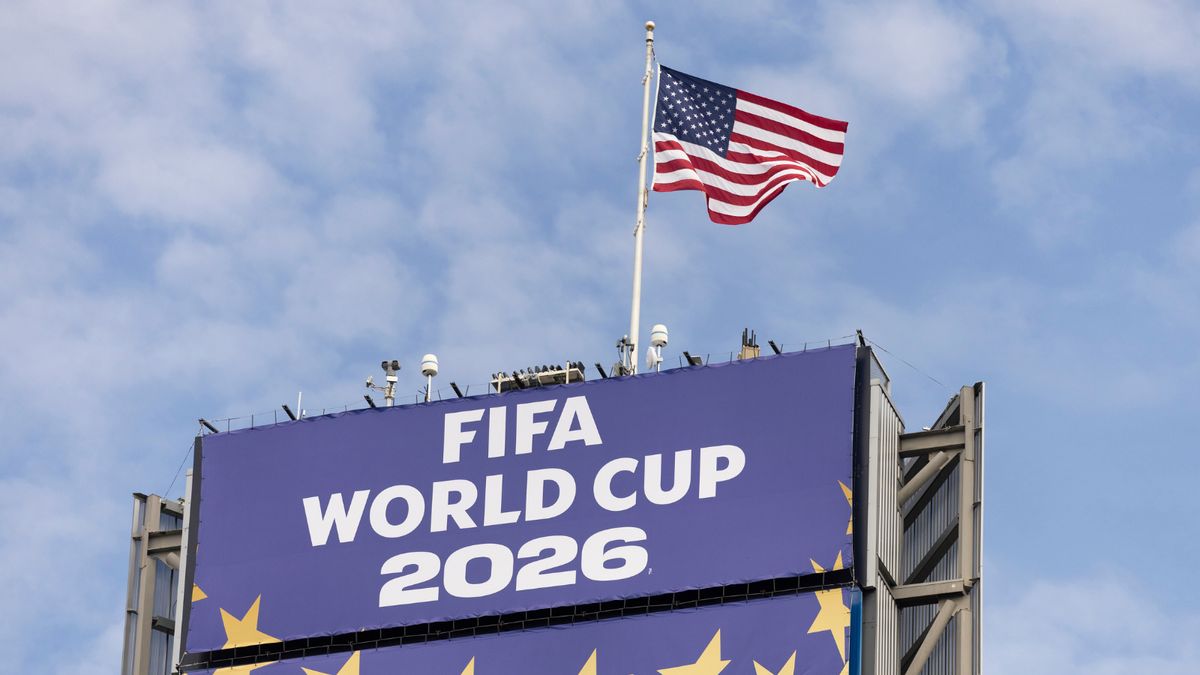
Image courtesy of MB Media, accessed via Getty Images
“);
}
else if(is_tablet()){
slot_number++;
var ad_class_name = “snopes_dt_incontent”;
var advertisement_text = “Advertisment:”;
if(isSponsorNewsletterUser){
ad_class_name += “_sponsorship”;
advertisement_text = “Sponsorship: “+info_icon;
}
document.write(”
“);
}
Claim:The United States is the only country competing in the 2026 FIFA World Cup without universal healthcare.
Rating:
False
About this rating
Context
The United States lacks universal health coverage, but it was not the only 2026 World Cup participant in that position. In Mexico, for example, 78% of the population was covered for a core set of health services. Official sources explicitly described coverage as nonuniversal in Bosnia and Herzegovina and documented incomplete reforms in several other participating countries. Therefore, the claim that the United States was the tournament’s only participant without universal health coverage was false.
In June and July 2026, as the FIFA World Cup unfolded in Canada, Mexico and the United States, social media users circulated a claim comparing the participating teams’ healthcare systems. The 2026 tournament was the first to feature 48 teams and the first to be hosted by three countries
“I saw a comment saying the U.S. is the only country in the World Cup without universal healthcare,” one Xpost(archived) read, “And I was like nahhh no way that’s accurate. 20 seconds on the world wide web later, THE UNITES STATES IS THE ONLY COUNTRY IN THE WORLD CUP WITHOUT UNIVERSAL HEALTHCARE.”
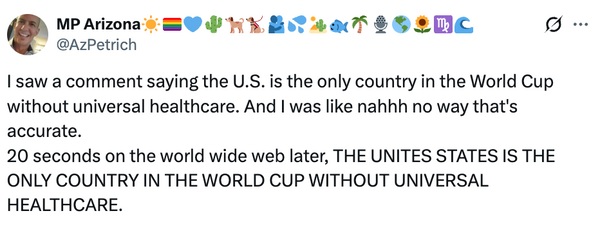
(X user @AzPetrich)
Variations of the claim appeared elsewhereon Xand also spread onInstagram,RedditandFacebook. Some versions simplydeclared: “The United States is the only country in the World Cup without Universal Healthcare.”
The claim was false. The United States does lack universal health coverage, but we found several other World Cup participants where population coverage remained incomplete, insurance systems were still being expanded or official
What does ‘universal healthcare’ mean?
The posts used the phrase “universal healthcare,” while the World Health Organization generally uses “universal health coverage,” or UHC
WHO defines UHC as a situation in which all people can access the quality health services they need, when and where they need them, without financial hardship. It includes prevention, treatment, rehabilitation and palliative care
Universal coverage does not require one particular type of health system. The Organization for Economic Co-operation and Development (OECD) recognizes coverage provided through tax-funded national health systems, social health insurance or mandatory private insurance
Nor does UHC mean every treatment must be free. WHO notes that no country can sustainably provide every possible health intervention free of charge. The OECD also cautions that eligibility for a core set of services does not by itself guarantee effective access. Patients may still encounter costs, waiting times or other unmet needs
US lacks universal coverage
The accurate part of the claim concerned the United States. Its health system combines private insurance with public programs such as Medicare and Medicaid, but not every resident is covered. The U.S. Census Bureau estimated that 27.1 million people, or 8% of the population, were uninsured for the entire 2024 calendar year. The Commonwealth Fund similarly described the United States as a country that had not achieved health coverage for all residents
What was inaccurate was the assertion that the United States stood alone among the World Cup’s 48 participants
US was not the only exception
Mexico provided the clearest and most immediate counterexample. According to the OECD’s Health at a Glance 2025 countrynote, 78% of Mexico’s population was covered for a core set of services. The OECD’s broader report found that Mexico’s 78% rate was the lowest among OECD members using the latest available country data. Population coverage was also below 95% in the United States, Costa Rica and Estonia
A May 2026Commonwealth Fund analysisreached the same conclusion. After comparing 20 countries, including numerous World Cup participants, it said the United States and Mexico were the two countries in the study that had not achieved health coverage for all residents
Other participants also contradicted the absolute claim
In Bosnia and Herzegovina, the European Observatory on Health Systems and Policiesstatedmandatory social health insurance exists across the country’s entities and districts, but that coverage “is not universal.” It said substantial parts of the population had very limited access to publicly financed care
In Morocco, the Health Ministryreportedin December 2025 that compulsory health coverage had reached 88% of the population. The minister also reiterated the country’s objective of achieving universal health coverage by 2030
South Africa’s government likewise treats universal coverage as the objective of an unfinished reform. The country’s Department of HealthdescribesNational Health Insurance as part of the “journey towards universal and comprehensive quality health coverage for all” and says implementation is being phased in from 2024 through 2028
Any one of these counterexamples would be sufficient to disprove a claim that the United States was the only World Cup participant without fully achieved universal coverage
Why the claim may sound familiar
The World Cup claim may have developed from a narrower and often-repeated comparison involving wealthy countries
In 2021, the Commonwealth Fund described the United States as “the only high-income country lacking universal health insurance coverage” in a report comparing it with 10 other selected high-income countries. That conclusion applied only to the countries included in the report, not to every country worldwide or every World Cup participant. In a 2026 comparison of 20 countries that included Mexico, the organization concluded that both the United States and Mexico had yet to achieve health coverage for all residents.
How to read the tracker below
Because the social media claim concerned whether each World Cup participant had universal health coverage, this tracker focuses primarily on population eligibility or legal entitlement to a core set of health services. Where no directly comparable population measure was available, we also considered explicit statements from governments and international health authorities about whether national coverage was universal or whether a nationwide rollout remained incomplete
“Universal coverage” means an authoritative source describes the system or population coverage as universal, or says the entire population is eligible or legally entitled to a core set of services. “Near-universal coverage” means recent evidence places population coverage at 95% or higher but below 100%. “Not fully achieved” means an authoritative source documents a substantial population gap, explicitly describes coverage as nonuniversal or says a nationwide rollout remains incomplete. “Unclear” means the available evidence did not support a confident assessment of population-wide coverage.
These statuses are Snopes’ summaries of the available evidence, not formal WHO classifications. Even countries with universal population entitlement may have copayments, uncovered services, waiting times, regional inequalities or other barriers to effective access
| 2026 World Cup group | Team/Participant | Health coverage status |
|---|---|---|
| 2026 World Cup groupA | Team/ParticipantMexico | Health coverage statusNot fully achieved |
OECD reported that 78% of Mexico’s population is covered for a core set of health services, meaning population coverage remains below universal levels | ||
| 2026 World Cup groupA | Team/ParticipantSouth Africa | Health coverage statusNot fully achieved |
South Africa’s Department of Health described National Health Insurance as a reform intended to deliver universal health coverage, indicating that nationwide universal coverage is not yet in place | ||
| 2026 World Cup groupA | Team/ParticipantKorea Republic | Health coverage statusUniversal coverage |
South Korea’s National Health Insurance Service described the country as having achieved universal health coverage. Residents are covered through compulsory National Health Insurance or separate public programs, including Medical Aid | ||
| 2026 World Cup groupA | Team/ParticipantCzech Republic | Health coverage statusUniversal coverage |
OECD’s 2025 country note reported that the entire population is covered for a core set of health services | ||
| 2026 World Cup groupB | Team/ParticipantCanada | Health coverage statusUniversal coverage |
The Canadian government described a universal, tax-funded system providing eligible residents with publicly funded medically necessary hospital and physician services | ||
| 2026 World Cup groupB | Team/ParticipantBosnia and Herzegovina | Health coverage statusNot fully achieved |
The European Observatory said mandatory social health insurance exists across Bosnia and Herzegovina’s entities and Brčko District, but coverage is not universal and substantial parts of the population have very limited access to publicly financed care | ||
| 2026 World Cup groupB | Team/ParticipantQatar | Health coverage statusUniversal coverage |
A WHO and UNDP report described Qatar’s health coverage as universal, with all citizens and residents able to obtain a government health card | ||
| 2026 World Cup groupB | Team/ParticipantSwitzerland | Health coverage statusUniversal coverage |
Switzerland’s Federal Office of Public Health stated that everyone residing in the country must obtain health insurance, generally within three months of taking up residence | ||
| 2026 World Cup groupC | Team/ParticipantBrazil | Health coverage statusUniversal coverage |
Brazil’s Ministry of Health said the Unified Health System, or SUS, guarantees universal, comprehensive and free access to health services throughout the country | ||
| 2026 World Cup groupC | Team/ParticipantMorocco | Health coverage statusNot fully achieved |
Morocco’s Health Ministry said compulsory health coverage had reached 88% of the population in 2025 and described achieving universal health coverage by 2030 as an objective of continuing reforms | ||
| 2026 World Cup groupC | Team/ParticipantHaiti | Health coverage statusNot fully achieved |
A 2025 World Bank report prepared with the Haitian government described universal health coverage as an objective and recommended reforms intended to move the country toward it | ||
| 2026 World Cup groupC | Team/ParticipantScotland | Health coverage statusUniversal coverage |
The Scottish Government stated that everyone living in Scotland is entitled to health care through the NHS, generally free at the point of use | ||
| 2026 World Cup groupD | Team/ParticipantUnited States | Health coverage statusNot fully achieved |
The Census Bureau estimated that 27.1 million people, or 8% of the population, were uninsured for the entire 2024 calendar year, so coverage is not guaranteed to every resident | ||
| 2026 World Cup groupD | Team/ParticipantParaguay | Health coverage statusNot fully achieved |
Paraguay provides free care through Health Ministry facilities, but universal health coverage has not yet been fully achieved. The National Institute of Statistics reported that 31% of the population had medical insurance in 2025, while PAHO said the country was still working to reduce inequalities and advance toward universal coverage | ||
| 2026 World Cup groupD | Team/ParticipantAustralia | Health coverage statusUniversal coverage |
Australia’s Department of Health described Medicare as the country’s universal health insurance scheme | ||
| 2026 World Cup groupD | Team/ParticipantTurkey | Health coverage statusNear-universal coverage |
OECD’s 2025 country note reported that 99% of Turkey’s population is covered for a core set of health services | ||
| 2026 World Cup groupE | Team/ParticipantGermany | Health coverage statusUniversal coverage |
The Federal Ministry of Health stated that all residents are required to have statutory or private health insurance | ||
| 2026 World Cup groupE | Team/ParticipantCuraçao | Health coverage statusUniversal coverage |
Curaçao’s Social Insurance Bank stated that the Basic Health Insurance scheme was introduced for all residents in 2013 | ||
| 2026 World Cup groupE | Team/ParticipantIvory Coast | Health coverage statusNot fully achieved |
An official February 2026 update said more than 23 million people were enrolled by the end of 2025 and set a target of 30 million in 2026, showing that coverage was still being expanded | ||
| 2026 World Cup groupE | Team/ParticipantEcuador | Health coverage statusNot fully achieved |
Ecuador’s 2022-2031 health plan said the country’s fragmented health system does not guarantee universal access and health coverage | ||
| 2026 World Cup groupF | Team/ParticipantNetherlands | Health coverage statusUniversal coverage |
The Dutch government said everyone who lives or works in the Netherlands must take out standard health insurance | ||
| 2026 World Cup groupF | Team/ParticipantJapan | Health coverage statusUniversal coverage |
Japan achieved universal health insurance in 1961, requiring eligible residents to enroll in a public health insurance scheme and generally pay part of the cost of covered care | ||
| 2026 World Cup groupF | Team/ParticipantSweden | Health coverage statusUniversal coverage |
The OECD reported that Sweden’s entire population is covered for a core set of health services through its predominantly tax-funded system | ||
| 2026 World Cup groupF | Team/ParticipantTunisia | Health coverage statusNot fully achieved |
Tunisia’s National Institute of Statistics reported that 82.1% of the population had health coverage | ||
| 2026 World Cup groupG | Team/ParticipantBelgium | Health coverage statusNear-universal coverage |
OECD’s 2025 country note reported that 98% of Belgium’s population is covered for a core set of health services | ||
| 2026 World Cup groupG | Team/ParticipantEgypt | Health coverage statusNot fully achieved |
An April 2026 Egyptian government update said the Universal Health Insurance system was entering its second phase and expanding to additional governorates, showing that nationwide implementation remained incomplete | ||
| 2026 World Cup groupG | Team/ParticipantIran | Health coverage statusNear-universal coverage |
A May 2026 Commonwealth Fund profile reported that about 95% of Iran’s population is enrolled in public insurance plans, describing this as significant progress toward universal health coverage | ||
| 2026 World Cup groupG | Team/ParticipantNew Zealand | Health coverage statusUniversal coverage |
New Zealand’s Health Ministry stateds that most core health services are publicly funded and available to eligible people. OECD’s 2025 country note reported that the entire population is covered for a core set of health services | ||
| 2026 World Cup groupH | Team/ParticipantSpain | Health coverage statusUniversal coverage |
Spain’s Health Ministry described the National Health System as providing universal population coverage. | ||
| 2026 World Cup groupH | Team/ParticipantCabo Verde | Health coverage statusUniversal coverage |
Cabo Verde’s Constitution requires the state to create conditions for universal access to health care, and WHO described the system as based on a universal model of public financing | ||
| 2026 World Cup groupH | Team/ParticipantSaudi Arabia | Health coverage statusUniversal coverage |
A WHO strategy for 2024-2026 said Saudi Arabia’s Ministry of Health provides comprehensive and universal health services to the entire population | ||
| 2026 World Cup groupH | Team/ParticipantUruguay | Health coverage statusUniversal coverage |
Uruguay’s official health portal said the Integrated National Health System regulates the right to health protection for all inhabitants. The 2007 law establishing the system guarantees all residents access to comprehensive health services through a system combining public and private providers and lists universal coverage as a governing principle | ||
| 2026 World Cup groupI | Team/ParticipantFrance | Health coverage statusUniversal coverage |
France’s statutory health insurer said French citizens and other people who work in France or live there on a stable and lawful basis are guaranteed coverage of their health care costs | ||
| 2026 World Cup groupI | Team/ParticipantSenegal | Health coverage statusNot fully achieved |
Senegal’s Health Ministry said the country is committed to moving toward universal health coverage and has introduced several strategies to achieve it, but acknowledges that difficulties remain. Its policy reported that health coverage had reached 53.2% of the population in 2022, up from 20% in 2012 | ||
| 2026 World Cup groupI | Team/ParticipantIraq | Health coverage statusNot fully achieved |
An April 2025 joint statementfrom Iraq’s Health Ministry and WHO said the country was piloting its health insurance law in Baghdad, covering 776,000 people in 2024. In November 2025, Iraq’s health minister told the Iraqi News Agency that the next phase would extend the system to nine governorates, indicating that nationwide coverage had not yet been achieved | ||
| 2026 World Cup groupI | Team/ParticipantNorway | Health coverage statusUniversal coverage |
Norway’s official health portal said everyone living in the country is entitled to essential medical and care services | ||
| 2026 World Cup groupJ | Team/ParticipantArgentina | Health coverage statusUniversal coverage |
Argentina’s public system provides health coverage to citizens and permanent residents, including people without social or private insurance. Other foreign nationals may need insurance or must pay for nonemergency care at nationally run facilities | ||
| 2026 World Cup groupJ | Team/ParticipantAlgeria | Health coverage statusUniversal coverage |
Algeria’s 2018 Health Law guarantees free care and access for all citizens through the public system | ||
| 2026 World Cup groupJ | Team/ParticipantJordan | Health coverage statusNot fully achieved |
A 2023 national survey found that 31% of ever-married women and 41% of men ages 15 to 49 had no health insurance. A Jordanian Health Ministry strategy said the country is working to realize universal health coverage, indicating that it remains an unfinished objective. | ||
| 2026 World Cup groupJ | Team/ParticipantAustria | Health coverage statusUniversal coverage |
OECD’s 2025 profile reported that the entire Austrian population is covered for a core set of health services | ||
| 2026 World Cup groupK | Team/ParticipantPortugal | Health coverage statusUniversal coverage |
Portugal’s Constitution establishes the National Health Service as universal and general and requires access to care regardless of citizens’ economic circumstances. The official SNS website also said access is guaranteed regardless of economic or social status, while the OECD reported that the entire population is covered for a core set of health services. | ||
| 2026 World Cup groupK | Team/ParticipantDR Congo | Health coverage statusNot fully achieved |
A 2025 World Bank report said the country is committed to UHC by 2030 and documents continuing financing and coverage challenges | ||
| 2026 World Cup groupK | Team/ParticipantUzbekistan | Health coverage statusNot fully achieved |
In 2024, the Uzbek president’s office said state medical insurance was introduced first in Tashkent, the Syrdarya region and Karakalpakstan, demonstrating that national implementation was still being phased in. A 2025 World Bank report explicitly said UHC remains an unmet goal | ||
| 2026 World Cup groupK | Team/ParticipantColombia | Health coverage statusNear-universal coverage |
A July 2026 Colombian Health Ministry resolution stated that health insurance coverage had reached 99.6% of the population | ||
| 2026 World Cup groupL | Team/ParticipantEngland | Health coverage statusUniversal coverage |
The NHS Constitution and the 2025 ten-year plan reaffirm universal care based on clinical need rather than ability to pay | ||
| 2026 World Cup groupL | Team/ParticipantCroatia | Health coverage statusNear-universal coverage |
A 2025 OECD-European Observatory profile described Croatia’s mandatory social health-insurance system as providing near-universal coverage, with about 99% of the population insured | ||
| 2026 World Cup groupL | Team/ParticipantGhana | Health coverage statusNot fully achieved |
WHO’s Ghana office described the 2026 Free Primary Health Care initiative as a pathway to universal health coverage. Ghana’s Health Ministry reported that 17.8 million people, or 55.5% of the population, had active National Health Insurance Scheme membership in 2023 | ||
| 2026 World Cup groupL | Team/ParticipantPanama | Health coverage statusNot fully achieved |
In January 2026, Panama’s Health Ministry said the integration of its public health systems was intended to achieve nationwide coverage and universal access, indicating that the reform remained incomplete |
Sources
Assembleia da República. “Constituição Da República Portuguesa.” Parlamento.Pt, 2019, https://www.parlamento.pt/Legislacao/Paginas/ConstituicaoRepublicaPortuguesa.aspx. Accessed 16 July 2026
Bureau, US Census. “Income, Poverty and Health Insurance Coverage in the United States: 2024.” Census.Gov, 9 Sept. 2025, https://www.census.gov/newsroom/press-releases/2025/income-poverty-health-insurance-coverage.html. Accessed 16 July 2026
—. “Income, Poverty and Health Insurance Coverage in the United States: 2024.” Census.Gov, 9 Sept. 2025, https://www.census.gov/newsroom/press-releases/2025/income-poverty-health-insurance-coverage.html. Accessed 16 July 2026
DE ESTADÍSTICA, INSTITUTO NACIONAL. “El Director Nacional Del Instituto Nacional De Estadística (INE), Iván Ojeda, Participó Este Jueves Como Primer Disertante Del Forbes Paraguay Health & Tech Summit 2026, Desarrollado En El Banco Central Del Paraguay, Donde Expuso Sobre Los Principales Indicadores Demográficos Y De Salud Del País Bajo El Lema ‘La Salud En Números.’.” Archive.Org, 2026, https://web.archive.org/web/20260716111708/https://www.ine.gov.py/noticias/2919/el-ine-presento-datos-sobre-salud-y-tendencias-demograficas-en-el-forbes-health–tech-summit-2026. Accessed 16 July 2026.
Department of Health and Social Care. “Fit for the Future: 10 Year Health Plan for England – Executive Summary.” GOV.UK, 2025, https://www.gov.uk/government/publications/10-year-health-plan-for-england-fit-for-the-future/fit-for-the-future-10-year-health-plan-for-england-executive-summary. Accessed 16 July 2026
—. “The NHS Constitution for England.” GOV.UK, 17 Aug. 2023, https://www.gov.uk/government/publications/the-nhs-constitution-for-england/the-nhs-constitution-for-england. Accessed 16 July 2026
Government of Canada. “About Canada’s Health Care System.” Government of Canada, 10 Oct. 2023, https://www.canada.ca/en/health-canada/services/canada-health-care-system.html. Accessed 16 July 2026
Group, World Bank. “Strengthening Panama’s Health System Post Covid-19.” World Bank, World Bank Group, 16 June 2025, https://www.worldbank.org/en/news/feature/2025/06/13/strengthening-panama-s-health-system-post-covid-19. Accessed 16 July 2026
—. “Universal Health Coverage and Pandemic Preparedness in Haiti (2019-2023).” World Bank, World Bank Group, 23 June 2025, https://www.worldbank.org/en/news/feature/2025/06/23/universal-health-coverage-and-pandemic-preparedness-in-haiti-2019-2023. Accessed 16 July 2026
https://www.facebook.com/casarosadaargentina. “Destacan Avances De La Cobertura Universal En Jornada De Equipos De Salud De Todo El País.” Argentina.Gob.Ar, 26 Nov. 2019, https://www.argentina.gob.ar/noticias/destacan-avances-de-la-cobertura-universal-en-jornada-de-equipos-de-salud-de-todo-el-pais. Accessed 16 July 2026
Maresso, A. “State of Health in the EU. Greece. Country Health Profile 2017.” European Journal of Public Health, vol. 28, no. suppl_4, 1 Nov. 2018, 10.1093/eurpub/cky212.595
Ministério da Saúde. “Sistema ÚNico De Saúde – SUS.” Ministério Da Saúde, 2024, https://www.gov.br/saude/pt-br/sus. Accessed 16 July 2026
National Department of Health. “National Health Insurance – National Department of Health.” National Department of Health, 2024, https://www.health.gov.za/nhi/. Accessed 16 July 2026
OECD. “Czechia.” Oecd.Org, 13 Nov. 2025, https://www.oecd.org/en/publications/health-at-a-glance-2025_15a55280-en/czechia_3f532d88-en.html, https://www.oecd.org/en/publications/health-at-a-glance-2025_15a55280-en/czechia_3f532d88-en.html. Accessed 16 July 2026
—. “Portugal.” Oecd.Org, 13 Nov. 2025, https://www.oecd.org/en/publications/health-at-a-glance-2025_15a55280-en/portugal_362f7cea-en.html, https://www.oecd.org/en/publications/health-at-a-glance-2025_15a55280-en/portugal_362f7cea-en.html. Accessed 16 July 2026
Referente, Normativa, et al. Ley No 18.211 SISTEMA NACIONAL INTEGRADO DE SALUD
Schneider, Eric C., et al. “Mirror, Mirror 2021: Reflecting Poorly.” Www.Commonwealthfund.Org, The Commonwealth Fund, 4 Aug. 2021, https://www.commonwealthfund.org/publications/fund-reports/2021/aug/mirror-mirror-2021-reflecting-poorly. Accessed 16 July 2026
Scottish Government. “Healthcare.” Www.Gov.Scot, 23 June 2022, https://www.gov.scot/publications/welcome-pack-new-scots/pages/5/. Accessed 16 July 2026
Tikkanen, Roosa, et al. “International Health Care System Profiles: United States.” The Commonwealth Fund, 2020, https://www.commonwealthfund.org/international-health-policy-center/countries/united-states. Accessed 16 July 2026
TurnDigital. “Egypt Highlights Progress of Health Insurance System.” Sis.Gov.Eg, 2024, https://sis.gov.eg/en/media-center/news/egypt-highlights-progress-of-health-insurance-system/. Accessed 16 July 2026
Verde, Cabo. Country Cooperation Strategy 2024-2028
WHO. “Universal Health Coverage.” Www.Who.Int, 2023, https://www.who.int/health-topics/universal-health-coverage. Accessed 16 July 2026
WHO Admin. “World Health Day: Joint Statement by the Ministry of Health and WHO in Iraq.” Who.Int, 2025, https://www.emro.who.int/iraq/news/world-health-day-joint-statement-by-the-ministry-of-health-and-who-in-iraq.html. Accessed 16 July 2026
World Health Organization: WHO. “Universal Health Coverage (UHC).” Who.Int, World Health Organization: WHO, Apr. 2021, https://www.who.int/news-room/fact-sheets/detail/universal-health-coverage-%28uhc%29. Accessed 16 July 2026
“1St Quarter Newsletter 2026.” WHO | Regional Office for Africa, 2026, https://www.afro.who.int/countries/ghana/publication/st-quarter-newsletter-2026. Accessed 16 July 2026
“Actualité.” Archive.Org, 2025, https://web.archive.org/web/20260624205030/https://www.sante.gov.ma/pages/actualites.aspx?idactu=731. Accessed 16 July 2026
“Algérie : Déclaration Conjointe Des Résultats De L’Evaluation Conjointe Externe De La Mise En œUvre En Algérie Du RSI (2005).” OMS | Bureau Régional Pour L’Afrique, 2022, https://www.afro.who.int/fr/countries/algeria/news/algerie-declaration-conjointe-des-resultats-de-levaluation-conjointe-externe-de-la-mise-en-oeuvre-en. Accessed 16 July 2026
“Basisverzekering Ziektekosten (BVZ) – SVB.” SVB, 30 July 2024, https://svbcur.org/en/werknemers/bvz/. Accessed 16 July 2026
CONSTITUTION OF THE REPUBLIC OF CABO VERDE NATIONAL ASSEMBLY 4 Th Edition 2010 Praia. 2010
“Health at a Glance 2025: Austria.” Oecd.Org, 2025, https://www.oecd.org/en/publications/health-at-a-glance-2025_15a55280-en/austria_df51bab3-en.html. Accessed 16 July 2026
“Health at a Glance 2025: Mexico.” Oecd.Org, 2025, https://www.oecd.org/en/publications/health-at-a-glance-2025_15a55280-en/mexico_f3342ed6-en.html. Accessed 16 July 2026
“Health at a Glance 2025: Sweden.” Oecd.Org, 2025, https://www.oecd.org/en/publications/health-at-a-glance-2025_15a55280-en/sweden_e51ede07-en.html. Accessed 16 July 2026
“Health Insurance in the Republic of Croatia | HZZO.” Hzzo.Hr, https://hzzo.hr/en/national-contact-point-ncp/health-insurance-republic-croatia. Accessed 16 July 2026
“Health Insurance: Requirement to Obtain Insurance for Persons Resident in Switzerland.” Admin.Ch, 2025, https://www.bag.admin.ch/en/health-insurance-requirement-to-obtain-insurance-for-persons-resident-in-switzerland. Accessed 16 July 2026
“Health Minister Dr. Koca at The ….” Saglik.Gov.Tr, 2019, https://www.saglik.gov.tr/en-55317/health-minister-dr-koca-at-the-world-health-assembly.html. Accessed 16 July 2026
“Health Systems in Action: Bosnia and Herzegovina|European Observatory on Health Systems and Policies.” Who.Int, 2024, https://eurohealthobservatory.who.int/publications/i/health-systems-in-action-bosnia-and-herzegovina. Accessed 16 July 2026
“Healthcare Rights in Norway.” Www.Helsenorge.No, 6 Nov. 2019, https://www.helsenorge.no/en/health-rights-in-norway/health-care-rights/. Accessed 16 July 2026
How Does Mexico Perform Overall?
“Iran.” Commonwealthfund.Org, May 2026, https://www.commonwealthfund.org/international-health-policy-center/countries/iran, https://doi.org/10.26099/3nes-bz48. Accessed 16 July 2026
“Iraqi News Agency.” Iraqi News Agency, 2025, https://ina.iq/en/local/43409-20-hospitals-opened-across-iraq-health-minister-says.html. Accessed 16 July 2026
“Moh.Gov.Jo.” Perma.Cc, 2026, https://perma.cc/w7z5-35tn. Accessed 16 July 2026
“Monitoring Universal Health Coverage – WHO.” Www.Who.Int, https://www.who.int/data/monitoring-universal-health-coverage. Accessed 16 July 2026
National Healt System National Health System SPAIN
“NHIS, as a WHO CC < WHO Collaborating Centre | 영어 사이트.” 영어 사이트, 6 Mar. 2023, https://www.nhis.or.kr/english/wbheaa03600m01.do. Accessed 16 July 2026
“Open Knowledge Repository.” Worldbank.Org, 2025, https://openknowledge.worldbank.org/entities/publication/5c686b33-3265-4755-9f1b-c92d79571952. Accessed 16 July 2026
“Paraguay Establishes Mesa Consultiva to Strengthen Primary Health Care with Support from PAHO, World Bank, and IDB.” Opsoms, 17 July 2025, https://www.paho.org/en/news/17-7-2025-paraguay-establishes-mesa-consultiva-strengthen-primary-health-care-support-paho. Accessed 16 July 2026
“Plateforme Officielle Pour Accéder Au Bilan Du Gouvernement De Côte D’Ivoire – Actualités – Société.” Gouv.Ci, 2026, https://bilan.gouv.ci/actualite/19220. Accessed 16 July 2026
Política Nacional. 2024
“Population Coverage.” 영어 사이트, 9 Nov. 2020, https://www.nhis.or.kr/english/wbheaa02400m01.do. Accessed 16 July 2026
“Population Coverage for Healthcare: Health at a Glance 2025.” OECD, 2025, https://www.oecd.org/en/publications/health-at-a-glance-2025_8f9e3f98-en/full-report/population-coverage-for-healthcare_5c968b73.html. Accessed 16 July 2026
“Population Coverage for Healthcare: Health at a Glance 2025.” OECD, 2025, https://www.oecd.org/en/publications/health-at-a-glance-2025_8f9e3f98-en/full-report/population-coverage-for-healthcare_5c968b73.html. Accessed 16 July 2026
“Presentation on Primary Healthcare and Insurance System Held.” President.Uz, 2024, https://president.uz/en/lists/view/7525. Accessed 16 July 2026
“Protection Universelle Maladie.” Www.Ameli.Fr, https://www.ameli.fr/assure/droits-demarches/principes/protection-universelle-maladie. Accessed 16 July 2026
“Salud | Sitio Oficial De La República Oriental Del Uruguay.” Www.Gub.Uy, 2026, https://www.gub.uy/salud. Accessed 16 July 2026
“Salud | Sitio Oficial De La República Oriental Del Uruguay.” Www.Gub.Uy, 2026, https://www.gub.uy/salud. Accessed 16 July 2026
“Serviço Nacional De Saúde.” Www.Sns.Gov.Pt, https://www.sns.gov.pt/sns/servico-nacional-de-saude/. Accessed 16 July 2026
Social Security
“Standard Health Insurance | Government.Nl.” Government.Nl, 2024, https://www.government.nl/themes/family-health-and-care/health-insurance/standard-health-insurance. Accessed 16 July 2026
“Statutory Health Insurance (SHI).” BMG, 2025, https://www.bundesgesundheitsministerium.de/en/themen/krankenversicherung/online-ratgeber-krankenversicherung/krankenversicherung/statutory-health-insurance-shi. Accessed 16 July 2026
“Universal Health Coverage.” WHO | Regional Office for Africa, https://www.afro.who.int/health-topics/universal-health-coverage. Accessed 16 July 2026
“U.S. Health Care from a Global Perspective, 2026.” Commonwealthfund.Org, 28 May 2026, https://www.commonwealthfund.org/publications/issue-briefs/2026/may/us-health-care-global-perspective-2026, https://doi.org/10.26099/2egm-8b76. Accessed 16 July 2026
By Aleksandra Wrona
Aleksandra Wrona is a reporting fellow for Snopes, based in the Warsaw, Poland, area
“);
}
else if(is_tablet()){
var ad_class_name = “snopes_dt_incontent”;
var advertisement_text = “Advertisment:”;
if(isSponsorNewsletterUser){
ad_class_name += “_sponsorship”;
advertisement_text = “Sponsorship: “+info_icon;
}
document.write(“
“+advertisement_text+”
“);
}
}
Article Tags
SportsFootballWorld CupHealth CareUnited States
