



‘It was like something was crawling over me’ – the worrying rise of shingles among millennial women
Stress, the cost of living, long working hours and even excessive exercise have all been touted as reasons the illness is rising among women in their 30s and 40s. What can be done to help them?
The “lightning strike” pain was like nothing Francine Jones had experienced before. “That is the only way I can describe it,” she says, of the stabbing in her torso that would occur every 10 minutes or so. “It was a really sharp, intense pain, as if someone was giving me an electric shock … it took my breath away.”
It had started in May with a strange pricking sensation under her bra. Then 10 large blisters, plus a host of smaller ones, formed in a band from her stomach to her back. They burned, “like someone was putting an iron on me. I don’t think I wore underwear for five or six weeks.” Showering, or even a cold flannel, would make her skin burn. Then came “the itch”, which lasted for five weeks and was so intense that she was lucky if she slept for four hours a night. “It was like something was crawling all over me all the time.” I can hear her wincing.
Jones is describing the stages of shingles she experienced. “Stages” is her terminology; there is no set pattern. It is her way of describing how the illness progressed. One night, she even feared she was having a heart attack. “I felt like I had a constant stitch and it intensified to where I was unable to walk,” she recalls. “I tried to take a deep breath and then the pain got worse. I was crying my eyes out.”
The healthcare assistant from Hereford is 39, not an age at which you might expect someone to get shingles. Yet she is not as much of a rarity as you might expect. Her story reflects a concerning trend: a 2019 US research paper reported that the sharpest rise in shingles cases was among those aged 30 to 49. Between 1998 and 2017, cases of shingles in this cohort more than doubled, overtaking the trajectory of older groups, although the latter experienced more cases overall. (Cases across all groups have been rising steadily in the US for decades, a trend for which experts do not appear to have a clear explanation, although they speculate that increased stress and depression, contributing to weakened immunity – a key cause of shingles – may play a role.)
After being diagnosed by a pharmacist, Jones was prescribed antiviral medication for seven days, then the nerve pain medication Gabapentin, which she is still taking. She has been off work for two months and still experiences sporadic aching in her side, as if she has twisted badly
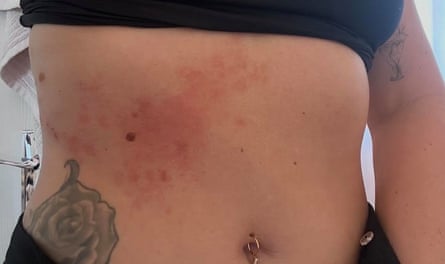
“I always thought it was old people who got shingles,” she says. In fact, a US study published in the journal Clinical Infectious Diseases this year found that those aged 30 to 39 with certain conditions, including asthma, diabetes, depression and stress, had a higher risk of shingles than those aged 50 to 59 who were immunocompetent. Experts say the uptake of the shingles vaccine in the over-50s in the US is still too low to offer an explanation for this
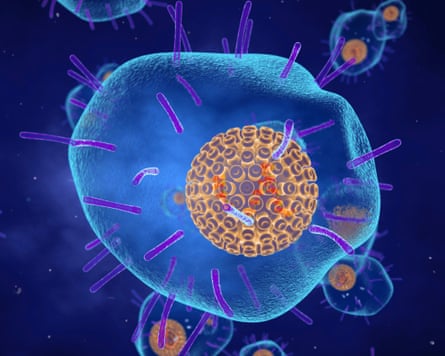
Shingles, also known as herpes zoster, is a reactivation of the varicella zoster (chickenpox) virus, which lies dormant in the sensory dorsal root ganglia – a cluster of neuron cell bodies just outside the spinal cord – after the contraction, often in childhood, of chickenpox. Reactivation can be triggered when immunity is impaired and T-cells in our blood can no longer keep it in check. The first symptom is usually pain or tingling in one area of the skin, sometimes accompanied by headaches and generally feeling unwell. This is typically followed by blisters. Pain is caused by inflamed nerves – one complication can be postherpetic neuralgia (persistent pain for more than 90 days), which occurs in around 20% of patients.
According to the NHS, around a quarter of us will experience shingles in our lifetime and the incidence increases with age, which is why the shingles vaccination is offered to those over 65 in the UK and those over 50 in the US. Cases in the UK are above the five year average, according to the Royal College of GPs Research and Surveillance Centre. It believes this may, in part, reflect additional diagnoses through the Pharmacy First scheme, which allows pharmacists as well as GPs to diagnose shingles and prescribe treatment.
“I’ve had shingles eight times in the last two years. I’m 38 years old,” wrote one woman, in a Facebook support group for those with shingles. “I had shingles in April for the first time at 36,” said another. Others have similar stories: “I got it last year at 32”; “I had it at 41 this time last year but I’ve only just finished recovering”; “I’m 44, got shingles last year and it was horrific, the pain!” The majority of voices are female. Across most age groups, women have a 56% higher chance of developing shingles, thought to be because their immune systems work differently from men’s (women are more prone to autoimmune conditions, for example).
In the US, one hypothesis for the rise in shingles is that the introduction in 1995 of the chickenpox vaccine for children, which eventually lowered rates of infection in young age groups, means adults who have not been vaccinated are missing out on exposure to chickenpox, and therefore the boosts to their own resilience to shingles
Indeed, the 2019 study expected to find this, especially when it came to explaining the rise in shingles in the millennial cohort, who are too old to have had the chickenpox vaccine and too young for the shingles vaccine
The less chickenpox, the less shingles resilience hypothesis sounds plausible, but Jennifer Moffat, associate professor of microbiology and immunology at the State University of New York Upstate Medical University, explains that this theory was disproved in the 2019 study because chickenpox and shingles rates did not tally as expected. “As chickenpox decreased, the rate of zoster was on the same trajectory in 30-year-olds as it always was,” she says. She adds that it is now believed that resilience is naturally built, with or without exposure to chickenpox. “Scientists and physicians now believe the virus occasionally reactivates without symptoms, which provides an internal immune boost. Only when that person has impaired immunity does it cause a rash and the symptoms of shingles.”
Moffat adds: “It only takes a small gap in your immune function to let this virus pop out. Having a respiratory disease like Covid or flu … getting a bad sunburn, having type 2 diabetes or even treatment with steroids (which suppress immune system responses) can lead to an eruption of shingles.” She also believes, “something else is happening on a very large scale that is putting people at higher risk for reactivation – the declining health of humans in general. Less activity, poor diet, more stress, even maybe a warming climate.” Her list goes on: “Lack of social supports, eating ultra-processed foods, not cooking at home, not sleeping enough, higher income inequality, lack of access to healthcare – this last [one] is a major problem for young people in the US,” she points out.
But why are millennial women especially struggling? Coupled with their immune systems being more prone to shingles than men’s, Moffat speculates that their health and mental health may be more compromised as they face a wide range of lifestyle pressures in midlife. “Well, if you looked at their general health, I imagine you’d find higher rates of high blood pressure, type 2 diabetes,” Moffat says. She finds the Clinical Infectious Diseases study compelling. “Having depression at ages 30 to 39 puts you at as high a risk for shingles as a person in their 50s,” she says. “How many women do you know who feel great? They’re trying to earn, to care for their families, maintain homes. They have [older] parents, small children. There’s so much pressure on women, and I think health is not as easy to obtain any more. I think women are very squeezed in that age group.”
Jones faced an acute period of personal stress before her shingles, but says life is generally quite stressful anyway. “The cost of living goes up, people are working more hours.” She says she would force herself to get to the gym at 8.30am on Sundays and sometimes do two classes a day. Studies have observed that exercising seven days a week can potentially increase the risk of developing shingles
It is stress that Daisy, now 51, believes may have been behind her three shingles flare-ups. She was 43 when she first had it in 2018. She noticed half her body felt sore and that there was a rash “the size of a penny under my arm”. Her GP initially gave her cream for heat rash. “I had post-shingles pain for a couple of years … dots and bolts of pain,” she says. She had recently started a new job and suffered a bereavement
In 2022, her shingles returned. “I was managing quite a demanding day job, studying, going to the gym, living life as a single woman,” she says. In 2023, it emerged a third time after a period of illnesses including laryngitis and Covid. She was also taking exams and had started perimenopause
Consultant dermatologist Dr Adil Sheraz explains that early diagnosis, pre-rash (some shingles cases never display one), can be missed and younger people can also be overlooked. This is problematic because antivirals are most effective if taken within 72 hours of the first symptoms. “I have seen it missed many times,” he says. “If the patient comes in quite late, we still treat them, but often you miss the treatment phase.”
Antivirals are taken for around 7-10 days, “after which the active infection goes away”, Sheraz explains. “You are then left with redness for quite some time. And then a certain percentage of patients will be left with nerve pain that may go on for many years.”
His younger patients do tend to be immunocompromised – although the shingles vaccine is now available for people aged 18 and over who have a severely weakened immune system or take immunosuppressant medication. It is growing use of the latter, he speculates, due to significant advances in drug technology and the treatment of autoimmune conditions, that may be another reason for the rise in cases of shingles. “Up to 10 years ago, we would never use these types of immune suppressants for eczema, for example, or for blistering conditions,” he says.
While shingles usually presents on the torso, it can appear anywhere, including the face. Proximity to the eye can risk blindness. Hayley, 42, from north Wales, suffered corneal scarring after her shingles was repeatedly missed. Aged 38, she began feeling an ache near her ear, jaw stiffness and then her eyebrow swelled. “Then my whole eye swelled,” she says. “It looked like I’d been punched.”
Her GP diagnosed an infected salivary gland. A week later, a rash appeared under her eyebrow and her eye also felt sore, akin to a “chopping onions” sensation. The rash and swelling subsided (the blisters have left a scar), but then her GP diagnosed allergic conjunctivitis. “I had trouble looking up,” she recalls. “I was sitting in a dark room. I couldn’t really watch TV, read a book. Doing computer work, I had to keep walking away.”
It was an optician who referred her to the hospital, where shingles was diagnosed almost two months later, and antivirals and steroids were prescribed. Thankfully, the corneal scarring was outside her field of vision
Moffat would welcome shingles vaccination at a younger age. “Shingles is terrible, it’s painful, it’s disfiguring,” she explains. For now, looking after your wellbeing is the best prevention for younger people, she believes
When we speak, Jones admits she is taking a rest day due to the re-emergence of her twisting pain. “I try to listen to my body now,” she explains. She won’t be at the gym on a Sunday morning any time soon
Explore more on these topicsShare
Reuse this content
