


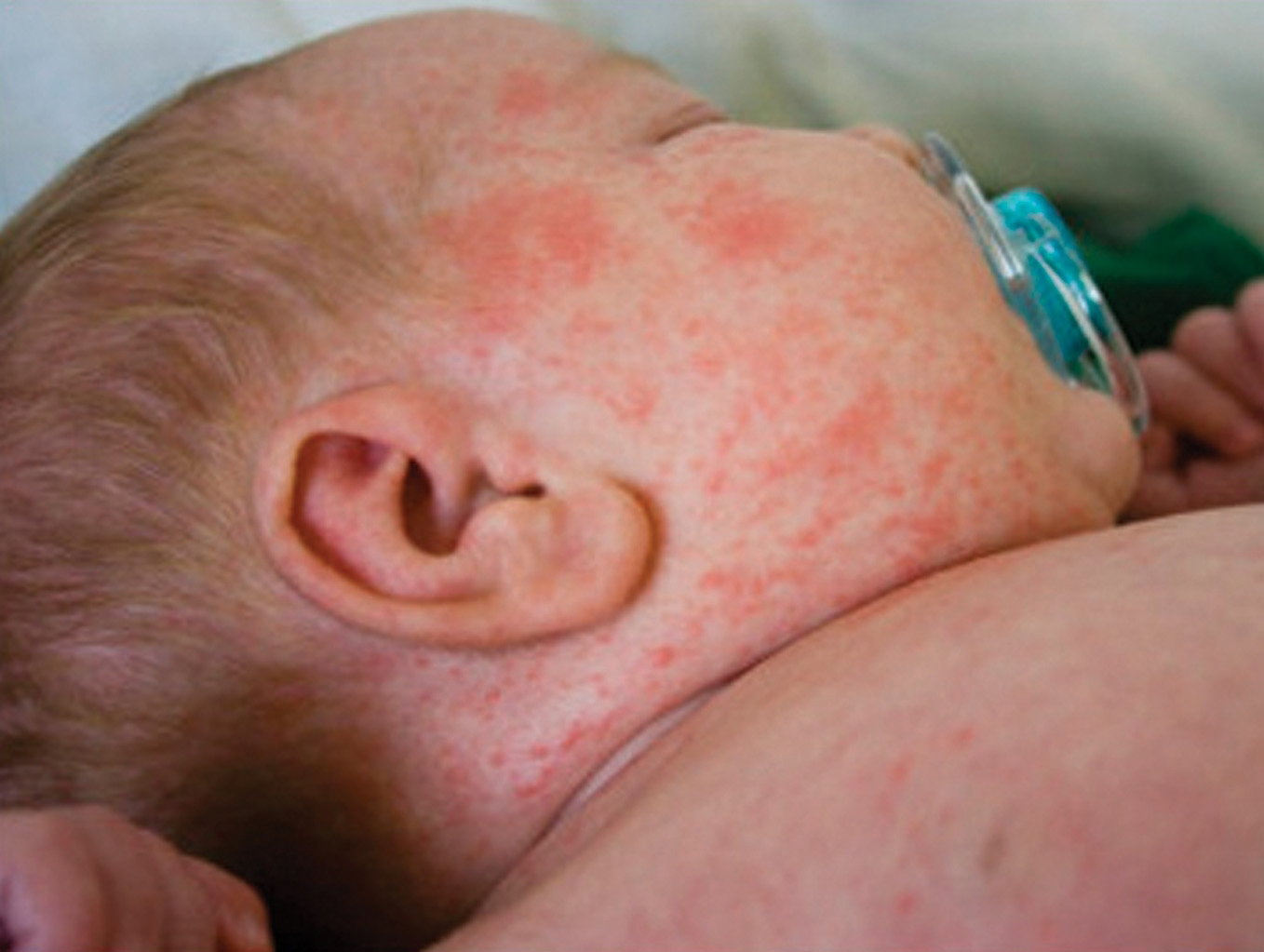
- Measles in babies can cause fever, cough, red eyes, irritability, and a red, blotchy rash.
- Babies with suspected measles should be evaluated promptly because complications can include pneumonia and encephalitis.
- The MMR vaccine is the main form of prevention, with early doses recommended in some situations.
Measles in babies is a highly contagious infection caused by the measles virus, which belongs to the Paramyxoviridae family. It can cause symptoms such as a red, blotchy rash, a fever above 100.4°F (38°C), and increased irritability
Measles can be prevented with the measles, mumps, and rubella (MMR) vaccine. The first routine dose is given between 12 and 15 months of age, although babies 6 through 11 months old may receive an early dose before international travel or when recommended by public health authorities during an outbreak
If measles is suspected, contact the baby’s pediatrician immediately and call the office before arriving to avoid exposing other people. Prompt medical care is important because measles can cause serious complications, including pneumonia and encephalitis
Measles symptoms in babies
The main symptoms of measles in babies are:
Severe irritability
Persistent dry cough
Runny nose
Red, watery eyes
Decreased appetite
Measles symptoms can initially be mistaken for the flu. However, 2 to 3 days after the first symptoms begin, the baby may develop small bluish-white spots inside the mouth, known as Koplik spots
About 3 to 5 days after the first symptoms, small, flat red spots commonly appear on the face and along the hairline. The rash then spreads to the rest of the body
As soon as the first signs or symptoms of measles are noticed, the baby should be seen by a pediatrician to confirm the diagnosis and start the most appropriate treatment
Measles rash vs allergy
When the first spots appear, measles may be mistaken for an allergic reaction
However, unlike an allergy, measles in babies usually begins with other symptoms, such as fever, a runny nose, cough, and red, watery eyes. The red rash typically appears several days later
Online symptom quiz
To assess the possibility that the baby may have measles, select the symptoms present in the following symptom checker:
The measles symptom checker is only a guidance tool. It cannot provide a diagnosis or replace an evaluation by a pediatrician
Confirming a diagnosis
Measles in babies is diagnosed by a pediatrician based on the baby’s symptoms, medical history, and physical examination
If the doctor suspects that the skin spots may be caused by another condition, a blood test may also be ordered
How long does measles last?
In general, the high fever caused by measles begins about 10 to 12 days after exposure to the virus and usually lasts between 4 and 7 days
The skin rash may appear up to 14 days after exposure to the virus and usually lasts about 5 to 6 days
How it spreads
The measles virus belongs to the Morbillivirus genus of the Paramyxoviridae family. It spreads easily through the air when an infected person coughs or sneezes and through direct contact with secretions from the nose or throat
According to the CDC, a person with measles can spread the virus from 4 days before until 4 days after the rash appears
Who is at higher risk?
Measles can affect people of any age, but children younger than 5 years old have a higher risk of serious complications, particularly if they are malnourished, have a weakened immune system, or have not been vaccinated against measles
Treatment options
Treatment for measles in babies should be supervised by a pediatrician. It usually involves rest, adequate hydration, and medications recommended by the doctor to reduce fever, relieve symptoms, and keep the baby comfortable
Measles treatment in babies are:
- Increasing fluid intake by offering breast milk or formula more often to babies up to 6 months old, or light foods and plenty of age-appropriate fluids to babies who have already started eating solid foods
- Applying cool compresses to the baby’s forehead, back of the neck, and groin to help relieve discomfort from fever
- Cleaning the baby’s eyes with a piece of cotton or gauze moistened with saline solution, always wiping from the inner corner of the eye toward the outer corner
According to the CDC, vitamin A may be given for 2 days to infants and children with measles under the supervision of a healthcare professional. Children with severe measles, including those who are hospitalized, should be treated with vitamin A
Antibiotics do not treat measles and should not be used routinely to prevent complications. However, a pediatrician may prescribe an antibiotic if the baby develops a secondary bacterial infection, such as an ear infection or bacterial pneumonia
Possible complications
Complications of measles in babies include ear infections, severe diarrhea that can lead to dehydration, pneumonia, and encephalitis. In the most serious cases, measles can cause permanent brain damage or death
Complications are more common in children younger than 5 years old, particularly those who have a weakened immune system
How to prevent
The main way to prevent measles is with the MMR vaccine. Children routinely receive the first dose between 12 and 15 months of age and the second dose between 4 and 6 years of age.
According to the CDC, babies 6 through 11 months old should receive an early dose of the MMR vaccine before international travel, and public health authorities may also recommend this dose during an outbreak when there is a risk of exposure
An MMR dose given before the first birthday does not count toward the routine two-dose series. Babies who receive an early dose still need two additional doses after turning 12 months old
Also recommended: Measles Vaccine: Indications, Vaccine Schedule & Side Effectstuasaude.com/en/measles-vaccine
During pregnancy, measles antibodies can pass from the mother to the baby through the placenta and provide temporary protection after birth. However, the amount of protection varies and decreases during the first months of life
If the mother has never had measles and has not received the MMR vaccine, she may not have measles antibodies to pass to the baby. This may increase the baby’s risk of developing measles before becoming eligible for routine vaccination
Update History
We regularly update our content with the latest scientific information to maintain an exceptional level of quality.
- 11 July, 2026 (Current version)
Updated by
Jillian Kinton-Vieira – Registered Nurse
Updated by
Jillian Kinton-Vieira – Registered Nurse
Updated by
Jillian Kinton-Vieira – Registered Nurse - 3 May, 2026
- Created on
May, 2026
by
Jillian Kinton-Vieira
– Registered Nurse
References
- Centers for Disease Control and Prevention. Clinical overview of measles. CDC. Updated 06 Mar 2026. Accessed 11 Jul 2026 https://www.cdc.gov/measles/hcp/clinical-overview/index.html
- Centers for Disease Control and Prevention. How measles spreads. CDC. Updated 29 Apr 2026. Accessed 11 Jul 2026 https://www.cdc.gov/measles/causes/index.html
- Centers for Disease Control and Prevention. Measles vaccination. CDC. Updated 29 Apr 2026. Accessed 11 Jul 2026 https://www.cdc.gov/measles/vaccines/index.html
- Sarampion. Organización Mundial de la Salud. 2024. Accessed 13 May 2024 https://www.who.int/es/news-room/fact-sheets/detail/measles
- Measles. Kondamudi, N. P.; Waymack, J. R. In: StatPearls [Internet]. Treasure Island (FL): StatPearls Publishing. 2023. Accessed 13 May 2024 https://www.ncbi.nlm.nih.gov/books/NBK448068/
- Measles – Signs and Symptoms. CDC – Centers for Disease Control and Prevention. 2020. Accessed 13 May 2024 https://www.cdc.gov/measles/symptoms/signs-symptoms.html
- BLUTINGER, E.; et al. Measles: Contemporary considerations for the emergency physician. J Am Coll Emerg Physicians Open. 2023;4(5):e13032.
- WILSON, S. E.; et al. Measles. CMAJ. 2024;196(15):E524.
- JEIMY, S.; et al. Measles vaccination. CMAJ. 2024;196(15):E525.
