


Abstract
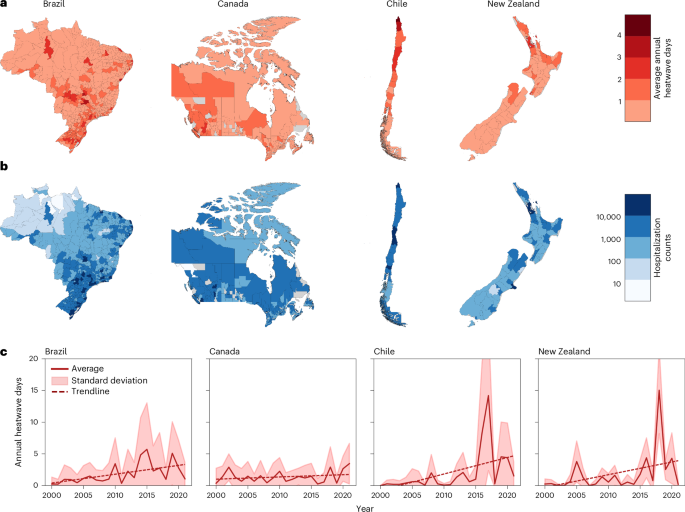
Heatwaves are increasing in frequency and intensity, yet their impacts on hospitalizations for mental and behavioural disorders remain insufficiently quantified across countries. Here we show, using a time-stratified case-crossover analysis of 2,618,307 warm-season hospitalization records from 852 locations in Brazil, Canada, Chile and New Zealand from 2000 to 2019, that sustained extreme heat was associated with increased hospitalization risk. Heatwaves were primarily defined as periods with daily mean temperature above the location-specific 97.5th percentile for at least 4 consecutive days. Under this definition, the relative risk was 1.033 (95% confidence interval, 1.007–1.059) on the same day and 1.056 (1.011–1.103) cumulatively from the same day through the next 8 days. Associations were stronger among older adults and residents of low-population-density areas. These findings indicate that prolonged extreme heat can acutely increase mental health-related hospital demand and support targeted preparedness during severe heatwaves.
Access through your institution
Buy or subscribe
This is a preview of subscription content, access
Access options
Access through your institution
- Purchase on SpringerLink
- Instant access to the full article PDF.
39,95 €
Prices may be subject to local taxes which are calculated during checkout
Data availability
The authors are not permitted to share the multicountry hospitalization data directly because of data-use agreements with the original data providers. Qualified researchers may request access from the relevant data custodians, subject to local governance and approval requirements; additional information can be obtained from the corresponding author. Any queries regarding data availability will be addressed by the corresponding author within 30 days of receipt. Source data are provided with this paper.
Code availability
Analysis codes are availablementalhealth_hospitalization.git
References
Arias, D., Saxena, S. & Verguet, S. Quantifying the global burden of mental disorders and their economic value. EClinicalMedicine54, 101675 (2022)
Patel, V. et al. The Lancet Commission on global mental health and sustainable development. Lancet392, 1553–1598 (2018)
Palinkas, L. A. & Wong, M. Global climate change and mental health. Curr. Opin. Psychol.32, 12–16 (2020)
Thompson, R., Hornigold, R., Page, L. & Waite, T. Associations between high ambient temperatures and heat waves with mental health outcomes: a systematic review. Public Health161, 171–191 (2018)
Brown, S. J. Future changes in heatwave severity, duration and frequency due to climate change for the most populous cities. Weather Clim. Extrem.30, 100278 (2020)
Zhao, Q. et al. Global, regional, and national burden of heatwave-related mortality from 1990 to 2019: a three-stage modelling study. PLOS Med.21, e1004364 (2024)
Turner, L. R., Connell, D. & Tong, S. The effect of heat waves on ambulance attendances in Brisbane, Australia. Prehosp. Disaster Med.28, 482–487 (2013)
Phung, D. et al. Heatwave and risk of hospitalization: a multi-province study in Vietnam. Environ. Pollut.220, 597–607 (2017)
Christodoulou, N. et al. Heatwaves and mental disorders: a study on national emergency and weather services data. Eur. J. Psych.38, 100249 (2024)
Zheng, G., Li, K. & Wang, Y. The effects of high-temperature weather on human sleep quality and appetite. Int. J. Environ. Res. Public Health16, 270 (2019)
McLoughlin, N., Howarth, C. & Shreedhar, G. Changing behavioral responses to heat risk in a warming world: how can communication approaches be improved? WIREs Clim. Change14, e819 (2023)
Zhao, Q. et al. The association between heatwaves and risk of hospitalization in Brazil: a nationwide time series study between 2000 and 2015. PLOS Med.16, e1002753 (2019)
Giebel, C. et al. Community-based mental health interventions in low-and middle-income countries: a qualitative study with international experts. Int. J. Equity Health23, 19 (2024)
Liu, J. et al. Is there an association between hot weather and poor mental health outcomes? A systematic review and meta-analysis. Environ. Int.153, 106533 (2021)
Kim, H. & Bell, M. L. On adjustment for temperature in heatwave epidemiology: a new method and toward clarification of methods to estimate health effects of heatwaves. Am. J. Epidemiol.193, kwae078 (2024)
Sun, Z. et al. Heat wave characteristics, mortality and effect modification by temperature zones: a time-series study in 130 counties of China. Int. J. Epidemiol.49, 1813–1822 (2020)
Anderson, G. B. & Bell, M. L. Heat waves in the United States: mortality risk during heat waves and effect modification by heat wave characteristics in 43 US communities. Environ. Health Perspect.119, 210–218 (2011)
Zhang, H. et al. Association between extreme heat and outpatient visits for mental disorders: a time-series analysis in Guangzhou, China. GeoHealth8, e2024GH001165 (2024)
Liu, X., Liu, H., Fan, H., Liu, Y. & Ding, G. Influence of heat waves on daily hospital visits for mental illness in Jinan, China—a case-crossover study. Int. J. Environ. Res. Public Health16, 87 (2019)
Hansen, A. et al. The effect of heatwaves on mental health in a temperate Australian city. Epidemiology19, S85 (2008)
Michel, V. et al. Decreased heat tolerance is associated with hypothalamo–pituitary–adrenocortical axis impairment. Neuroscience147, 522–531 (2007)
Rony, M. K. K. & Alamgir, H. M. High temperatures on mental health: recognizing the association and the need for proactive strategies—a perspective. Health Sci. Rep.6, e1729 (2023)
McMorris, T. et al. Heat stress, plasma concentrations of adrenaline, noradrenaline, 5-hydroxytryptamine and cortisol, mood state and cognitive performance. Int. J. Psychophysiol.61, 204–215 (2006)
Trang, P. M., Rocklöv, J., Giang, K. B., Kullgren, G. & Nilsson, M. Heatwaves and hospital admissions for mental disorders in northern Vietnam. PLOS ONE11, e0155609 (2016)
Russo, M. et al. The relationship between sleep quality and neurocognition in bipolar disorder. J. Affect. Disord.187, 156–162 (2015)
Baglioni, C. et al. Insomnia as a predictor of depression: a meta-analytic evaluation of longitudinal epidemiological studies. J. Affect. Disord.135, 10–19 (2011)
Wallace, D. A. & Johnson, D. A. in Climate Change and Mental Health Equity (ed. Moore, R. J.) 177–203 (Springer, 2024)
Zhou, W. et al. Heatwave exposure in relation to decreased sleep duration in older adults. Environ. Int.183, 108348 (2024)
Mason, H., King, J. C., Peden, A. E. & Franklin, R. C. Systematic review of the impact of heatwaves on health service demand in Australia. BMC Health Serv. Res.22, 960 (2022)
Niu, L. et al. Temperature and mental health-related emergency department and hospital encounters among children, adolescents and young adults. Epidemiol. Psychiatr. Sci.32, e22 (2023)
Kriebel-Gasparro, A. Climate change: effects on the older adult. J. Nurse Pract.18, 372–376 (2022)
Fahey, K. M., Dermody, S. S. & Cservenka, A. The importance of community engagement in experimental stress and substance use research with marginalized groups: lessons from research with sexual and gender minority populations. Drug Alcohol Depend.260, 111349 (2024)
Carek, P. J., Laibstain, S. E. & Carek, S. M. Exercise for the treatment of depression and anxiety. Int. J. Psychiatr. Med.41, 15–28 (2011)
Jehn, M. et al. Heat stress is associated with reduced health status in pulmonary arterial hypertension: a prospective study cohort. Lung192, 619–624 (2014)
Mayrhuber, E. A.-S. et al. Vulnerability to heatwaves and implications for public health interventions—a scoping review. Environ. Res.166, 42–54 (2018)
Ma, R. et al. The effectiveness of interventions for reducing subjective and objective social isolation among people with mental health problems: a systematic review. Soc. Psychiatry Psychiatr. Epidemiol.55, 839–876 (2020)
Kafeety, A. et al. Social connection as a public health adaptation to extreme heat events. Can. J. Public Health111, 876–879 (2020)
Kircanski, K., LeMoult, J., Ordaz, S. & Gotlib, I. H. Investigating the nature of co-occurring depression and anxiety: comparing diagnostic and dimensional research approaches. J. Affect. Disord.216, 123–135 (2017)
Vázquez, G. H. et al. Mixed symptoms in major depressive and bipolar disorders: a systematic review. J. Affect. Disord.225, 756–760 (2018)
Cohen, G. et al. Daily temperature variability and mental health-related hospital visits in New York State. Environ. Res.257, 119238 (2024)
Nakamura-Pereira, M., Mendes-Silva, W., Dias, M. A., Reichenheim, M. E. & Lobato, G. The Hospital Information System of the Brazilian Unified National Health System: a performance evaluation for auditing maternal near miss. Cad Saude Publica29, 1333–1345 (2013)
Amuah, J. E. et al. Development and validation of a hospital frailty risk measure using Canadian clinical administrative data. Can. Med. Assoc. J.195, E437–E448 (2023)
Health Statistics and Information (DEIS, 2023); https://deis.minsal.cl/#datosabiertos
Milne, B. J. et al. Data re. Int. J. Epidemiol.48, 677–677e (2019)
Xu, R., Xiong, X., Abramson, M. J., Li, S. & Guo, Y. Association between ambient temperature and sex offense: a case-crossover study in seven large US cities, 2007–2017. Sustain. Cities Soc.69, 102828 (2021)
Muñoz-Sabater, J. et al. ERA5-Land: a state-of-the-art global reanalysis dataset for land applications. Earth Syst. Sci. Data13, 4349–4383 (2021)
Dobson, J. E., Bright, E. A., Coleman, P. R., Durfee, R. C. & Worley, B. A. LandScan: a global population database for estimating populations at risk. Photogram. Eng. Remote Sens.66, 849–857 (2000)
Zhang, Y. et al. Heat exposure and hospitalisation for epileptic seizures: a nationwide case-crossover study in Brazil. Urban Clim.49, 101497 (2023)
Acknowledgements
This study is supported by the Australian Research Council (DP210102076) and the Australian National Health & Medical Research Council (APP2000581). The funders had no role in study design, data collection and analysis, decision to publish or preparation of the paper
Funding
Yiwen Zhang is supported by NHMRC e-Asia Joint Research Program Grant (GNT2000581). W. Huang and T.Y. are supported by China Scholarship Council funds (W. Huang, 202006380055; T.Y., 201906320051). R.X. is supported by Monash Faculty of Medicine Nursing and Health Science (FMNHS) Bridging Postdoctoral Fellowships 2022 and VicHealth Postdoctoral Research Fellowships 2022. M.S.Z.S.C. and P.H.N.S. are supported by the São Paulo Research Foundation. S.L. is supported by the Emerging Leader Fellowship (GNT2009866) of the Australian National Health and Medical Research Council. Y.G. is supported by the Career Development Fellowship (GNT1163693) and the Leader Fellowship (GNT2008813) of the Australian National Health and Medical Research Council.
Author information
Authors and Affiliations
Climate, Air Quality Research Unit, School of Public Health and Preventive Medicine, Monash University, Melbourne, Victoria, Australia
Yanming Liu, Zhihu Xu, Wenzhong Huang, Zhengyu Yang, Rongbin Xu, Wenhua Yu, Yiwen Zhang, Yao Wu, Pei Yu, Tingting Ye, Bo Wen, Gongbo Chen, Shuang Zhou, Ke Ju, Shanshan Li & Yuming Guo
Chongqing Emergency Medical Center, Chongqing University Central Hospital, School of Medicine, Chongqing University, Chongqing, China
Rongbin Xu
School of Life and Environment Science, University of Sydney, Sydney, New South Wales, Australia
Yuxi Zhang
Department of Public Health, University of Otago, Wellington, New Zealand
Simon Hales
School of Epidemiology and Public Health, University of Ottawa, Ottawa, Ontario, Canada
Eric Lavigne
Department of Pathology, School of Medicine, University of São Paulo, São Paulo, Brazil
Paulo H. N. Sadiva & Micheline S. Z. S. Coelho
School of Medicine, University of the Andes (Chile), Las Condes, Chile
Patricia Matus
School of Public Health and Preventive Medicine, Monash University, Melbourne, Victoria, Australia
Anthony Capon
School of Public Health, The University of Adelaide, Adelaide, South Australia, Australia
Peng Bi
School of Population Health, The University of New South Wales, Sydney, New South Wales, Australia
Bin Jalaludin
School of Public Health & Social Work, Queensland University of Technology, Brisbane, Queensland, Australia
Wenbiao Hu
School of Biological, Earth & Environmental Sciences, The University of New South Wales, Sydney, New South Wales, Australia
Donna Green
Sydney School of Public Health, The University of Sydney, Sydney, New South Wales, Australia
Ying Zhang
School of Public Health, University of Queensland, Brisbane, Queensland, Australia
Dung Phung
Authors
- Yanming LiuView author publications
Search author on:PubMed Google Scholar
- Zhihu XuView author publications
Search author on:PubMed Google Scholar
- Wenzhong HuangView author publications
Search author on:PubMed Google Scholar
- Zhengyu YangView author publications
Search author on:PubMed Google Scholar
- Rongbin XuView author publications
Search author on:PubMed Google Scholar
- Wenhua YuView author publications
Search author on:PubMed Google Scholar
- Yiwen ZhangView author publications
Search author on:PubMed Google Scholar
- Yao WuView author publications
Search author on:PubMed Google Scholar
- Pei YuView author publications
Search author on:PubMed Google Scholar
- Tingting YeView author publications
Search author on:PubMed Google Scholar
- Bo WenView author publications
Search author on:PubMed Google Scholar
- Gongbo ChenView author publications
Search author on:PubMed Google Scholar
- Shuang ZhouView author publications
Search author on:PubMed Google Scholar
- Yuxi ZhangView author publications
Search author on:PubMed Google Scholar
- Ke JuView author publications
Search author on:PubMed Google Scholar
- Simon HalesView author publications
Search author on:PubMed Google Scholar
- Eric LavigneView author publications
Search author on:PubMed Google Scholar
- Paulo H. N. SadivaView author publications
Search author on:PubMed Google Scholar
- Micheline S. Z. S. CoelhoView author publications
Search author on:PubMed Google Scholar
- Patricia MatusView author publications
Search author on:PubMed Google Scholar
- Anthony CaponView author publications
Search author on:PubMed Google Scholar
- Peng BiView author publications
Search author on:PubMed Google Scholar
- Bin JalaludinView author publications
Search author on:PubMed Google Scholar
- Wenbiao HuView author publications
Search author on:PubMed Google Scholar
- Donna GreenView author publications
Search author on:PubMed Google Scholar
- Ying ZhangView author publications
Search author on:PubMed Google Scholar
- Dung PhungView author publications
Search author on:PubMed Google Scholar
- Shanshan LiView author publications
Search author on:PubMed Google Scholar
- Yuming GuoView author publications
Search author on:PubMed Google Scholar
Contributions
Y.G. designed and supervised the study. Y.L. conducted the statistical analysis, interpreted the results and took the lead in drafting the paper. Z.X., W. Huang, Z.Y., R.X., W.Y., Yiwen Zhang, Y.W., P.Y., T.Y., B.W., G.C., S.Z., K.J. and Yuxi Zhang contributed to data cleaning, analysis, result interpretation and paper revision. S.H., E.L., P.H.N.S., M.S.Z.S.C., P.M., A.C., P.B., B.J., W. Hu, D.G., Ying Zhang and D.P. provided data, facilitated data access and contributed to the submitted version of the paper. S.L. critically revised and edited the paper. All authors reviewed, edited and approved the submitted version of the paper. The corresponding author attests that all listed authors meet authorship criteria and that no others meeting the criteria have been omitted.
Ethics declarations
Competing interests
The authors declare no competing interests
Peer review
Peer review information
Nature Health thanks Tomáš Janoš, Andrea Mechelli, Kim Meidenbauer and Amruta Nori-Sarma for their contribution to the peer review of this work. Primary Handling Editor: Ben Johnson, in collaboration with the Nature Health team
Additional information
Publisher’s note Springer Nature remains neutral with regard to jurisdictional claims in published maps and institutional affiliations
Extended data
Extended Data Fig. 1 Temporal comparison of heatwave associations between 2000–2009 and 2010–2019
a, Population-wise comparison of lag 0 RR for mental and behavioural disorder hospitalisations following heatwave exposure in 2000–2009 and 2010–2019, overall and stratified by sex, age group, and country. b, Cause-specific comparison of lag 0 RR for mental and behavioural disorder hospitalisations following heatwave exposure in 2000–2009 and 2010–2019. Heatwave exposure was defined as daily mean temperature above the 97.5th percentile for at least 4 consecutive days. Dots indicate model-derived point estimates, and error bars indicate the corresponding 95% CIs. Estimates were obtained from location-specific time-stratified case-crossover models and pooled using random-effects meta-analysis. The unit of analysis was the location. Analyses for all locations combined were conducted across n = 852 locations; country-specific analyses included n = 510 locations for Brazil, n = 261 for Canada, n = 15 for Chile, and n = 66 for New Zealand. Detailed subgroup- and cause-specific hospitalisation counts are provided in Supplementary Table 2. Abbreviations: RR, relative risk; CI, confidence interval.
Source data
Extended Data Fig. 2 Country-wise day-of-month patterns in all-cause mental and behavioural disorder hospitalisations
Cumulative counts of all-cause mental and behavioural disorder hospitalisations across the study period are shown by day of the month for (a) Brazil, (b) Canada, (c) Chile, and (d) New Zealand. This figure is intended to illustrate within-country reporting patterns and is not designed for cross-country comparisons of admission levels
Source data
Extended Data Fig. 3 All-cause lag-response associations across heatwave definitions
Dots indicate model-derived estimates of relative risks across lag 0–8 days under different heatwave definitions, with error bars indicating the corresponding 95% confidence intervals. Heatwave effect estimates represent the associations between heatwave days and hospitalisations. Added risk effect estimates represent the associations after additional adjustment for daily mean temperature, isolating the excess association attributable to heatwave conditions beyond temperature alone. Estimates were obtained from location-specific time-stratified case-crossover models and pooled using random-effects meta-analysis. The unit of analysis was the location, and analyses were conducted across n = 852 locations.
Source data
Extended Data Fig. 4 Lag 0 associations across heatwave definitions by population subgroup
Dots indicate model-derived estimates of lag 0 relative risks under different heatwave definitions for the overall population and by sex and age group, with error bars indicating the corresponding 95% confidence intervals. Estimates were obtained from location-specific time-stratified case-crossover models and pooled using random-effects meta-analysis. The unit of analysis was the location, and analyses were conducted across n = 852 locations. Detailed subgroup-specific hospitalisation counts are provided in Supplementary Table 2.
Source data
Extended Data Fig. 5 Lag 0 associations across heatwave definitions by country
Dots indicate model-derived estimates of lag 0 relative risks under different heatwave definitions for the overall population and by sex and age group, with error bars indicating the corresponding 95% confidence intervals. Estimates were obtained from location-specific time-stratified case-crossover models and pooled using random-effects meta-analysis. The unit of analysis was the location. Country-specific analyses included n = 510 locations for Brazil, n = 261 for Canada, n = 15 for Chile, and n = 66 for New Zealand.
Source data
Extended Data Fig. 6 Cause-specific lag 0 associations across heatwave definitions
Dots indicate model-derived estimates of lag 0 relative risks under different heatwave definitions by mental and behavioural disorder category, with error bars indicating the corresponding 95% confidence intervals. Estimates were obtained from location-specific time-stratified case-crossover models and pooled using random-effects meta-analysis. The unit of analysis was the location, and analyses were conducted across n = 852 locations. Detailed cause-specific hospitalisation counts are provided in Supplementary Table 2.
Source data
Extended Data Fig. 7 All-cause Lag 0 associations across heatwave definitions by location characteristic
Dots indicate model-derived estimates of lag 0 relative risks under different heatwave definitions, stratified by location characteristics, with error bars indicating the corresponding 95% confidence intervals. Estimates were obtained from location-specific time-stratified case-crossover models and pooled using random-effects meta-analysis. The unit of analysis was the location. For each location characteristic, locations were divided into low and high groups, with n = 426 locations per group. Detailed subgroup-specific hospitalisation counts are provided in Supplementary Table 2.
Source data
Extended Data Fig. 8 Sensitivity analysis with additional adjustment for precipitation and greenness at lag 0
Dots indicate model-derived estimates of lag 0 relative risks from sensitivity models additionally adjusted for precipitation, greenness, or both variables, compared with the main model specification. Error bars indicate the corresponding 95% confidence intervals. Precipitation is closely related to ambient moisture conditions, which were already controlled for using relative humidity, whereas greenness changes slowly over time and is unlikely to confound within-month comparisons in a case-crossover design. Estimates were obtained from location-specific time-stratified case-crossover models and pooled using random-effects meta-analysis. The unit of analysis was the location. Analyses for all locations combined were conducted across n = 852 locations, and low/high group comparisons were conducted with n = 426 locations per group. Exact P values are provided in the Source Data.
Source data
Extended Data Fig. 9 Sensitivity analysis using alternative moving-average windows at lag 0
Dots indicate model-derived estimates of lag 0 relative risks under alternative moving-average windows for temperature and relative humidity, with error bars indicating the corresponding 95% confidence intervals. Temperature windows ranged from 8 to 12 days, and relative humidity windows ranged from 5 to 9 days. Estimates were obtained from location-specific time-stratified case-crossover models and pooled using random-effects meta-analysis. The unit of analysis was the location, and analyses were conducted across n = 852 locations.
Source data
Extended Data Fig. 10 Lag-response associations by sex and age group
Dots indicate model-derived estimates of relative risks across lag 0–8 days for sex and age subgroups, with error bars indicating the corresponding 95% confidence intervals. Estimates were obtained from location-specific time-stratified case-crossover models and pooled using random-effects meta-analysis. The unit of analysis was the location, and analyses were conducted across n = 852 locations. Detailed subgroup-specific hospitalisation counts are provided in Supplementary Table 2
Source data
Supplementary information
Supplementary Data 1 (download PDF )
Supplementary Information Supplementary Notes 1–9, including Figs. 1–3 and Tables 1–20
Reporting Summary (download PDF )
Source data
Source Data Figs. 1–4 (download XLSX )
Statistical
Source Data Extended Data Figs. 1–10 (download XLSX )
Statistical
Rights and permissions
Springer Nature or its licensor (e.g. a society or other partner) holds exclusive rights to this article under a publishing agreement with the author(s) or other rightsholder(s); author self-archiving of the accepted manuscript version of this article is solely governed by the terms of such publishing agreement and applicable law
About this article
Cite this article
Liu, Y., Xu, Z., Huang, W. et al. Mental health hospitalizations associated with sustained extreme heat in multiple countries.
Nat. Health (2026). https://doi.org/10.1038/s44360-026-00166-2
Received:26 November 2025
Accepted:15 June 2026
Published:10 July 2026
Version of record:10 July 2026
DOI
:https://doi.org/10.1038/s44360-026-00166-2
