


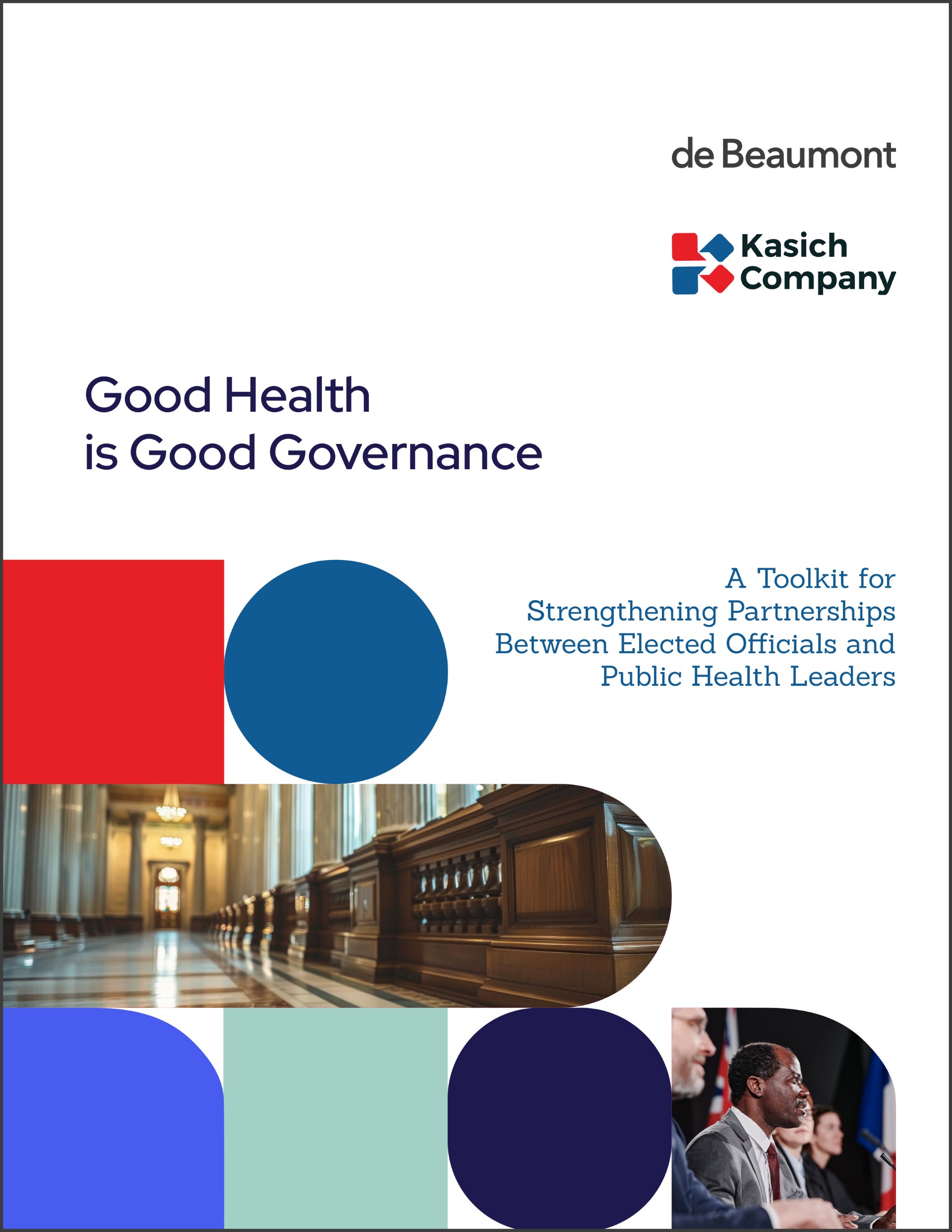
Explore the Good Health is Good Governance toolkit
A nonpartisan commission of leaders in health, policy, medicine, and business released a roadmap today to empower local health departments and elected officials to shore up public health in their communities
“There should be no partisan divide over clean water and clean air. Strong communities start with strong partnerships, and this roadmap is about building a united effort to protect health and save lives,” said John Kasich, chair of the National Commission on Local Public Health Leadership and former governor of Ohio.
The roadmap, “Good Health is Good Governance,” unveiled this morning at the National Association of County and City Health Officials’ annual conference in Louisville, Kentucky, encourages local leaders to commit to five concrete actions to improve collaboration around public health in their communities.
“There is incredible opportunity at the local level. When a health director and a mayor are working from the same playbook, communities respond to crises faster, smarter, and more efficiently,” said John Cranley, co-chair of the Commission and former mayor of Cincinnati
A recentpollfrom de Beaumont, which organized the Commission, and the Harvard Opinion Research Program found that state and local health departments have greater public trust than federal health agencies. The Commission’s work builds on this finding by providing practical tools to strengthen and extend that trust throughout local communities.
The roadmap begins with a public commitment for local elected and public health leaders to work together, such as a proclamation, press conference, or other form of announcement; followed by regular working sessions focused on level-setting the relationship and identifying mutual areas of concern. Once this cadence is set, they should establish clear roles for their work together. Traditionally, public health departments contribute data, scientific expertise, and operational experience; elected officials enact and fund policy, while also weighing public health needs in the context of other community needs.
After building a solid foundation from which to work together, elected officials and public health leaders should seek and maintain partnerships with other leaders in business, education, transportation, agriculture, public safety, healthcare, social services, and faith institutions — all of whom are affected by and have a direct interest in public health.
Finally, they should agree on mutual priorities for action. The Commission identified two policies, strengthening localized data and ensuring reliable access to personal protective equipment (PPE), as initial projects that are popular across diverse communities and political ideologies
The roadmap includes practical tools, like starter questions for those initial meetings, as well as concrete early steps to strengthen data and PPE protocols. Drawing on insights and experiences from leaders across the country, the roadmap offers a path forward to ensure that the health and well-being of all communities remain a defining strength of the nation for generations to come
“Public health has always been medicine’s greatest partner — and local government its most powerful ally. When these forces align, our communities thrive. This roadmap is an invitation to unlock that potential in every community across America,” said Dr. Patrice Harris, a commissioner and former president of the American Medical Association
The National Commission on Local Public Health Leadership was formed in July 2025 to develop a unified, actionable vision for public health policy that honors diverse perspectives while prioritizing the health and well-being of every American.Learn more about the members of the Commission and “Good Health is Good Governance” atleadinglocalpublichealth.org
