


When Mason Margolis was in high school, he recalls drinking protein shakes and eating extra meat after his workouts because he thought it was the best way to gain muscle mass
As a varsity basketball player, Margolis wanted to do anything he could to improve his athletic performance
But after Margolis took a kinesiology class his first year at the University of Miami, he realized that he had become a victim of clever marketing, and in fact, he did not need to consume so much protein. Instead, he could diversify his diet, keep up with regular exercise, and still gain muscle
He is now working to educate other young consumers about many of the tactics that food companies use to attract customers. And, along with the instructor who helped enlighten him, lecturer Michelina Witte, Margolis is hoping to improve the digital health literacy of young students in Miami and in his hometown of Jersey City, New Jersey
“I’m hoping to clarify the myths and health misconceptions so that kids can discover the right information about what they are eating,” said Margolis, a sophomore studying applied physiology
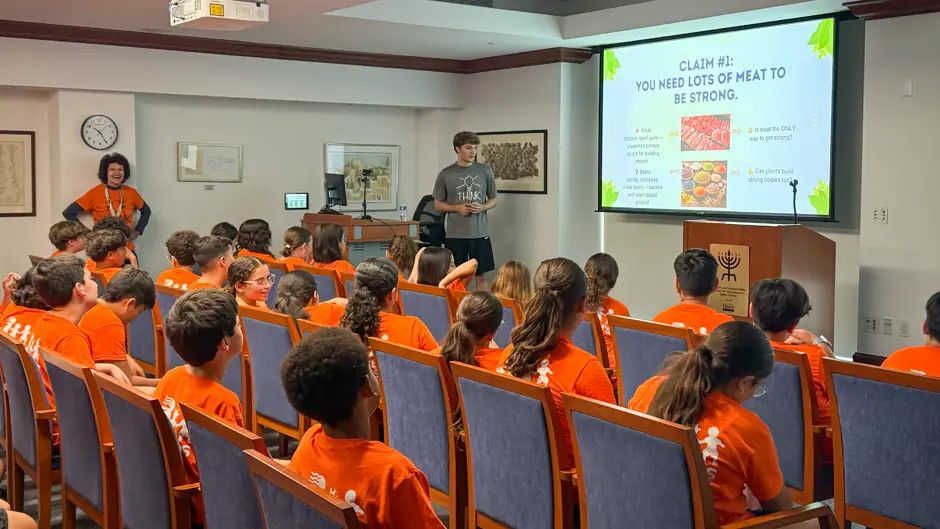
Through a research fellowship Margolis earned through the University’s Office of Academic Enhancement, he worked with Witte earlier this summer to create an interactive workshop about digital health literacy and presented it recently to athletes at his former high school. In late June, Margolis and Witte also presented to 50 middle school students on the Coral Gables Campus as part of the School of Education and Human Development’s Translational Health In Nutrition and Kinesiology, or THINK program, a seven-week camp founded and led by professor Arlette Perry, where local middle schoolers learn about exercise and nutrition and the science behind it. The program and research study have been evolving for 10 years in an effort to help youth develop healthy habits.
“Today’s youth receive an endless stream of nutrition and health misinformation through social media, influencers, and algorithms,” said Witte, who is also a neuroscientist at the Miller School of Medicine. “Our goal was to help campers develop the skills to critically evaluate what they see online, distinguish credible information from misinformation, and become more informed digital consumers.”
Since the focus of the camp was nutrition and exercise, Witte and Margolis talked to students about foods that everyone should eat, such as fruits and vegetables, as well as fiber, categorized as “green” foods, while also highlighting other options that are less healthy, in the “yellow” and “red” categories. Then Margolis and Witte taught the middle schoolers about “health halos,” or marketing on packages that can make foods appear healthier than they are, and showed these budding consumers how to read nutrition labels carefully, noting the levels of sugar, fat, and serving sizes on each package. The students even got an outdoor cooking lesson from health coach and plant-based educator Shauné Hayes.
As part of the workshop, students also learned about healthy consumption of digital media. They learned about credible health informationis and Witte also encouraged students to protect their attention span by limiting screen time, playing sports, reading a book, and keeping a routine that includes at least seven hours of sleep every night
“Your attention is a valuable resaid. “These are ways to protect and shield your attention. If nothing else, remember your brain gets better at whatever you practice, so if you’re watching short videos, your brain will only be able to pay attention for the length of a short video.”
Perry was glad she could add this new component to the THINK program, which receives funding support from The Children’s Trust and is one of her top research projects. Perry said she began the program to help improve nutrition and exercise education, and it has grown over the years to include a unit on social-emotional health, too. She is now working on a textbook from the success of the THINK curriculum and hopes she can include a section on digital health as well that will one day be part of schools’ regular course materials.
“We need to educate these students to be smart consumers, to understand the benefits of quality nutrition and the importance of exercise, and to take all of this home to their parents,” Perry said. “That way, they can establish these healthy habits as part of their personal lifestyle behaviors.”
topics:
Health and MedicinePeople and CommunityHealth and LifestyleIn the Community
Top
