


Getting your Trinity Audio player ready…
In so many ways, it was the opposite of just about everything one might expect from a public meeting these days
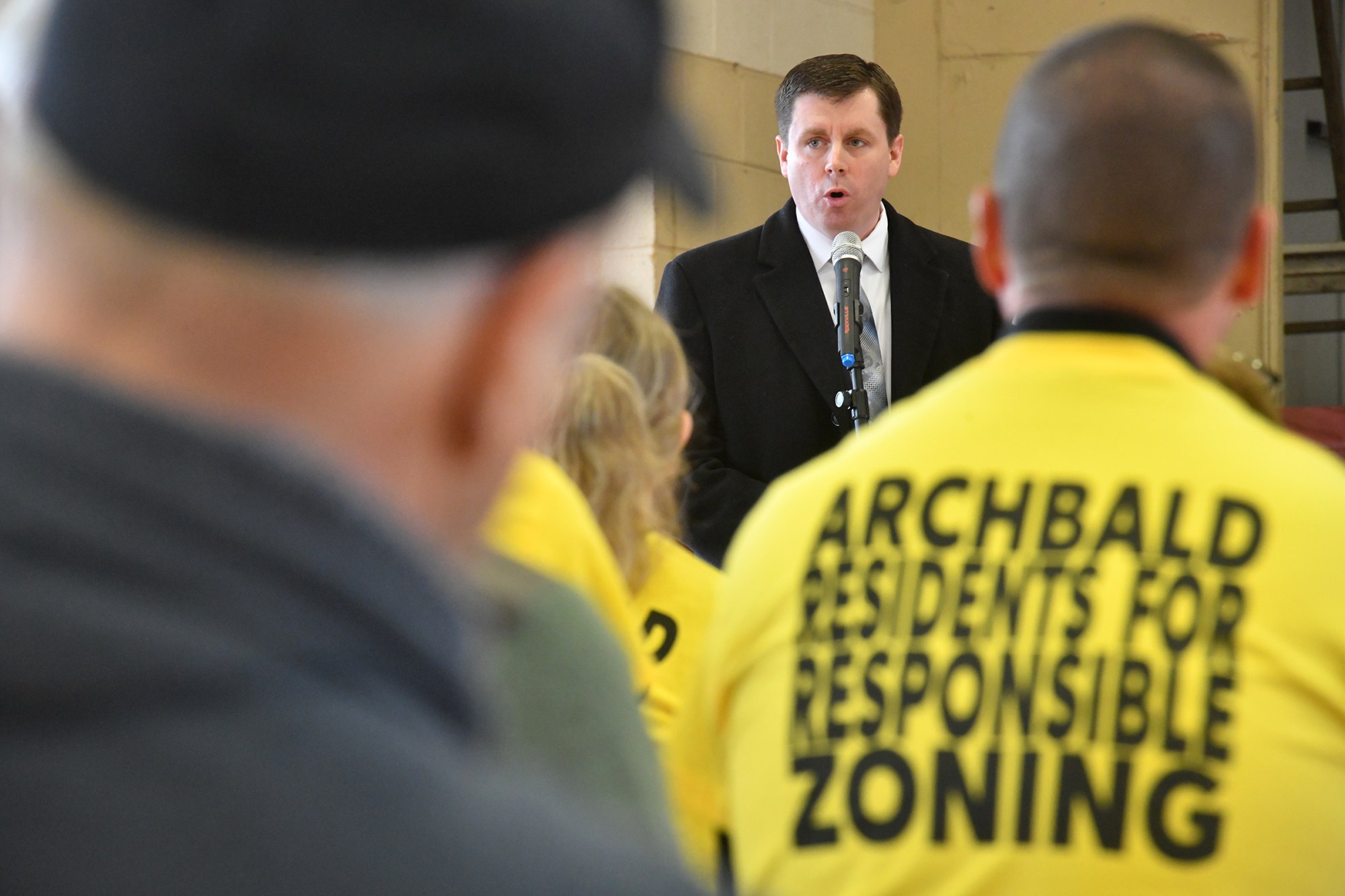
An overflow crowd of residents jammed into the Lackawanna County Commissioners’ meeting room in Scranton on Wednesday, demanding their tax dollars be spent to conduct a $165,000 study aimed at quantifying cumulative air quality and public health impacts of a swarm of proposed data centers and power plants within county limits
Despite that enthusiasm, a majority of county commissioners stalled anyway, insisting there are good reasons to take a more patient approach
We’ll explore some of those reasons in a bit, but suffice to say, Lackawanna County residents vehemently disagreed with waiting
“We’ve been fighting this for over a year now in Archbald and it’s really just taken over our lives, and we’re just pleading with you to help us in any way in Archbald,” Archbald Neighborhood Association co-founder Kayleigh Cornell said, through tears and with her young daughter in her arms. “I just plead with you to pass, make a motion, for the countywide health impact assessment as soon as you can.”
With the sheer amount of data centers proposed throughout the region, we believe a cumulative health and environmental impacts study like the one proposed in Lackawanna County by Commissioner Bill Gaughan is not only a responsible investment, but a necessary one
As part of their proposals, developers submit site-specific applications that do include environmental impact estimates specific to their own facilities. Often, they tout low-impact effects
However, they also naturally ignore impacts that compound in tandem with concentrated industrial growth surrounding their proposed facilities in small communities, or in tighter industrial areas
Evaluating each project individually does not highlight the aggregate risks to public health and air quality brought by the dozens upon dozens of proposed facilities throughout Northeast Pennsylvania. That, in itself, makes comprehensive cumulative impact studies valuable in the decision-making process, as well as later in potential court hearings
More knowledge is good knowledge, especially when it educates us on a relatively new industry that wants to create a foothold in an area burned before by big businesses that consume our natural re
Last Wednesday, Gaughan asked fellow commissioners Thom Welby and Chris Chermak to approve a study from EmPower Analytics Group that would assess those environmental and health concerns. Neither commissioner did, nor would they commit to putting Gaughan’s request to a vote at their Aug. 19 meeting
Chermak, the board’s lone registered Republican, expressed a desire to get the study “right” the first time
A Democrat, Welby has stressed that he supports a healthy impact study, but he said he’d like local municipalities and the state to chip in for the cost. He also insisted the commissioners will find an appropriate person or firm to conduct the study
We find those concerns curious on their face
EmPower Analytics co-founder Michael Cork, Ph.D. — an environmental health scientist and biostatistician from Harvard University who would be part of the cumulative study — seems highly qualified and already has knowledge of the area’s plight. He has reported an air quality and public health assessment on the proposed Wildcat Ridge Data Center Campus to support the grassroots Stop Archbald Data Centers movement
While this kind of study would certainly benefit neighboring counties like Luzerne and even likely be cited statewide, we believe it is absolutely the county’s responsibility to commission and pay for such an undertaking
While Archbald is the epicenter of developers’ plans, data centers have been proposed for a plethora of communities throughout the county, namely Clifton Twp., Covington Twp., Dickson City, Jessup, Olyphant, Newton Twp. and Ransom Twp. Three natural gas power plants have also been proposed by developers in Dickson City, and there is another one on the table in Archbald
For a cost that would barely dent the county’s $181 million general fund budget, Lackawanna County can take the lead in garnering information that would be helpful to all residents of Northeast Pennsylvania. Cumulative impact assessments should be sought on county-wide bases throughout the region
