


InfographicsCompanies
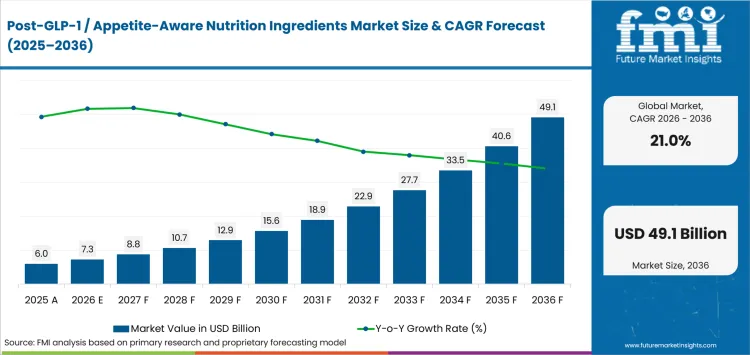
Market Size (2026)
USD 7.3 Bn
Forecast (2036)
USD 49.1 Bn
CAGR (2026 to 2036)
21.0%
How big is Post-GLP-1 / Appetite-Aware Nutrition Ingredients Market in 2026?
USD 7.3 billion in 2026 and USD 49.1 billion by 2036 at a 21.0% CAGR
Demand for post-GLP-1 / appetite-aware nutrition ingredients is projected to expand at 21.0% CAGR from 2026 to 2036. This means the valuation is expected to rise from USD 7.3 billion in 2026 to USD 49.1 billion by 2036. The Obesity Society’s May 2025 joint advisory prioritized nutrient-dense diets and adequate protein during GLP-1 therapy. Smaller eating volumes therefore increase formulation demand for protein ingredients that deliver useful protein without larger portions. Dietary fibers complement those protein systems when formulators need digestive support and nutrient density within compact serving formats.
Country conversion depends on reimbursement design and clinical access because those conditions determine how many users reach nutrition channels. Australia’s PBAC reported in March 2026 that three injectable medicines were registered for <a href="https://healthylife7.com/pallas-health-glp-1-reviews-2026-ready-to-make-weight-management-a-real-priority-discover-the-doctor-led-online-glp/” title=”Pallas Health GLP-1 Reviews 2026: Ready to Make Weight Management a Real Priority? Discover the Doctor-Led Online GLP”>weight management while broader subsidy still required cost-effectiveness review. That pathway differs from Germany’s greater private-payment exposure and the USA’s newer Medicare access route. These differences change the addressable population for clinical nutrition brands and determine whether dedicated appetite-aware products can sustain repeat purchase.
Key Takeaways
- Reduced food intake increases demand for nutrition systems that place protein and essential nutrients into smaller eating occasions.
- High-protein is projected at 46.2% of ingredient revenue in 2026 because smaller servings increase protein-density requirements.
- Functional F&B is estimated at 45.5% of application revenue in 2026 because familiar formats deliver concentrated nutrition in smaller occasions.
- Fiber and micronutrient systems gain relevance as reduced eating volume makes digestive tolerance and nutrient coverage central to formulation.
- Variable gastrointestinal tolerance and uneven access can shorten dedicated product runs or shift brands toward broader weight-management positioning.
- The profiled company register includes Nestlé Health Science, Abbott, dsm-firmenich, Glanbia, Kerry, Danone, Herbalife and Arla Foods Ingredients.
Analyst Perspective
“Appetite-aware formulations earn value when nutrient density fits smaller servings without texture or tolerance problems. Ingredient selection should start with eating occasions then test protein delivery, fortification stability and claims.”
– , Principal Consultant, Future Market Insights
How is the post-GLP-1 / appetite-aware nutrition ingredients market segmented?
The post-GLP-1 / appetite-aware nutrition ingredients market is segmented by ingredient, application and region
Market taxonomy separates ingredient function from the finished format carrying the formulation. Ingredient analysis covers high-protein, fiber, micronutrients and satiety actives. Application analysis covers functional F&B, supplements and meal replacement. Regional analysis follows the standard FMI geography used for country comparison and market sizing
What makes high-protein central to the ingredient category?
High-protein formulations solve a volume problem because reduced appetite limits eating occasions for muscle-supporting nutrition. dsm-firmenich reported in February 2026 that its 2025 portfolio introduced compact Mix-in protein granules with high protein density and neutral taste. The format illustrates why protein concentration and sensory control must work together in reduced-volume formulations intended for regular use
- By ingredient high-protein is estimated to hold 46.2% in 2026 because formulators need meaningful protein delivery without excessive serving volume.
- Brands also borrow formulation knowledge from sports nutrition to manage solubility and mouthfeel while adapting protein systems for smaller appetite-aware servings.
Why does functional F&B lead the application category?
Functional F&B places appetite-aware nutrition inside familiar drinks and foods instead of adding another pill or powder routine. Ingredion stated in January 2026 that GLP-1-related reformulation is concentrating protein and fiber into smaller portions across bakery, snacks and beverages
- Functional F&B is projected to represent 45.5% of application revenue in 2026 because functional food ingredients can combine nutrient delivery with familiar eating occasions.
- Commercial adoption depends on functional beverages and foods retaining acceptable taste and texture after higher nutrient loads alter viscosity or sweetness.
What are the drivers, restraints and opportunities in the Post-GLP-1 / Appetite-Aware Nutrition Ingredients Market?
Reduced intake raises nutrient-density requirements while gastrointestinal tolerance limits dedicated formulations and post-treatment nutrition broadens the addressable use case
- Driver: Smaller eating occasions increase demand for concentrated protein, fiber and micronutrient systems that fit reduced appetite without losing nutritional coverage.
- Restraint: Gastrointestinal discomfort and variable treatment persistence make repeat demand less predictable for products tied narrowly to active medication use.
- Opportunity: Nutrition positioned for active therapy and later weight maintenance can extend ingredient demand beyond one medication-dependent product cycle.
Reduced food intake changes the formulation target because each finished serving must carry more useful nutrition. WHO explained in December 2025 that GLP-1 therapies slow digestion and increase fullness which reduces food intake. Food developers therefore need concentrated proteins and vitamin premixes that fit smaller servings without turning every product into a clinical format
Tolerance creates a practical ceiling on how much functionality brands can add to one small serving. Kerry reported in June 2025 that an open-label uncontrolled perception study among GLP-1 users examined digestive comfort during BC30 use. The limited study design does not prove efficacy but it confirms that gastrointestinal experience is important enough to shape probiotic ingredients and companion-product development
The post-treatment period gives ingredient companies a route into broader weight management products without depending on pharmaceutical claims. BENEO reported in July 2025 that 73% of surveyed US GLP-1 users were concerned about weight regain after stopping medication. Formulators can address that concern with GLP-1 meal replacement formats and compact foods built around protein, fiber and portion control
Which country CAGRs are profiled in the Post-GLP-1 / Appetite-Aware Nutrition Ingredients Market?
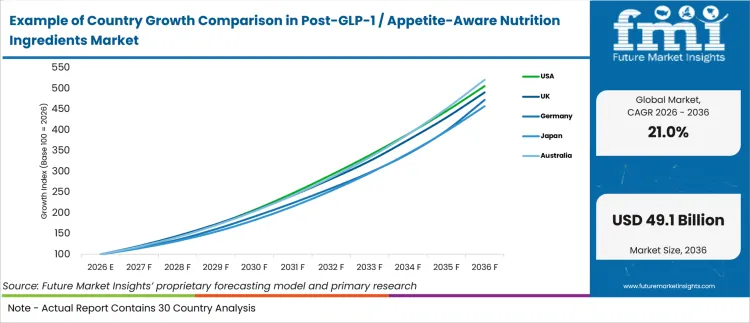
| Country | CAGR |
|---|---|
| Australia | 18.0% |
| USA | 17.6% |
| UK | 17.2% |
| Germany | 16.8% |
| Japan | 16.4% |
How do country-level CAGRs compare in the Post-GLP-1 / Appetite-Aware Nutrition Ingredients Market?
The countries span a 1.6 percentage-point range from Australia at 18.0% to Japan at 16.4%. Australia and the USA form the upper pair while the UK occupies a central position. Germany and Japan remain close behind. The distribution reflects access design and clinical eligibility more than revenue scale
- Australia combines private access with subsidy review that keeps price sensitivity visible.
- USA growth adds a Medicare access route beside established commercial nutrition channels.
- UK demand follows phased NHS primary-care capacity with mandated nutrition support services.
- Germany carries greater private-payment exposure under statutory rules for weight-regulation medicines nationally.
- Japan combines clinician oversight with post-market safety review for approved GLP-1 therapies.
Similar CAGRs therefore produce different launch economics because treatment access and channel structure vary. The full report provides country-level CAGR analysis across North America, Latin America, Europe, East Asia, South Asia, Oceania and the Middle East and Africa
Country-wise Analysis
- Australia combines substantial private GLP-1 access with broad retail nutrition channels that give formulators a visible test market for compact appetite-aware products before wider public reimbursement changes treatment economics and eligible demand nationally. The Australian post-GLP-1 / appetite-aware nutrition ingredients market is projected to grow at 18.0% CAGR through 2036 as an April 2026 PBS status page showed Wegovy listing arrangements had not commenced for reimbursed obesity treatment. Subsidy uncertainty keeps price sensitivity material for recurring nutrition purchases, so ingredient companies need nutrient-dense systems that can serve premium private demand and lower-cost retail formats if public access broadens across more patient groups.
- USA formulators can reach consumers through mass retail nutrition channels beside a Medicare route that CMS launched in July 2026 through its GLP-1 Bridge with a USD 50 copay for eligible Part D beneficiaries. Demand for post-GLP-1 / appetite-aware nutrition ingredients in the USA is forecast to rise at 17.6% CAGR over the assessment period as public access widens the treated population alongside established commercial prescribing channels. Eligibility and treatment persistence remain uneven despite that wider route, so protein and fortification systems gain commercial flexibility when they also fit mainstream weight-management products beyond therapy-linked ranges across national retail and pharmacy channels.
- UK commercial access combines private prescribing with an NHS pathway that deliberately phases tirzepatide treatment around primary-care capacity and clinical priority for higher-need patient groups receiving multidisciplinary weight-management support and dietary guidance. The UK post-GLP-1 / appetite-aware nutrition ingredients market is anticipated to advance at 17.2% CAGR by 2036 as NHS England stated in April 2026 that approximately 220,000 patients are targeted during three implementation years. Public access gives nutrition brands a structured clinical route yet commissioning capacity limits near-term reach, so ingredient providers need compact products that work across retail and supervised programmes without depending on one reimbursement pathway.
- Germany combines established nutrition manufacturing with reimbursement rules that leave obesity treatment more exposed to private payment, and the Federal Ministry of Health confirmed in December 2025 that statutory insurance generally excludes appetite suppressants and weight-regulation medicines. Germany is estimated to post 16.8% CAGR over the forecast period as private-pay treatment and mainstream weight-management channels sustain appetite-aware formulation activity across established food and supplement categories nationally. Private payment can shorten treatment persistence even with broad retail demand, so ingredient companies need economical protein and fortification systems that serve dedicated companion products plus mainstream ranges without relying on reimbursed therapy volume.
- Japan routes weight-management pharmacotherapy through medical supervision that keeps companion nutrition claims conservative and gives clinically aligned small-format products a clearer commercial entry route for users receiving specialist obesity care and follow-up. Clinically aligned nutrition can fit small portions and conservative claims around supervised care, but manufacturers still need tolerable formats that avoid stretching evidence around appetite control or treatment outcomes and channel selection. The Japanese post-GLP-1 / appetite-aware nutrition ingredients market is estimated to expand at 16.4% CAGR through 2036 while PMDA precaution revisions for semaglutide and tirzepatide in July 2025 keep post-market safety review visible across local product development.
Who are the notable companies in the Post-GLP-1 / Appetite-Aware Nutrition Ingredients Market?
Nestlé Health Science, Abbott, dsm-firmenich, Glanbia, Kerry, Danone, Herbalife and Arla Foods Ingredients are the notable companies profiled in this market
Competition spans upstream ingredient platforms and downstream nutrition formulators because each group influences specifications used for appetite-aware products. Ingredient platforms compete on protein density and premix flexibility alongside sensory support for compact formats. Finished nutrition brands show which ingredient combinations survive retail use and channel economics across repeat weight-management purchases. Comparable requirements also appear in sports nutrition where high nutrient loads remain practical in compact formats.
- Ingredient systems and formulation platforms include dsm-firmenich, Glanbia, Kerry and Arla Foods Ingredients with protein, premix and application capabilities.
- Specialized adult nutrition platforms include Nestlé Health Science and Abbott which translate weight-management needs into compact nutrition specifications and repeat-use formats.
- Consumer weight-management formulators include Danone and Herbalife which connect protein, fiber and micronutrient combinations with food or direct-selling channels.
Competitive Benchmarking: Post-GLP-1 / Appetite-Aware Nutrition Ingredients Market
| Company | Protein-Dense Formulation Depth | Fiber & Micronutrient Integration | Appetite-Aware Activation | Geographic Reach |
|---|---|---|---|---|
| Nestlé Health Science | High | High | High | Global nutrition portfolio |
| Abbott | High | High | Medium | Global nutrition business |
| dsm-firmenich | Medium | High | Medium | Global operations |
| Glanbia | High | High | High | Global ingredient customers |
| Kerry | Medium | Medium | High | Global food and nutrition reach |
| Danone | High | Medium | High | Global with direct evidence in USA |
| Herbalife | Medium | High | High | 95 markets |
| Arla Foods Ingredients | High | Medium | High | International ingredient sales |
Scoring basis: High protein depth requires documented concentrated-protein formats across several target applications while Medium requires one credible route. High integration requires documented fiber and micronutrient capability together while Medium covers one of those functions. High appetite-aware activation requires direct GLP-1 or weight-loss product activity while Medium reflects broader current weight-management capability. Geographic reach remains descriptive because regional presence does not itself prove deeper appetite-aware formulation capability.
Key Developments in the Post-GLP-1 / Appetite-Aware Nutrition Ingredients Market
- In April 2026, Arla Foods Ingredients announced high-protein nutrient-dense concepts for GLP-1 users including compact fermented shots and yogurt formats with digestive-support components.
- In August 2025, Danone announced OIKOS FUSION with 23 grams of complete protein and 5 grams of prebiotic fiber in a compact seven-fluid-ounce cultured dairy drink.
- In April 2025, Nestlé announced proprietary whey protein microgel technology and weight-management nutrition work that includes solutions for people using GLP-1 receptor agonists.
Key Players in the Post-GLP-1 / Appetite-Aware Nutrition Ingredients Market
Ingredient and Formulation Platforms
- dsm-firmenich
- Glanbia
- Kerry
- Arla Foods Ingredients
Specialized Adult Nutrition Platforms
- Nestlé Health Science
- Abbott
Consumer Weight-Management Formulators
- Danone
- Herbalife
Post-GLP-1 / Appetite-Aware Nutrition Ingredients Market – Report Scope
| Coverage field | Report scope |
|---|---|
| Market breakdown | By ingredient, application and region. |
| Quantitative Units | USD billion. |
| Market Definition | Ingredients and nutrient systems used in appetite-aware foods, beverages, supplements and meal replacements for active GLP-1 use or wider weight-management nutrition. |
| Regions Covered | North America, Latin America, Europe, East Asia, South Asia and Pacific, and Middle East and Africa. |
| Countries Covered | Australia, USA, UK, Germany, Japan, and 20+ countries included in the full report. |
| Key Companies Profiled | Nestlé Health Science, Abbott, dsm-firmenich, Glanbia, Kerry, Danone, Herbalife, Arla Foods Ingredients. |
| Forecast Period | 2026 to 2036. |
| Approach | Primary and secondary research with market triangulation. |
Post-GLP-1 / Appetite-Aware Nutrition Ingredients Market – Research Methodology
| Method | Approach |
|---|---|
| Primary Research | FMI analysts gathered input from manufacturers, service providers, technology developers, distributors, end users, procurement teams, and subject-matter experts. Interviews examined purchasing decisions, product or service evaluation, adoption barriers, approval requirements, pricing considerations, and expectations for technical or commercial support. Respondents were also asked what evidence is required before a trial, pilot, or initial order develops into regular purchasing. |
| Desk Research | Desk research covered government statistics, regulatory publications, trade data, industry associations, technical literature, standards, company filings, product information, and official corporate announcements. Sources were reviewed for relevance, publication date, geographic coverage, and consistency with the defined market scope. Claims relating to performance, applications, approvals, capacity, investment, and commercial activity were retained only when supported by credible public evidence. |
| Market Sizing and Forecasting | The market model combined the baseline value with historical performance, segment structure, pricing and volume indicators, adoption levels, company participation, and country-level demand conditions. Forecast assumptions considered economic activity, investment trends, regulatory developments, technology adoption, purchasing cycles, supply availability, and barriers to wider market use. Segment and regional estimates were reconciled before the final market total was calculated. |
| Data Validation | Estimates were checked against multiple independent indicators, including public data, company activity, trade patterns, industry developments, and findings from primary interviews. Validation also tested whether products, services, applications, and company revenues fell within the defined market boundaries. Adjacent categories, unsupported claims, overlapping revenues, and activities without direct market relevance were excluded to reduce double counting and maintain consistency across segments and countries. |
Post-GLP-1 / Appetite-Aware Nutrition Ingredients Market by Segments
Post-GLP-1 / Appetite-Aware Nutrition Ingredients Market segmented by Ingredient:
- High-Protein
- Fiber
- Micronutrients
- Satiety Actives
Post-GLP-1 / Appetite-Aware Nutrition Ingredients Market segmented by Application:
- Functional F&B
- Supplements
- Meal Replacement
Post-GLP-1 / Appetite-Aware Nutrition Ingredients Market by Region:
- North America
- United States
- Canada
- Latin America
- Brazil
- Mexico
- Chile
- Rest of Latin America
- Western Europe
- Germany
- United Kingdom
- Italy
- Spain
- France
- Nordics
- Benelux
- Rest of Western Europe
- Eastern Europe
- Russia
- Poland
- Hungary
- Balkan and Baltic States
- Rest of Eastern Europe
- East Asia
- China
- Japan
- South Korea
- South Asia and Pacific
- India
- ASEAN
- Australia and New Zealand
- Rest of South Asia and Pacific
- Middle East and Africa
- Kingdom of Saudi Arabia
- Other GCC Countries
- Türkiye
- South Africa
- Other African Union Countries
- Rest of Middle East and Africa
Research
- The Obesity Society. (2025, May 30). Nutritional Priorities to Support GLP-1 Therapy for Obesity.
- Australian Government Department of Health, Disability and Ageing. (2026, March 17). Pharmaceutical Benefits Advisory Committee (PBAC) advice on equitable access to GLP-1 obesity treatments.
- dsm-firmenich. (2026, February 20). The year in review – dsm-firmenich Integrated Annual Report 2025.
- Ingredion. (2026, January 15). The GLP-1 effect: Reformulating for high-protein, nutrient-packed demand.
- World Health Organization. (2025, December 2). Obesity: GLP-1 therapies.
- Kerry. (2025, June 4). GLP-1 users report improved quality of life & better digestive comfort when consuming Kerry Group’s BC30™ Probiotic.
- BENEO. (2025, July 13). Weight management: Addressing consumer demands with natural solutions.
- Australian Government Department of Health, Disability and Ageing. (2026, March 31). SEMAGLUTIDE.
- Centers for Medicare & Medicaid Services. (2026, July 1). CMS Launches Medicare GLP-1 Bridge, Expanding Access to GLP-1 Medications.
- NHS England. (2026, April 2). Interim commissioning guidance.
- Federal Ministry of Health. (2025, December 4). Zuzahlung und Erstattung von Arzneimitteln.
- Pharmaceuticals and Medical Devices Agency. (2025, July 30). Revisions of PRECAUTIONS (FY2025).
- Arla Foods Ingredients. (2026, April 15). Arla Foods Ingredients targets GLP-1 companion nutrition at Vitafoods Europe.
- Danone North America. (2025, August 11). OIKOS® Launches First-of-Its-Kind Cultured Dairy Drink Featuring A Patented Blend of Nutrients Designed to Help Build & Retain Muscle Mass During Weight Loss.
- Nestlé. (2025, April 15). Nestlé’s protein expertise delivers weight management innovation.
- Abbott. (2025, November 13). Abbott Launches New and Advanced Ensure Diabetes Care, A Clinically Proven Formula to Help Manage Blood Sugar.
- Herbalife. (2025, May 2). GLP-1 Weight Loss Medicines & Your Nutrition Needs.
- Glanbia Nutritionals. (2026, February 19). Exploring nutrient density in the GLP-1 era.
This bibliography is provided for reader reference and is not exhaustive. The full report contains the complete reference list and detailed citations
This Report Answers
- How large is the post-GLP-1 / appetite-aware nutrition ingredients market in 2026 and 2036?
- Why does reduced food intake change formulation requirements for appetite-aware nutrition products?
- Why does high-protein account for 46.2% of ingredient revenue in 2026?
- Why does functional F&B represent 45.5% of application revenue in 2026?
- Which factors limit repeat demand for products tied closely to active GLP-1 therapy?
- How can post-treatment weight maintenance extend the addressable ingredient opportunity?
- How do the five profiled countries differ despite a narrow range of forecast CAGRs?
- Which companies shape upstream formulation capability and downstream appetite-aware product specifications?
- What buyer criteria distinguish protein depth, nutrient integration and appetite-aware activation across competitors?
Frequently Asked Questions
How big is the Post-GLP-1 / Appetite-Aware Nutrition Ingredients Market in 2026?
The post-GLP-1 / appetite-aware nutrition ingredients market is expected to be valued at USD 7.3 billion in 2026 and reach USD 49.1 billion by 2036. Smaller eating occasions increase the need for compact protein and nutrient systems that preserve nutritional coverage without requiring portions
What is the CAGR of the Post-GLP-1 / Appetite-Aware Nutrition Ingredients Market from 2026 to 2036?
The post-GLP-1 / appetite-aware nutrition ingredients market is projected to grow at 21.0% CAGR between 2026 and 2036. Reduced food intake raises nutrient-density requirements across active-treatment products and broader weight-management formulations intended for repeat everyday use
Which ingredient segment is projected to account for 46.2% of the Post-GLP-1 / Appetite-Aware Nutrition Ingredients Market?
The high-protein segment is projected to account for 46.2% of ingredient revenue in 2026 within the post-GLP-1 / appetite-aware nutrition ingredients market. Protein concentration addresses muscle-support needs when reduced appetite limits total eating volume across daily meals and snack occasions
Which application segment is projected to account for 45.5% of the Post-GLP-1 / Appetite-Aware Nutrition Ingredients Market?
The functional F&B segment is estimated to capture 45.5% of application revenue in 2026 within the post-GLP-1 / appetite-aware nutrition ingredients market. Familiar foods and drinks can deliver concentrated nutrition without adding another separate dosing routine for consumers managing reduced appetite
Which companies are active in the Post-GLP-1 / Appetite-Aware Nutrition Ingredients Market?
Key companies in the post-GLP-1 / appetite-aware nutrition ingredients market include Nestlé Health Science, Abbott, dsm-firmenich, Glanbia, Kerry, Danone, Herbalife and Arla Foods Ingredients. Their roles span ingredient systems and specialized nutrition alongside consumer formulations that translate reduced-appetite needs into practical products
Preview the report firsthand – request a free sample
Get Sample
Get the brochure for pricing and purchase details
Get PDF
Table of Content
- Key Takeaways
- Market Size and CAGR
- Top Growth Driver
- Fastest Growing Segment
- Leading Region
- Key Companies
- Emerging Opportunities
- Executive Summary
- Global Market Outlook
- Demand-side Trends
- Supply-side Trends
- Technology Roadmap Analysis
- Analysis and Recommendations
- Analyst Perspective (What is happening? Why now? What should investors know?)
- Key Questions Answered
- How large is the market?
- What is the CAGR?
- What are key trends?
- Which region dominates?
- Who are the leaders?
- Market Overview
- Market Coverage / Taxonomy
- Market Definition / Scope / Limitations
- Research Methodology
- Chapter Orientation
- Analytical Lens and Working Hypotheses
- Market Structure, Signals, and Trend Drivers
- Benchmarking and Cross-market Comparability
- Market Sizing, Forecasting, and Opportunity Mapping
- Research Design and Evidence Framework
- Desk Research Programme (Secondary Evidence)
- Expert Input and Fieldwork (Primary Evidence)
- Tooling, Models, and Reference Databases
- Data Engineering and Model Build
- Quality Assurance and Audit Trail
- Market Background
- Market Dynamics (Drivers, Restraints, Opportunity, Trends)
- Scenario Forecast (Optimistic, Likely, Conservative)
- Impact Analysis
- AI Impact
- Sustainability Impact
- Regulatory Impact
- Technology Impact
- Consumer / Buyer Analysis
- Purchase Drivers
- Adoption Barriers
- Buyer Journey
- Opportunity Map Analysis
- Product Life Cycle Analysis
- Supply Chain Analysis
- Investment Feasibility Matrix
- Value Chain Analysis
- PESTLE and Porter’s Analysis
- Regulatory Landscape
- Regional Parent Market Outlook
- Production and Consumption Statistics
- Import and Export Statistics
- Global Market Analysis and Forecast, 2021 to 2036
- Historical Market Size Value (USD Billion) Analysis, 2021 to 2025
- Current and Future Market Size Value (USD Billion) Projections, 2026 to 2036
- Y-o-Y Growth Trend Analysis
- Absolute $ Opportunity Analysis
- Global Market Pricing Analysis, 2021 to 2036
- Global Market Analysis and Forecast, By Ingredient, 2021 to 2036
- Introduction / Key Findings
- Historical Market Size Value (USD Billion) Analysis By Ingredient, 2021 to 2025
- Current and Future Market Size Value (USD Billion) Analysis and Forecast By Ingredient, 2026 to 2036
- High-Protein
- Fiber
- Micronutrients
- Satiety Actives
- Y-o-Y Growth Trend Analysis By Ingredient, 2021 to 2025
- Absolute $ Opportunity Analysis By Ingredient, 2026 to 2036
- Global Market Analysis and Forecast, By Application, 2021 to 2036
- Introduction / Key Findings
- Historical Market Size Value (USD Billion) Analysis By Application, 2021 to 2025
- Current and Future Market Size Value (USD Billion) Analysis and Forecast By Application, 2026 to 2036
- Functional F&B
- Supplements
- Meal Replacement
- Y-o-Y Growth Trend Analysis By Application, 2021 to 2025
- Absolute $ Opportunity Analysis By Application, 2026 to 2036
- Global Market Analysis and Forecast, By Region, 2021 to 2036
- Introduction
- Historical Market Size Value (USD Billion) Analysis By Region, 2021 to 2025
- Current Market Size Value (USD Billion) Analysis and Forecast By Region, 2026 to 2036
- North America
- Latin America
- Western Europe
- Eastern Europe
- East Asia
- South Asia and Pacific
- Middle East & Africa
- Market Attractiveness Analysis By Region
- North America Market Analysis and Forecast, By Country, 2021 to 2036
- Historical Market Size Value (USD Billion) Trend Analysis By Market Taxonomy, 2021 to 2025
- Market Size Value (USD Billion) Forecast By Market Taxonomy, 2026 to 2036
- By Country
- USA
- Canada
- By Ingredient
- By Application
- By Country
- Market Attractiveness Analysis
- By Country
- By Ingredient
- By Application
- Key Takeaways
- Latin America Market Analysis and Forecast, By Country
- Historical Market Size Value (USD Billion) Trend Analysis By Market Taxonomy, 2021 to 2025
- Market Size Value (USD Billion) Forecast By Market Taxonomy, 2026 to 2036
- By Country
- Brazil
- Mexico
- Chile
- Rest of Latin America
- By Ingredient
- By Application
- By Country
- Market Attractiveness Analysis
- By Country
- By Ingredient
- By Application
- Key Takeaways
- Western Europe Market Analysis and Forecast, By Country
- Historical Market Size Value (USD Billion) Trend Analysis By Market Taxonomy, 2021 to 2025
- Market Size Value (USD Billion) Forecast By Market Taxonomy, 2026 to 2036
- By Country
- Germany
- UK
- Italy
- Spain
- France
- Nordic
- BENELUX
- Rest of Western Europe
- By Ingredient
- By Application
- By Country
- Market Attractiveness Analysis
- By Country
- By Ingredient
- By Application
- Key Takeaways
- Eastern Europe Market Analysis and Forecast, By Country
- Historical Market Size Value (USD Billion) Trend Analysis By Market Taxonomy, 2021 to 2025
- Market Size Value (USD Billion) Forecast By Market Taxonomy, 2026 to 2036
- By Country
- Russia
- Poland
- Hungary
- Balkan & Baltic
- Rest of Eastern Europe
- By Ingredient
- By Application
- By Country
- Market Attractiveness Analysis
- By Country
- By Ingredient
- By Application
- Key Takeaways
- East Asia Market Analysis and Forecast, By Country
- Historical Market Size Value (USD Billion) Trend Analysis By Market Taxonomy, 2021 to 2025
- Market Size Value (USD Billion) Forecast By Market Taxonomy, 2026 to 2036
- By Country
- China
- Japan
- South Korea
- By Ingredient
- By Application
- By Country
- Market Attractiveness Analysis
- By Country
- By Ingredient
- By Application
- Key Takeaways
- South Asia and Pacific Market Analysis and Forecast, By Country
- Historical Market Size Value (USD Billion) Trend Analysis By Market Taxonomy, 2021 to 2025
- Market Size Value (USD Billion) Forecast By Market Taxonomy, 2026 to 2036
- By Country
- India
- ASEAN
- Australia & New Zealand
- Rest of South Asia and Pacific
- By Ingredient
- By Application
- By Country
- Market Attractiveness Analysis
- By Country
- By Ingredient
- By Application
- Key Takeaways
- Middle East & Africa Market Analysis and Forecast, By Country
- Historical Market Size Value (USD Billion) Trend Analysis By Market Taxonomy, 2021 to 2025
- Market Size Value (USD Billion) Forecast By Market Taxonomy, 2026 to 2036
- By Country
- Kingdom of Saudi Arabia
- Other GCC Countries
- Türkiye
- South Africa
- Other African Union
- Rest of Middle East & Africa
- By Ingredient
- By Application
- By Country
- Market Attractiveness Analysis
- By Country
- By Ingredient
- By Application
- Key Takeaways
- Key Countries Market Analysis
- USA
- Pricing Analysis
- Market Share Analysis, 2025
- By Ingredient
- By Application
- Canada
- Pricing Analysis
- Market Share Analysis, 2025
- By Ingredient
- By Application
- Mexico
- Pricing Analysis
- Market Share Analysis, 2025
- By Ingredient
- By Application
- Brazil
- Pricing Analysis
- Market Share Analysis, 2025
- By Ingredient
- By Application
- Chile
- Pricing Analysis
- Market Share Analysis, 2025
- By Ingredient
- By Application
- Germany
- Pricing Analysis
- Market Share Analysis, 2025
- By Ingredient
- By Application
- UK
- Pricing Analysis
- Market Share Analysis, 2025
- By Ingredient
- By Application
- Italy
- Pricing Analysis
- Market Share Analysis, 2025
- By Ingredient
- By Application
- Spain
- Pricing Analysis
- Market Share Analysis, 2025
- By Ingredient
- By Application
- France
- Pricing Analysis
- Market Share Analysis, 2025
- By Ingredient
- By Application
- India
- Pricing Analysis
- Market Share Analysis, 2025
- By Ingredient
- By Application
- ASEAN
- Pricing Analysis
- Market Share Analysis, 2025
- By Ingredient
- By Application
- Australia & New Zealand
- Pricing Analysis
- Market Share Analysis, 2025
- By Ingredient
- By Application
- China
- Pricing Analysis
- Market Share Analysis, 2025
- By Ingredient
- By Application
- Japan
- Pricing Analysis
- Market Share Analysis, 2025
- By Ingredient
- By Application
- South Korea
- Pricing Analysis
- Market Share Analysis, 2025
- By Ingredient
- By Application
- Russia
- Pricing Analysis
- Market Share Analysis, 2025
- By Ingredient
- By Application
- Poland
- Pricing Analysis
- Market Share Analysis, 2025
- By Ingredient
- By Application
- Hungary
- Pricing Analysis
- Market Share Analysis, 2025
- By Ingredient
- By Application
- Kingdom of Saudi Arabia
- Pricing Analysis
- Market Share Analysis, 2025
- By Ingredient
- By Application
- Türkiye
- Pricing Analysis
- Market Share Analysis, 2025
- By Ingredient
- By Application
- South Africa
- Pricing Analysis
- Market Share Analysis, 2025
- By Ingredient
- By Application
- USA
- Market Structure Analysis
- Competition Dashboard
- Competition Benchmarking
- Market Share Analysis of Top Players
- By Regional
- By Ingredient
- By Application
- Emerging Startups
- Innovation Benchmarking
- Competition Analysis
- Competition Deep Dive
- Nestlé Health Science
- Overview
- Product Portfolio
- Profitability by Market Segments
- Sales Footprint
- Strategy Overview
- Marketing Strategy
- Product Strategy
- Channel Strategy
- Abbott
- dsm-firmenich
- Glanbia
- Kerry
- Danone
- Herbalife
- Nestlé Health Science
- Case Studies
- Success Stories
- Recent Developments
- Competition Deep Dive
- Assumptions & Acronyms Used
- Table 1: Global Market Value (USD Billion) Forecast by Region, 2021 to 2036
- Table 2: Global Market Value (USD Billion) Forecast by Ingredient, 2021 to 2036
- Table 3: Global Market Value (USD Billion) Forecast by Application, 2021 to 2036
- Table 4: North America Market Value (USD Billion) Forecast by Country, 2021 to 2036
- Table 5: North America Market Value (USD Billion) Forecast by Ingredient, 2021 to 2036
- Table 6: North America Market Value (USD Billion) Forecast by Application, 2021 to 2036
- Table 7: Latin America Market Value (USD Billion) Forecast by Country, 2021 to 2036
- Table 8: Latin America Market Value (USD Billion) Forecast by Ingredient, 2021 to 2036
- Table 9: Latin America Market Value (USD Billion) Forecast by Application, 2021 to 2036
- Table 10: Western Europe Market Value (USD Billion) Forecast by Country, 2021 to 2036
- Table 11: Western Europe Market Value (USD Billion) Forecast by Ingredient, 2021 to 2036
- Table 12: Western Europe Market Value (USD Billion) Forecast by Application, 2021 to 2036
- Table 13: Eastern Europe Market Value (USD Billion) Forecast by Country, 2021 to 2036
- Table 14: Eastern Europe Market Value (USD Billion) Forecast by Ingredient, 2021 to 2036
- Table 15: Eastern Europe Market Value (USD Billion) Forecast by Application, 2021 to 2036
- Table 16: East Asia Market Value (USD Billion) Forecast by Country, 2021 to 2036
- Table 17: East Asia Market Value (USD Billion) Forecast by Ingredient, 2021 to 2036
- Table 18: East Asia Market Value (USD Billion) Forecast by Application, 2021 to 2036
- Table 19: South Asia and Pacific Market Value (USD Billion) Forecast by Country, 2021 to 2036
- Table 20: South Asia and Pacific Market Value (USD Billion) Forecast by Ingredient, 2021 to 2036
- Table 21: South Asia and Pacific Market Value (USD Billion) Forecast by Application, 2021 to 2036
- Table 22: Middle East & Africa Market Value (USD Billion) Forecast by Country, 2021 to 2036
- Table 23: Middle East & Africa Market Value (USD Billion) Forecast by Ingredient, 2021 to 2036
- Table 24: Middle East & Africa Market Value (USD Billion) Forecast by Application, 2021 to 2036
- Figure 1: Global Market Pricing Analysis
- Figure 2: Global Market Value (USD Billion) Forecast 2021-2036
- Figure 3: Global Market Value Share and BPS Analysis by Ingredient, 2026 and 2036
- Figure 4: Global Market Y-o-Y Growth Comparison by Ingredient, 2026-2036
- Figure 5: Global Market Attractiveness Analysis by Ingredient
- Figure 6: Global Market Value Share and BPS Analysis by Application, 2026 and 2036
- Figure 7: Global Market Y-o-Y Growth Comparison by Application, 2026-2036
- Figure 8: Global Market Attractiveness Analysis by Application
- Figure 9: Global Market Value (USD Billion) Share and BPS Analysis by Region, 2026 and 2036
- Figure 10: Global Market Y-o-Y Growth Comparison by Region, 2026-2036
- Figure 11: Global Market Attractiveness Analysis by Region
- Figure 12: North America Market Incremental Dollar Opportunity, 2026-2036
- Figure 13: Latin America Market Incremental Dollar Opportunity, 2026-2036
- Figure 14: Western Europe Market Incremental Dollar Opportunity, 2026-2036
- Figure 15: Eastern Europe Market Incremental Dollar Opportunity, 2026-2036
- Figure 16: East Asia Market Incremental Dollar Opportunity, 2026-2036
- Figure 17: South Asia and Pacific Market Incremental Dollar Opportunity, 2026-2036
- Figure 18: Middle East & Africa Market Incremental Dollar Opportunity, 2026-2036
- Figure 19: North America Market Value Share and BPS Analysis by Country, 2026 and 2036
- Figure 20: North America Market Value Share and BPS Analysis by Ingredient, 2026 and 2036
- Figure 21: North America Market Y-o-Y Growth Comparison by Ingredient, 2026-2036
- Figure 22: North America Market Attractiveness Analysis by Ingredient
- Figure 23: North America Market Value Share and BPS Analysis by Application, 2026 and 2036
- Figure 24: North America Market Y-o-Y Growth Comparison by Application, 2026-2036
- Figure 25: North America Market Attractiveness Analysis by Application
- Figure 26: Latin America Market Value Share and BPS Analysis by Country, 2026 and 2036
- Figure 27: Latin America Market Value Share and BPS Analysis by Ingredient, 2026 and 2036
- Figure 28: Latin America Market Y-o-Y Growth Comparison by Ingredient, 2026-2036
- Figure 29: Latin America Market Attractiveness Analysis by Ingredient
- Figure 30: Latin America Market Value Share and BPS Analysis by Application, 2026 and 2036
- Figure 31: Latin America Market Y-o-Y Growth Comparison by Application, 2026-2036
- Figure 32: Latin America Market Attractiveness Analysis by Application
- Figure 33: Western Europe Market Value Share and BPS Analysis by Country, 2026 and 2036
- Figure 34: Western Europe Market Value Share and BPS Analysis by Ingredient, 2026 and 2036
- Figure 35: Western Europe Market Y-o-Y Growth Comparison by Ingredient, 2026-2036
- Figure 36: Western Europe Market Attractiveness Analysis by Ingredient
- Figure 37: Western Europe Market Value Share and BPS Analysis by Application, 2026 and 2036
- Figure 38: Western Europe Market Y-o-Y Growth Comparison by Application, 2026-2036
- Figure 39: Western Europe Market Attractiveness Analysis by Application
- Figure 40: Eastern Europe Market Value Share and BPS Analysis by Country, 2026 and 2036
- Figure 41: Eastern Europe Market Value Share and BPS Analysis by Ingredient, 2026 and 2036
- Figure 42: Eastern Europe Market Y-o-Y Growth Comparison by Ingredient, 2026-2036
- Figure 43: Eastern Europe Market Attractiveness Analysis by Ingredient
- Figure 44: Eastern Europe Market Value Share and BPS Analysis by Application, 2026 and 2036
- Figure 45: Eastern Europe Market Y-o-Y Growth Comparison by Application, 2026-2036
- Figure 46: Eastern Europe Market Attractiveness Analysis by Application
- Figure 47: East Asia Market Value Share and BPS Analysis by Country, 2026 and 2036
- Figure 48: East Asia Market Value Share and BPS Analysis by Ingredient, 2026 and 2036
- Figure 49: East Asia Market Y-o-Y Growth Comparison by Ingredient, 2026-2036
- Figure 50: East Asia Market Attractiveness Analysis by Ingredient
- Figure 51: East Asia Market Value Share and BPS Analysis by Application, 2026 and 2036
- Figure 52: East Asia Market Y-o-Y Growth Comparison by Application, 2026-2036
- Figure 53: East Asia Market Attractiveness Analysis by Application
- Figure 54: South Asia and Pacific Market Value Share and BPS Analysis by Country, 2026 and 2036
- Figure 55: South Asia and Pacific Market Value Share and BPS Analysis by Ingredient, 2026 and 2036
- Figure 56: South Asia and Pacific Market Y-o-Y Growth Comparison by Ingredient, 2026-2036
- Figure 57: South Asia and Pacific Market Attractiveness Analysis by Ingredient
- Figure 58: South Asia and Pacific Market Value Share and BPS Analysis by Application, 2026 and 2036
- Figure 59: South Asia and Pacific Market Y-o-Y Growth Comparison by Application, 2026-2036
- Figure 60: South Asia and Pacific Market Attractiveness Analysis by Application
- Figure 61: Middle East & Africa Market Value Share and BPS Analysis by Country, 2026 and 2036
- Figure 62: Middle East & Africa Market Value Share and BPS Analysis by Ingredient, 2026 and 2036
- Figure 63: Middle East & Africa Market Y-o-Y Growth Comparison by Ingredient, 2026-2036
- Figure 64: Middle East & Africa Market Attractiveness Analysis by Ingredient
- Figure 65: Middle East & Africa Market Value Share and BPS Analysis by Application, 2026 and 2036
- Figure 66: Middle East & Africa Market Y-o-Y Growth Comparison by Application, 2026-2036
- Figure 67: Middle East & Africa Market Attractiveness Analysis by Application
- Figure 68: Global Market – Tier Structure Analysis
- Figure 69: Global Market – Company Share Analysis
