


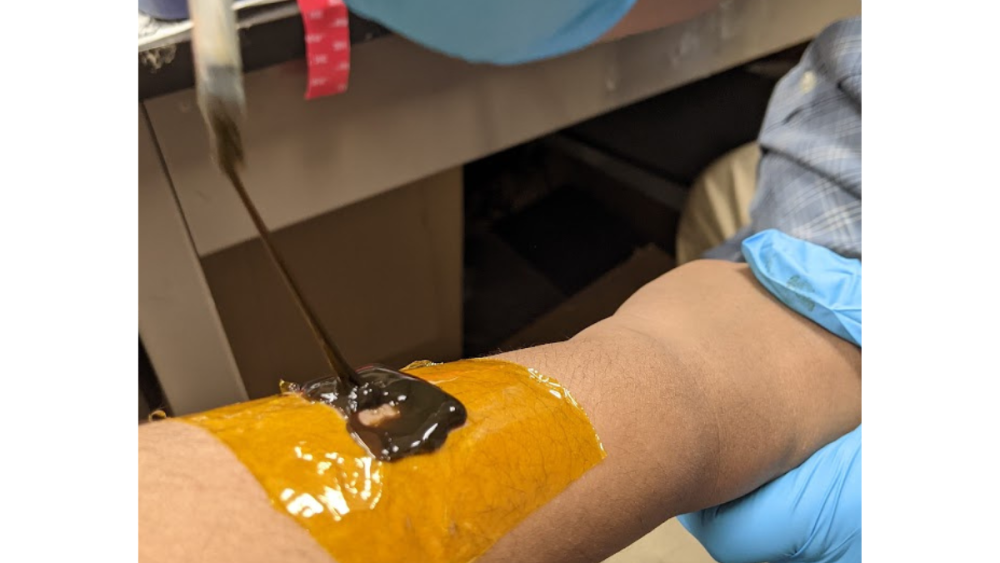
Pa. — Wearable health monitors can track heart rate, muscle activity, brain signals and other physiological measurements, but many devices are designed to capture only one type of signal at a time. Recording multiple signals simultaneously is more difficult because sensors must maintain reliable contact with the body even through hair, sweat and everyday movement
A team of researchers led by Penn State developed an ultrasoft, adhesive and printable hydrogel — a soft, water-rich material that mimics the flexibility of living tissue — designed to conform to dry, wet, moving and hairy skin. In proof-of-concept experiments, the material simultaneously recorded different combinations of heart, eye, brain and muscle activity, changes in sweating and body movement, demonstrating its potential as a platform for future wearable health-monitoring technologies. The researchers tested the platform for potential applications including monitoring physiological responses to stress and tracking brain, muscle and movement signals that could one day help assess nerve rehabilitation. The work was published in Science Advances.
The researchers call the material RTLR gel, a name that refers to its “radically tuned” setting time and the two forms of graphene it contains. Graphene is a single-atom-thick form of graphite. By adjusting the mixture’s pH, the team can control how quickly it changes from a liquid into a gel. That gives researchers more control over how the material is applied, whether it is deposited directly onto the skin or shaped with a 3D printer. The gel contains two forms of graphene: laser-induced graphene, which has a porous structure, and reduced graphene oxide, a chemically modified form of graphene that helps conduct electrical signals. Together, they help the gel remain soft, stretchable and conductive.
“We have shown the feasibility of printing, but we can improve the printing resolution,” said Huanyu “Larry” Cheng, James L. Henderson Jr. Memorial Professor of Engineering Science and Mechanics and co-corresponding author of the study. “That can help us integrate multiple sensors into a single patch, making the technology more compact and versatile.”
Abu Musa Abdullah, a postdoctoral researcher at Drexel University who earned a doctorate in engineering science and mechanics from Penn State, is co-first and co-corresponding author of the study
“Skin is a dynamic part of the body,” Abdullah said. “It sweats, it can have different motions and it can be hairy, so we wanted to design a hydrogel that can be used for all of these conditions.”
Existing wearable electrodes often require trade-offs, Abdullah said. A material that is too stiff may not follow the contours of the skin, while a very soft material may lack durability. Adhesion also must be balanced: Too little can allow the electrode to shift or detach, while excessive adhesion can make removal uncomfortable and potentially damage the skin. To better strike a balance between flexibility and adhesion, the team developed several formulations of the hydrogel, each with different properties.
In laboratory tests, one version of the RTLR gel was extremely soft and flexible. It was softer than human skin and could stretch to more than 80 times its original length before breaking. The gel also continued to stick well to pig skin when the surface was wet
In separate electrical tests, the RTLR electrodes made better contact with the skin than commercial gel electrodes. That lower electrical resistance where the electrode meets the skin can help the system capture clearer physiological signals, including heart, brain and sweat-related activity
In one test, researchers applied the RTLR gel to a participant’s chest to evaluate its performance through body hair. The RTLR gel formed a much better electrical connection with the skin than the commercial electrodes. It also recorded heart signals more reliably during arm and chest movements, with less interference from motion. In a separate long-term test, the researchers continuously monitored heart signals with the RTLR gel over 11 hours, finding that it maintained low electrical resistance with the skin and high signal quality. The researchers also demonstrated stable heart-signal recording in the presence of artificial sweat.
“Gelation time is important,” said Fatema Tuz Zohra, a doctoral candidate in engineering science and mechanics at Penn State and co-first author of the study. “When you put the gel into a syringe for 3D printing or on-skin printing, that gelation time determines how much time you have to print it before it solidifies.”
Unlike conventional prefabricated electrodes, the printable material can be deposited directly onto the skin in customized shapes, allowing sensors to be positioned where they are needed while maintaining close contact with the body’s surface
In supplemental demonstrations, the gel was repeatedly attached and removed 25 times without visible residue. Gentle pressure helped it make contact through hair, and the researchers used aloe vera moisturizer and warm water to remove it from the scalp
To explore its potential for stress monitoring, the researchers measured electrodermal activity, or changes in the skin’s electrical properties caused by sweating, from nine healthy participants on two separate days. During each test, participants listened to sounds ranging from low to high frequencies
A machine-learning model analyzed patterns in the sweating-related measurements and classified the sounds into low-, middle- and high-frequency groups with an accuracy of 82.61%. The researchers also compared the measured responses with participants’ own assessments. The proof-of-concept results suggest that patterns in these physiological measurements could eventually help wearable systems distinguish different responses to stress-related stimuli, although larger studies would be needed to explore their use in health monitoring.
In another demonstration involving one volunteer with arachnophobia, electrodes on the eyelid, palm and wrist simultaneously recorded eye movement, changes related to sweating and heart activity. After the participant viewed a video of a spider, the researchers observed increased blinking, sweating-related activity and heart rate
“Heart rate, sweating and even blinking can be related,” Abdullah said. “That’s why we focused on concurrent monitoring.”
The researchers also conducted a ball-squeezing experiment intended as a model for future nerve-rehabilitation monitoring. A participant squeezed the ball normally and then repeated the exercise with index-finger movement artificially restricted using tape and a pen. Measurements of brain activity, muscle activity and finger movement differed between the unrestricted and simulated impaired conditions
The experiment did not involve a person with a nerve injury or measure actual nerve recovery. The researchers said clinical studies will be needed to determine whether the system can eventually help monitor patients during rehabilitation
Cheng said the team also plans to improve the material’s stability and adhesion in wet, changing environments while refining the printing process. Those advances could eventually support more compact wearable systems, implantable or injectable devices and personalized health monitoring, although those applications were not demonstrated in the current study
Along with Cheng, Abdullah and Zohra, other Penn State authors on the paper include Yangbo Yuan, doctoral student in engineering science and mechanics; Wanqing Zhang, doctoral student in engineering science and mechanics; Kazi Safowan Shahed, doctoral student in industrial and manufacturing engineering; Md. Abu Sayeed Biswas, doctoral student in engineering science and mechanics; Bowen Li, assistant professor of engineering at Penn State Harrisburg; Xiaojun Lian, associate professor of biology and biomedical engineering; and Su Yan, associate research professor of biomedical engineering. A full list of authors and their affiliations is available in the paper.
This work was supported by the U.S. National Science Foundation (NSF) under award numbers 2309323, 2319139 and 2243979; and the National Institutes of Health’s National Institute of Biomedical Imaging and Bioengineering under award number R21EB030140. The content is solely the responsibility of the authors and does not necessarily represent the official views of NSF or the National Institutes of Health
At Penn State, researchers are solving real problems that impact the health, safety and quality of life of people across the commonwealth, the nation and around the world
For decades, federal support for research has fueled innovation that makes our country safer, our industries more competitive and our economy stronger. Recent federal funding cuts threaten this progress
Learn more about the implications of federal funding cuts to our future atResearch or Regress
Last Updated August 14, 2026
Contact
- jco11@psu.edu
- Cell Phone: 814-865-0285
