


Getting your Trinity Audio player ready…
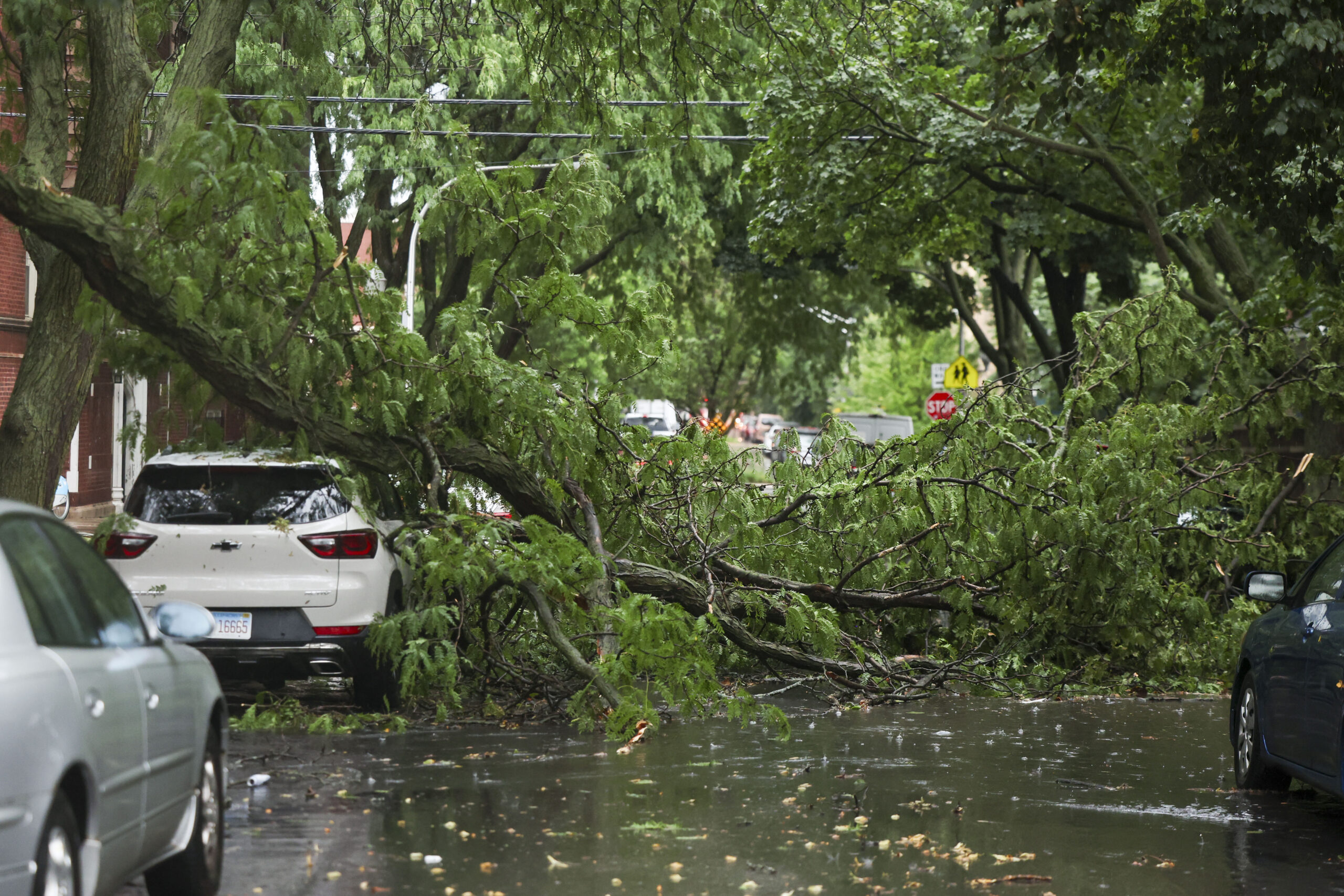
Even a minuscule, 0.03% increase in Chicago’s tree canopy each year could save the lives of more than 100 residents citywide by offering relief from extreme heat, a recent study found. But that has to happen while keeping current mature trees alive, researchers say, as increasingly intense severe storms like last week’s knock them down, uproot them and fling away their branches
The research from Northwestern University also found that yearly increases in tree canopy cover in Chicago neighborhoods were associated with lower death rates and a reduced risk of dying from heart, lung, mental health and some musculoskeletal conditions
For context, the city had almost 4 million trees in the most recent tree census conducted by the Morton Arboretum in 2020, averaging 27 trees per acre across its 150,000 acres. Ten years earlier, the U.S. Forest Service counted 3.6 million
Between the 2010 and 2020 tree census, however, Chicago saw a decline in its tree canopy cover from 19% to 16%, largely due to the loss of mature ash trees. Canopy refers to upper branches and leaves that cover a portion of the ground, not number of trees
“If we continuously strive to better that (canopy), that’s when you actually see an associated reduction in mortality,” said Harrison Garcia, a medical student at Northwestern’s Feinberg School of Medicine and lead author of the study, which was published Aug. 5 in the scientific journal GeoHealth
“But even more dramatically, if we choose to do nothing and let climate change continue to wreak havoc on the canopy — as we’ve seen it’s declined over the past decade — then the risk of mortality increasing, especially in the hottest neighborhoods, in the other direction is so much more dramatic than any of the gains that we would see with investment,” Garcia said
Warming global temperatures and climate change from human activities like fossil fuel burning have increased Chicago’s average summer temperatures by 1.9 degrees since 1970 as Midwest summers become more humid. Average lows on summer nights have increased by at least 2.5 degrees in that same time
Just this summer, successive heat waves in late June and early to mid-July pushed indices, a combination of temperatures and humidity, to over 100 degrees for several days. At least 12 people have died in Cook County this year from heat-related causes as of mid-August. Nine of these deaths occurred in Chicago, specifically on the South and West sides. More people are killed and hospitalized during heat waves than any other extreme weather event, experts say
Trees can cool down cities, where asphalt and concrete absorb heat, by blocking direct sunlight and releasing water vapor through their leaves. Because of its buildings and limited green spaces, Chicago has the potential to be an average of 8.71 degrees hotter on a given day, particularly when temperatures are already high
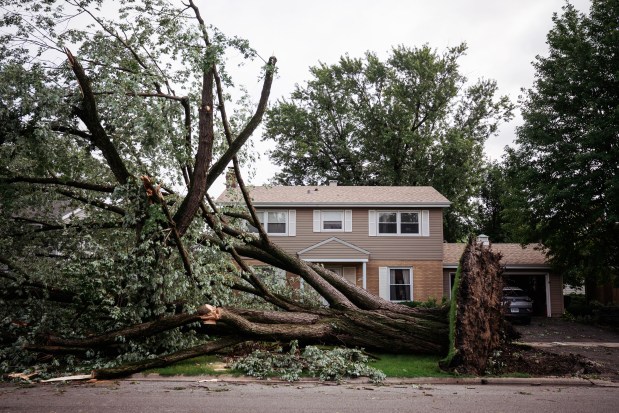
At the same time, climate change is supercharging the water cycle, intensifying severe storms — which, characterized by hail, strong winds and tornadoes, have knocked down branches and even mature trees across the Chicago area time and again this summer. For instance, storms from Aug. 9 through Sunday led to more than 2,700 requests to 311 related to tree emergencies, or regarding fallen or hanging trees or limbs blocking the public way or traffic, according to city data
A spokesperson for the city’s Department of Streets and Sanitation said its Bureau of Forestry “has no automatic process for replacing trees after storms” since site conditions vary. For instance, a location might be in the process of redevelopment, or it has utilities, buildings or other trees that would not make it an appropriate replanting site
But residents are encouraged to call 311 with tree planting requests, and the city “will replace trees lost in storms upon request once the planting location is verified as suitable for a new tree and confirmed by the adjacent resident.” The bureau does not have a backlog on such requests from previous years, though some 2,000 additional requests from 2026 will be planted beginning next year
According to the U.S. Department of Agriculture, increases in the frequency and severity of drought due to climate change will also likely lead to more tree mortality from insects — such as the emerald ash borer, which has ravaged Chicago-area trees since 2006 — as water stress reduces trees’ ability to defend themselves
These simultaneous climate realities emphasize the importance of protecting and maintaining existing canopy alongside tree planting to ensure the resilience of communities across the city, especially vulnerable ones
“The thing that stood out to me was that the mature canopy matters now. It makes the news, the numbers of trees planted,” said Raed Mansour, a study co-author and member of the board of directors for nonprofit Openlands. “But the mature trees are the ones that are providing shade and cooling the neighborhoods today. Newly planted trees can take years or decades to provide those same benefits.”
All study authors are part of the Defusing Disasters Working Group at Northwestern’s Buffett Institute for Global Affairs. The group is an interdisciplinary initiative that brings together experts such as climatologists, medical and public health experts, city leaders and community partners to explore the effects of extreme weather on vulnerable populations in Chicago
Researchers looked at satellite measurements across all Chicago census tracts between 2011 and 2021 and compared them with over 220,000 death records from the Illinois and Chicago Departments of Public Health
They found that, despite a higher-than-average tree canopy cover on the South and West sides, faster rates of canopy loss were likely leading to higher mortality rates
In the hottest neighborhoods, clustered on the South and West sides of the city and farther from the lake, the researchers modeled increased mortality as the tree canopy decreased year to year
On the other hand, while tree canopy is lower in North Side neighborhoods and downtown Chicago, mortality is also lower. And those areas are also experiencing lower rates of year-to-year canopy loss. Indeed, a 2022 Tribune investigation found the city planted more trees in wealthier, whiter neighborhoods. Additional factors such as socioeconomic resources, access to healthcare and proximity to Lake Michigan and its cooling effect likely play a role in reduced mortality in these parts of the city.
The city’s nine heat deaths this year have occurred in East Garfield Park, Near West Side, McKinley Park, New City, Englewood,Greater Grand Crossing, East Side and Chicago Lawn, where two men in their 40s died over the Independence Day weekend blocks from each other. One of them, whom the Tribune had not previously identified, was David Pedro Sopys, 46. He died of hyperthermia — having an abnormally high core body temperature — with drug intoxication being a contributing factor
The majority of the 12 people who have died in Cook County had underlying health conditions that were complicated by the extreme heat, according to the county medical examiner’s office, including heart disease, hypertension and obesity. Periods of extreme heat can add stress to preexisting conditions, triggering heart attacks, strokes and heart failure. However, this interaction can complicate an accurate count of heat-related mortalities, as preexisting conditions can obscure the role extreme temperatures had in someone’s death.
Most recently, 64-year-old Otto George Kendzior of Dolton died Aug. 4 on Chicago’s Near West Side, in the heart of the Illinois Medical District. On July 14, 65-year-old Joseph W. Huff died in the village of Oak Lawn. Both deaths were ruled natural, with the primary cause being organic cardiovascular disease and the secondary cause being heat stress
On July 17, a 33-year-old Latino man died of hyperthermia and drug toxicity in the East Side community area on the city’s Far South Side, the medical examiner reported last week
Heat can also cause health problems and lead to deaths several days, weeks or even months after a heat wave is over: A few days earlier, on July 10, Robert Feldon, 77, of Westchester, died after being hospitalized for more than a week. The medical examiner ruled his death accidental, with the primary cause being complications from a fall, and several secondary causes listed, including heat stress, tachycardia and osteoporosis
After autopsy results were pending for more than a month, the Cook County medical examiner confirmed last week that Claramon Elizabeth Little, 94, died of heat stroke in the Greater Grand Crossing neighborhood on July 2
Underlying health conditions that can be exacerbated by extreme heat also tend to be more prevalent in communities of color, like Austin, where rates of asthma, diabetes, hypertension, obesity and pulmonary disease are higher than the Chicago average, according to city data
The study found this neighborhood would benefit the most from a 0.03% increase in tree canopy cover, preventing four deaths each year
“Austin represents a place where there was a high mortality rate and low tree canopy cover relative to some other areas of the city,” said Benjamin Barrett, a postdoctoral candidate in health and biomedical informatics at Northwestern’s school of medicine. “That’s an area where preserving existing canopy and planting new trees could really have a strong effect.”
One to two deaths could be prevented in each of the city’s other 76 community areas, for a total of 105 fewer deaths citywide
That small increase in planting is about the same as the average of roughly 14,000 trees the city of Chicago has planted annually in recent years. But the study suggests that tree maintenance or care — like pruning, watering, mulching and pest and disease management — might be even more important than only increasing tree planting
In 2022, the city set a goal to plant 75,000 trees by the end of 2026, prioritizing neighborhoods with the highest need. They planted 18,000 that first year, almost 25,000 in 2023 and, according to the city, almost 17,000 in 2024 and around 9,000 last year. So far in 2026, the city has planted 2,750 and plans to plant another 3,350 this fall, on track to reach the goal by the end of the year
The city has removed almost 25,000 trees since 2022 due to disease, insects and storms
Mansour said the city has done a good job of prioritizing heat-vulnerable communities
“But tree equity shouldn’t end when the tree goes into the ground,” he said. “You can apply the same equity principles of tree planting into care, maintenance, preservation, replanting, long-term survival.”
Even an increase in tree numbers does not necessarily entail a similar increase in canopy cover, especially if the trees have small or few branches, or if these are knocked down by storms, for example
City departments work together to develop tree preservation measures that work in Chicago, the spokesperson from Streets and Sanitation said, “to allow for proper growing conditions when maintaining infrastructure and utilities, and when possible, to protect existing trees and ensure they can be enjoyed for years to come.”
For instance, a tree sidewalk cutout should be at least 5-by-10 inches, or a tree should preferably be planted in a grass parkway for best root growth, to achieve vibrant maturity and ensure resiliency during drought
Another measure sets standards for excavation near trees to occur at least 5 inches away from the base of the tree. In some cases, air excavation — a nondestructive digging method that uses high-pressure compressed air to avoid traditional heavy machinery — and root pruning are necessary to preserve roots
A city ordinance is also in the works to require additional protective measures for heritage trees, or large, old trees that hold significant historical, ecological and community value
Improving the canopy cover is not just about how many trees are planted, but which kind. For instance, trees that grow fast tend to have shallower roots, making them more prone to felling
The most common species the city plants are oaks — which are hardy, long-lived and have large canopies — followed by elms, maples, Kentucky Coffeetrees and ginkgo
“The city should focus on planting, identifying whatever species are the most resilient in the face of climate change, so you don’t see such dramatic losses, with entire trees knocked down during a storm or branches broken,” Garcia said
He said the city’s current tree canopy is a gift from previous generations
“But what we choose to do with that gift, I think, is the most important part of our study,” Garcia said
Chicago Tribune’s Lila Hempel-Edgers, Evgenia Anastasakos and Tess Kenny contributed
