


Benchmarks
Nifty24,570.65-65.35
FEATURED FUNDS★★★★★
Motilal Oswal Midcap Fund Direct-Growth
5Y Return
23.23 %
Invest Now
Enter search text:
The Economic Times daily newspaper is available online now.
Read Today’s Paper
Psychology explains why you want to keep eating even when your stomach is full – and what your brain may really be looking for
Psychology explains why you want to keep eating even when your stomach is full – and what your brain may really be looking for
By Mukesh Thapliyal
, Global DeskLast Updated: Aug 08, 2026, 10:14:00 AM IST
Synopsis
Even when your body has had enough, your brain can still crave food. This intriguing phenomenon highlights how pleasurable food can seem appealing, despite feelings of fullness. Influences like food cues, emotional states, and distractions feed these cravings. Understanding the roots of your hunger can help you eat more consciously, making your choices deliberate rather than automatic
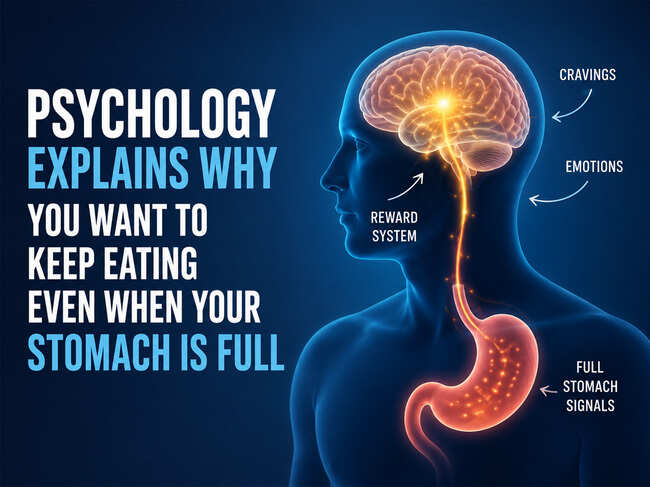
You finish dinner, feel comfortably full and tell yourself you are done. Then you see a slice of cake, smell freshly baked cookies or open a bag of chips – and suddenly eating feels tempting again. If this sounds familiar, it may not be simple hunger. Your stomach and brain communicate constantly, but they do not always want the same thing. Physical fullness can tell you that your body has received enough food, while your brain can still respond to taste, smell, memories, emotions and food cues. Researchers call one part of this phenomenon hedonic eating – because food is pleasurable rather than because the body needs energy.YOUR BRAIN CAN WANT FOOD WITHOUT NEEDING ITOne important distinction is between hunger and wanting. Hunger is largely driven by the body’s need for energy. But food can also become rewarding, creating a desire to eat even when you are physically satisfied. Psychologist Kent Berridge of the University of Michigan has studied the difference between ‘liking’ and ‘wanting’ in food rewards. His research shows that brain systems involved in motivation can encourage us to seek rewarding foods even when eating is not necessary for survival. More recent research by Zhenggang Zhu, Rong Gong, Vicente Rodriguez and colleagues, published in Science in 2025, found that dopamine neurons can help drive hedonic eating in mice, creating a neural pathway that can oppose signals associated with satiety. The researchers cautioned that this is animal research, but it offers insight into why pleasurable food can remain appealing after fullness.FOOD CUES CAN TRIGGER CRAVINGSSometimes the craving begins before you even take a bite. The smell of popcorn at a movie theater, a dessert displayed in a restaurant or an advertisement showing a cheeseburger can make food suddenly seem irresistible. Research has found that food-related cues can activate brain regions involved in reward and motivation. A 2017 study by Agnieszka Sorokowska, Katherina Schoen, Cornelia Hummel and colleagues found that food-related odors can activate dopaminergic brain areas associated with reward processing. Another line of research has focused on sensory-specific satiety. In classic experiments, E.T. Rolls, B.J. Rolls and E.A. Rowe found that the appeal of a food decreases after eating it, while other foods can remain attractive. That helps explain why you can feel full after dinner but still have room – or at least desire – for dessert.DISTRACTIONS CAN MAKE EATING FEEL AUTOMATICYour surroundings can also influence how much you eat. When you watch television, scroll through your phone or focus on another activity while eating, you may pay less attention to the food and to signals of fullness. A 2026 systematic review, published in American Journal of Clinical Nutrition, and meta-analysis by Thomas Gough, Traci Mann, Khaleda Ahmadyar and colleagues examined research on distracted eating. The authors found evidence that distraction can affect food intake, although the size of the effect varies depending on the situation. Earlier research by Jane Ogden and colleagues also found that participants watching television during a taste test consumed more than participants in some other conditions.STRESS, TIREDNESS AND EMOTIONS CAN CHANGE WHAT YOU WANTSometimes your brain is not looking for calories at all. It may be looking for comfort, stimulation, relaxation or a quick reward. Sleep can also influence food motivation. Research led by Marie-Pierre St-Onge found that sleep restriction increased activation in brain regions responsive to food stimuli. A separate review by Ari Shechter, Michael Grandner and St-Onge concluded that the evidence generally points toward greater energy intake when sleep is restricted. This does not mean every craving is caused by stress or poor sleep. But it shows why appetite is more complicated than simply asking whether your stomach is full.Wanting food after you are full does not automatically mean you lack willpower. Your eating behavior is influenced by several overlapping systems: physical hunger, reward, learned habits, food cues, emotions, sleep and attention. The next time you feel full but still want a snack, pause for a moment and ask yourself what you are actually experiencing. Are you physically hungry, or did a smell, sight, emotion or habit trigger the desire to eat? That small pause can help separate hunger from craving.You do not have to treat every craving as a problem, either. The goal is simply to understand where the urge is coming from. Recognizing the difference can make eating more deliberate and less automatic – and may help you make choices that better match what your body actually needs.Add 
as a Reliable and Trusted News Source

Add Now!
Read More News on
psychology of eatinghedonic eatingsleep and appetitefood cuesdistracted eatingcomfort eatingneural pathways and eating
Read More News on
psychology of eatinghedonic eatingsleep and appetitefood cuesdistracted eatingcomfort eatingneural pathways and eating
Stories you might be interested in
