


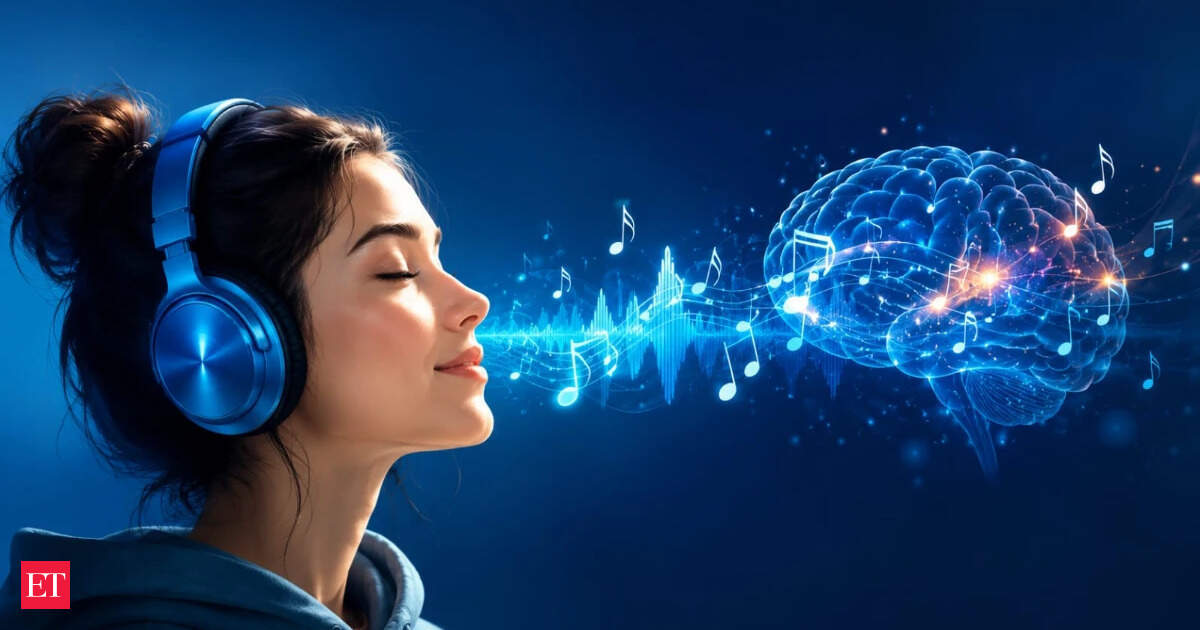
Some people need only two or three notes before confidently saying, “I know this song.” Before the singer appears, before the chorus begins and sometimes before the melody has even fully developed, their brain appears to have already identified it. This ability can look like an impressive musical talent, but psychology and neuroscience suggest something more specific may be happening: the brain is rapidly comparing incoming sounds with stored auditory patterns in long-term memory. Research by Simone Dalla Bella, Isabelle Peretz and Neil Aronoff found that recognition of familiar melodies develops progressively as a melody unfolds, with more familiar melodies requiring fewer notes for recognition.
Psychology Says the Brain Does Not Wait for the Whole Song
When you hear a familiar song, your brain does not necessarily wait until it has enough information to analyze the entire piece. Instead, recognition can begin almost immediately.In a landmark melody-recognition experiment, researchers presented listeners with increasingly longer sections of familiar and unfamiliar melodies, starting with the first note, followed by the first two notes, then three and so on. The researchers found that the more familiar the melody, the fewer notes people generally needed to recognize it.This is important because it suggests that recognizing a song is not simply a matter of remembering its complete sequence. The brain can use an incomplete fragment to activate a much larger stored representation. That is a form of auditory pattern recognition.You Might Also Like:

Psychology says women who keep asking for permission even if they have the right to decide may be carrying more than patriarchy
Familiarity Gives the Brain a Head Start
Think about hearing the opening notes of a song you have played hundreds of times. Those notes are not completely new information. Your brain has encountered their acoustic pattern repeatedly and has built associations between the opening sequence and the larger musical representation.Research on music familiarity shows that recognition draws upon long-term memory traces and mental representations of previously heard musical phrases. Neuroimaging studies have identified a network involving areas such as the superior temporal cortex, frontal regions and hippocampus during recognition of familiar melodies.This means your brain is effectively asking: “What previously stored pattern matches these sounds?”If the match is strong enough, recognition can occur before the song has provided much additional information.
Psychology Says Auditory Pattern Recognition Works Like a Rapid Matching System
The phenomenon resembles other forms of pattern recognition. You do not need to see an entire face to recognize someone you know. You may recognize a familiar voice after hearing only a few words.Similarly, a familiar melody can become identifiable from a small auditory fragment.Dalla Bella, Peretz and Aronoff interpreted melody recognition using ideas related to the cohort model, a framework originally developed for spoken-word recognition. The basic idea is that early information narrows down the possible candidates, and subsequent information eliminates alternatives until one representation becomes the strongest match.For music, the opening notes can therefore act like a filter. At first, many songs could theoretically fit.Then another note arrives.The possibilities shrink.Another arrives.The brain becomes increasingly confident.And suddenly: “That’s that song.”
Why Familiar Songs Are Recognized Faster
Familiarity is crucial. If someone plays an obscure melody you have never heard, the opening notes may mean almost nothing.But if it is a song you heard repeatedly during childhood, listened to every morning for years or played hundreds of times on your phone, the same number of notes can trigger recognition almost instantly.A 1998 study by Isabelle Peretz, Diane Gaudreau and Anne-Marie Bonnel examined how exposure to melodies affected subsequent recognition and liking, demonstrating the importance of previous exposure in how listeners respond to music.This is one reason the experience of “knowing a song immediately” can vary dramatically between two people.One person’s three-note fragment may be another person’s completely unfamiliar sound.
Psychology Says Repetition Builds Powerful Familiarity
This connects to Robert Zajonc’s mere-exposure effect, one of the best-known concepts in social psychology.The mere-exposure effect describes how repeated exposure to a stimulus can increase familiarity and, under many conditions, positive affect toward it. Zajonc’s work demonstrated that repeated exposure itself can influence responses to stimuli, even when people are not necessarily consciously aware of every previous exposure.Music provides an especially intuitive example. You may initially hear a song and feel indifferent. After hearing it several times, you begin recognizing its structure. Eventually, the opening beat or first few notes can be enough to bring the entire song to mind.Research specifically examining music has found links between repeated exposure, recognition and liking.
The Brain Can Recognize a Song Before You Can Explain Why
An interesting part of this experience is that recognition can feel instantaneous. You might say, “I don’t know how I knew it. I just knew.” This is consistent with the distinction between explicit recollection and rapid recognition.You do not necessarily need to consciously retrieve the song’s title, artist, album or lyrics before identifying the auditory pattern.Your brain can first register familiarity and only afterward retrieve the verbal information needed to name it.Research using EEG has found that the brain can differentiate familiar from unfamiliar music very rapidly, with measurable differences appearing within hundreds of milliseconds after the music begins.So the subjective experience of “I knew it immediately” has a measurable cognitive basis.
Psychology Says Musicians May Have an Advantage
Musical training can influence how quickly people process certain aspects of music. In the melody-recognition study by Dalla Bella and colleagues, musicians generally made familiarity judgments with fewer notes than nonmusicians. Interestingly, however, the pattern changed when participants were asked to produce a sung response rather than simply judge familiarity.That finding matters because musical expertise is not a single mental ability. Recognizing familiarity, recalling a melody, naming a song and reproducing it vocally involve overlapping but different processes.You do not have to be a professional musician to develop highly effective musical recognition. Repeated listening alone can create extensive auditory familiarity.
Psychology Says Your Personal History Changes What You Recognize
Your brain’s musical “library” is highly individual. A song associated with a childhood memory may be recognized instantly by one person and completely missed by another.Research on music familiarity has also connected familiar music with autobiographical memories and emotional associations, helping explain why certain songs can feel immediately recognizable and personally significant.Imagine two people hearing the same three opening notes.One heard the song repeatedly during school.The other has never encountered it.Their brains are not starting from the same point.For the first person, the fragment activates a richly established representation. For the second, there may be no matching representation at all.
Auditory Pattern Recognition Is Not the Same as Perfect Musical Memory
Being exceptionally quick at recognizing songs does not necessarily mean someone has a superior memory in every area. It may indicate domain-specific familiarity and efficient auditory processing.Someone might identify hundreds of songs within seconds but struggle to remember names or dates.Another person might have excellent verbal memory but be unable to identify melodies quickly. Memory is not one single ability. It is made up of multiple interacting systems that are influenced by experience, attention, familiarity and the type of information being remembered.
The Psychology Behind Instantly Recognizing Songs
The brain is constantly comparing incoming sounds with previously learned patterns. When the match is strong, only a small fragment may be necessary.That is why three notes can sometimes feel like an entire song. The remarkable part is not simply that the brain remembers music.It is that years of listening can make recognition so efficient that conscious analysis barely seems to happen at all. The next time someone identifies a song before the singer even starts, they may not be guessing. Their brain may simply have already found the pattern.
Why can some people recognize a song after only a few notes?
Familiar melodies can be recognized from very short fragments because the brain can compare incoming sounds with stored representations of previously heard musical patterns. Research has found that more familiar melodies generally require fewer notes for recognition.
Does recognizing songs quickly mean someone has a better memory?
Not necessarily. It may reflect highly developed auditory memory and pattern recognition, particularly for music. Memory abilities are domain-specific, so being excellent at recognizing songs does not automatically indicate superior memory in other areas.Add 
as a Reliable and Trusted News Source

Add Now!
(You can now subscribe to our Economic Times WhatsApp channel)
Read More News on
music and memorysong recognitionpsychology of musicfamiliar melodiesmusical training and recognitionneuroscience of music
(Catch all the US News, UK News, Canada News, International Breaking News Events, and Latest News Updates on The Economic Times.)
Download The Economic Times News App to get Daily International News Updates
…moreless
(You can now subscribe to our Economic Times WhatsApp channel)
Read More News on
music and memorysong recognitionpsychology of musicfamiliar melodiesmusical training and recognitionneuroscience of music
(Catch all the US News, UK News, Canada News, International Breaking News Events, and Latest News Updates on The Economic Times.)
Download The Economic Times News App to get Daily International News Updates
…moreless
