


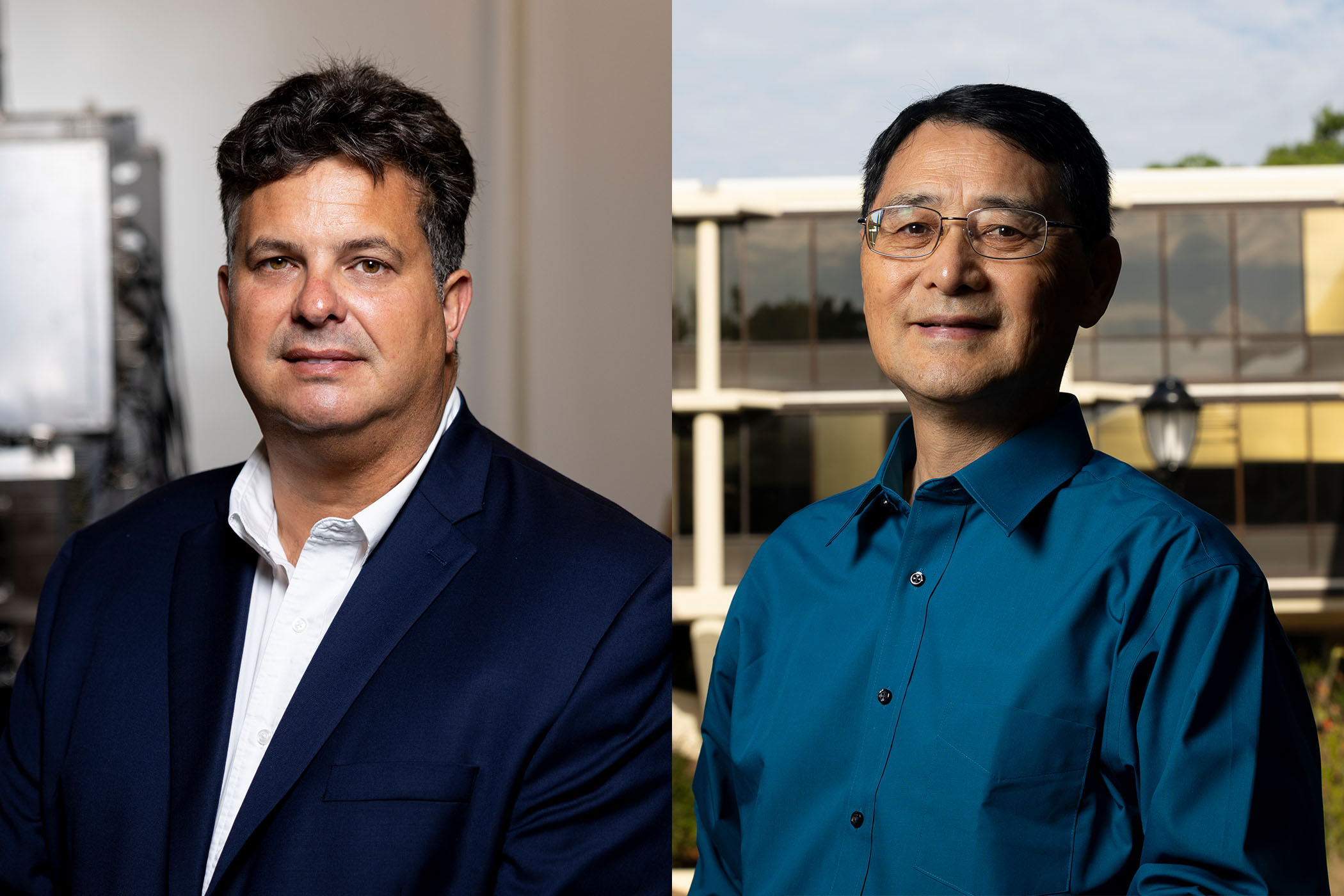
Two internationally recognized researchers whose work is speeding drug development, advancing environmental science and expanding the frontiers of personalized medicine will join the University of Georgia as its newest Georgia Research Alliance Eminent Scholars
Francisco Fernandez-Lima, currently a professor of chemistry, physics and biochemistry at Florida International University, and Guo-Wei Wei, MSU Research Foundation Distinguished Professor of Mathematics at Michigan State University, will bring UGA’s total of active GRA Eminent Scholars to 18 once they arrive on campus Aug. 1
“The Georgia Research Alliance Eminent Scholars program continues to excel at bringing renowned scholars to Georgia,” said UGA President Jere W. Morehead. “Drs. Fernandez-Lima and Wei will harness collaborative and innovative approaches to elevate the research enterprise at the University of Georgia as they pursue answers to the most pressing questions facing our state, nation and world.”
The Georgia Research Alliance is a nonprofit, public-private partnership that invests state funds to recruit top scientific talent, enhance labs and promote discovery and entrepreneurship to drive economic impact in Georgia. GRA Eminent Scholars are leading experts in their respective fields at Georgia’s top research universities. Collectively, the scholars attract hundreds of millions of dollars in public and private grants each year
“Both Dr. Wei and Dr. Fernandez-Lima are high-impact researchers who perfectly reflect the caliber and potential of GRA Eminent Scholars,” said Tim Denning, GRA’s president and CEO. “In different but complementary ways, both are deepening our understanding of the complex structure of molecules. The knowledge they generate speeds drug development, advances environmental science and addresses critical human health challenges.”
Building tools for personalized medicine
Francisco Fernandez-Lima will be UGA’s new GRA Eminent Scholar in Microbial Physiology with an appointment in the department of chemistry in the Franklin College of Arts and Sciences. Upon appointment, he will become director of the new Biomolecular and Human Analysis Center, which will develop instrumentation for personalized medicine as a center of excellence certified under the federal Clinical Laboratory Improvement Amendments (CLIA)
At FIU, Fernandez-Lima has worked both in the development of new instrumentation and methodologies for biomedical research and in the characterization of the chemical environment at the single-cell and sub-cellular levels of cell systems and tissue sections
“My lab addresses problems that require new measurement capabilities — cases where existing technologies do not provide the molecular specificity, structural resolution or systems-level insight needed to answer important questions,” he said. “The overarching objective is to generate tools that advance mechanistic understanding while enabling translational progress in precision and patient-centered research.”
Fernandez-Lima said his work is not translational by design but driven by translational priorities. Most importantly, the tools he develops improve our ability to characterize molecular heterogeneity across patients, tissues and cellular systems
He’s also deeply committed to mentoring students and hopes students leave his lab with both technical skills and the confidence to think independently, ask important questions, communicate effectively and develop as leaders
“My interest is not simply in growing a lab but in building a platform — one that combines next-generation medical technologies, shared infrastructure, strategic partnerships and translational vision,” Fernandez-Lima said. “UGA is an institution where that platform can become nationally visible.”
Connecting mathematics and bioscience
Guo-Wei Wei, a fellow of the American Institute for Medical and Biological Engineering and Society for Industrial and Applied Mathematics, will become UGA’s GRA Eminent Scholar in Structural Biology, with a split appointment in the department of biochemistry and molecular biology and the department of mathematics in the Franklin College. His work concentrates on the mathematical foundations of bioscience and artificial intelligence, with applications in drug discovery, bioinformatics, virology, biomedical imaging and other areas.
“I’m looking for deeper collaboration opportunities, and I believe the joint appointment in [BCMB] and mathematics will give me the best chance to talk both to people who are doing the lab work but also those working on the pure math such as geometry, topology, combinatorics and algebra,” Wei said. “I’m particularly interested in using mathematical AI for drug discovery, for example, in designing drugs for things like drug addiction, which is an important problem.”
During the COVID-19 pandemic, Wei and his research team used mathematical AI to develop a mechanism for tracking and predicting the virus’s mutations, as well as the potential severity of those mutations
“Early in 2020, we were able to make predictions about [the COVID virus’] mutations,” he said. “Even two years later, all the important mutations of the virus had been predicted by our group. That’s one thing we were very proud of, that we were able to predict which new variant was going to become dominant.”
Wei is looking forward to collaborating with researchers in UGA’s Complex Carbohydrate Research Center who work toward biomedical applications
The two scholars’ appointments in the Franklin College build on UGA’s existing interdisciplinary strengths in life sciences research and set the stage for increased collaboration with faculty in several related UGA colleges and schools, particularly the School of Medicine, which will welcome its first cohort of students this fall
“Dr. Fernandez-Lima and Dr. Wei represent the kind of boundary-crossing research excellence that defines Franklin College,” said Anna Stenport, dean of the Franklin College. “Their work connects chemistry, mathematics, biology, artificial intelligence and human health in ways that expand discovery and create new possibilities for translational research. We are thrilled to welcome them to UGA and to Franklin, where their leadership will strengthen collaboration across disciplines and advance research with meaningful impact for Georgia and beyond.”
