


A game of chess would be impossible to play if one didn’t know what pieces occupied what squares and didn’t understand how each piece moved
That is the problem researchers have faced in devising any sort of treatment strategy for cryptococcal infections
Kirsten Nielsen, professor of microbiology and immunology in the Center for One Health Research within the Virginia-Maryland College of Veterinary Medicine, is senior author on a paper published in mBio detailing research that sheds more light on the CD4 T-cells that keep Cryptococcus neoformans in check for the vast majority of human beings, until something happens that allows the fungus to proliferate in the lungs and spread to the brain
“Our studies highlight the previously unappreciated diversity and complex regulation of the CD4 T-cell response that is required to prevent disease in this important fungal pathogen,” the paper summarizes.
Or, in other words: “Everybody assumed that we had the queen that was going to be the single most powerful player,” Nielsen said. “But it turns out it’s not just one queen. Imagine playing chess with five queens.”
At ease, until it gets different orders
For most healthy people, cryptococcus is an unnoticed infection. The immune system walls it off in the lungs and keeps it dormant for life.
But in patients undergoing cancer chemotherapy, recovering from an organ transplant, living with HIV, or taking newer immune-suppressing drugs for autoimmune disease, the fungus can reactivate, spread to the brain and cause meningitis.
Cryptococcus kills more than 150,000 people worldwide each year, according to the Centers for Disease Control and the World Heath Organization, and is the second-leading cause of death among people living with HIV, especially in Africa
Doctors have no way to predict or prevent that reactivation, largely because it hasn’t been well understood which immune cells were doing the work of controlling the infection in the first place
Nielsen’s team at Virginia Tech, whose research is supported by the National Institutes of Health, set out to identify those cells, collaborating with researchers at Harvard and the University of Illinois
They focused on CD4 T cells, the immune system’s coordinators
“If you think about it as the immune army, you have your soldiers on the front line — those are your innate immune cells, like macrophages,” Nielsen said. “The CD4 T cells are the generals. They’re the ones telling the soldiers what they’re supposed to do, and who should be coming onto the battlefield. Like the queens in chess, these generals are a very important and powerful part of the army
“Disease happens when these CD4 T cells, the generals are lost or they don’t transmit the right orders to the army.”
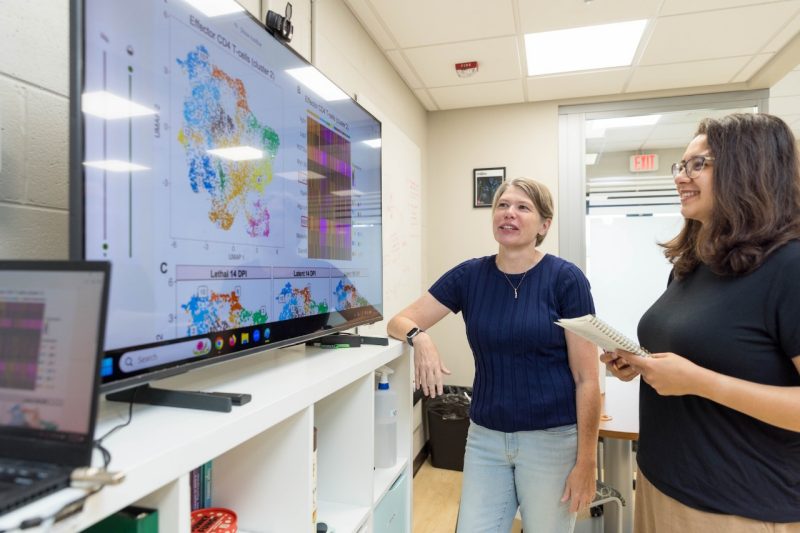
Surprisingly, Nielsen’s research showed that it is not a single type of CD4 T cells involved in restricting cryptococcus, but several.
“There are lots of different CD4 T cells controlling the infection and all are important in their own way,” Nieslen said. “There is not one single cell type that we could gave to patients and allow them to control the infection.”
Long-running research
This discovery is the latest layer in a research program Nielsen has built for more than a decade.
The project traces back to a realization she had nearly two decades ago, while studying how Cryptococcus changes shape inside the body, that those transformations were happening almost entirely in the lungs. That meant the lungs— not the brain, where symptoms of disease eventually appear — are where the outcome of infection is decided
Turning that insight into research meant building mouse models that could reproduce the same quiet, lifelong lung infection seen in humans, work that took years before Nielsen’s lab — first at the University of Minnesota, then at Virginia Tech — could even begin asking which immune cells mattered.
“You have to have a really foundational question that you’re trying to address, and then you have to think outside the box,” Nielsen said about maintaining such a long-term focused research program. “Every time you hit an exit or an off-ramp, you ask: Is that just going to be a rest stop on the path, or is that really taking me in a different direction?”
There are still many potential paths left on the journey. Nielsen’s team has not yet determined how these T cells communicate with the front-line cells they command, or which specific downstream cells each type recruits
“We don’t know what they’re telling their troops, or what the troops are hearing, or what troops they’re coordinating,” Nielsen said. “We still don’t know any of that. Those will be the next steps.”
For this paper, Nielsen collaborated with two previous associates in her lab as well as researchers at Harvard and the University of Illinois
Co-author Minna Ding completed her thesis as part of an M.D./Ph.D. program working in Nielsen’s lab at the University of Minnesota. Fellow co-author Marina Yoder, a technician and lab manager, briefly moved to Virginia Tech when Nielsen moved her laboratory here in 2023.
Co-author Eric Dang, an immunologist formerly with the National Institutes of Health, now serves as an assistant professor at the Ragon Institute at Harvard. Co-author Jenny Drnevich is a bioinformaticist at the University of Illinois who helped Ding analyze single cell data
Much more must be known before there is a cure
Physicians could, in theory, intervene before cryptococcal reactivation ever happens. But designing that kind of preventive treatment requires knowing exactly which cells to protect or replace
“We don’t yet have an understanding of what functions of the immune response are causing the protection we need to maintain,” Nielsen said. “We have an idea of some of the players involved, but we don’t know what they’re doing.”
Cryptococcus doesn’t only threaten humans. Cats, dogs, and even pet birds develop infections
Because animals share similar immune responses as humans, Nielsen said, findings from her lab are expected to apply to both veterinary and human medicine — a connection at the heart of the veterinary college’s One Health mission
“The diseases that we see in animals are not that much different than we see in humans,” Nielsen said. “When environmental outbreaks of cryptococcus have occurred, animal species have been monitored to track them.”
It’s all gathering information that adds to the grid of what is known and what remains unknown about cryptococcus
“We’ve added another piece to the puzzle,” Nielsen said. “The picture is starting to resolve, but we’re still a long way from completing the puzzle and knowing what the answer is.”
The full paper, “Paradoxical Th1 activation and CTLA-4 regulation is beneficial during latent cryptococcosis,” appearing in mBio is linked here
Contact:
540-231-9005
