


<img src="https://healthylife7.com/wp-content/uploads/2026/08/indigenous_message_2021.jpg” alt=””>
NEW YORK — On August 9, 2026, the United Nations observes the International Day of the World’s Indigenous Peoples, an annual commemoration recognizing the cultures, identities, knowledge, and contributions of Indigenous communities around the world
Formally proclaimed by the United Nations General Assembly in 1994, the observance marks the anniversary of the first meeting of the UN Working Group on Indigenous Populations in 1982. Today, an estimated 476 million Indigenous people live across more than 90 countries, representing thousands of distinct cultures and languages
Indigenous communities are also important stewards of biodiversity and traditional ecological knowledge, but many continue to face land dispossession, economic inequality, discrimination, threats to their languages and cultures, and challenges to their sovereignty and ref the global population, they represent at least 15% of those living in extreme poverty
The annual observance draws attention to those disparities while reaffirming principles contained in the UN Declaration on the Rights of Indigenous Peoples, including rights to self-determination, cultural preservation, traditional lands and renities
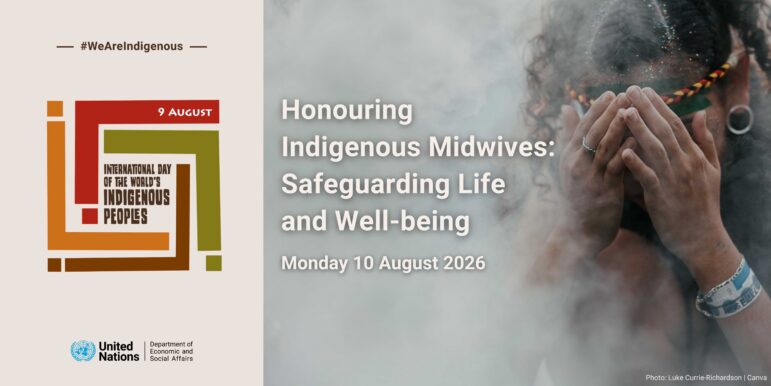
This year’s theme focuses on Indigenous midwifery and its role in sustaining health, culture, and traditional knowledge: “Honouring Indigenous Midwives: Safeguarding Life and Well-being.”
“Indigenous Peoples account for over 6 per cent of the world’s population. They are guardians of cultural heritage, stewards of vital ecosystems and crucial contributors to our shared future,” UN Secretary-General António Guterres said in a statement
“On this International Day of the World’s Indigenous Peoples, we celebrate Indigenous midwives. Evidence shows that they improve outcomes for mothers and babies, strengthen trust in health systems and ensure continuity of care. As knowledge holders and leaders, they also help preserve the languages, values and practices that sustain Indigenous cultures across generations.”
The United Nations describes Indigenous midwifery as part of holistic knowledge systems connecting health with community, spirituality, culture, and relationships with land and territory. Within many communities, midwives serve not only as caregivers during pregnancy and childbirth but also as custodians of medicinal, ceremonial, and cultural knowledge transmitted across generations. From that perspective, Indigenous midwifery is not simply a medical practice but rather a component of a larger cultural and spiritual worldview.
Guterres said the United Nations is working with Member States and Indigenous Peoples to advance rights-based approaches to health. Priorities include addressing gaps in data that can leave Indigenous patients invisible in health systems, increasing investment in training for midwives and natal care, and protecting Indigenous women’s rights to make informed decisions about their own bodies and care
The UN will expand on those issues during a two-hour online observance on Monday, August 10, from 8:30 to 10:30 a.m. Eastern (UTC-4). The program will explore the experiences of Indigenous midwives, barriers they encounter within national health systems, and ways governments and institutions can support Indigenous-led care without undermining Indigenous control over traditional knowledge and practices
Registration for the event is available through the UN Department of Economic and Social Affairs
via United Nations
The virtual commemoration will open with an Indigenous spiritual ceremony, followed by statements from senior UN officials and the Chair of the Permanent Forum on Indigenous Issues. Two moderated dialogues with invited speakers and an interactive discussion will follow
The first, “Indigenous Midwives as Knowledge Holders and Guardians of Well-being,” will explore Indigenous midwifery as a living knowledge system and the contributions midwives make to community well-being. Speakers will also address the challenges Indigenous midwives face in maintaining their practices and transmitting their knowledge to future generations. The erosion of Indigenous midwifery traditions can therefore mean more than the loss of a form of maternal care; it can disrupt the transmission of language, ceremony, cultural identity, and ancestral knowledge.
The second dialogue, “From Recognition to Action: Protecting and Supporting Indigenous Midwifery,” moves from recognition toward policy and implementation. Speakers will examine reforms and practical approaches for recognizing and supporting Indigenous midwifery while advancing international commitments, human rights obligations, and recommendations concerning Indigenous Peoples
Those issues remain pressing because Indigenous midwives in some countries continue to experience discrimination, stigmatization, and even criminalization. At the same time, their knowledge and practices may receive little recognition under national health and legal frameworks
The discussion consequently goes beyond the relationship between Indigenous midwives and conventional health systems. It raises broader questions about self-determination and control of Indigenous knowledge, including who determines whether a traditional practice is legitimate, who establishes standards for practitioners, and how governments can provide re
Those concerns are closely connected to the UN Declaration on the Rights of Indigenous Peoples, particularly its recognition of Indigenous Peoples’ rights to maintain their cultural traditions and institutions and participate in decisions affecting them. The UN Permanent Forum on Indigenous Issues has also called for greater recognition of Indigenous midwives and the removal of discriminatory barriers affecting their work
Together, the two dialogues approach Indigenous midwifery both as a living system of cultural, spiritual, and medical knowledge and as a matter of Indigenous rights. Speakers will consider how traditional knowledge can be protected while improving cooperation between Indigenous practitioners and formal health systems
The UN’s approach emphasizes not merely recognition of Indigenous traditions, but ensuring that the communities maintaining them retain authority over their future
“Traditional wisdom can protect new life,” Guterres said. “Together, let us ensure that Indigenous midwives, and the communities they serve, have everything they need to thrive.”
The Wild Hunt is not responsible for links to external content
To join a conversation on this post:
Visit our The Wild Hunt subreddit! Point your favorite browser to https://www.reddit.com/r/The_Wild_Hunt_News/, then click “JOIN”. Make sure to click the bell, too, to be notified of new articles posted to our subreddit
