


Undergraduate researchers show promise, research results
Published Jul 30, 2026 by
- Frank Piemonte
Filed under:
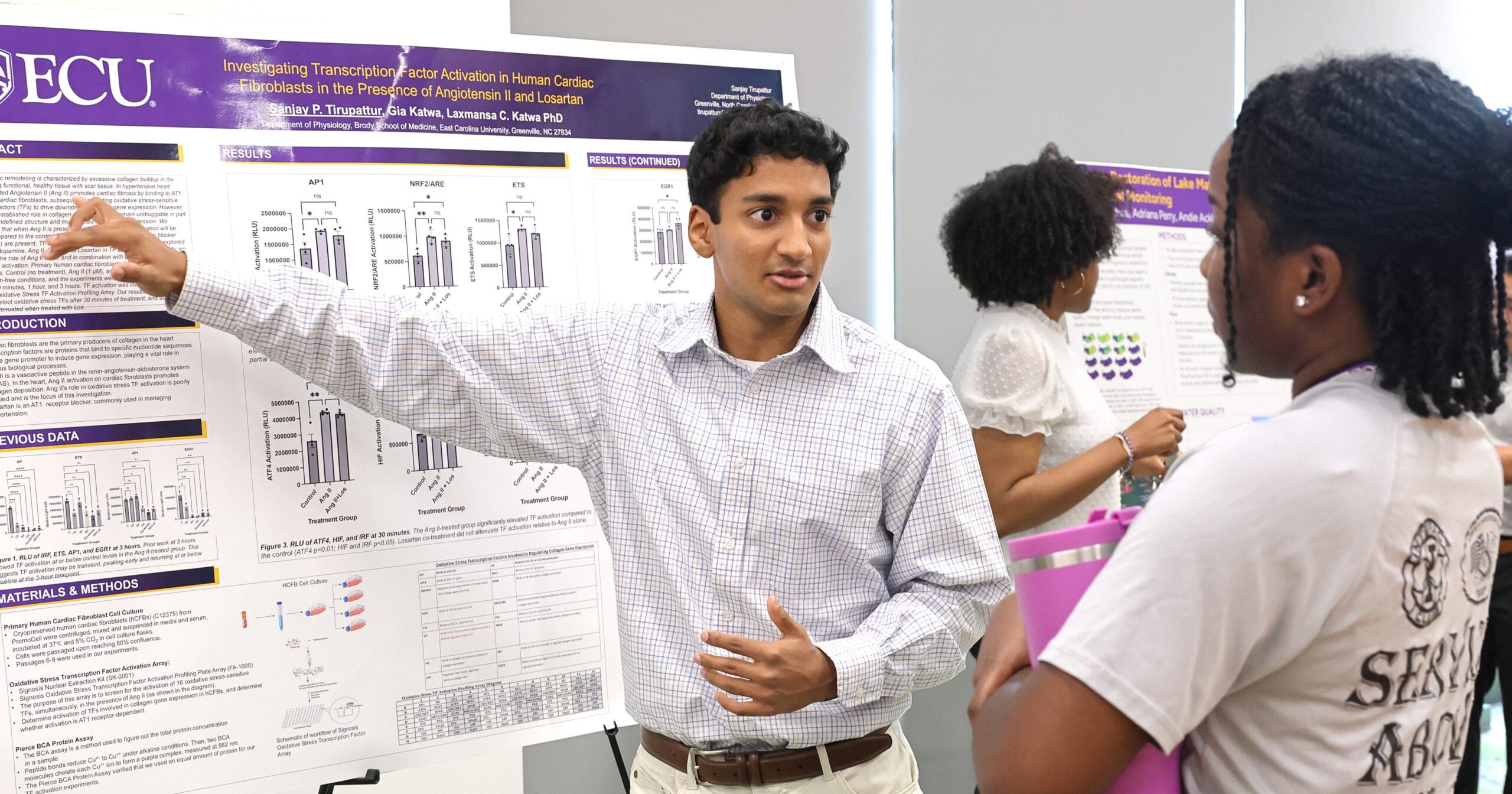
- Undergraduate and visiting student researchers showcased faculty-mentored projects in AI, public health, engineering, healthcare and other fields at the Summer Undergraduate Research Symposium.
- Students gain hands-on experience in critical thinking, data analysis, communication and professional presentations that prepare them for graduate school and future careers.
Twenty-six undergraduate researchers wrapped up their summer by showcasing innovative research alongside their faculty mentors at East Carolina University’s Summer Undergraduate Research Symposium (SURS). The annual event highlights the discoveries, creativity, and hands-on experiences that prepare students for careers in science, healthcare, engineering, technology and other professional fields
Erin Elsberry, Biochemical and Biomedical Engineering, shares her findings with a fellow peer, highlighting key insights and discoveries from her summer project during the poster session. (Photo by Rhett Butler)
For senior software engineering major Matthew Smith, the symposium represented an opportunity to combine two rapidly growing fields — artificial intelligence and healthcare. Smith developed an AI-powered website designed to help dental students identify lesions in dental X-rays by providing additional learning support beyond traditional classroom instruction
“AI is becoming more prevalent every day,” Smith said. “This project allowed me to learn how to apply that technology in a meaningful way while developing skills employers are increasingly looking for.”
Now in its fourth year, the symposium provides undergraduates with an opportunity to present the results of their summer research projects through professional poster presentations. More than a showcase of scientific discoveries, the symposium emphasizes communication, critical thinking and professional development with skills that extend well beyond the laboratory
This year’s SURS welcomed undergraduate students from ECU and visiting undergrads from colleges and universities across the UNC System. The symposium also included participants enrolled in a research training program in the U.S. Department of Agriculture’s Research and Extension Experiences for Undergraduates (REEU), along with high school students from across North Carolina participating in the Summer Ventures in Science and Mathematics program
For junior Izzy Joseph, undergraduate research became much more than a summer project. Working on a public health study focused on mosquitoes and disease prevention helped shape future career aspirations
“This research project made me fall in love with public health and research,” Joseph said. “I knew I wanted to get involved as a freshman, and ECU connected me with the right people and opportunities. I wouldn’t have been able to do this without the support of the university and my mentors.”
Originally launched during the COVID-19 pandemic by Dr. Mary Farwell, the symposium has evolved as undergraduate research opportunities have changed. While the program initially focused on students participating in federally funded research cohorts, it now welcomes a broader range of individually mentored research projects from across the university
That evolution has expanded opportunities for students from diverse academic disciplines while strengthening the connection between faculty mentors and emerging researchers
“The Summer Undergraduate Research Symposium gives students the opportunity to complete their research by presenting it to an audience while developing the communication and professional skills they’ll use throughout their careers,” said Dr. Tuan Tran, director of undergraduate research at ECU. “Whether they pursue research, medical school or another profession, this experience helps build the confidence they need to succeed.”
Faculty mentors say the symposium demonstrates that research is about much more than producing results. It also teaches students how to develop ideas, solve problems, analyze data and communicate their findings — skills that are valuable across virtually every profession
“The research process teaches students skills they can carry into any career,” said Stephanie Richards, faculty mentor in the College of Health and Human Sciences. “Writing proposals, collecting data, presenting results and collaborating with faculty and community partners all contribute to their professional growth while building connections that can benefit them long after graduation.”
More Blogs
Nurse educator turns her own cancer battle into a classroomECU vocal program offers oft-missing science to singingMedical school welcomes in thriving physician assistant studies departmentECU Foundation welcomes three new board membersUndergraduate researchers show promise, research resultsSky-high learning: Nursing students join elite pediatric transport crew
