


Download PDF
Abstract
Although adverse childhood experiences (ACEs) increase risk for mental illness at the population level, existing ACEs screens are less helpful in forecasting individual outcomes, suggesting they may not capture significant elements of childhood adversity. We have previously identified unpredictable parental and household experiences as an ACE that portends poorer cognitive and mental health. However, the contribution of unpredictability to established ACEs in real-world settings is unknown. Here, leveraging existing ACEs screening in California, we added the five-item Questionnaire on Unpredictability in Childhood (QUIC-5) in 19 pediatric clinics spanning broad sociodemographic constituencies and compared in ~30,000 children the link of each screen with mental health diagnoses. Scores on either the ACEs or QUIC-5 associated with probabilities of depression, externalizing symptoms, sleep disorders, anxiety and somatic symptoms. Each screen provided unique contributions and combining them often doubled the strength of associations. For depression and sleep disorders, the QUIC-5 identified vulnerable individuals missed by ACEs screen, improving risk detection and facilitating future interventions.
Pivotal studies, including the Centers for Disease Control and Prevention (CDC)–Kaiser Permanente study1 focusing on adverse childhood experiences (ACEs), documented cumulative effects of exposure to potentially traumatic experiences (for example, abuse, neglect or violence witnessing) on a wide range of mental and physical health conditions. These discoveries prompted examination of the enduring role of ACEs in health and disease2,3,4,5,6,7 and it is now estimated that the economic burden of exposure to ACEs in the US adult population is US$14.1 trillion annually3. Given the accumulating evidence regarding the human and fiscal toll of ACEs, calls to address the prevalence and consequences of ACEs are rapidly increasing5,8,9,10,11,12,13,14,15,16. At the forefront of these efforts, California became the first state (in 2020) to implement a publicly supported screening program. Although the goal of the program is to dramatically reduce the burden of ACEs on the population8,16, the value of this public health initiative has been questioned on several grounds, the primary being that ACEs screens identify risk at the population level, yet perform little better than chance at the level of the individual, limiting their ability to direct prevention or intervention resources to the most vulnerable children17,18,19,20,21.
There are several potential explanations for why ACEs scores are limited in their ability to better detect health risks. One possibility is that substantial sources of stress and trauma occurring in childhood are missed with existing instruments. Indeed, one early-life exposure that is not currently included in standard screening instruments is unpredictability of parental and environmental signals received by the child, which activates the brain’s stress responses21,22,23,24,25. The concept that unpredictable signals to the developing brain are stressful and disrupt brain maturation arose initially in experimental animal studies21,22,23,24,25. Since then, unpredictable parental care and lack of structure in the family and home environment have been shown to strongly predict poorer cognitive and emotional development across a broad range of cultures and sociodemographic groups26,27,28,29,30,31,32,33. Unpredictability in childhood, independent from parental support and sensitivity, has been linked by several independent groups to decreased executive control, a slower trajectory of cognitive development, poorer memory and increased risk for depression, anhedonia, anxiety and post-traumatic stress disorder later in life26,27,28,29,30,31,32,34,35,36,37,38. These associations persist after consideration of other well-established ACEs (for example poverty, abuse or neglect), suggesting that unpredictable experiences in themselves are a robust risk factor for poor mental health outcomes, and their absence from existing assessments of ACEs may account for some of the limitations of these assessments in predicting risk profiles.
Here, we test the contribution of unpredictability to mental health outcomes in a large, population-based cohort (~30,000 participants). We examine the relative and cumulative contributions of ACEs and unpredictability as risk factors for mental health problems. We leverage the existing ACEs screening implemented in the Children’s Hospital of Orange County (CHOC) primary care network39, engaging with families from a broad range of sociodemographic backgrounds. Adding our well-validated five-item measure of unpredictability40 we address the following questions: (1) When used in routine pediatric primary care, does ACEs screening with the Pediatrics ACEs and Related Life-events Screen (PEARLS) identify children at increased risk of mental health problems? (2) Does screening for parental and environmental unpredictability provide added value in assessing risk beyond ACEs screening?
Results
Exposures to ACEs and to unpredictability increase with age
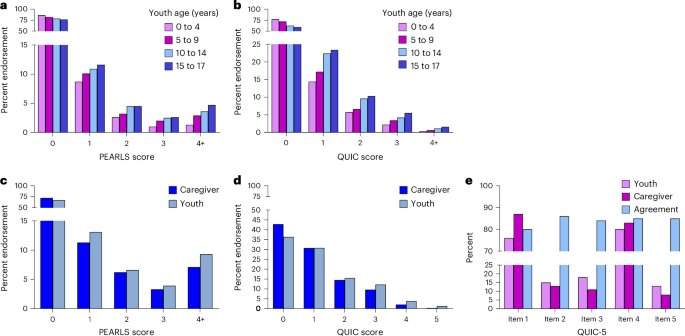
For all ages, 0–17 years (Table 1), older children experienced, on average, more exposure to both ACEs and unpredictability (Fig. 1a,b). Notably, exposure to at least one ACE (13%) or at least one form of unpredictability (23%) was observed even among the youngest children at ages 0–4 years. In addition, youths generally reported more exposures to both ACEs and unpredictability than did caregivers (Fig. 1c,d). The correlation between youth and caregiver reports was 0.64 for PEARLS and 0.54 for the five-item Questionnaire on Unpredictability in Childhood (QUIC-5) (P < 0.001 for both). Further evidence of the validity of the QUIC-5 screen is provided by the strong agreement of specific item endorsement between youth and caregiver ranging from 0.8 to 0.85. (Fig. 1e). Finally, scores on the two screens were associated: the correlation between QUIC-5 and PEARLS was 0.51 for child report and 0.43 for caregiver report (P < 0.001 for both).
a,b, The distribution of scores across child age for PEARLS (a) and QUIC-5 (b), based on the caregiver report, which is available for all ages. c,d, A comparison of the distribution of ACEs (PEARLS) (c) and unpredictability (QUIC-5) (d) for caregiver report and youth self-report, the latter for age 12 years and above. e, The agreement of item endorsement between youth and caregiver reports on the QUIC-5
Both ACEs and unpredictability screens portend mental health and somatic symptoms
Increasing exposures to ACEs, assessed with PEARLS, and to unpredictability, measured with QUIC-5, associated with a higher probability of a mental health problem (depression, anxiety, externalizing problems and sleep disorder) and somatic symptoms (abdominal pain and headache). This was true for reports by both youth (Fig. 2) and caregivers. Across diagnoses, the associations were generally dose-dependent, with odds ratios (ORs) increasing with each additional exposure (ORs and confidence intervals (CIs) are provided for both reporters for all outcomes in Supplementary Tables 1 and 2). For youth self-report, the ORs for those with 4 or more exposures compared with those with zero ranged from 1.7 to 7.2 for PEARLS and 1.6 to 6.1 for QUIC-5. The range of ORs for caregiver reports was similar in magnitude. Running the same analyses with adjustments for private versus public insurance (a proxy for socioeconomic status) did not substantively alter these associations (Supplementary Tables 3 and 4).
The figure depicts results from the youth self-report. ORs and 95% CIs are shown. CIs that do not cross the line indicate a statistically significant increased risk (see Supplementary Tables 1 and 2 for the ORs and CIs for both youth and caregiver)
Measuring unpredictability uncovers children at risk for mental health problems that are not detected by ACEs screens
The correlation between PEARLS and QUIC-5 scores raised the question of whether including screening for unpredictability adds any value for predicting child health outcomes beyond that obtained from PEARLS alone. To address this question, we conducted two types of analyses. First, we determined the adjusted ORs for both QUIC-5 and PEARLS in logistic regressions in which continuous scores for both were concurrently included as predictors of youth mental health problems and somatic symptoms (Fig. 3 and Supplementary Tables 5 and 6). For most mental and somatic health diagnoses examined, both PEARLS and QUIC-5 provided unique predictive contributions (given that the other is also in the logistic regression model), and the predictive powers (ORs) were similar. For sleep disorders, QUIC-5 was a notably stronger predictor of the increased probability of a diagnosis than PEARLS (Fig. 3).
The results are similar for caregiver report. ORs and 95% CIs are shown (see Supplementary Tables 5 and 6 for numerical values). CIs that do not cross the line indicate statistically significant increased risk
Indeed, QUIC-5 identified a significant risk for mental health problems that was not captured by PEARLS screen alone, as uncovered with the use of the second independent analytic approach: taking depression as an example, the ORs for this diagnosis associated with all possible combinations of QUIC-5 and PEARLS scores were calculated, generating a ‘heat map’. As shown in Fig. 4, top, children with a score of 4 or more on PEARLS had a significantly increased risk of depression: The OR for a PEARLS score of 4 or more and a QUIC-5 score of zero was 7.9, consistent with prevailing knowledge about the contribution of ACEs to subsequent depression. Surprisingly, for the subpopulation (50 children) with PEARLS score of zero and a high QUIC-5 score (4+), the risk for developing depression was 11.7-fold higher compared with the risk of a child who scored a zero on both screens. This fact indicates that the QUIC-5 identifies children at risk for depression that would be missed by the use of current ACEs tools alone. It also bolsters the idea that, independent of other ACEs, unpredictability is a potent harbinger of mental health problems.
ORs and 95% CIs are shown. If the lower end of the CI is greater than 1, this indicates a statistically significant increased risk. Examples shown here are for youth self-report. Results for both youth and caregiver reports for all diagnoses can be found in Supplementary Figs. 1 and 2. LE, less than; GE, greater than
This observation was not unique to depression. For example, a child with a high score on PEARLS (4 or more) and with a score of 1 on QUIC-5 was not at increased risk of a sleep disorder (Fig. 4, bottom). Similarly, the increased risk for a sleep disorder generated by a high QUIC-5 score with low PEARLS score (0) was not significant. However, a child with both high PEARLS and QUIC-5 scores (that is, 3 or 4+ on both) was significantly more likely to have a sleep disorder diagnosis than a child with zero scores. Heat maps for all diagnoses as well as the numbers of children who fall in each cell can be found in Supplementary Figs. 1 and 2.
Discussion
The current studies, conducted with more than 29,000 children at 19 pediatric clinics, have yielded several findings. First, large-scale, systematic screening for ACEs and for early-life unpredictability is feasible in busy primary care settings within a broad range of communities. Throughout these communities, exposure to adversity measured with both QUIC-5 and PEARLS is prevalent even among the youngest children and increases with age. In comparing the two screens, QUIC-5 predicts mental and physical health outcomes at least as well, and in some cases better, than current ACEs screens. Crucially, for some mental health problems (for example depression, sleep disorders), QUIC-5 identifies risk that is not captured by PEARLS screen alone. Because unpredictability of early-life experiences might be amenable to intervention, recognizing its impact on children’s mental health outcomes is a critical prerequisite for devising potential intervention and mitigation approaches.
Orange County, California, USA, the location of the current studies, is home to over 3 million people. CHOC is the dominant healthcare provider in the county. Children receiving well-child and healthcare at the large network of CHOC clinics, and thus included in the current studies, are fully reflective of the county and state’s population and represent a broad range of socioeconomic, ethnic and cultural backgrounds41. In addition, the questionnaires were administered during all well-child visits at all clinics, eliminating a potential bias for illness or ‘convenience’ samples. These facts suggest that both the feasibility of the screening and the associations we observed with child health outcomes are likely to be broadly applicable.
As expected based on a robust literature1,2,3,4,5,8,9,10,11,12,13,14,15,19,42, exposure to more ACEs captured by screening in pediatric primary care clinics exhibited a graded relationship with risk of a mental health diagnosis. These clear associations have been the impetus for addressing ACEs, aiming to either prevent abuse and neglect43 or mitigate their consequences8,9,10,11,12,13,14,15,44,45. Prevention of ACEs is a daunting task, and studies aiming to provide fiscal support to families with infants have only been partially successful43,46. Alternative approaches have included interventions to combat the effects of ACEs on neurodevelopment or on manifestations of altered stress-responses, anxiety and other mental and physical health issues triggered by ACEs10,47,48,49,50,51,52,53.
Here, we identify unpredictability of a child’s parental and environmental input as an actionable ACE: introducing predictability into a child’s world may exert protective influences on child development and buffer children from adversity54,55. For example, in families experiencing poverty, parental substance use disorders or divorce, family routines predict child resilience56,57,58. Furthermore, during the coronavirus disease 2019 pandemic, a significant stressor that had major impacts on children’s mental health, those children living in families that maintained predictable routines were largely spared the increased oppositional behavior and externalizing symptoms inflicted by pandemic-related disruption on other preschoolers55.
How unpredictability influences brain maturation, leading to vulnerability to mental health problems59,60, is not fully resolved. For established ACEs, alterations in maturation of specific brain networks (for example, amygdala–prefrontal cortex6,61,62,63,64) have been reported, and the specific alterations may depend on the dimensions of the ACES and their timing4,21,63,65. Altered connectivity of distinct brain nodes has also been shown for unpredictability, including major connections between temporal and frontal regions, and functional responses of hippocampus and amygdala to novelty66,67,68. Although information about the impact of ACEs in children has been accumulating for decades, our understanding of how unpredictability may interfere with the fine-tuning of functional connectivity of the developing brain, leading to symptoms of mental health problems, is in its infancy21. A plausible hypothesis, being tested in experimental animal models21,25, suggests that predictable sequences of parental and family signals to the child, manifesting as structure in family life and consistent responses and behaviors from parents, may be important as they activate—and thus promote healthy maturation of—brain circuits involved in reward and safety21. This creates a solid, foundation for exploration and healthy development7,29,69.
For the majority of child health outcomes examined, the ACEs screen and QUIC-5 provide similar degrees of association (Fig. 2). However, the QUIC provides critical additional power to detect risk (Figs. 3 and 4). For sleep disorders, for example, QUIC-5 was superior in risk identification compared with PEARLS. For depression, the contribution of a high QUIC-5 score to the risk of diagnosis (a roughly 12-fold increase with a QUIC-5 score of 4 or above) is striking (Fig. 4 and Supplementary Fig. 1). It is notable that this large effect size is present among individuals with minimal ‘typical’ ACEs, that is, with low scores on PEARLS. These individuals would thus not be identified as high-risk by current screens, potentially leading to missed opportunities for early intervention. The association of unpredictability with sleep disorders is not entirely surprising as optimal sleep is partially dependent on predictable family structure45. Together, these findings highlight the value of delineating both the shared and unique contributions of different forms of early-life adversity to individual mental illness. This paves the path for a more granular understanding of individual exposures and the mechanisms through which those exposures operate.
Indeed, in the case of unpredictable childhood experiences, there are multiple opportunities for prevention and intervention, including the prospect of multilevel intervention54,69. These range from the level of the individual (for example, altering caregiver attitudes regarding the importance of predictability), to the family systems level (for example, implementing family routines), to the public policy level (for example, adoption of Fair Work Week regulations that address precarious parental work schedules)54. Addressing the full range of ACEs should be a top priority to improve the well-being of children and families.
A limitation of the study lies in the use of ORs, which describe relative but not absolute risk for any adverse outcome. Second, we rely on child health diagnoses derived from electronic health records. Given the cross-sectional study design, it is not possible to disentangle the temporal relations between exposures and diagnoses. Further, we are unable to probe the associations between exposures and subclinical symptom profiles, which are highly likely. Future studies will explore how structural and social determinants of health influence exposures to unpredictability and their associations with mental health. This is of particular importance because structural determinants of both ACEs and unpredictability are not evenly distributed and individuals of historically and currently marginalized and systematically excluded backgrounds are at disproportionate risk for these exposures70,71,72.
In summary, we demonstrate that large-scale systematic screening for both ACEs and early-life unpredictability is feasible in primary care clinics serving a broad range of communities. Exposures to adversities detected by these distinct instruments are prevalent even among the youngest children, and both screens predict mental health outcomes and are complementary. Notably, QUIC-5 portends child outcomes and identifies risk for mental health problems that is not captured by the ACEs screen. These findings suggest that adding a screen for unpredictability will1 identify children at risk that will be otherwise missed2 and may provide an opportunity for monitoring and counseling intervention in the pediatric primary care setting, with the potential to make meaningful positive impacts on children’s mental health.
Methods
Study setting and participants
This study took place in 19 pediatric primary care clinics affiliated with CHOC that serve a diverse community of children in Orange County, California, USA (see Table 1 for an overview of demographics). Our research complied with all relevant ethical regulations and was approved by the Children’s Hospital of Orange County In-House Institutional Review Board (#2109123). The primary care clinics implemented routine ACEs screening for all children at their annual well-child visits starting in 2020. Supported by funding from the California Initiative to Advance Precision Medicine73, we initiated an optional screening for unpredictability in 2021, and the current study analyzes screens obtained during 2021–2024. After appropriate consent and assent procedures, caregivers filled out both screens, providing information about their child, and the screens were also administered to children aged 12 years and over. Inclusion criteria for the study included: (1) completion of the QUIC-5 screen, (2) child aged 0–17 years and (3) English or Spanish language preference. Here, we present data for the first 29,861 children screened for both ACEs and unpredictability.
Assessment of ACEs
ACEs were assessed with the face-valid PEARLS74. Following current state recommendations, we examined the score for part 1, which focuses on ten ACEs yielding a potential score of 0 to 10. Current protocols at the CHOC pediatric primary care clinics utilize the aggregated or deidentified version of PEARLS in which the respondent provides a count of the number of items positively endorsed without specification of the individual items contributing to these scores. PEARLS scores are then made available in electronic health records.
Assessment of unpredictability
Unpredictability was assessed with QUIC-540,75,76 (Supplementary Table 7) an abbreviated version of the full-length QUIC, which broadly assesses unpredictability in a child’s social, emotional and physical environments. At the well-child visit, caregiver and child (based on age) were given the opportunity to complete the unpredictability screen. The QUIC-5, on which scores range from 0 to 5, is correlated on average 0.84 with the full-length QUIC40,75. Further, validation work in four independent cohorts that spanned gender, socioeconomic groups, multiple languages and ages from 11 to 70 years showed that QUIC-5 predicted mental health outcomes with virtually identical effect sizes to the full-length QUIC.
Mental health and somatic symptoms
Mental health conditions and somatic symptoms that have strong stress-related and behavioral components and have been previously identified as common outcomes of exposure to early-life adversity in pediatric populations were selected for evaluation1,2,3,4,5,6,7,8,14,15,42,77. The presence or absence of the following conditions in each child’s electronic medical record before or concurrent with the well-child visit at which the screen was conducted were obtained: depression, externalizing problems, sleep disorders, anxiety, headache and abdominal pain. Specific International Classification of Diseases (ICD)-10 codes for each diagnosis and the incidence of each diagnosis in Supplementary Table 8.
Analytic approaches
Analyses were conducted in IBM SPSS version 31. For both QUIC-5 and PEARLS, separate binary logistic regressions were conducted to examine the associations between caregiver and youth reports with mental health outcomes. In these regressions, scores on both screens were categorized as 0, 1, 2, 3 and 4+. To consider the possibility that youth and caregivers reports were incongruent and could differ in predictive power, we also analyzed separately the caregiver and child questionnaires that we obtained for participants aged 12 and older: we examined the distributions of caregiver and youth endorsements on PEARLS and QUIC-5, examined the concordance by item on the QUIC (for which item-level data were available) and performed bivariate correlations to determine the degree of association between youth and caregiver reports for each screen.
We then computed the correlation between PEARLS and QUIC-5, and, to determine whether the QUIC adds predictive power to PEARLS, we used two approaches: (1) QUIC and PEARLS scores (continuous) were entered simultaneously into binary logistic regressions predicting mental health and somatic symptoms outcomes; and (2) in a second set of binary logistic regressions, we examined the independent contributions of all possible combinations of QUIC (0, 1, 2, 3 and 4+) and PEARLS scores (0, 1, 2, 3 and 4+) to these outcomes, generating a ‘heat map’ and setting a score of 0 on each screen as reference. All regression models adjusted for child gender and age (with both linear and quadratic terms considered, as appropriate), and determination of statistical significance was two-sided.
Reporting summary
Further information on research design is available in the Nature Portfolio Reporting Summary linked to this article
Data availability
De-identified data will be shared with investigators upon receipt of well-justified request because these involve clinical diagnoses of a sensitive population (children). Requests should be submitted to one of the corresponding authors, L.M.G., at lglynn@chapman.edu, and the reply will be had within 2 weeks
Code availability
There was no code available for this study
References
Felitti, V. J. et al. Relationship of childhood abuse and household dysfunction to many of the leading causes of death in adults. Am. J. Prev. Med.14, 245–258 (1998)
Hughes, K. et al. The effect of multiple adverse childhood experiences on health: a systematic review and meta-analysis. Lancet Public Health2, e356–e366 (2017)
Peterson, C. et al. Economic burden of health conditions associated with adverse childhood experiences among US adults. JAMA Netw. Open6, e2346323 (2023)
Sheridan, M. A. & McLaughlin, K. A. Dimensions of early experience and neural development: deprivation and threat. Trends Cogn. Sci.18, 580–585 (2014)
Garner, A. S. & Shonkoff, J. P. Early childhood adversity, toxic stress, and the role of the pediatrician: translating developmental science into lifelong health. Pediatrics129, e224–e231 (2012)
Tottenham, N. & Sheridan, M. A. A review of adversity, the amygdala and the hippocampus: a consideration of developmental timing. Front. Hum. Neurosci.3, 68 (2009)
Smith, K. E. & Pollak, S. D. Early life stress and development: potential mechanisms for adverse outcomes. J. Neurodev. Disord.12, 34 (2020)
Jeung, J. et al. A caregiver-child intervention for mitigating toxic stress (‘the resiliency clinic’): a pilot study. Matern. Child Health J.26, 1959–1966 (2022)
Luby, J. L., Baram, T. Z., Rogers, C. E. & Barch, D. M. Neurodevelopmental optimization after early-life adversity: cross-species studies to elucidate sensitive periods and brain mechanisms to inform early intervention. Trends Neurosci.43, 744–751 (2020)
Slopen, N., McLaughlin, K. A. & Shonkoff, J. P. Interventions to improve cortisol regulation in children: a systematic review. Pediatrics133, 312–326 (2014)
Purewal Boparai, S. K. et al. Ameliorating the biological impacts of childhood adversity: a review of intervention programs. Child Abuse Negl.81, 82–105 (2018)
Gilgoff, R., Singh, L., Koita, K., Gentile, B. & Marques, S. S. Adverse childhood experiences, outcomes, and interventions. Pediatr. Clin. North Am.67, 259–273 (2020)
Campbell, T. S., Donoghue, K. M., Ghosh, U., Nelson, C. M. & Roth, T. L. Early life stress affects bdnf regulation: a role for exercise interventions. Int. J. Mol. Sci.23, 11729 (2022)
Cohen, Z. P. et al. The effect of a mindfulness-based stress intervention on neurobiological and symptom measures in adolescents with early life stress: a randomized feasibility study. BMC Complement. Med. Ther.21, 123 (2021)
Slomine, B. S. & Copeland-Linder, N. Early-life adversity and executive functioning-highlighting an urgent need for identification, prevention, and intervention in childhood. JAMA Pediatr.175, e212517 (2021)
Underwood, E. California Has Begun Screening for Early Childhood Trauma, but Critics Urge Caution (American Association for the Advancement of Science, 2020)
Baldwin, J. R. et al. Population vs individual prediction of poor health from results of adverse childhood experiences screening. JAMA Pediatr.175, 385–393 (2021)
Meehan, A. J., Baldwin, J. R., Lewis, S. J., MacLeod, J. G. & Danese, A. Poor individual risk classification from adverse childhood experiences screening. Am. J. Prev. Med.62, 427–432 (2022)
Anda, R. F., Porter, L. E. & Brown, D. W. Inside the Adverse Childhood Experience score: strengths, limitations, and misapplications. Am. J. Prev. Med.59, 293–295 (2020)
McLennan, J. D., Gonzalez, A., MacMillan, H. L. & Afifi, T. O. Routine screening for adverse childhood experiences (ACEs) still doesn’t make sense. Child Abuse Negl.https://doi.org/10.1016/j.chiabu.2024.106708 (2024)
Birnie, M. T. & Baram, T. Z. The evolving neurobiology of early-life stress. Neuron113, 1474–1490 (2025)
Demaestri, C. et al. Rematernal care sequences in mice and both upregulate Crh-associated gene expression in the amygdala. Neurobiol. Stress20, 100484 (2022)
Molet, J. et al. Fragmentation and high entropy of neonatal experience predict adolescent emotional outcome. Transl Psychiatry6, e702 (2016)
Kooiker, C. L., Chen, Y., Birnie, M. T. & Baram, T. Z. Genetic tagging uncovers a robust, selective activation of the thalamic paraventricular nucleus by adverse experiences early in life. Biol. Psychiatry Glob. Open Sci.https://doi.org/10.1016/j.bpsgos.2023.01.002 (2023)
Birnie, M. T. & Baram, T. Z. Principles of emotional brain circuit maturation. Science376, 1055–1056 (2022)
Davis, E. P. et al. Exposure to unpredictable maternal sensory signals influences cognitive development across species. Proc. Natl Acad. Sci. USA114, 10390–10395 (2017)
Davis, E. P. et al. Early life exposure to unpredictable parental sensory signals shapes cognitive development across three species. Front. Behav. Neurosci.16, 960262 (2022)
Davis, E. P. et al. Across continents and demographics, unpredictable maternal signals are associated with children’s cognitive function. EBioMedicine46, 256–263 (2019)
Xu, Y., Harms, M. B., Green, C. S., Wilson, R. C. & Pollak, S. D. Childhood unpredictability and the development of exploration. Proc. Natl Acad. Sci. USA120, e2303869120 (2023)
Furtado, E. J., Camacho, M. C., Chin, J. H. & Barch, D. M. Complex emotion processing and early life adversity in the Healthy Brain Network sample. Dev. Cogn. Neurosci.70, 101469 (2024)
Howland, M. A. et al. Prenatal maternal mood entropy is associated with child neurodevelopment. Emotion21, 489–498 (2021)
Short, A. K. et al. Individual longitudinal changes in DNA-methylome identify signatures of early-life adversity and correlate with later outcome. Neurobiol. Stress31, 100652 (2024)
Davis, E. P. & Glynn, L. M. Annual Research Review: the power of predictability—patterns of signals in early life shape neurodevelopment and mental health trajectories. J. Child Psychol. Psychiatry65, 508–534 (2024)
Spadoni, A. D. et al. Contribution of early-life unpredictability to neuropsychiatric symptom patterns in adulthood. Depress. Anxiety39, 706–717 (2022)
Hunt, C. et al. Childhood unpredictability is associated with increased risk for long- and short-term depression and anhedonia symptoms following combat deployment. J. Mood Anxiety Disord.6, 100045 (2024)
Gillespie, M. L. & Rao, U. Relationships between depression and executive functioning in adolescents: the moderating role of unpredictable home environment. J. Child Fam. Stud.31, 2518–2534 (2022)
Mittal, C., Griskevicius, V., Simpson, J. A., Sung, S. & Young, E. S. Cognitive adaptations to stressful environments: When childhood adversity enhances adult executive function. J. Pers. Soc. Psychol.109, 604–621 (2015)
Glynn, L. M. et al. Prenatal maternal mood patterns predict child temperament and adolescent mental health. J. Affect. Disord.228, 83–90 (2018)
Golden, C. V. et al. Age, adverse childhood experiences, and health care utilization. Pediatricshttps://doi.org/10.1542/peds.2023-064838 (2024)
Lindert, N. G. et al. Exposure to unpredictability and mental health: validation of the brief version of the Questionnaire of Unpredictability in Childhood (QUIC-5) in English and Spanish. Front. Psychol.13, 971350 (2022)
Child population, by race/ethnicity 2024. KidsDatahttps://kidsdata.org/topic/33/child-population-race/Pie#fmt=144&loc=2&tf=141&ch=7,11,70,10,72,9,73&pdist=73 (2024)
Oh, D. L. et al. Systematic review of pediatric health outcomes associated with childhood adversity. BMC Pediatr.18, 83 (2018)
Hart, E. R. et al. Mothers with low incomes view both individual and structural interventions as potentially helpful for supporting early child development. Sci. Rep.14, 18374 (2024)
Reemst, K. et al. Molecular underpinnings of programming by early-life stress and the protective effects of early dietary omega6/omega3 ratio, basally and in response to LPS: integrated mRNA-miRNAs approach. Brain Behav. Immun.117, 283–297 (2024)
Mindell, J. A., Li, A. M., Sadeh, A., Kwon, R. & Goh, D. Y. Bedtime routines for young children: a dose-dependent association with sleep outcomes. Sleep38, 717–722 (2015)
Troller-Renfree, S. V. et al. The impact of a poverty reduction intervention on infant brain activity. Proc. Natl Acad. Sci. USAhttps://doi.org/10.1073/pnas.2115649119 (2022)
Jonkman, C. S. et al. Effects of Multidimensional Treatment Foster Care for Preschoolers (MTFC-P) for young foster children with severe behavioral disturbances. J. Child Fam. Stud.26, 1491–1503 (2017)
Houtepen, L. C. et al. Genome-wide DNA methylation levels and altered cortisol stress reactivity following childhood trauma in humans. Nat. Commun.7, 10967 (2016)
de Mendonca Filho, E. J. et al. Stress JPBRNoT. Linking specific biological signatures to different childhood adversities: findings from the HERO project. Pediatr. Res.94, 564–574 (2023)
McLaughlin, K. A. et al. Causal effects of the early caregiving environment on development of stress response systems in children. Proc. Natl Acad. Sci. USA112, 5637–5642 (2015)
Ouellet-Morin, I. et al. Blunted cortisol responses to stress signal social and behavioral problems among maltreated/bullied 12-year-old children. Biol. Psychiatry70, 1016–1023 (2011)
Hunter, A. L., Minnis, H. & Wilson, P. Altered stress responses in children exposed to early adversity: a systematic review of salivary cortisol studies. Stress14, 614–626 (2011)
Brotman, L. M. et al. Effects of a psychosocial family-based preventive intervention on cortisol response to a social challenge in preschoolers at high risk for antisocial behavior. Arch. Gen. Psychiatry64, 1172–1179 (2007)
Glynn, L. M., Liu, S. R., Lucas, C. T. & Davis, E. P. Leveraging the science of early life predictability to inform policies promoting child health. Dev. Cogn. Neurosci.69, 101437 (2024)
Glynn, L. M., Davis, E. P., Luby, J. L., Baram, T. Z. & Sandman, C. A. A predictable home environment may protect child mental health during the COVID-19 pandemic. Neurobiol. Stress14, 100291 (2021)
Betancourt, T. S., Meyers-Ohki, S. E., Charrow, A. & Hansen, N. Annual Research Review: mental health and resilience in HIV/AIDS-affected children—a review of the literature and recommendations for future research. J. Child Psychol. Psychiatry54, 423–444 (2013)
Crespo, C. et al. Family routines and rituals in the context of chronic conditions: a review. Int. J. Psychol.48, 729–746 (2013)
Guidubaldi, J., Cleminshaw, H. K., Perry, J. D., Nastasi, B. K. & Lightel, J. The role of selected family environment factors in children’s post-divorce adjustment. Fam. Relat.35, 141–151 (1986)
Harhen, N. C. & Bornstein, A. M. Interval timing as a computational pathway from early life adversity to affective disorders. Top. Cogn. Sci.16, 92–112 (2024)
Hardy, M. & Baram, T. Z. The importance of predictability in the early-life environment for neurodevelopment and mental health. Annu. Rev. Dev. Psychol. (in the press)
VanTieghem, M. et al. Longitudinal changes in amygdala, hippocampus and cortisol development following early caregiving adversity. Dev. Cogn. Neurosci.48, 100916 (2021)
Gee, D. G. et al. Early developmental emergence of human amygdala-prefrontal connectivity after maternal deprivation. Proc. Natl Acad. Sci. USA110, 15638–15643 (2013)
Teicher, M. H., Samson, J. A., Anderson, C. M. & Ohashi, K. The effects of childhood maltreatment on brain structure, function and connectivity. Nat. Rev. Neurosci.17, 652–666 (2016)
Barch, D. et al. Effect of hippocampal and amygdala connectivity on the relationship between preschool poverty and school-age depression. Am. J. Psychiatry173, 625–634 (2016)
Sisk, L. M. et al. Multivariate links between the developmental timing of adversity exposure and white matter tract connectivity in adulthood. Biol. Psychiatry Cogn. Neurosci. Neuroimaginghttps://doi.org/10.1016/j.bpsc.2025.02.003 (2025)
Granger, S. J. et al. Aberrant maturation of the uncinate fasciculus follows exposure to unpredictable patterns of maternal signals. J. Neurosci.41, 1242–1250 (2021)
Davis, E. P. et al. Sex-specific effects of early-life unpredictability on hippocampal and amygdala responses to novelty in adolescents. Biol. Psychiatry Glob. Open Sci.5, 100561 (2025)
Jirsaraie, R. J. et al. Prenatal exposure to maternal mood entropy is associated with a weakened and inflexible salience network in adolescence. Biol. Psychiatry Cogn. Neurosci. Neuroimaging9, 207–216 (2024)
Paskett, E. et al. Multilevel interventions to address health disparities show promise in improving population health. Health Aff.35, 1429–1434 (2016)
Allwood, M. A., Ford, J. D. & Levendosky, A. Introduction to the special issue: disproportionate trauma, stress, and adversities as a pathway to health disparities among disenfranchised groups globally. J. Trauma Stress34, 899–904 (2021)
Williams, D. R. Stress and the mental health of populations of color: advancing our understanding of race-related stressors. J. Health Soc. Behav.59, 466–485 (2018)
Liu, S. R., Kia-Keating, M., Santacrose, D. E. & Modir, S. Linking profiles of neighborhood elements to health and related outcomes among children across the United States. Health Place53, 203–209 (2018)
California Initiative to Advance Precision Medicine 2016 (California Health and Human Services, 2026); https://www.chhs.ca.gov/blog/2026/06/08/50505/
Thakur, N. et al. Pediatrics adverse childhood experiences and related life events screener (PEARLS) and health in a safety-net practice. Child Abuse Negl.108, 104685 (2020)
Glynn, L. M. et al. Measuring novel antecedents of mental illness: the Questionnaire of Unpredictability in Childhood. Neuropsychopharmacology44, 876–882 (2019)
Liu, S. R. et al. The QUIC-SP: a Spanish language tool assessing unpredictability in early life is linked to physical and mental health. PLoS ONE20, e0298296 (2025)
Anderson, S. E. & Whitaker, R. C. Association of self-regulation with obesity in boys vs girls in a US national sample. JAMA Pediatr.172, 842–850 (2018)
Acknowledgements
We are grateful to the families who participated, to the valuable guidance provided by the SoCal Kids Study Community Advisory Board, to the dedicated staff at the Early Human and Lifespan Development Program and CHOC whose efforts made this work possible, and to J. McCall and D. Reiner of the California Initiative for Precision Medicine for their inspiration and support
Funding
This work was funded by the California Initiative to Advance Precision Medicine and the National Institutes of Health (grant nos. P50 MH96889; MH132680) with support from the CHOC Neuroscience Institute, the Bren and Shepard Foundations and a generous gift from Syntropy Technologies LLC
Author information
Authors and Affiliations
Department of Psychology, Chapman University, Orange, CA, USA
Laura M. Glynn
Department of Psychology, California State University, San Marcos, San Marcos, CA, USA
Sabrina R. Liu
Children’s Hospital of Orange County, Orange, CA, USA
Charles Golden, Michael Weiss & Louis Ehwerhemuepha
Department of Pediatrics, University of California, Irvine, Irvine, CA, USA
Charles Golden, Michael Weiss, Candice Taylor Lucas, Dan M. Cooper, Louis Ehwerhemuepha & Tallie Z. Baram
Department of Statistics, University of California, Irvine, Irvine, CA, USA
Hal S. Stern
Department of Anatomy and Neurobiology, University of California, Irvine, Irvine, CA, USA
Tallie Z. Baram
Department of Neurology, University of California, Irvine, Irvine, CA, USA
Tallie Z. Baram
Authors
- Laura M. GlynnView author publications
Search author on:PubMed Google Scholar
- Sabrina R. LiuView author publications
Search author on:PubMed Google Scholar
- Charles GoldenView author publications
Search author on:PubMed Google Scholar
- Michael WeissView author publications
Search author on:PubMed Google Scholar
- Candice Taylor LucasView author publications
Search author on:PubMed Google Scholar
- Dan M. CooperView author publications
Search author on:PubMed Google Scholar
- Louis EhwerhemuephaView author publications
Search author on:PubMed Google Scholar
- Hal S. SternView author publications
Search author on:PubMed Google Scholar
- Tallie Z. BaramView author publications
Search author on:PubMed Google Scholar
Contributions
L.M.G. and T.Z.B. conceived of and planned the studies. L.M.G., S.R.L., C.G., M.W. and C.T.L. performed the studies, with input from D.M.C. and T.Z.B. L.M.G., S.R.L. H.S.S. and T.Z.B. analyzed data with input from L.E. L.M.G., H.S.S. and T.Z.B. wrote the study, and all authors contributed to editing
Ethics declarations
Competing interests
The authors declare no conflicts of interest
Peer review
Peer review information
Nature Mental Health thanks Mercie Digangi and the other, anonymous, reviewer(s) for their contribution to the peer review of this work
Additional information
Publisher’s note Springer Nature remains neutral with regard to jurisdictional claims in published maps and institutional affiliations
Supplementary information
Reporting Summary (download PDF )
Supplementary Fig. 1 (download JPG )
Combined predictive contributions (youth self-report). Data summary of the combined and unique predictive contributions of PEARLS and QUIC-5 for youth self-report
Supplementary Fig. 2 (download JPG )
Combined predictive contributions (caregiver report). Data summary of the combined and unique predictive contributions of PEARLS and QUIC-5 for caregiver report
Supplementary Table 1 (download PDF )
Caregiver reports predict child mental health. Caregiver report on PEARLS (n = 20,261) and QUIC (n = 26,804) screens predict child mental health conditions
Supplementary Table 2 (download PDF )
Youth self-reports predict mental health. Youth self-report on PEARLS (n = 8,906) and QUIC (n = 9,870) screens predict mental health conditions
Supplementary Table 3 (download PDF )
Caregiver reports predict child mental health after adjustment for socioeconomic status. Caregiver report on PEARLS (n = 20,261) and QUIC (n = 26,804) screens predict child mental health conditions adjusting for socioeconomic status
Supplementary Table 4 (download PDF )
Youth self-reports predict mental health after adjustment for socioeconomic status. Youth self-report on PEARLS (n = 8,906) and QUIC (n = 9,870) screens predict mental health conditions after adjusting for socioeconomic status
Supplementary Table 5 (download PDF )
Independent contributions of ACEs and unpredictability to child mental health (caregiver). Binary logistic regressions with PEARLS and QUIC caregiver scores (continuous) concurrently entered as predictors (n = 18,486)
Supplementary Table 6 (download PDF )
Independent contributions of ACEs and unpredictability to child mental health (youth self-report). Binary logistic regressions with PEARLS and QUIC youth scores (continuous) concurrently entered as predictors (n = 7,149)
Supplementary Table 7 (download PDF )
QUIC-5 Items. The Questionnaire on Unpredictability in Childhood brief version (QUIC-5)40
Supplementary Table 8 (download PDF )
Incidence of child health conditions. Incidence of child mental and somatic health diagnoses (ICD codes used for defining diagnoses shown in parentheses)
Rights and permissions
Open Access This article is licensed under a Creative Commons Attribution 4.0 International License, which permits use, sharing, adaptation, distribution and reproduction in any medium or format, as long as you give appropriate credit to the original author(s) and the source, provide a link to the Creative Commons licence, and indicate if changes were made. The images or other third party material in this article are included in the article’s Creative Commons licence, unless indicated otherwise in a credit line to the material. If material is not included in the article’s Creative Commons licence and your intended use is not permitted by statutory regulation or exceeds the permitted use, you will need to obtain permission directly from the copyright holder. To view a copy of this licence, visit http://creativecommons.org/licenses/by/4.0/.
About this article
Cite this article
Glynn, L.M., Liu, S.R., Golden, C. et al. Unpredictability is a childhood adversity that contributes to mental health problems.
Nat. Mental Health (2026). https://doi.org/10.1038/s44220-026-00681-x
Received:11 November 2025
Accepted:12 June 2026
Published:21 July 2026
Version of record:21 July 2026
DOI
:https://doi.org/10.1038/s44220-026-00681-x
