




Researchers are exploring whether anti-obesity drugs can deliver benefits beyond weight loss, extending to cardiovascular health, liver and brain function, and fertility. AI-generated image
The scope of use for the anti-obesity drug Wegovy (active ingredient semaglutide) is expanding beyond weight loss to include the prevention of cardiovascular disease, improvement of fatty liver, mental health benefits, and enhanced fertility.
Recently published studies suggest that drugs in the glucagon-like peptide-1 (GLP-1) class may offer additional health benefits across a range of conditions. However, many of these studies are still at the stage of early clinical trials or observational research, so large-scale clinical trials are needed to verify actual therapeutic effects
● Research moves beyond appetite suppression to diverse diseases
Wegovy and Ozempic are GLP-1 class drugs. They are widely used as anti-obesity medications that help with weight loss by reducing appetite and increasing satiety. More recently, intensive research has been conducted to confirm additional benefits beyond simple weight reduction, including cardiovascular disease prevention, fatty liver improvement, blood sugar control, and mental health
● “Eating the same amount” … a new obesity treatment strategy that boosts energy expenditure
While existing anti-obesity drugs mainly work by suppressing appetite, a new approach has been proposed that increases energy expenditure in the body to counter weight gain
An international research team including the Institute for Research in Biomedicine (IRB Barcelona) in Spain, the Karolinska Institute in Sweden, and the University of Houston in the United States used animal experiments to show that the protein neuritin 1, expressed in brown fat, increases energy expenditure and thereby suppresses weight gain. The findings were published on 4 September 2025 in the international journal Nature Communications
Brown fat is an adipose tissue that generates heat to maintain body temperature. The team found that neuritin 1 boosts mitochondrial activity in brown fat and promotes the expression of thermogenic genes, thereby increasing energy expenditure. In fact, mice genetically engineered to produce more neuritin 1 in brown fat consumed food and moved as usual, yet their energy expenditure increased. Their weight gain was suppressed, blood sugar control improved, liver inflammation decreased, and overall metabolic health was enhanced.
The researchers reported that higher neuritin 1 expression in humans is genetically associated with lower susceptibility to obesity, suggesting that neuritin 1 could eventually be developed into a treatment for obesity, type 2 diabetes, and fatty liver
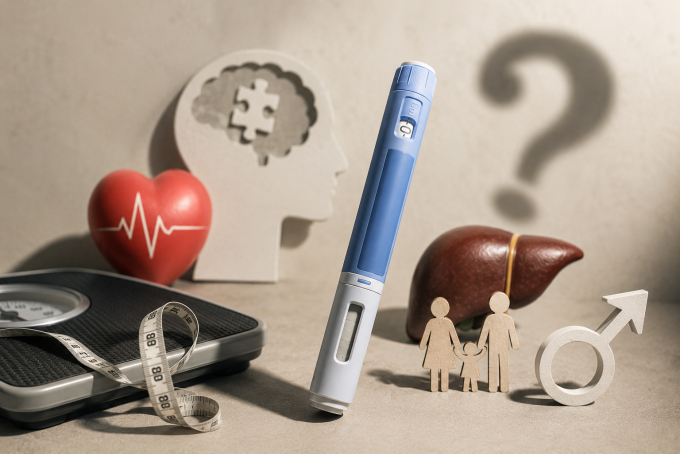
As evidence accumulates for health effects beyond weight loss, the potential applications of GLP-1 anti-obesity drugs are drawing increasing attention. AI-generated image
● Less craving for alcohol … potential treatment for alcohol use disorder
Another study suggested that GLP-1 class drugs may help reduce alcohol consumption. A research team at Virginia Tech in the United States found that GLP-1 anti-obesity medications slow the rate at which alcohol leaves the stomach and is absorbed into the bloodstream. The results were published on 15 October 2025 in the international journal Scientific Reports
In experiments where participants were given a fixed amount of alcohol, those who received GLP-1 drugs showed a slower rise in breath alcohol concentration compared with those who did not. In self-assessments, participants who received the drugs also reported feeling less intoxicated
The research team suggested that GLP-1 drugs may reduce cravings for alcohol and help lower consumption, and expressed hope that the findings would serve as foundational data for large-scale studies on treating alcohol use disorder
● Possible reduction in the risk of worsening depression and anxiety disorders
There have also been new findings related to mental health. A joint research team from the Finnish Institute for Health and Welfare and the University of Edinburgh in the UK conducted a long-term follow-up analysis of 95,490 Swedish adults with depression or anxiety disorders. The findings were published in the April 2026 issue of the international journal The Lancet Psychiatry
They found that during periods when the same individuals were taking semaglutide, the main ingredient of Wegovy and Ozempic, their risk of mental illness worsening was 42% lower than during periods when they were not taking the drug. The risk of worsening depression fell by 44%, anxiety disorders by 38%, and substance use disorders by 47%. When the analysis was extended to the entire GLP-1 drug class, the risk of self-harm was also 44% lower
However, the researchers cautioned that because this was an observational study, randomized clinical trials are needed to confirm the effects
● Can weight loss also improve male fertility?
Another study suggested that GLP-1 drugs might improve male fertility. A team at the University of Warwick in the UK conducted a meta-analysis of randomized controlled trials involving GLP-1 medications and found a tendency for testosterone levels to increase in obese men with hypogonadism. In some studies, the proportion of morphologically normal sperm in men receiving GLP-1 drugs rose from an average of 2% at baseline to 4% after treatment.
In addition, researchers at the Mayo Clinic in the United States analyzed electronic medical records from more than 1,600 men prescribed anti-obesity drugs and found that those treated with GLP-1 class drugs or GLP-1/GIP dual agonists had approximately 30% higher testosterone levels
The researchers explained that weight loss may help restore testosterone levels and improve sperm quality

Around the world, studies are underway to determine whether GLP-1 anti-obesity drugs can be used to treat a wide range of conditions beyond weight loss. AI-generated image
● Effects still being confirmed … more clinical trials needed
Taken together, the studies published so far suggest that GLP-1 anti-obesity drugs may offer positive potential beyond weight loss, including blood sugar control, fatty liver improvement, reduced alcohol use, better mental health, and improved male fertility
However, some of these findings come from animal experiments, observational studies, or early-stage clinical trials. Researchers consistently emphasize that to translate these various effects into actual treatments, large-scale randomized clinical trials and long-term follow-up studies involving more patients are essential
<Reference>
– doi.org/10.1038/s41467-025-62255-2
– doi.org/10.1038/s41598-025-17927-w
– doi.org/10.1016/S2215-0366(26)00014-3
Copyright ⓒ DongA Science. All rights reserved.
