


Download PDF
Abstract
Background
Although discrimination against individuals with higher body weights is prevalent both within and outside the United States, research has largely overlooked how cultural norms and gender shape the experiences of those individuals. While cross-cultural work on anti-fat attitudes has examined variations in the Negative Cultural Value of Fat (NCF), how perceptions of NCF and Perceived Weight Discrimination (PWD) jointly affect well-being among individuals with higher weights across different countries has not been examined. The present study focused on participants who self-identified as overweight, hypothesizing larger gender disparities in well-being in Portugal and Mexico than in the United States, partly due to higher PWD and NCF among women.
Methods
1865 participants from the United States (n = 676), Portugal (n = 616), and Mexico (n = 573) who self-identified as overweight completed an online survey lasting approximately 12 min (50% Women; Age: M = 34.6, SD = 12.44). The cross-sectional survey assessed PWD, NCF, Psychological Distress, and Difficulties in Emotion Regulation
Results
Mediational models for Psychological Distress (F(8,1856) = 83.96, p < 0.001, R² = 0.27) and Difficulties in Emotion Regulation (F(8,1856) = 82.51, p < 0.001, R² = 0.26) were significant. Gender had indirect effects on well-beingal and Mexico than in the United States. This indicates that cultural context moderates the association between gender, NCF, weight stigma, and mental health outcomes
Conclusions
Findings underscore NCF as a distinct and important construct in understanding the cultural dimensions of weight stigma and highlight the necessity of cross-cultural approaches to studying the mental health impacts of weight stigma
Subjects
- Risk factors
- Signs and symptoms
Weight stigma, defined as the social devaluation and denigration of individuals in larger bodies—encompassing experiences of discrimination, internalization of negative stereotypes, and awareness of bias based on one’s weight—has been extensively linked to adverse psychological and physical health outcomes [1,2,3,4]. However, little is known about how cultural factors shape these experiences. Current cross-cultural research on weight stigma has largely focused on nations culturally similar to the United States [5], and, to our knowledge, no study in the weight stigma literature has captured perceptions of cultural norms around having higher weights from the perspective of individuals who identify as part of that group. To address this critical gap, the present study introduces an important and novel contribution by directly examining how individuals with higher weights perceive their culture’s Negative Cultural Value of Fat [6]—a construct distinct from perceived discrimination or internalized/awareness of bias—and how this perception may affect their well-being. Furthermore, we explore for the first time how cultural norms around weight may differentially impact men and women outside of the United States and influence their well-being.
Within the United States, women are generally found to experience more frequent weight discrimination and greater psychological harm compared to men [7, 8], yet evidence remains mixed. These gender differences may be even bigger in countries where traditional gender roles and cultural body ideals are differentially enforced depending on gender [6, 9]. Thus, our study seeks to expand the literature by investigating cross-cultural gender differences in perceived weight discrimination and negative cultural value of fat. Additionally, we aimed to test how perceived weight discrimination and cultural norms around weight predict gender differences in well-being depending on nationality.
Perceived weight discrimination
Perceived weight discrimination, an individual’s perception of experiencing discrimination based on their weight (e.g., ref. [10]), is often viewed as an adverse emotional experience that introduces stress, especially among individuals with higher weights [11,12,13]. The theoretical framework of the Cyclic Obesity/Weight-Based Stigma (COBWEBS) model posits that such stress can contribute to a feedback loop, in which exposure to stigma can influence weight gain through a combination of behavioral, emotional, and physiological mechanisms, including changes in eating behavior and increased cortisol secretion [13, 14]. Importantly, this framework emphasizes that these processes are multifaceted and not uniform, reflecting complex stress responses rather than a simple or deterministic pathway from discrimination to eating behavior to weight gain [15,16,17,18,19].
Overall, Perceived Weight Discrimination has been linked to psychological distress such as challenges in emotional regulation (e.g., ref. [4]), heightened anxiety (e.g., ref. [3]), and increased depression (e.g. refs. [3, 11]). Additionally, it is also associated with higher levels of emotional eating and rigid restrained eating (e.g., refs. [12,13,14]), two primary contributors to disordered eating, including binge eating [20,21,22]
Weight stigma cross-culturally
Most of the research on the negative effects of perceived weight discrimination is conducted in the United States, with few studies having explored this issue internationally. Recent efforts have been made in exploring this construct in Eastern countries [23,24,25,26,27] and show similar patterns to the ones observed within the United States. However, cross-country comparisons with the United States remain limited. Existing Western comparisons that include the United States [5, 28,29,30] also report comparable findings, but these studies primarily focus on culturally similar countries, thereby limiting the extent to which conclusions drawn from the American literature can be generalized to more diverse global contexts. This gap is particularly important given the lack of measures that account for how cultural norms shape attitudes toward having a higher weight. While weight discrimination and obesity are widespread internationally [5, 31], we still have limited information on how cultural variations shape the experience of individuals with higher weights across different societies.
One construct that might help address that gap, Negative Cultural Value of Fat, has been introduced in the anti-fat attitudes literature. Negative Cultural Value of Fat captures the extent to which having higher weights is seen as a hindrance to attractiveness in a specific culture. A 2001 cross-cultural study tested differences in Negative Cultural Value of Fat in Collectivist vs Individualistic countries [6]. This work showed that both negative cultural attitudes toward fat and personal responsibility beliefs predicted anti-fat prejudice, with cultural differences in how these factors interacted [6, 32]. However, this research did not specifically examine the experiences of individuals with higher weights within these different cultural contexts.
Examining the Negative Cultural Value of Fat in that population may offer valuable insights for cross-cultural studies of weight stigma. In cultures with strong norms around weight, individuals with higher weights may experience worse well-being from violating these norms. Importantly, Negative Cultural Value of Fat provides a distinct approach to conceptualizing weight stigma. It differs from constructs like Perceived Weight Discrimination and other weight stigma constructs by focusing on individuals’ perceptions of their culture’s values.
Gender differences
When examining the role of gender, evidence from research conducted in the United States shows that women are more likely than men to perceive and experience weight-based discrimination, even when controlling for body mass index (BMI). For example, a study found that 30.2% of White women and 21.0% of Black women reported experiencing weight discrimination, compared to only 12.0% of White men and 11.5% of Black men, highlighting greater perceived discrimination among women across racial groups and BMI levels [33]. Another study similarly found that women reported more weight discrimination across employment, healthcare, and interpersonal settings. This trend likely reflects societal expectations placing greater value on women’s physical appearance, making deviations from thinness more socially penalized [34].
Perceived weight discrimination is also more strongly linked to negative well-being outcomes for women. A review shows higher depression levels among women experiencing weight discrimination [7, 35, 36]. Although findings related to anxiety are mixed, some evidence suggests that the psychological burden of weight stigma, including stress and emotion regulation difficulties, is often greater among women due to intensified societal pressures [7, 34]
Given these gender differences, it is critical to explore how experiences and consequences of weight stigma vary across nations. As beauty standards and markers of attractiveness differ across cultures [37], the value placed on body weight is also likely to vary. In societies with stricter gender norms, especially those that place greater emphasis on women’s appearance, cultural expectations surrounding body image may amplify the psychological toll for women who do not conform to such standards. As a result, perceived weight discrimination and the negative cultural value of fat may be especially consequential in these contexts.
The current study
The present study aims to extend the existing literature by (1) examining perceptions of the negative cultural value placed on higher body weight and its link to well-being in a novel population, and (2) investigating how gender and nationality shape experiences of weight stigmatization
Previous research has found that women express less anti-fat bias than men in collectivistic countries, while no significant gender differences emerge in more individualistic societies like the United States [6]. Similarly, a separate study suggested that women’s greater vulnerability to appearance-based judgments may explain their lower endorsement of anti-fat bias [38]. Building on this, we expect greater gender differences in perceived weight discrimination and perceived negative cultural value of fat in countries with more traditional gender norms compared to the United States. Consistent with the COBWEBS model, we hypothesize that deviating from rigid cultural norms may be especially burdensome for women, with perceived weight discrimination and negative cultural value of fat acting as key mediators between gender, nationality, and well-being outcomes.
To our knowledge, no prior study has directly examined how perceptions of negative cultural attitudes about higher body weights impact mental health across national contexts. To address this gap, we focus on Portugal, Mexico, and the United States. These countries were selected because prior research shows traditional gender norms are generally stronger in Portugal and Mexico than in the United States [9, 39], which may intensify weight-related pressures for women. Additionally, although weight stigma has been well studied in the United States, there is a lack of research on these issues in Portugal and Mexico [5].
We hypothesized that perceived weight discrimination and the negative cultural value of fat would vary by both gender and nationality, and that these differences would mediate variations in psychological distress and difficulties in emotion regulation
Method
Participants
Participants from the United States (n = 676), Portugal (n = 616), and Mexico (n = 573) were recruited separately through Prolific to participate in this study. To qualify, individuals were screened based on their agreement with the statement “I consider myself to be overweight”, rated on a 7-point Likert scale (1 = strongly disagree, 4 = neither agree nor disagree, 7 = strongly agree). Participants who selected a score of 5 (somewhat agree) or higher were included in the study. Overweight status perception was used instead of BMI, as research has shown it to be more predictive of negative outcomes [40]. Participants also had to self-report being fluent in English and being a native of the United States, Portugal, or Mexico and currently residing in their native country. A total sample of N = 1969 completed the survey. However, data from 104 individuals were excluded due to missing information on nationality, gender, age, key measures of interest, or not answering at least 2 attention checks correctly (4 total attention checks on the Portuguese and American samples, 3 attention checks in the Mexican Sample). Participants were also excluded if they reported an age not between 18 and 110. This resulted in a final combined sample of N = 1865 (934 Women, 931 Men; Age: M = 34.60, SD = 12.44, Range: 18–84; Nationality: 676 American, 616 Portuguese, 573 Mexican). The American sample was 78.8% White, 9% Black, 3.1% Latine, and 2.7% Asian. The remaining 6.4% identified either as mixed race or other. In the Portuguese sample, 95.3% of participants identified as White, 1.5% Latine, and 1% Black. The remaining 2.3% identified either as mixed race or other. In the Mexican sample, 53.2% of participants identified as Latine, 19.7% White, 6.6% American Indian, and 0.2% Black. The remaining 20.2% identified either as mixed race, other, or did not answer.
Procedure
This study was completed onlineort questionnaires measuring perceived weight discrimination, negative cultural value of fat, psychological distress, and difficulties in emotion regulation. The survey lasted approximately 12 min. Upon completion of the study, participants received monetary compensation and were thanked for their time
Measures
Mean, range, scale reliability, and correlations among variables can be found in Table 1
Perceived weight discrimination
Participants reported their personal experiences of weight-based prejudice and discrimination using 7 items [8]. Participants responded on a scale of 1(Strongly Disagree) and 7(Strongly Agree) to items such as “I experience discrimination because of my weight.” An average was computed across these items. Higher scores indicate that participants feel that they experience more weight-based discrimination
Negative cultural value of fat
The negative cultural value of fat was measured by two items [6]. Each item was rated on a 1–7 Likert scale; The items were: “In my culture, being fat is considered a bad thing” and “In my culture, being thin is an important part of being attractive.” Higher scores correspond with a more negative value of fat
Psychological distress
Participants completed the Depression, Anxiety, and Stress Scales (DASS-21) [41], a self-report tool consisting of 21 items, evaluating three negative emotional states: depression, anxiety, and stress. Each of these subscales contains seven items. Participants were asked to indicate the extent to which they experienced these emotional states within the past week. Responses were provided on a 4-point Likert scale, ranging from “did not apply to me at all (0)” to “applied to me very much, or most of the time (3)”. An example statement of the depression subscale is “I felt that life was meaningless”. Items were summed for a total score.
Difficulties in emotion regulation
Participants’ ability to manage emotional responses to distress was measured using the 16-item Difficulties with Emotion Regulation scale [42]. Participants responded on a scale from 1 (Almost Never) to 5 (Almost Always) to items such as “When I am upset, I have difficulty controlling my behaviors.” This scale was summed for a total score, with higher scores representing more difficulty in emotion regulation
Data analysis
We conducted a between-subjects ANOVA to test if there were age differences between American, Portuguese, and Mexican participants. Since there were significant nationality differences in age (F(2, 1862) = 501.29, p < 0.001; ({{eta }}_{p}^{2}=0.35)), we included it as a covariate in our analysis
We conducted 2 × 3 ANCOVAs to examine the interaction of gender (Men vs. Women) and nationality (United States vs. Portugal vs. Mexico) on perceived weight discrimination, negative cultural value of fat, and the outcome variables of interest (Psychological Distress and Difficulties in Emotion Regulation). Pairwise comparisons were used to probe significant interactions. Sensitivity analysis showed that, with the sample size of 1865, we had 95% power to detect an interaction effect as small as ({{eta }}_{p}^{2}=0.008).
After examining interactions, we wanted to investigate whether perceptions of negative cultural value of fat and/or perceived weight discrimination could mediate gender differences across nationalities in our outcomes of interest. Well-established gender differences in psychological distress and difficulties with emotion regulation further support the need to examine mechanisms that may underlie these disparities [43, 44]. In this context, extensive prior research linking Perceived Weight Discrimination to poorer psychological and social well-being [3, 4, 10] suggests that it may serve as a key pathway through which broader social and cultural factors influence individuals’ outcomes. Prior research indicates that men and women differ in their experiences of Perceived Weight Discrimination and in their perceptions of societal norms surrounding body weight, providing further justification for examining these constructs as mechanisms underlying gender differences [33, 34]. Cross-cultural differences in gender norms and expectations, particularly those related to body image and appearance, may also influence both perceptions of weight-related stigma [37], and perceptions of the negative cultural value of fat.
Therefore, we used PROCESS (Model 8; [45]) to test the moderated mediation framework that the relationships between gender and each outcome variable were mediated by negative cultural value of fat and/or perceived weight discrimination, and that these mediational paths would be moderated by nationality. Age was included as a covariate. Although related, Perceived Weight Discrimination and Negative Cultural Value of fat are distinct concepts, demonstrated by the correlation coefficient of r = 0.31 [95% CI: 0.27–0.35]. Accordingly, both variables were included as mediators in the proposed models. By including both, we aimed to assess whether Perceived Weight Discrimination accounts for gender and nationality differences in well-being, and whether perceptions of Negative Cultural Value of Fat explain additional variance. A bias-corrected 95% confidence interval was used as the index of moderated mediation, and direct and indirect effects are based on 5000 bootstrapped samples. A significant indirect effect is indicated by a confidence interval that does not contain zero. The moderated mediational model is represented in Fig. 2.
Ethical approval and consent to participate
All methods were performed in accordance with the relevant guidelines and regulations. This research was reviewed and approved by the Institutional Review Board at the University of Mississippi (Protocol #23x-276). Informed consent was obtained from all participants prior to their participation in the study
Results
Correlations for all study variables are provided in Table 1
Moderation by nationality and gender
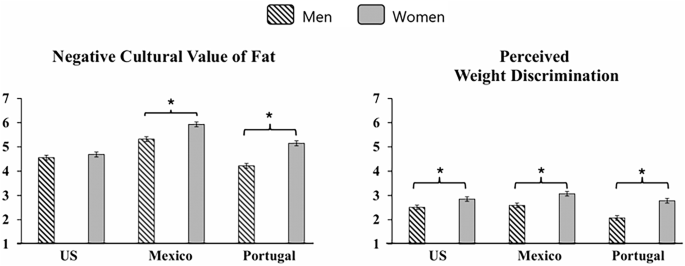
The table of means for all cells can be found in Table 2, and a graphic representation of the difference in means for Perceived Weight Discrimination and Negative Cultural Value of Fat can be found in Fig. 1
Note. ANCOVA examining the interaction of gender and nationality differences on Perceived Weight Discrimination and Negative Cultural value of Fat, controlling for age. Interaction term included. US is used in the graph to abbreisk represents significant differences at the p < 0.05 level
Perceived weight discrimination
Age was a significant covariate (F(1,1858) = 28.40, p < 0.001; ({{eta }}_{p}^{2}=0.02)) in this model. After controlling for age, there was no significant interaction between nationality and gender (F(2,1858) = 2.28, p = 0.102; ({{eta }}_{p}^{2}=0.002)). There was a main effect of Nationality on Perceived Weight Discrimination (F(2,1858) = 9.87, p < 0.001; ({{eta }}_{p}^{2}=0.011)). Portuguese participants reported significantly higher Perceived Weight Discrimination compared to both American (Mdif = −0.256, p = 0.014) and Mexican participants (Mdif = −0.401, p < 0.001). There was no significant difference between American and Mexican participants (Mdif = 0.145, p = 0.091). There was also a main effect of Gender on Perceived Weight Discrimination such that Women reported higher Perceived Weight Discrimination compared to Men (Mdif = 0.513; F(1,1858) = 49.58, p < 0.001; ({{eta }}_{p}^{2}=0.026)).
Negative cultural value of fatness
Age was not a significant covariate (F(1,1858) = 0.498, p = 0.482; ({{eta }}_{p}^{2}=0.000)) in this model. There was a significant interaction between nationality and gender (F(1,1858) = 9.472, p < 0.001; ({{eta }}_{p}^{2}=0.010)) such that there was a gender difference within Portuguese and Mexican participants but not within American participants. Portuguese Women reported a higher Negative Cultural Value of Fat than Portuguese Men (Mdif = 0.934; F(1, 1858) = 48.46, p < 0.001; ({{eta }}_{p}^{2}=0.025)) and Mexican Women reported higher negative cultural value of fat than Mexican Men (Mdif = 0.606; F(1, 1858) = 18.97, p < 0.001; ({{eta }}_{p}^{2}=0.010)), however, there were no significant differences between American Women and Men in their perceptions of Negative Cultural Value of Fat (Mdif = 0.130; F(1, 1858) = 1.03, p = 0.311; ({{eta }}_{p}^{2}=0.001)).
Psychological distress
Age was a significant covariate (F(1,1858) = 77.92, p < 0.001; ({{eta }}_{p}^{2}=0.040)) in this model. After controlling for age, there was no significant interaction between nationality and gender (F(2,1858) = 1.76, p = 0.172; ({{eta }}_{p}^{2}=0.002)). There was a main effect of nationality on Psychological Distress (F(2,1858) = 9.67, p < 0.001; ({{eta }}_{p}^{2}=0.010)). American participants reported significantly lower Psychological Distress compared to both Portuguese (Mdif = −3.271, p < 0.001) and Mexican participants (Mdif = −3.442, p < 0.001). There was no significant difference between Portuguese and Mexican participants (Mdif = −0.151, p = 0.838). There was also a main effect of Gender on Psychological Distress, such that Women reported higher Psychological Distress compared to Men (Mdif = 2.916; F(1,1858) = 24.33, p < 0.001; ({{eta }}_{p}^{2}=0.013)).Footnote1
Difficulties in emotion regulation
Age was a significant covariate (F(1,1858) = 83.76, p < 0.001; ({{eta }}_{p}^{2}=0.043)) in this model. After controlling for age, there was no significant interaction between nationality and gender (F(2,1858) = 1.76, p = 0.172; ({{eta }}_{p}^{2}=0.002)). There was a main effect of Nationality on Difficulties in Emotion Regulation (F(1,1858) = 15.66, p < 0.001; ({{eta }}_{p}^{2}=0.017)). American participants reported significantly fewer Difficulties in Emotion Regulation compared to both Portuguese (Mdif = −0.313, p < 0.001) and Mexican participants (Mdif = −0.271, p < 0.001). There was no significant difference between Portuguese and Mexican participants (Mdiff = 0.042, p = 0.414). There was also a main effect of Gender, such that Women reported greater Difficulties in Emotion Regulation compared to Men (Mdif = 0.275; F(1,1858) = 44.70, p < 0.001; ({{eta }}_{p}^{2}=0.023)).
Negative cultural value and perceived weight discrimination mediating the relationship between gender, nationality, and well-being outcomes
The full output can be found in Table 3. See Fig. 2 for the model diagram
Moderated Mediational model (PROCESS model 8) with gender as a predictor of the outcomes of interest (Psychological Distress and Difficulties in Emotion Regulation), mediated simultaneously by Negative Cultural Value of Fat (NCF) and Perceived Weight Discrimination (PWD); with Nationality as a moderator of the pathway from gender to the mediators as well as of the direct pathway to the outcomes
Psychological distress
Perceived weight discrimination significantly mediated the relationship between gender and psychological distress across all nationalities, with stronger indirect effects among Portuguese participants. Negative cultural value of fat also served as a mediator, but only among Portuguese and Mexican participants, with stronger effects relative to American participants
Difficulties in emotion regulation
Perceived weight discrimination mediated the relationship between gender and difficulties in emotion regulation across all groups, with stronger effects among Portuguese participants. Negative cultural value of fat was also a significant mediator for Portuguese and Mexican participants, but not for American participants, with stronger effects relative to American participants
Discussion
The present study provides important new insights into how cultural norms surrounding higher body weights shape well-being by introducing Negative Cultural Value of Fat as a distinct and impactful facet of weight stigmatization. Our work builds on prior evidence that weight stigma is harmful to psychological health [1, 3, 4]. This study findings uniquely show that for individuals who identify as overweight, their perception of how negatively their culture views higher weights, beyond their personal experiences of discrimination, significantly relates to well-being outcomes. This novel approach advances the field by highlighting a cultural facet of weight stigma previously underexplored.
Across samples from the United States, Portugal, and Mexico, women consistently reported worse well-being outcomes than men, with these gender disparities partially explained by perceived weight discrimination and negative cultural value of fat. Importantly, while perceived discrimination mediated gender differences similarly across countries, the role of negative cultural value of fat varied significantly by cultural context. Specifically, the negative cultural value of fat construct mediated gender disparities in psychological distress, and Difficulties in Emotion Regulation among Portuguese and Mexican participants, but not among Americans, suggesting that internalized cultural norms around body size have pronounced effects in contexts where traditional gender expectations are more strongly enforced.
These results align with the theoretical framework of the Cyclic Obesity/Weight-Based Stigma (COBWEBS) model [13], underscoring how stress from cultural non-conformity may exacerbate psychological distress. They also build upon previous findings [6] by showing, for the first time, that individuals with higher weights perceive and are affected by these negative cultural norms, especially for women in countries with greater gender inequality (e.g., Portugal and Mexico; [9, 31])
As a separate analysis, we examined the correlations between Negative Cultural Value of Fat and other established weight stigma constructs like weight discrimination, weight bias internalization, and weight stigma consciousness (see https://osf.io/5hq3d/?view_only=604742bc6f6e4d38a3d672115a887cf6 for Supplemental Analysis). The moderate correlations between Negative Cultural Value of Fat and these constructs (r = 0.32–0.40) suggest that Negative Cultural Value of Fat taps into a unique cultural dimension of weight stigma, emphasizing societal expectations and norm violations rather than personal internalization or expectation of discrimination. This distinction opens new avenues for understanding how stigma operates across individual, interpersonal, and cultural levels. It also highlights the necessity of including cultural perceptions in weight stigma research, particularly in cross-national studies.
The larger gender differences in negative cultural value of fat in Portugal and Mexico compared to the United States also suggest that cultural enforcement of gendered appearance norms may intensify the psychological toll of weight stigma. In more collectivistic or traditionally gendered societies, deviation from body ideals may be perceived as a more severe social violation for women than men, leading to greater internal stress, self-blame, and adverse mental health outcomes. This pattern aligns with broader literature on norm violation, where not meeting cultural standards often incurs significant psychological costs [46, 47].
Several limitations of our study must be acknowledged. The cross-sectional and correlational nature of the data limits causal interpretations. Reliance on self-report measures raises potential concerns about social desirability and recall bias. Additionally, administering the survey in English outside the United States may have introduced cultural priming effects [48, 49], selecting more acculturated participants or influencing responses to align with United States cultural norms. Lastly, online recruitment may have excluded individuals without internet access or familiarity with online platforms, limiting generalizability.
Despite these limitations, the current research offers critical contributions. It underscores the central role of perceived cultural norms, specifically the Negative Cultural Value of Fat, in shaping the experiences of weight stigma and mental health outcomes. It highlights that, across contexts, women consistently perceive greater weight-based cultural stigma, which might make them more vulnerable to psychological distress and difficulties with emotion regulation. Importantly, the findings suggest that cultural and gender norms interact to produce different psychological outcomes across nations, emphasizing the need for culturally sensitive models.
Future research should continue to investigate the role of Negative Cultural Value of Fat across more diverse cultural contexts, particularly those with varying degrees of collectivism, gender equality, and beauty ideal enforcement. Given recent literature published in Eastern contexts, future studies should also examine similarities and differences in patterns observed across these settings. In addition, future work may benefit from capitalizing on recently developed measures of weight stigma exposure, such as the Weight Stigma Exposure Inventory (WeSEI) [25], which has been tested across multiple Eastern countries, to improve cross-cultural comparability and strengthen the assessment of stigma-related experiences. Further studies should also explore the mechanisms through which perceptions of cultural norms become internalized and translate into stress and mental health symptoms, possibly incorporating longitudinal or experimental designs to establish causality.
In sum, this study advances the field by introducing the perception of negative cultural value of fat as a critical and previously overlooked factor influencing well-being in individuals with higher weights. Understanding cultural and societal pressures around weight, particularly as they interact with gender norms, is essential for developing more effective interventions aimed at reducing the mental health burden of weight stigma worldwide
Data availability
The datasets generated during and analyzed in the current study are available on https://osf.io/5hq3d/?view_only=604742bc6f6e4d38a3d672115a887cf6
Notes
*Results for each DASS-21 subscale, along with other supplemental materials, are available on https://osf.io/5hq3d/?view_only=604742bc6f6e4d38a3d672115a887cf6
References
Puhl R, Brownell KD. Bias, discrimination, and obesity. Obes Res. 2001;9:788–805
Puhl RM, Heuer CA. The stigma of obesity: a review and update. Obesity. 2009;19307381. Available from: https://www.academia.edu/download/58540291/Puhl_et_al-2009-Obesity.pdf
Alimoradi Z, Golboni F, Griffiths MD, Broström A, Lin CY, Pakpour AH. Weight-related stigma and psychological distress: a systematic review and meta-analysis. Clin Nutr. 2020;39:2001–13. https://doi.org/10.1016/j.clnu.2019.10.016
Douglas VJ, Kwan MY, Gordon K. The roles of weight stigma, emotion dysregulation, and eating pathology in suicide risk. Body Image. 2021;38:162–70. https://doi.org/10.1016/j.bodyim.2021.04.005
Puhl RM, Lessard LM, Himmelstein MS, Foster GD. The roles of experienced and internalized weight stigma in healthcare experiences: perspectives of adults engaged in weight management across six countries. PloS ONE. 2021;16:e0251566
Crandall CS, D’Anello S, Sakalli N, Lazarus E, Nejtardt GW, Feather NT. An attribution-value model of prejudice: anti-fat attitudes in six nations. Pers Soc Psychol Bull. 2001;27:30–7. https://doi.org/10.1177/0146167201271003
Pearl RL, Puhl RM. Weight bias internalization and health: a systematic review. Obes Rev. 2018;19:1141–63. https://doi.org/10.1111/obr.12701
Wellman JD, Araiza AM, Solano C, Berru E. Sex differences in the relationships among weight stigma, depression, and binge eating. Appetite. 2019;133:166–73. https://doi.org/10.1016/j.appet.2018.10.029
Meireles M, Ferro-Lebres V, Almeida-de-Souza J, Podestá OG, Machado A, Ferreira J, et al. Historical and cultural perspectives on obesity and body image in Portugal. In: Cultural and Historical Perspectives on Body Image, Obesity and Eating Disorders. Târgu Mureș: University Press; 2022. pp 87–98
Araiza AM, Wellman JD. Weight stigma predicts inhibitory control and food selection in response to the salience of weight discrimination. Appetite. 2017;114:382–90
Brewis AA, Wutich A, Falletta-Cowden A, Rodriguez-Soto I. Body norms and fat stigma in global perspective. Curr Anthropol. 2011;52:269–76. https://doi.org/10.1086/659309
Major B, Eliezer D, Rieck H. The psychological weight of weight stigma. Soc Psychol Personal Sci. 2012;3:651–8
Tomiyama AJ. Weight stigma is stressful. A review of evidence for the Cyclic Obesity/Weight-Based Stigma model. Appetite. 2014;82:8–15
Jackson SE, Steptoe A. Obesity, perceived weight discrimination, and hair cortisol: a population-based study. Psychoneuroendocrinology. 2018;98:67–73. https://doi.org/10.1016/j.psyneuen.2018.08.018
Lee KM, Wang C, Du H, Hunger J, Tomiyama AJ. Weight stigma as a stressor: A preliminary multi-wave, longitudinal study testing the biobehavioral pathways of the cyclic obesity/weight-based stigma (COBWEBS) model. Appetite. 2024;201:107573. https://doi.org/10.1016/j.appet.2024.107573
Robinson E, Sutin A, Daly M. Perceived weight discrimination mediates the prospective relation between obesity and depressive symptoms in US and UK adults. Health Psychol. 2017;36:112
Hemmingsson E. A new model of the role of psychological and emotional distress in promoting obesity: conceptual review with implications for treatment and prevention. Obes Rev. 2014;15:769–79
Hunger JM, Tomiyama AJ. Weight labeling and obesity: a longitudinal study of girls aged 10 to 19 years. JAMA Pediatr. 2014;168:579–80. https://doi.org/10.1001/jamapediatrics.2014.122
Jackson TD, Grilo CM, Masheb RM. Teasing history, onset of obesity, current eating disorder psychopathology, body dissatisfaction, and psychological functioning in binge eating disorder. Obes Res. 2000;8:451–8. https://doi.org/10.1038/oby.2000.56
Stice E, Agras WS. Subtyping bulimic women along dietary restraint and negative affect dimensions. J Consult Clin Psychol. 1999;67:460–9
Stice E, Presnell K, Spangler D. Risk factors for binge eating onset in adolescent girls: a 2-year prospective investigation. Health Psychol Off J Div Health Psychol Am Psychol Assoc. 2002;21:131–8
Waters A, Hill A, Waller G. Internal and external antecedents of binge eating episodes in a group of women with bulimia nervosa. Int J Eat Disord. 2001;29:17–22
Gan WY, Huang YT, Hou WL, Tung SEH, Poon WC, Siaw YL, et al. Relationship between body mass index and quality of life among Malaysian young adults: sequential mediated effects of perceived weight stigma and weight-related self-stigma. J Health Psychol. 2026;31:1454–68. https://doi.org/10.1177/13591053251358460
Fung XCC, Siu AMH, Ye J, Chen JH, Chen JS, Bevan N, et al. Exploring how weight stigma relates to psychological distress, physical activity, and eating behaviors over time: a longitudinal study among young adults in Hong Kong. J Eat Disord. 2026;14:50. https://doi.org/10.1186/s40337-026-01525-w
Fan CW, Ruckwongpatr K, Lin IC, Chen IH, Chen JK, Nurmala I, et al. Cross-cultural validation of the Weight Stigma Exposure Inventory (WeSEI): secondary data analysis from Taiwan, China, Hong Kong, Indonesia, Türkiye, and Malaysia. J Eat Disord. 2025;14:18. https://doi.org/10.1186/s40337-025-01480-y
Huang PC, Latner JD, Bevan N, Griffiths MD, Chen JS, Huang CH, et al. Internalized weight stigma and psychological distress mediate the association of perceived weight stigma with food addiction among young adults: a cross-sectional study. J Eat Disord. 2024;12:150. https://doi.org/10.1186/s40337-024-01112-x
Mohsen S, Lin YC, Huang PC, Huang YT, Huang RY, Huang CH, et al. Tendency to avoid physical activity and sport: associations with weight stigma, and psychological distress in a two-wave longitudinal study. Int J Ment Health Promot. 2024. https://doi.org/10.32604/ijmhp.2024.053432
Hackman J, Maupin J, Brewis AA. Weight-related stigma is a significant psychosocial stressor in developing countries: evidence from Guatemala. Soc Sci Med. 2016;161:55–60. https://doi.org/10.1016/j.socscimed.2016.05.032
Marini M, Sriram N, Schnabel K, Maliszewski N, Devos T, Ekehammar B, et al. Overweight people have low levels of implicit weight bias, but overweight nations have high levels of implicit weight bias. PLOS ONE. 2013;8:e83543. https://doi.org/10.1371/journal.pone.0083543
Puhl RM, Lessard LM, Pearl RL, Himmelstein MS, Foster GD. International comparisons of weight stigma: addressing a void in the field. Int J Obes. 2021;45:1976–85
Organization WHO. One in eight people are now living with obesity. 2024;1:2024
Crandall CS, Martinez R. Culture, ideology, and antifat attitudes. Pers Soc Psychol Bull. 1996;22:1165–76. https://doi.org/10.1177/01461672962211007
Sutin AR, Terracciano A. Perceived weight discrimination and obesity. PLOS ONE. 2013;8:e70048 https://doi.org/10.1371/journal.pone.0070048
Himmelstein MS, Puhl RM, Quinn DM. Intersectionality: an understudied framework for addressing weight stigma. Am J Prev Med. 2017;53:421–31. https://doi.org/10.1016/j.amepre.2017.04.003
Boswell RG, White MA. Gender differences in weight bias internalisation and eating pathology in overweight individuals. Adv Eat Disord. 2015;3:259–68. https://doi.org/10.1080/21662630.2015.1047881
Barber J, Palmese L, Reutenauer EL, Grilo C, Tek C. Implications of weight-based stigma and self-bias on quality of life among individuals with Schizophrenia. J Nerv Ment Dis. 2011;199:431–5. https://doi.org/10.1097/NMD.0b013e318221403d
Madan S, Basu S, Ng S, Ching Lim EA. Impact of culture on the pursuit of beauty: evidence from five countries. J Int Mark. 2018;26:54–68. https://doi.org/10.1177/1069031X18805493
Puhl RM, Latner JD, O’Brien K, Luedicke J, Danielsdottir S, Forhan M. A multinational examination of weight bias: predictors of anti-fat attitudes across four countries. Int J Obes. 2015;39:7. https://doi.org/10.1038/ijo.2015.32
Hietanen AE, Pick S. Gender stereotypes, sexuality, and culture in Mexico. In: Safdar S, Kosakowska-Berezecka N, editors. Psychology of gender through the lens of culture: theories and applications. Cham: Springer; 2015. p. 285–305. https://doi.org/10.1007/978-3-319-14005-6_14
Atlantis E, Ball K. Association between weight perception and psychological distress. Int J Obes. 2008;32:715–21. https://doi.org/10.1038/sj.ijo.0803762
Lovibond SH, Lovibond PF. Depression anxiety stress scales (DASS). Syd Psychol Found. 1995;119–21
Bjureberg J, Ljótsson B, Tull MT, Hedman E, Sahlin H, Lundh LG, et al. Development and validation of a brief version of the difficulties in emotion regulation scale: the DERS-16. J Psychopathol Behav Assess. 2016;38:284–96. https://doi.org/10.1007/s10862-015-9514-x
Min J, Koenig J, Nashiro K, Yoo HJ, Cho C, Thayer JF, et al. Sex differences in neural correlates of emotion regulation in relation to resting heart rate variability. Brain Topogr. 2023;36:698–709. https://doi.org/10.1007/s10548-023-00974-9
Elliott M. Gender differences in the determinants of distress, alcohol misuse, and related psychiatric disorders. Soc Ment Health. 2013;3:96–113. https://doi.org/10.1177/2156869312474828
Hayes AF. Introduction to mediation, moderation, and conditional process analysis, second edition: a regression-based approach. Guilford Publications; 2017. p. 714
Boer D. Values and affective well-being: how culture and environmental threat influence their association. In: Roccas S, Sagiv L, editors. Values and behavior: taking a cross cultural perspective. Cham: Springer; 2017. p. 191–218. https://doi.org/10.1007/978-3-319-56352-7_9
Van Kleef GA, Wanders F, Stamkou E, Homan AC. The social dynamics of breaking the rules: Antecedents and consequences of norm-violating behavior. Curr Opin Psychol. 2015;6:25–31
Candlin C, Ng SH, Chiu CY, editors. Language matters: communication, culture and identity. Hong Kong: City University of Hong Kong Press; 2004
Ross M, Xun WQE, Wilson AE. Language and the bicultural self. Pers Soc Psychol Bull. 2002;28:1040–50. https://doi.org/10.1177/01461672022811003
Funding
JDW discloses support for this research from a Research and Creative Achievement Grant from the College of Liberal Arts at the University of Mississippi. The remaining authors declare no relevant funding
Author information
Authors and Affiliations
Department of Psychology, University of Mississippi, Oxford, MS, USA
Ana Clara Vieira Zaidan & Joseph D. Wellman
Authors
- Ana Clara Vieira ZaidanView author publications
Search author on:PubMed Google Scholar
- Joseph D. WellmanView author publications
Search author on:PubMed Google Scholar
Contributions
Ana Clara Vieira Zaidan and Joseph D Wellman both contributed to the conceptualization, study design, data collection, analysis, and interpretation of results. Ana Clara Vieira Zaidan drafted the initial manuscript, while Joseph D. Wellman obtained funding for the project and provided overall supervision. Both authors reviewed, edited, and approved the final version of the manuscript and take responsibility for the integrity of the work
Ethics declarations
Competing interests
The authors declare no competing interests
Additional information
Publisher’s note Springer Nature remains neutral with regard to jurisdictional claims in published maps and institutional affiliations
Rights and permissions
Open Access This article is licensed under a Creative Commons Attribution 4.0 International License, which permits use, sharing, adaptation, distribution and reproduction in any medium or format, as long as you give appropriate credit to the original author(s) and the source, provide a link to the Creative Commons licence, and indicate if changes were made. The images or other third party material in this article are included in the article’s Creative Commons licence, unless indicated otherwise in a credit line to the material. If material is not included in the article’s Creative Commons licence and your intended use is not permitted by statutory regulation or exceeds the permitted use, you will need to obtain permission directly from the copyright holder. To view a copy of this licence, visit http://creativecommons.org/licenses/by/4.0/.
About this article
Cite this article
Vieira Zaidan, A.C., Wellman, J.D. Weight discrimination and the negative cultural value of fat: the relationship to well-being across individuals with higher weights of different nations.
Int J Obes (2026). https://doi.org/10.1038/s41366-026-02192-2
Received:25 September 2025
Revised:08 July 2026
Accepted:31 July 2026
Published:20 August 2026
Version of record:20 August 2026
DOI
:https://doi.org/10.1038/s41366-026-02192-2
