


Download PDF
Abstract
Introduction
This study aimed to determine the independent and interactive effects of changes in alcohol intake and body weight on hepatic steatosis remission in elderly patients with Metabolic Alcohol-associated Liver Disease (MetALD)
Methods
This population-based retrospective cohort study included 46,570 elderly individuals (≥65 years) with MetALD in Zhejiang Province, China (2021–2023). Changes in alcohol consumption and body weight were assessed. The primary outcome was remission of hepatic steatosis. Multivariable logistic regression was used to evaluate the associations between hepatic steatosis remission and changes in weight and alcohol consumption, with adjustment for potential confounders. Interaction effects between weight loss and alcohol reduction were also assessed.
Results
Over two years, 12.43% (n = 5789) achieved >5% weight loss, and 2.54% (n = 1181) achieved alcohol cessation. The overall remission rate for hepatic steatosis was 22.64% (n = 10,543). Weight loss was the primary driver: remission rates were 34.34% for >5% loss (Odds ratios 2.15, 95% confidence interval [CI] 1.99–2.32) and 24.07% for 1–5% loss (1.26, [1.18–1.34]). Weight gain >5% was associated with lower remission likelihood (0.67, [0.61–0.74]). Compared with the stable consumption group, neither alcohol reduction (1.02, [0.96–1.08]) nor cessation (1.13, [0.98–1.29]) alone was significantly associated with increased remission likelihood, whereas increased consumption was associated with decreased likelihood (0.83, [0.78–0.89]). Notably, a supra-additive synergistic interaction was observed between weight loss (>1%) and alcohol reduction (including cessation) (1.88, [1.74–2.03]). The remission rate reached 37.66% (2.67, [1.69–4.29]) in the alcohol cessation group with >5% weight loss.
Conclusion
In elderly patients with MetALD, weight loss >5% is strongly correlated with hepatic steatosis remission, while alcohol reduction exhibits a supra-additive synergistic association with weight loss for steatosis improvement. Clinical strategies should prioritize weight loss of 1–5%—a feasible and safe target in older adults—alongside alcohol reduction, as this combination is associated with optimized clinical outcomes
Introduction
Metabolic Alcohol-associated Liver Disease (MetALD) is a clinically significant subtype of Metabolic Dysfunction-Associated Steatotic Liver Disease (MASLD) [1,2,3]. Its diagnosis requires the presence of at least one metabolic risk factor (e.g., overweight/obesity, type 2 diabetes, dyslipidemia, or hypertension) alongside moderate alcohol consumption (female: 20–50 g/day, male: 30–60 g/day) [1,2,3,4]. Against the backdrop of rising global obesity and alcohol use, the prevalence of MetALD is increasing, contributing substantially to liver cirrhosis and hepatocellular carcinoma [1, 4]. In Asia, MASLD approximatedly 30% of middle-aged and older adults, with MetALD accounting for 3–6% of these cases [1, 4, 5]. Without intervention, MetALD patients face a 1.8-fold higher risk of progressing to liver fibrosis within a decade compared with those with MASLD alone, alongside a significantly elevated incidence of hepatocellular carcinoma [3,4,5,6,7].
International guidelines recommend a dual strategy of alcohol abstinence and weight loss (≥5%) to mitigate metabolic risks and direct alcohol toxicity [2, 3]. However, the evidence supporting this approach is derived primarily from younger patients (<50 years), with a notable lack of data in older adults. Elderly MetALD patients present distinct pathophysiological challenges: age-related sarcopenia and reduced metabolic rate increase their vulnerability to inappropriate weight loss, which may exacerbate frailty and sarcopenia [6]. Furthermore, over 80% have multiple metabolic comorbidities, complicating weight management [7]. Ethanol metabolism also declines with age, leading to greater acetaldehyde accumulation and lower thresholds for liver injury even at moderate intake levels [8, 9]. Strict abstinence may introduce risks such as malnutrition or social isolation. Critically, the interaction between changes in alcohol intake and weight loss interventions in the elderly remains poorly understood.
This study utilized large-sample data from elderly MetALD patients (total n = 46,570) based on Electronic Health Records (EHRs) to conduct an in-depth analysis of the independent effects and interactions of dynamic changes in alcohol consumption and weight fluctuations on hepatic steatosis remission in this population. It aims to elucidate the response patterns of hepatic steatosis in elderly patients undergoing changes in alcohol intake and body weight, thereby providing preliminary observational evidence to inform individualized clinical strategies. The findings support the refinement of tailored clinical approaches for elderly MetALD patients, with potential implications for reducing liver disease progression and lowering the risk of hepatocellular carcinoma.
Methods
Study population
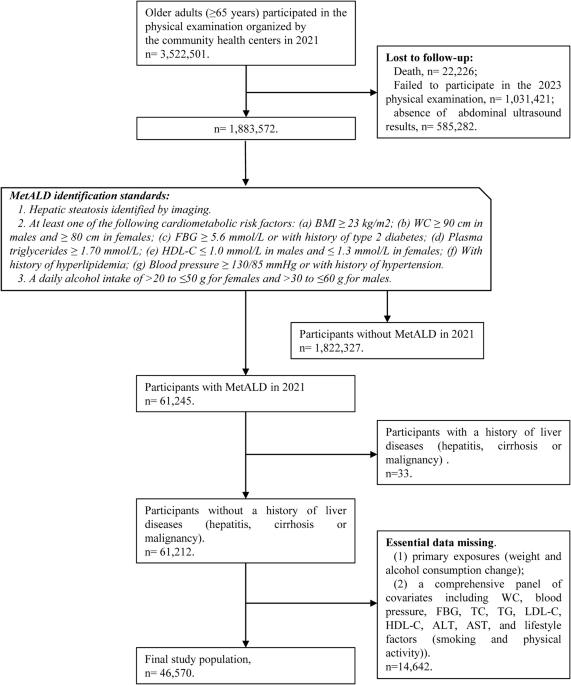
Data for this study were sourced from EHRs of elderly individuals in Zhejiang Province for the years 2021 and 2023, a platform centralizing routine physical examination data for individuals aged 65 and above in the province [10]. The study initially enrolled 1,883,572 individuals from the 2021 and 2023 EHRs who had abdominal ultrasonography findings and survived the follow-up period. Based on the EASL-EASD-EASO joint guidelines [2] and data of EHRs, 61,245 MetALD patients in 2021 were selected through a systematic screening process (1. hepatic steatosis identified by imaging; 2. assessment of cardiometabolic risk factors; 3. assessment of alcohol consumption). Hepatic steatosis was assessed via abdominal ultrasonography by certified practitioners. All examinations followed standardized diagnostic protocols to ensure clinical consistency across different primary healthcare institutions. Additionally, patients with a history of other liver conditions, including hepatitis, cirrhosis, and malignant tumors, and those with incomplete essential data were excluded from the study (n = 14,675). Essential data were defined as complete records for: (1) primary exposures (weight and alcohol consumption change); and (2) a comprehensive panel of covariates including waist circumference (WC), blood pressure, fasting blood glucose (FBG), total cholesterol (TC), triglycerides (TG), low-density lipoprotein cholesterol (LDL-C), high-density lipoprotein cholesterol (HDL-C), alanine aminotransferase (ALT), aspartate aminotransferase (AST), and lifestyle factors (smoking and physical activity). The final study population comprised 46,570 elderly individuals aged 65 and above with MetALD (Fig. 1). The baseline characteristics of the excluded and included participants were summarized in Supplementary table 1.
Flowchart of study participants selection
Ethics approval was obtained from the Ethical Review Committee of Zhejiang Provincial Center for Disease Control and Prevention (2025-014-01). All methods were performed in accordance with the relevant guidelines and regulations
Assessment of alcohol consumption change
Alcohol consumption information was collected through standardized health examination questionnaires administered by qualified physicians, which included detailed questions on drinking frequency, average daily volume, beverage types, and history of cessation (including cessation age). Daily pure alcohol intake (g) in 2021 and 2023 was calculated by beverage type, amount, and frequency. Alcohol content (v/v) of common Chinese drinks: beer 4%, grape wine 12%, Chinese rice wine 15%, white spirit 50% [11, 12].
To minimize the “sick quitter” bias, all participants were active drinkers at baseline in 2021, specifically those meeting the diagnostic criteria for MetALD: >20– ≤ 50 g/day (females) and >30– ≤ 60 g/day (males) [2]. No abstainers or former drinkers were included at baseline
2023 alcohol intake was initially categorized into four levels: (1) 0 g/day (cessation); (2) > 0– ≤ 20 g/day (females) and >0- ≤ 30 g/day (males); (3) > 20– ≤ 50 g/day (females) and >30– ≤ 60 g/day (males); and (4) > 50 g/day (females) and >60 g/day (males) [2]. Subsequently, based on the change in alcohol consumption compared to 2021, participants were assigned to one of the following four groups: (1) alcohol cessation (transition to 0 g/day at 2023), (2) alcohol reduction (reduced to level 2 in 2023), (3) stable alcohol consumption (maintained a baseline level), and (4) alcohol increase (increased to level 4 in 2023) [13].
Assessment of weight change
The extent of weight change between 2021 and 2023 was determined by calculating the difference between the weight recorded in 2023 and the weight in 2021, and then dividing this difference by the weight in 2021. Because more than 5% weight loss from the baseline is widely accepted as being clinically relevant [14], and considering moderate weight changes, weight changes were categorized into the following five groups: weight loss >5%, weight loss 1%-5%, weight change <1%, weight gain 1%-5%, and weight gain >5% [15].
Variables definition
Body mass index (BMI) was calculated as weight (kg) divided by height (m) squared. BMI ≥23 kg/m2, and ≥27.5 kg/m2 were defined as overweight and obesity, respectively. WC ≥90 cm for men and ≥80 cm for women were defined as central obesity [2]. Behavioral variables were defined by residents’ actual reported information. Smoking status had three categories: never (no smoking), regular smokers (≥1 cigarette/day), former smokers (quit smoking). Physical exercise was defined as conscious non-work activity ≥30 min/day for >3 days/week, categorized as “no” or “yes” in this study.
Study outcomes
Given that independent changes in weight and alcohol intake are sufficient to affect MetALD diagnosis, even if hepatic steatosis itself does not improve [2], the disappearance of hepatic steatosis features on abdominal ultrasonography was defined as the primary endpoint, rather than MetALD remission. Hepatic steatosis remission was defined as the absence of hepatic steatosis findings in the 2023 ultrasound examination. Additionally, to investigate the effects of changes in alcohol consumption and weight on MetALD-related cardiometabolic risk factors and to assess the robustness of the primary study results, their impact on WC, FBG, TG, HDL-C, systolic blood pressure (SBP), and diastolic blood pressure (DBP) was also analyzed.
Statistical analysis
Logistic regression models were employed to evaluate the association between hepatic steatosis remission in MetALD patients and changes in weight and alcohol consumption. In the primary analyses, univariable logistic regression models were first performed for each exposure. Multivariable logistic regression models were subsequently constructed, including weight change categories and alcohol change categories simultaneously, adjusting for baseline (2021) characteristics as potential confounding factors and covariates (age, sex, BMI, WC, SBP, DBP, FBG, TC, TG, LDL-C, HDL-C, ALT, AST, smoking status, and physical activity).
To investigate the interaction between changes in alcohol consumption and weight, two complementary approaches were applied
First, stratified analyses were conducted according to alcohol change categories. Within each stratum of alcohol consumption change, the association between weight change categories and steatosis remission was estimated using multivariable logistic regression. This approach was intended to descriptively assess heterogeneity of associations across alcohol-change groups
Second, to formally test statistical interaction while minimizing instability due to sparse data across multiple categories, weight change was dichotomized as “weight loss” (weight loss >1%) versus “no weight loss”, and alcohol change was dichotomized as “alcohol reduction” (reduction group plus cessation group) versus ‘no alcohol reduction’. A multiplicative interaction term between these two binary variables was then included in a multivariable logistic regression model. The interaction coefficients, including the Relative Excess Risk due to Interaction (RERI), Attributable Proportion due to interaction (AP), and Synergy Index (S), were used to evaluate statistical interaction [16, 17].
Two sets of sensitivity analyses were conducted to evaluate the robustness and biological plausibility of the primary findings
First, to examine whether changes in alcohol consumption and weight were accompanied by MetALD-related cardiometabolic risk factors shifts, within-group changes in selected metabolic parameters were assessed. Changes in cardiometabolic risk factors were calculated as the 2023 value minus the 2021 value for each factor. Within categories defined by alcohol consumption change and weight change, the mean change and corresponding 95% CI for each cardiometabolic parameter were estimated
Second, to assess potential non-linear associations between continuous changes in weight and alcohol consumption with steatosis remission, restricted cubic spline (RCS) analyses within multivariable logistic regression models were performed. Continuous weight change (%) and alcohol change (g/day) were modeled using RCS with four knots located at the 5th, 35th, 65th, and 95th percentiles. Models were adjusted for the same baseline covariates included in the primary analyses, with no change (0% weight change; 0 g/day alcohol change) as the reference. Non-linearity was formally evaluated using likelihood ratio tests comparing spline models to models including only linear terms [18].
All models reported odds ratios (ORs) with 95% confidence intervals (CIs). Analyses were performed using R 4.5.0 (R Foundation for Statistical Computing, Vienna, Austria. https://www.R-project.org/), and the significance level was set at 0.05
Results
In total, 46,570 elderly MetALD patients were included. Mean age was 70.69 ± 4.96 years, and 90.41% (n = 42,104) were male. 2023 abdominal ultrasonography showed 10,543 patients had no imaging evidence of hepatic steatosis, giving a two-year remission rate of 22.64%. Baseline characteristics stratified by alcohol consumption changes are presented in Table 1. Over two years, 1181 (2.54%) achieved alcohol cessation and 8757 (18.80%) reduced intake. Compared to the stable consumption group, the alcohol cessation group showed higher proportions of obesity and central obesity, as well as higher baseline ALT/AST levels. Baseline characteristics by weight change categories are in Table 2. 5789 (12.43%) lost >5% of baseline weight; 14,301 (30.71%) lost 1–5%. Compared to participants with <1% weight loss, those who weight loss >5% were more likely to have obesity and central obesity at baseline, and had higher SBP, DBP, FBG, ALT, and AST.
Hepatic steatosis remission rates for the alcohol cessation, reduction, stable, and increase groups were 25.40%, 22.77%, 22.80%, and 21.14%, respectively (Table 3). Compared to the stable consumption group, the alcohol increase group had significantly lower remission likelihood (adjusted OR [aOR], 0.83 [95% CI, 0.78–0.89]). However, neither alcohol reduction nor cessation group showed significantly increased remission likelihood vs. stable group (1.02 [0.96–1.08] and 1.13 [0.98–1.29], respectively).
Weight change correlated significantly with hepatic steatosis remission. Remission rates were 34.34% for >5% weight loss, decreasing with lesser loss: 24.07% (1–5% loss) and 20.87% (<1% change). Conversely, when weight increased, the remission rate declined further, to 18.50% for weight gain 1–5% and 17.89% for weight gain >5%, respectively (Table 3). Multivariable logistic regression indicated that weight loss was associated with an increased likelihood of hepatic steatosis remission. Compared to <1% weight change, aORs were 2.15 (95% CI, 1.99–2.32) for >5% loss, and 1.26 (1.18–1.34) for 1–5% loss. Conversely, weight gain reduced remission likelihood: relative to the reference group. Consistent results were found in the female subgroup (Supplementary table 2).
Across alcohol consumption change groups, aORs varied with weight change degree (Figs. 2–3; P for trend <0.001). Stratified by alcohol changes, weight loss aORs were more pronounced in cessation and reduction groups. Compared to <1% weight change, the aORs for >5% weight loss were 2.67 (1.69–4.29), 2.37 (2.00–2.82), 2.17 (1.98–2.38), and 1.67 (1.35–2.06) for the alcohol cessation, reduction, stable, and increase groups, respectively. For 1–5% weight loss, respective aORs were 1.60 (1.03–2.52), 1.30 (1.12–1.51), 1.28 (1.18–1.38), and 1.08 (0.90–1.29). Conversely, weight gain had marked adverse effects in the alcohol increase and stable groups. For the increase group, aORs were 0.72 (0.59–0.87) for 1–5% weight gain and 0.56 (0.43–0.74) for >5% weight gain, respectively, when compared to <1% weight change. For the stable consumption group, the corresponding aORs were 0.85 (0.79–0.93) and 0.67 (0.60–0.76). Notably, the detrimental impact weight gain was less pronounced in the alcohol cessation group. Compared to <1% weight change, aORs were 0.87 (0.53–1.42) for 1–5% weight gain and 0.81 (0.45–1.45) for >5% weight gain, respectively.
Adjusted for age, sex, BMI (normal, overweight, or obesity), waist circumference (normal, or central obesity), SBP, DBP, FBG, TC, TG, LDL-C, HDL-C, ALT, AST smoking status (never, regular, or former smoker), and physical activity (no, or yes). OR odds ratio; 95% CI 95% confidence interval
Remission rate of hepatic steatosis by weight and alcohol consumption changes, among elderly patients with MetALD
Multivariable logistic regression analysis revealed a supra-additive interaction between weight loss and reduced alcohol consumption in promoting hepatic steatosis remission (Table 4; aOR, 1.88 [95% CI, 1.74–2.03]). The combined effect of weight loss and reduced alcohol consumption on hepatic steatosis remission exceeded the sum of their individual effects (RERI, 0.21 [95% CI, 0.05–0.37]; AP, 0.11 [0.02–0.18]; S, 1.31 [1.06–1.61])
Except for HDL-C, other analyzed cardiometabolic risk factors (WC, FBG, TG, SBP, DBP) decreased significantly in both the alcohol cessation and the >5% weight loss groups (Supplementary Tables 3-4). Changes in these indicators exhibited a dose-response relationship with weight change degree: as weight shifted from >5% loss to >5% gain, the net change in these risk factors generally transitioned from a decrease to an increase (Supplementary Table 4). Similar results were observed in subgroup analyses (Supplementary Table 5, Supplementary Fig. 1). Furthermore, a degree of interaction between changes in alcohol consumption and weight was observed on the changes in some cardiometabolic risk factors. For instance, among participants with >5% weight loss, the alcohol cessation group had greater reductions in WC and DBP compared to the alcohol increase group. Conversely, among those with >5% weight gain, the alcohol cessation group exhibited smaller increases (or even non-significant changes) in SBP and DBP.
The RCS confirmed the robustness of categorical findings. For alcohol change, the RCS showed a predominantly linear association (P for non−linearity = 0.221), consistent with the significantly lower remission likelihood in the alcohol increase group and the non-significant positive trends observed in the alcohol reduction and cessation groups (Supplementary Fig 2A). In contrast, weight change exhibited a strong non-linear association (P for non−linearity < 0.001), with an increased probability of remission during weight loss and a decreased probability of remission during weight gain (Supplementary Fig 2B).
Discussion
This large-scale cohort study of 46,570 elderly MetALD patients provides the first observational evidence that weight loss is strongly associated with hepatic steatosis remission as a key correlative factor, whereas alcohol reduction exhibits a supra-additive synergistic association with weight loss. Crucially, weight loss exceeding 5% was linked to the highest remission rate (34.34%, aOR = 2.15), whereas weight gain exceeding 5% was significantly associated with reduced remission likelihood (aOR = 0.67). Notably, neither mere reduction nor complete cessation of alcohol consumption alone was significantly associated with improved remission outcomes compared with maintaining consumption levels (aOR = 1.02 and 1.13, respectively). Furthermore, increased alcohol consumption was independently associated with a lower probability of remission (aOR=0.83). However, the combination of weight loss and alcohol reduction was associated with supra-additive correlative benefits (aOR = 1.88; RERI = 0.21, AP = 0.11, S = 1.31). The remission rate in the group achieving >5% weight loss plus alcohol cessation reached 37.66% (aOR = 2.67), which was significantly higher than in the weight loss alone group. Both the >5% weight loss group and the alcohol cessation group were also significantly associated with improvements in waist circumference, blood glucose, blood pressure, and other indicators, with these improvements exhibiting a dose-gradient relationship with the extent of weight change. These findings redefine intervention priorities for elderly MetALD.
Weight management is recognized as a cornerstone of MetALD treatment [2, 5], with prior evidence linking it to improvements in insulin resistance and lipotoxicity [19, 20]. However, aging is correlated with alterations in key metabolic pathways: mitochondrial dysfunction (e.g., reduced PGC-1α) is associated with 30-40% decreases in fatty acid oxidation [19, 21]; insulin sensitivity declines 7-10% per decade, which correlates with increased SREBP-1c-mediated lipogenesis [21]; and sarcopenia, present in over 50% of the elderly, is linked to reduced peripheral glucose disposal and increased hepatic metabolic load [22]. Consequently, elderly patients exhibit distinct pathophysiological responses. This study quantifies a dose-dependent association: weight loss exceeding 5% was correlated with an increase in the hepatic steatosis remission rate to 34.34%, whereas even moderate weight loss of 1–5% was still associated with significant correlative benefits (aOR=1.28, 95% CI: 1.18–1.38) among those maintaining their current alcohol consumption levels. This may be attributed to the observation that aged hepatocytes exhibit heightened responsiveness to improvements in insulin sensitivity, and the more pronounced baseline insulin resistance correlates with greater metabolic improvements following weight loss [23, 24]. In stark contrast, although complete alcohol cessation alone was associated with a remission rate of 25.40%, this was not statistically significant compared with the maintenance group (22.80%); the correlative value of mere alcohol reduction was even more limited (aOR = 1.02). This indicates that in elderly MetALD patients, alcohol management interventions (including cessation and reduction) are associated with limited correlative efficacy for hepatic steatosis improvement, whereas weight loss is a key correlative factor for remission. Thus, weight loss represents the primary modifiable correlative factor, and moderate loss (1–5%) may be particularly feasible and safe in elderly patients at risk of sarcopenia [25], offering a safe clinical approach for frail elderly individuals.
Alcohol aggravates metabolic liver injury via acetaldehyde-mediated mitochondrial damage, gut dysbiosis, and oxidative stress [26, 27]. Elderly individuals are more susceptible due to markedly reduced alcohol dehydrogenase activity (∼40% decline), higher blood ethanol levels, and impaired acetaldehyde clearance [28, 29]. However, alcohol cessation alone was associated with limited correlative efficacy, a finding that may be explained by the dual pathogenesis of hepatic steatosis in elderly MetALD patients: hepatic steatosis in this population is jointly mediated by metabolic dysfunction and alcohol-induced liver injury. Isolated alcohol cessation only eliminates alcohol-related liver damage but does not alter core metabolic disturbances such as insulin resistance and central obesity. In contrast, weight loss is associated with improved insulin resistance and reduced hepatic lipid synthesis, thereby acting on the metabolic component of steatosis. The combination of these two modifications addresses both alcohol toxicity and metabolic dysfunction, which may explain the stronger association with hepatic steatosis remission observed in the combined group. Conversely, increased alcohol intake was associated with the lowest remission rate (21.14%) and was linked to attenuated correlative benefits of weight loss (aOR reduced from 2.17 to 1.67 with >5% weight loss), indicating that alcohol consumption may counteract the metabolic benefits correlated with weight loss. Thus, alcohol management should prioritize preventing any increase in consumption over enforcing strict abstinence, as excessive emphasis on abstinence may compromise nutritional status and harm frail elderly patients. Notably, reducing alcohol intake exhibited effective synergistic association with weight loss (interaction aOR = 1.88; RERI = 0.21, AP = 0.11, S = 1.31). This is consistent with prior evidence that metabolic syndrome and alcohol jointly associated with increased liver injury through overlapping pathways including oxidative stress, CYP2E1 activation, and gut dysbiosis [4]. This synergistic correlation is especially critical in aged livers, which exhibit mitochondrial decline and reduced regenerative capacity [30]. Weight loss is associated with improved insulin sensitivity and inhibits alcohol-induced SREBP-1c activation, thereby correlating with decreased lipogenesis, while alcohol reduction is associated with lower acetaldehyde levels and exhibits synergistic correlation with weight loss via AMPK/PGC-1α, which correlates with enhanced mitochondrial function and lipophagy [21, 30], providing targeted correlative protection for aging livers.
Furthermore, weight loss exceeding 5% was significantly associated with improvements in most cardiometabolic risk factors (WC, FBG, TG, and blood pressure), exhibiting a clear dose-response relationship, consistent with prior large studies [31, 32]. Across all alcohol consumption subgroups, changes in these parameters correlated directly with weight change. Although alcohol cessation alone was associated with reductions in blood pressure and FBG, these benefits were not fully correlated with hepatic improvement, possibly due to compensatory high-calorie intake post-cessation [33]. and prolonged recovery from alcohol-induced mitochondrial dysfunction and gut dysbiosis [34]. Importantly, this study reveals that weight loss and alcohol modulation exhibit synergistic correlation rather than independent associations: alcohol cessation is associated with enhanced metabolic improvements during weight loss (e.g., greater WC and DBP reductions) and is correlated with mitigated metabolic deterioration during weight gain (e.g., was associated with attenuated BP increases). Thus, abstinence exhibits correlative roles as an enhancer of weight loss-associated benefits and a mitigator of weight gain-related effects, supporting a combined clinical approach. Even without weight loss, abstinence is associated with attenuated cardiometabolic risk, offering a compensatory clinical approach for high-risk patients. Notably, HDL-C responded differently from other risk factors, with higher levels correlating with increased alcohol intake and showing less weight-dependency, suggesting distinct regulatory mechanisms (e.g., genetic or exercise-related) warranting further investigation.
Although weight loss and alcohol control are recognized as cornerstone approaches for MetALD, their interactive correlative mechanisms and associative efficacy in the elderly–who face pronounced age-related physiological challenges such as aggravated insulin resistance, mitochondrial decline, and high sarcopenia prevalence–remain poorly understood. The key novel finding of this study is the identification of a robust synergistic correlative relationship between weight management and alcohol control, whereby the combined implementation of these two lifestyle modifications correlates with the highest rates of hepatic steatosis remission, and alcohol cessation is uniquely associated with enhanced metabolic improvements in patients with weight loss as well as mitigated metabolic deterioration in those with weight gain. These correlative findings may provide preliminary observational clues for the clinical management of elderly MetALD patients, pending further validation via well-designed prospective interventional research.
Limitations
Several limitations of this study should be noted. First, hepatic steatosis was assessed primarily via abdominal ultrasonography, rather than advanced imaging or histology, which precluded the precise grading of steatosis severity. Ultrasonography is commonly used in routine physical examinations and epidemiological studies, and allows for reliable diagnosis of fatty liver [35]. Additionally, since the data originated from multiple centers within the provincial health records system, equipment models and operators varied. However, the professional certification of all examiners and the adherence to national standardized protocols minimize the potential for systemic measurement bias. Second, data on the specific motivations for behavioral changes (e.g., weight loss and alcohol cessation) were unavailable. While the public health framework provides a structured environment for promoting healthy lifestyles, we cannot definitively distinguish between elective modifications encouraged by family doctors and unintentional changes due to underlying health issues. Furthermore, although participants received health guidance under the National Basic Public Health Service Project, the specific intensity, frequency, and duration of these consultations were not granularly digitized in the electronic health records. Third, potential selection bias may have been introduced by exclusion of participants with missing essential data. Although baseline comparisons revealed statistically significant differences in certain demographic traits between the included and excluded groups, the absolute clinical differences remained negligible. Besides, no significant differences were observed in core metabolic or liver-related markers, suggesting that while this attrition might slightly limit generalizability to individuals with lower healthcare adherence, its impact on our primary associations is likely minimal. Fourth, the observational period limited causal inference regarding temporal relationships between exposure changes and remission. Longer follow-up using expanding EHR may address this. Finally, regional restriction to one Chinese province may limit generalizability.
Conclusion
In a large cohort of elderly patients with MetALD, this study suggests that weight change represents a primary correlative factor for hepatic steatosis remission, wherein weight loss is associated with substantial favorable correlates of disease improvement while weight gain is linked to a reduced likelihood of remission; notably, alcohol reduction or cessation alone exhibits modest independent correlative value but displays a critical supra-additive synergistic association with weight loss. These findings support the rationale for prioritizing a clinically feasible and well-tolerated intervention strategy—combining moderate weight loss with alcohol reduction (rather than strict abstinence)—for this physiologically vulnerable population, as this approach achieves a balance between therapeutic relevance and physiological tolerance, thereby mitigating potential adverse outcomes including sarcopenia and malnutrition. This work fills a critical evidence gap in the understudied elderly MetALD subgroup, challenges the universal applicability of clinical guidelines derived from younger patient cohorts, and provides observational evidence to guide the development of age-tailored intervention paradigms, emphasizing the need for prospective interventional studies to validate these correlative findings and refine personalized lifestyle modification protocols for this high-risk population.
Data availability
The data that support the findings of this study are available from Health Commission of Zhejiang Province, but restrictions apply to the availability of these data, because of the security requirement of the Chinese government. Data were used under license for the current study. Data are however available from the authors upon reasonable request and with permission of Health Commission of Zhejiang Province
References
Arab JP, Díaz LA, Rehm J, Im G, Arrese M, Kamath PS, et al. Metabolic dysfunction and alcohol-related liver disease (MetALD): position statement by an expert panel on alcohol-related liver disease. J Hepatol. 2025;82:744–56
European Association for the Study of the Liver (EASL); European Association for the Study of Diabetes (EASD); European Association for the Study of Obesity (EASO).EASL-EASD-EASO clinical practice guidelines on the management of metabolic dysfunction-associated steatotic liver disease (MASLD). J Hepatol. 2024;81:492–542
Rinella ME, Lazarus JV, Ratziu V, Francque SM, Sanyal AJ, Kanwal F, et al. A multisociety Delphi consensus statement on new fatty liver disease nomenclature. Hepatol (Balt, Md). 2023;78:1966–86
Åberg F, Byrne CD, Pirola CJ, Männistö V, Sookoian S. Alcohol consumption and metabolic syndrome: clinical and epidemiological impact on liver disease. J Hepatol. 2023;78:191–206
Tavaglione F, Amangurbanova M, Yang AH, Tincopa MA, Ajmera V, Richards L, et al. Head-to-head comparison between phosphatidylethanol versus indirect alcohol biomarkers for diagnosis of MetALD versus MASLD: a prospective study. Aliment Pharm Ther. 2025;61:1043–54
Sousana K Papadopoulou. Sarcopenia: a contemporary health problem among older adult populations. Nutrients. 2020;12. https://doi.org/10.3390/nu12051293
Choe HJ, Moon JH, Kim W, Koo BK, Cho NH. Steatotic liver disease predicts cardiovascular disease and advanced liver fibrosis: a community-dwelling cohort study with 20-year follow-up. Metabolism. 2024;153:155800
Culberson JW. Alcohol use in the elderly: beyond the CAGE. Geriatrics. 2006;61:23–27
Seitz HK, Stickel F. Alcoholic liver disease in the elderly. Clin Geriatr Med. 2007;23:905–21
Li X, Krumholz HM, Yip W, Cheng KK, De Maeseneer J, Meng Q, et al. Quality of primary health care in China: challenges and recommendations. Lancet. 2020;395:1802–12
Cochrane J, Chen H, Conigrave KM, Hao W. Alcohol use in China. Alcohol Alcohol. 2003;38:537–42
Millwood IY, Li L, Smith M, Guo Y, Yang L, Bian Z, et al. Alcohol consumption in 0.5 million people from 10 diverse regions of China: prevalence, patterns and socio-demographic and health-related correlates. Int J Epidemiol. 2013;42:816–27
Jeong SM, Lee HR, Han K, Jeon KH, Kim D, Yoo JE, et al. Association of Change in Alcohol Consumption With Risk of Ischemic Stroke. Stroke. 2022;53:2488–96
Williamson DA, Bray GA, Ryan DH. Is 5% weight loss a satisfactory criterion to define clinically significant weight loss?. Obes (Silver Spring). 2015;23:2319–20
Cho IY, Chang Y, Sung E, Kang JH, Shin H, Wild SH, et al. Weight change and the development of nonalcoholic fatty liver disease in metabolically healthy overweight individuals. Clin Gastroenterol Hepatol. 2022;20:e583–99
Patra J, Buckley C, Kerr WC, Brennan A, Purshouse RC, Rehm J. Impact of body mass and alcohol consumption on all-cause and liver mortality in 2,40,000 adults in the United States. Drug Alcohol Rev. 2021;40:1061–70
Zhao Y, Yuan X, Lin T, Yang Q, Jiang X, Yang S, et al. Combined impact of alcohol consumption and metabolic syndrome on liver dysfunction in an elderly Chinese population. Diabetol Metab Syndr. 2024;16:74 23
Durrleman S, Simon R. Flexible regression models with cubic splines. Stat Med. 1989;8:551–61
Wada N, Iwaki M, Kobayashi T, Nakajima A, Yoneda M. Reducing complications of metabolic dysfunction-associated steatotic liver disease. Expert Rev Gastroenterol Hepatol. 2025;19:577–88
Younossi ZM, Kalligeros M, Henry L. Epidemiology of metabolic dysfunction-associated steatotic liver disease. Clin Mol Heptol. 2025;31:S32–50
Phielix E, Szendroedi J, Roden M. Mitochondrial function and insulin resistance during aging: a mini-review. Gerontology. 2011;57:387–96
Ng Fat L, Bell S, Britton A. A life-time of hazardous drinking and harm to health among older adults: findings from the Whitehall II prospective cohort study. Addiction. 2020;115:1855–66
Kitada M, Koya D. Autophagy in metabolic disease and ageing. Nat Rev Endocrinol. 2021;17:647–61
Guo M, Yao J, Li J, Zhang J, Wang D, Zuo H, et al. Irisin ameliorates age-associated sarcopenia and metabolic dysfunction. J Cachexia Sarcopenia Muscle. 2023;14:391–405
Han TS, Wu FC, Lean ME. Obesity and weight management in the elderly: a focus on men. Best Pr Res Clin Endocrinol Metab. 2013;27:509–25
Díaz LA, Fuentes-López E, Idalsoaga F, Ayares G, Corsi O, Arnold J, et al. Association between public health policies on alcohol and worldwide cancer, liver disease and cardiovascular disease outcomes. J Hepatol. 2024;80:409–18
Hansen JK, Israelsen M, Nishijima S, Stinson SE, Andersen P, Johansen S, et al. The postbiotic ReFerm® versus standard nutritional support in advanced alcohol-related liver disease (GALA-POSTBIO): a randomized controlled phase 2 trial. Nat Commun. 2025;16:5969
Oneta CM, Pedrosa M, Rüttimann S, Russell RM, Seitz HK. Age and bioavailability of alcohol. Z Gastroenterol. 2001;39:783–8
Gärtner U, Schmier M, Bogusz M, Seitz HK. Blood alcohol concentrations after oral alcohol administration-effect of age and sex. Z Gastroenterol. 1996;34:675–9
Kim D, Yan J, Bak J, Park J, Lee H, Kim H. Sargassum thunbergii extract attenuates high-fat diet-induced obesity in mice by modulating AMPK activation and the gut microbiota. Foods. 2022;11:2529
Wang Y, Shi M, Li X. Effects of weight loss on cognitive function in patients with diabetes: a systematic review and meta-analysis. Diab Res Clin Pr. 2023;200:110687
Coskun T, Wu Q, Schloot NC, Haupt A, Milicevic Z, Khouli C, et al. Effects of retatrutide on body composition in people with type 2 diabetes: a substudy of a phase 2, double-blind, parallel-group, placebo-controlled, randomised trial. Lancet Diab Endocrinol. 2025;13:674–84
Cope K, Risby T, Diehl AM. Increased gastrointestinal ethanol production in obese mice: implications for fatty liver disease pathogenesis. Gastroenterology. 2000;119:1340–7
Liu Y, Méric G, Havulinna AS, Teo SM, Åberg F, Ruuskanen M, et al. Early prediction of incident liver disease using conventional risk factors and gut-microbiome-augmented gradient boosting. Cell Metab. 2022;34:719–30.e4
Hernaez R, Lazo M, Bonekamp S, Kamel I, Brancati FL, Guallar E, et al. Diagnostic accuracy and reliability of ultrasonography for the detection of fatty liver: a meta-analysis. Hepatology. 2011;54:1082–90
Funding
This work was supported by Zhejiang Health Information Association Research Program (2024XHSZ-Y03), Beijing Municipal Administration of Hospitals Incubating Program (PX2022071) and High level public health talent cultivation project (XKGG-02-30), Natural Science Foundation of Beijing (7262066), the Capital Medical University Scientific Research Cultivation Fund for Natural Category (PYZ25161)
Author information
Author notes
These authors contributed equally: Tianxiang Lin, Xiaoxue Yuan
Authors and Affiliations
Zhejiang Provincial Center for Disease Control and Prevention, Hangzhou, China
Tianxiang Lin, Yanrong Zhao, Wei Wang, Chen Wu & Yinwei Qiu
National Key Laboratory of Intelligent Tracking and Forecasting for Infectious Diseases, Beijing Ditan Hospital, Capital Medical University, Beijing, China
Xiaoxue Yuan
Beijing Key Laboratory of Viral Infectious Disease, Institute of Infectious Diseases, Beijing Ditan Hospital, Capital Medical University, Beijing, China
Xiaoxue Yuan
Beijing Institute of Infectious Diseases, Beijing, China
Xiaoxue Yuan
National Center for Infectious Diseases, Beijing Ditan Hospital, Capital Medical University, Beijing, China
Xiaoxue Yuan
Department of Infectious Diseases, China-Japan Friendship Hospital, Beijing, China
Song Yang
Authors
- Tianxiang LinView author publications
Search author on:PubMed Google Scholar
- Xiaoxue YuanView author publications
Search author on:PubMed Google Scholar
- Yanrong ZhaoView author publications
Search author on:PubMed Google Scholar
- Wei WangView author publications
Search author on:PubMed Google Scholar
- Chen WuView author publications
Search author on:PubMed Google Scholar
- Song YangView author publications
Search author on:PubMed Google Scholar
- Yinwei QiuView author publications
Search author on:PubMed Google Scholar
Contributions
TL, XY, SY, and YQ conceptualization; TL and XY data curation; YZ, TL, and WW formal analysis; TL, XY, and CW writing-original draft; SY supervision; SY and YQ writing-review and editing; TL, XY, SY, and YQ funding acquisition
Ethics declarations
Competing interests
The authors declare no competing interests
Additional information
Publisher’s note Springer Nature remains neutral with regard to jurisdictional claims in published maps and institutional affiliations
Supplementary information
Supplemental material (download DOCX )
Rights and permissions
Open Access This article is licensed under a Creative Commons Attribution-NonCommercial-NoDerivatives 4.0 International License, which permits any non-commercial use, sharing, distribution and reproduction in any medium or format, as long as you give appropriate credit to the original author(s) and the source, provide a link to the Creative Commons licence, and indicate if you modified the licensed material. You do not have permission under this licence to share adapted material derived from this article or parts of it. The images or other third party material in this article are included in the article’s Creative Commons licence, unless indicated otherwise in a credit line to the material. If material is not included in the article’s Creative Commons licence and your intended use is not permitted by statutory regulation or exceeds the permitted use, you will need to obtain permission directly from the copyright holder. To view a copy of this licence, visit http://creativecommons.org/licenses/by-nc-nd/4.0/.
About this article
Cite this article
Lin, T., Yuan, X., Zhao, Y. et al. Weight loss and alcohol reduction synergize for hepatic steatosis remission in elderly patients with metabolic alcohol-associated liver disease (MetALD): a retrospective cohort study.
Int J Obes (2026). https://doi.org/10.1038/s41366-026-02155-7
Received:03 November 2025
Revised:18 May 2026
Accepted:23 June 2026
Published:08 July 2026
Version of record:08 July 2026
DOI
:https://doi.org/10.1038/s41366-026-02155-7
