


A patient of record walks in for what should be a routine six-month adult prophylaxis visit. As part of the initial assessment, the dental hygienist takes the patient’s blood pressure: 180/110.
The patient feels fine. No history of hypertension. No concerns.
Anyone who has practiced dental hygiene long enough knows the exact moment when a routine visit suddenly becomes anything but routine.
After more than 30 years in both private practice and public health settings, I’ve learned that some of the most significant health discoveries don’t happen in emergencies—they happen in everyday dental appointments.
Recognizing the severity of the reading, the dental team recommends immediate medical evaluation. The next day, during a follow-up call, the patient shares they were diagnosed with hypertension and started medication—potentially preventing a life-threatening cardiovascular event. This scenario is not unusual. In fact, many dental hygienists can recall a similar moment in their own practice.
A different but similar situation may unfold during a comprehensive exam. A patient reports no medical conditions, no concerns, and no medications. However, radiographs and clinical findings tell a different story—moderate generalized bone loss, 6–9 mm pocketing in the posterior dentition, and generalized inflammation.
With further discussion, the patient recalls being told over a year ago that they might be prediabetic, but they never followed up for diabetes testing.
These moments are becoming more common in dental settings, especially as more practices begin incorporating basic health screenings into routine care.
Throughout my years in public health dentistry, I’ve come to recognize that the dental visit often becomes a “moment of truth”—a point where underlying health concerns begin to surface.
As research continues to highlight the connection between oral health and systemic health, dental professionals are beginning to recognize something important: The dental office is not just a place for oral care—it is a critical entry point into the health-care system.
Understanding medical–dental integration
This growing awareness is part of a broader movement known as medical–dental integration (MDI). MDI promotes collaboration between dental and medical professionals to identify health risks earlier, coordinate care, and improve overall patient outcomes.
While larger health-care organizations have been at the forefront, the same principles can—and should—be applied in everyday dental practice.
For many years, dentistry and medicine have functioned as separate health-care delivery systems. However, as health-care providers, we now better understand the interrelationship between oral health and systemic health.
Research has consistently revealed a relationship between periodontal diseases and systemic diseases such as diabetes, cardiovascular diseases, and pregnancy complications.¹
The relationship between diabetes and periodontal disease has been well documented. Periodontal inflammation can negatively affect diabetes management, and diabetes can negatively affect periodontal disease.²
For hygienists, this connection often becomes visible during routine clinical care.
A patient struggling to control periodontal disease may also be struggling to control their blood sugar. Another presenting with xerostomia or delayed healing may be experiencing early signs of diabetes.
These examples reinforce what many hygienists already know: Oral health and systemic health are intricately connected.
Dental professionals are in a unique position to catch early warning signs of health concerns that extend beyond oral health. They often see patients more frequently than primary care providers, creating an opportunity to detect undiagnosed conditions such as hypertension and diabetes.
Nearly 30 million Americans visit a dentist each year but do not see a primary care provider, highlighting a critical opportunity for dental teams to identify unmet health needs.³
Medical–dental integration builds on this opportunity by encouraging screenings, referrals, and collaboration between health-care providers. In doing so, dental teams can support not only oral health—but overall health as well.
How FQHCs are leading the way
Much of the progress in medical–dental integration has taken place within Federally Qualified Health Centers (FQHCs).
FQHCs follow a model that focuses on delivering comprehensive, patient-centered care, including medical, dental, behavioral, and social health services in an integrated manner.
In this collaborative environment, teamwork is often more organic. Dental teams can communicate directly with physicians and access shared electronic health records that provide a more complete picture of the patient’s health.
Because many patients served in these settings face barriers to health-care access, early detection of systemic disease becomes even more critical.
While private practices may not have the same structure, the lessons learned from these integrated care environments are highly applicable across the dental profession.
What MDI looks like in practice
In many integrated care settings, dental visits now include basic medical screenings (blood pressure measurement, diabetes risk assessment, tobacco use, etc.) as part of routine care.
These screenings can be incredibly impactful. Research has shown that dental settings are effective for identifying previously undiagnosed hypertension and facilitating referral for medical follow-up.⁴
Referral pathways are another essential component of integrated care. When dental providers identify potential health concerns, they can refer patients directly to primary care providers. Likewise, physicians may refer patients to dental services when oral health issues are identified during medical appointments.
Chronic disease management also benefits from this collaborative approach. Patients with diabetes often experience improved outcomes when periodontal therapy is included as part of their overall care plan.⁵
How private practices can implement MDI
One of the biggest misconceptions about MDI is that it requires a complete redesign of a dental practice. In reality, many hygienists are already doing elements of this work every day.
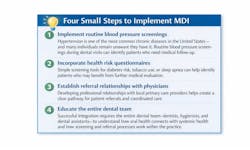
Private practices can begin incorporating integrated care principles through a few practical steps:
Implementing routine blood pressure screenings. Hypertension is one of the most common chronic diseases in the United States, and many individuals remain unaware they have it
Incorporating health risk questionnaires. Screening tools for diabetes, tobacco use, or sleep apnea can help identify patients who may benefit from medical follow-up.
Establishing referral relationships with physicians. Building partnerships with local providers creates a pathway for coordinated care
Educating the dental team. Dentists, hygienists, and dental assistants should understand how oral health connects with systemic health.

Overcoming barriers to integration
Dental practices may be reluctant to embrace MDI due to time, workflow, or reimbursement concerns. However, meaningful change often begins with small steps.
Incorporating routine screenings or strengthening referral relationships can significantly improve a practice’s ability to detect systemic health issues. In community health settings, even small changes can have a profound impact on patient outcomes.
As awareness of the oral-systemic connection continues to grow, many dental professionals are discovering that integrated care not only improves patient outcomes but also elevates the role of the dental team.
The future of dentistry is integrated care
HealthcareHealth care is becoming more collaborative and patient-centered, focusing on prevention and early intervention; when. When dental and medical providers work together, patients benefit from earlier disease detection, improved chronic disease management, and more coordinated care.
In many ways, MDI is an extension of what hygienists have always done: assess the whole patient, identify risk, and connect patients to care. As healthcarehealth care continues to evolve, the future of dentistry is collaboration—and dental hygienists will be at the center of it.
References
Eke PI, Dye BA, Wei L, et al. Prevalence of periodontitis in adults in the United States: 2009 and 2010. J Periodontol. 2012;83(12):1479-1484. doi:10.1177/0022034512457373
Preshaw PM, Alba AL, Herrera D, et al. Periodontitis and diabetes: a two-way relationship. Diabetologia. 2012;55(1):21-31. doi:10.1007/s00125-011-2342-y
More than a dental visit: oral health as a gateway to overall health. CareQuest Institute for Oral Health. 2022. Accessed April 6, 2026. https://www.carequest.org/re
Greenberg BL, Glick M, Frantsve-Hawley J, Kantor ML. Dentists’ attitudes toward chairside screening for medical conditions.J Am Dent Assoc. 2010;141(1):52-62. doi:10.14219/jada.archive.2010.0228
Simpson TC, Weldon JC, Worthington HV, et al. Treatment of periodontal disease for glycaemic control in people with diabetes. Cochrane Database Syst Rev.2015;(11):CD004714. doi:10.1002/14651858.CD004714.pub3
