


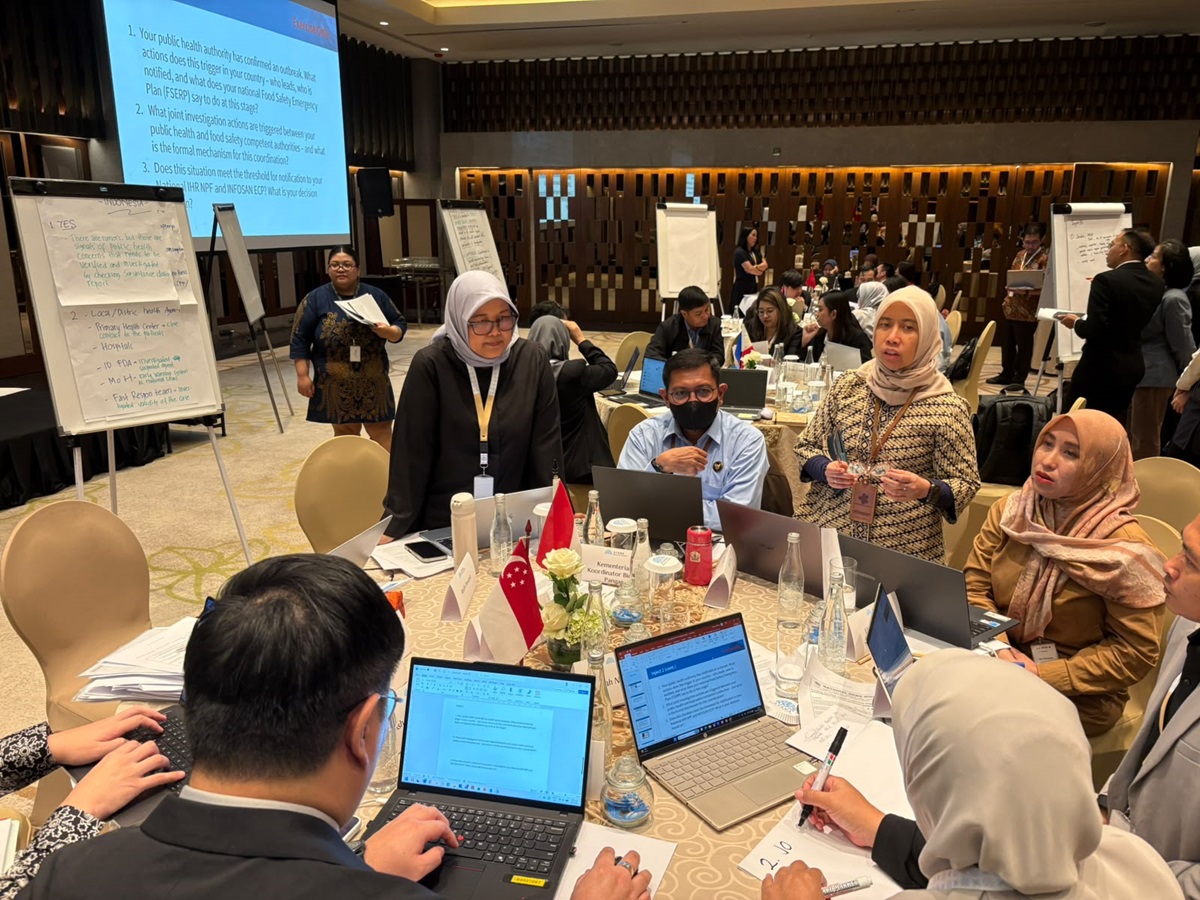
ASEAN Member States joined WHO and international partners in Jakarta to rehearse a coordinated response to a simulated cross-border food contamination event – testing the systems designed to keep a local incident from becoming a regional emergency
What if a food product contaminated in one country was making people sick across Southeast Asia? What processes are in place to identify there more people fall ill?
All 11 Member States of the Association of Southeast Asian Nations (ASEAN) came together in Jakarta, Indonesia from 7 to 9 July 2026 for a Food Safety Emergency Response Tabletop Simulation Exercise to explore response to such an event. This event brought together food safety and health authorities to strengthen national capacity and to test the region’s readiness to detect, collaborate and respond to a food safety emergency in a single, coordinated simulation exercise
With foodborne illnesses causing over 1.5 million deaths and 426 million illnesses each year in the Asia Pacific region, food safety emergency preparedness depends on strong coordination. When contamination occurs, every hour matters. Rapid information-sharing between countries can help identify unsafe products sooner, remove them from markets and reduce the number of people exposed
Working through a realistic scenario in which a contaminated food product crossed borders and caused illness in multiple countries, participants discussed whether national food safety emergency response plans could function under pressure. The exercise tested laboratory and epidemiology systems, risk assessment, risk and public communications, and product traceability and recall procedures
Partnerships as preparedness
While the exercise was hosted by BPOM with support from the ASEAN Secretariat, it brought together a range of technical partners including the Southeast Asian Food and Agricultural Science and Technology Centre (SEAFAST), the Ministry of Food and Drug Safety of the Republic of Korea as the newly designated WHO Collaborating Centre for Food Safety Emergencies, the UK Health Security Agency, and WHO. This activity was supported by the Quadripartite (FAO/UNEP/WHO/WOAH) through the ASEAN-UK Health Security Partnership (HSP) Pillar 3 Project.
The exercise examined the information sharing pathways linking public health authorities, food safety competent authorities, National Focal Points for the International Health Regulations (IHR), and International Food Safety Authorities Network (INFOSAN) Emergency Contact Points. It also examined how ASEAN’s regional mechanisms – including the ASEAN Risk Assessment Centre for Food Safety (ARAC) and the ASEAN Rapid Alert System for Food and Feed (ARASFF) – connect with these national and global networks.
“This exercise translated the WHO Global Strategy for Food Safety: 2022-2030 into practice by testing emergency response systems, IHR food safety core capacities, and the multisectoral and regional collaboration mechanism for food safety events,” explained Dr Katherine Helena Oliveira de Matos, the Technical Officer for Food Safety at the WHO Western Pacific Regional Office
“The emergence of biological, chemical, and environmental hazards requires a food safety emergency system capable of rapid detection, timely information sharing, science-based risk assessment, and a coordinated regional response,” said Professor Taruna Ikrar, Chairperson of the Indonesian Food and Drug Authority, Badan Pengawas Obat dan Makanan (BPOM). He further emphasized that “these challenges cannot be faced by one country, or one institution alone but rather require close collaboration between stakeholders and between countries.”
Participants responding to exercise injects. Credit: BPOM
What the exercise team observed
Evaluators and members of the exercise team identified several themes emerging from the exercise. It demonstrated the importance of sustained collaboration among national authorities, ASEAN sectoral bodies, and international partners in supporting regional food safety preparedness. Evaluators observed that while many participating countries have established multisectoral mechanisms to respond to food safety emergencies, some are continuing to develop or finalize national response plans. They also highlighted the value of regular simulation exercises in strengthening preparedness, coordination, and operational readiness.
Through this simulation exercise, evaluators highlighted the importance of effective communication and coordination between National IHR Focal Points and INFOSAN Emergency Contact Points to facilitate timely information sharing and response during food safety emergencies. They also noted common challenges related to public risk communication when information is limited or evolving, addressing misinformation, and ensuring the rapid removal of unsafe food products from traditional markets and online platforms.
“The Food Safety Emergency Response Plan is not a plan unless the functionality of the plan is tested for operational readiness,” said Dr Gyanendra Gongal, Senior Public Health Officer for the WHO South-East Asia Regional Office
Based on exercise observations, the exercise team identified several areas for continued strengthening, including coordination mechanisms, clarification of roles and responsibilities, establishment of clearer operational triggers for food safety emergencies, technical capacity development, and regular joint exercises. The exercise also highlighted the potential complementarity of ASEAN regional mechanisms, including ARAC and ARASFF, with IHR and INFOSAN processes in supporting timely and effective responses to food safety events across the region.
From simulation to health security
Simulation exercises help responders find and fix gaps in a safe environment before a real emergency exposes them. “Testing plans and systems together builds a sense of community. Exercises contribute to new ways of working, updated plans, revised procedures and greater solidarity,” said Hitesh Chugh, Technical Officer (Emergency Simulation Exercises) at the WHO Western Pacific Regional Office
A culture of learning and continuous improvement – within and across country contexts – ultimately contributes to safeguarding the health of people everywhere. Through this exercise, ASEAN Member States are strengthening their collective ability to detect risks early, share information quickly and protect millions.
