


Abstract
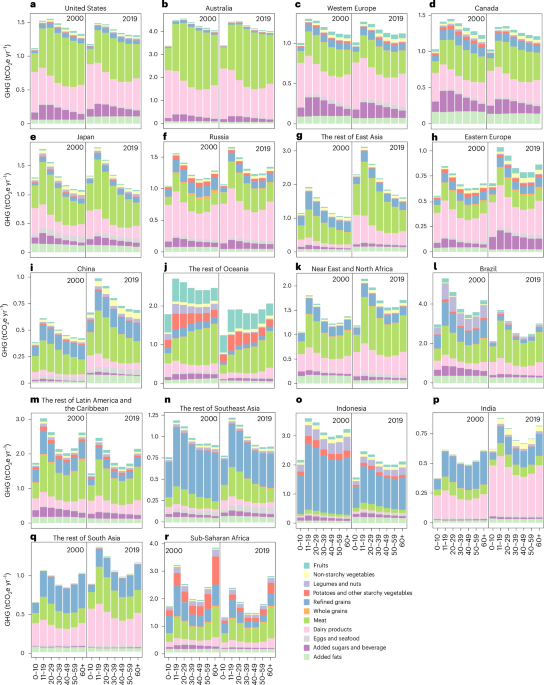
Diets across age groups vary in both nutritional quality and greenhouse gas emissions, yet their relationship remains poorly understood in the context of population aging and evolving dietary patterns. We evaluated dietary emissions associated with 141 products across 22 age groups in 149 countries from 2000 to 2019, combining age-specific dietary intake from the Global Dietary Database with a consumption-based emission inventory derived from FAOSTAT. We quantified changes in emissions alongside shifts in nutritional quality and examined contributions of demographic and dietary factors. Adolescents and young adults generally had the highest per capita dietary emissions, while seniors contributed most to global emission growth, particularly in high- and upper-middle-income countries. Increased meat intake was a leading contributor to rising emissions and frequently coincided with declining nutritional quality. These findings highlight the need for dietary-emission mitigation efforts across age groups that account for demographic shifts, nutritional needs and national development contexts.
Access through your institution
Buy or subscribe
This is a preview of subscription content, access
Access options
Access through your institution
- Purchase on SpringerLink
- Instant access to the full article PDF.
39,95 €
Prices may be subject to local taxes which are calculated during checkout
Data availability
Data for emissions from agricultural land use and land use change, on-farm agricultural production and post-farm processes, and for physical food consumption, are curated by the FAO and can be freely obtained from FAOSTAT63, available from ref. 20. Data on food loss and waste rate are retrieved from FAOSTAT63 and ref. 18. Dietary intake data for different food categories by age are obtained from the GDD1,8,17. Population data used in this study are obtained from the World Population Prospects of the United Nations66. Supplementary figures and tables used in the analysis can be found in the Supplementary Information files. Supplementary datasets supporting the analyses of this study are provided with the paper. Additional detailed results are available from the corresponding author upon reasonable request. Source data are provided with this paper.
Code availability
The code developed for data processing in R is provided as Supplementary Code files
References
Miller, V. et al. Global dietary quality in 185 countries from 1990 to 2018 show wide differences by nation, age, education, and urbanicity. Nat. Food3, 694–702 (2022)
Leng, G. et al. The determinants of food choice. Proc. Nutr. Soc.76, 316–327 (2017)
Laine, J. E. et al. Co-benefits from sustainable dietary shifts for population and environmental health: an assessment from a large European cohort study. Lancet Planet. Health5, e786–e796 (2021)
He, P., Feng, K., Baiocchi, G., Sun, L. & Hubacek, K. Shifts towards healthy diets in the US can reduce environmental impacts but would be unaffordable for poorer minorities. Nat. Food2, 664–672 (2021)
Hiç, C., Pradhan, P., Rybski, D. & Kropp, J. R. P. Food surplus and its climate burdens. Environ. Sci. Technol.50, 4269–4277 (2016)
Yin, K., Zhao, X., Liu, Y., Zhu, J. & Fei, X. Aging increases global annual food greenhouse gas emissions up to 300 million tonnes by 2100. Environ. Sci. Technol.58, 5784–5795 (2024)
Shigetomi, Y., Ishigami, A., Long, Y. & Chapman, A. Curbing household food waste and associated climate change impacts in an ageing society. Nat. Commun.15, 8806 (2024)
Miller, V. et al. Global, regional, and national consumption of animal-y Database. Lancet Planet. Health6, e243–e256 (2022)
Lara-Castor, L. et al. Sugar-sweetened beverage intakes among adults between 1990 and 2018 in 185 countries. Nat. Commun.14, 5957 (2023)
He, P., Baiocchi, G., Hubacek, K., Feng, K. & Yu, Y. The environmental impacts of rapidly changing diets and their nutritional quality in China. Nat. Sustain.1, 122–127 (2018)
He, P. et al. Health–environment efficiency of diets shows nonlinear trends over 1990–2011. Nat. Food5, 116–124 (2024)
Guo, Y. et al. Environmental and human health trade-offs in potential Chinese dietary shifts. One Earth5, 268–282 (2022)
Zheng, H. et al. Ageing society in developed countries challenges carbon mitigation. Nat. Clim. Change12, 241–248 (2022)
Article
ADS
CAS
Google ScholarWang, Q., Kwan, M.-P., Lin, J. & Dang, N. The impacts of population aging on residential energy consumption and carbon emissions in the United States. Humanit. Soc. Sci. Commun.12, 1741 (2025)
Tang, L. et al. Assessing the impacts of fertility and retirement policies on China’s carbon emissions. Nat. Clim. Change14, 1261–1267 (2024)
Supply Utilization Accounts, Food Balances. FAOSTAT Online Database (Food and Agriculture Organization of the United Nations, 2022); https://www.fao.org/faostat/en/#data/SCL
Miller, V., Webb, P., Micha, R. & Mozaffarian, D. Defining diet quality: a synthesis of dietary quality metrics and their validity for the double burden of malnutrition. Lancet Planet. Health4, e352–e370 (2020)
Tuninetti, M., Ridolfi, L. & Laio, F. Compliance with EAT–Lancet dietary guidelines would reduce global water footprint but increase it for 40% of the world population. Nat. Food3, 143–151 (2022)
Gustavsson, J., Cederberg, C., Sonesson, U., Van Otterdijk, R. & Meybeck, A. Global Food Losses and Food Waste—Extent, Causes and Prevention (Food and Agriculture Organization, 2011); https://www.fao.org/3/mb060e/mb060e00.htm
Li, Y. et al. Changes in global food consumption increase GHG emissions despite efficiency gains along global supply chains. Nat. Food4, 483–495 (2023)
Li, Y. et al. Reducing climate change impacts from the global food system through diet shifts. Nat. Clim. Change14, 943–953 (2024)
Götmark, F., Cafaro, P. & O’Sullivan, J. Aging human populations: good for us, good for the earth. Trends Ecol. Evol.33, 851–862 (2018)
Scott, A. J. The longevity society. Lancet Healthy Longev.2, e820–e827 (2021)
Bongaarts, J. & O’Neill, B. C. Global warming policy: is population left out in the cold?. Science361, 650–652 (2018)
Gu, D., Andreev, K. & Dupre, M. E. Major trends in population growth around the world. China CDC Wkly.3, 604–613 (2021)
Teggart, K. et al. Group-based nutrition interventions to promote healthy eating and mobility in community-dwelling older adults: a systematic review. Public Health Nutr.25, 2920–2951 (2022)
Saffel-Shrier, S., Johnson, M. A. & Francis, S. L. Position of the Academy of Nutrition and Dietetics and the Society for Nutrition Education and Behavior: food and nutrition programs for community-residing older adults. J. Nutr. Educ. Behav.51, 781–797 (2019)
Realini, C. E. et al. Meat insights: Uruguayan consumers’ mental associations and motives underlying consumption changes. Meat Sci.192, 108901 (2022)
Habumugisha, T. et al. Older adults’ perceptions about meat consumption: a qualitative study in Gasabo district, Kigali, Rwanda. BMC Public Health24, 1515 (2024)
Hurree, N. & Jeewon, R. An analysis of contributors to energy intake among middle aged and elderly adults. Curr. Res. Nutr. Food Sci. J.4, 8–18 (2016)
Gorski, I., Chung, W.-C., Herr, K. & Mehta, K. Nyama choma culture: implications of increased red meat and alcohol consumption in East Africa. J. Sustain. Dev.9, 96–102 (2016)
Cornelsen, L. et al. Cross-sectional study of drivers of animal-. BMC Nutr.2, 70 (2016)
Vranken, L., Avermaete, T., Petalios, D. & Mathijs, E. Curbing global meat consumption: emerging evidence of a second nutrition transition. Environ. Sci. Policy39, 95–106 (2014)
Oostindjer, M. et al. Are school meals aainability of children’s diet and food consumption? A cross-national comparative perspective. Crit. Rev. Food Sci. Nutr.57, 3942–3958 (2017)
Carducci, B. et al. Gaps and priorities in assessment of food environments for children and adolescents in low-and middle-income countries. Nat. Food2, 396–403 (2021)
Ochola, S. & Masibo, P. K. Dietary intake of school children and adolescents in developing countries. Ann. Nutr. Metab.64, 24–40 (2014)
HLPE. Nutrition and Food Systems. A Report by the High Level Panel of Experts on Food Security and Nutrition of the Committee on World Food Security (FAO, 2017); https://openknowledge.fao.org/handle/20.500.14283/i7846e
2018GlobalNutrition Report: Shining a Light to Spur Action on Nutrition (Development Initiatives, 2018); https://globalnutritionreport.org/reports/global-nutrition-report-2018/
Food Systems and Diets: Facing the Challenges of the 21st Century (Global Panel on Agriculture and Food Systems for Nutrition, 2016); https://glopan.org/sites/default/files/ForesightReport.pdf
FAO, IFAD, UNICEF, WFP & WHO. The State of Food Security and Nutrition in the World 2025—Addressing High Food Price Inflation for Food Security and Nutrition (FAO, 2025); https://doi.org/10.4060/cd6008en
Pradhan, P., Fischer, G., Van Velthuizen, H., Reusser, D. E. & Kropp, J. P. Closing yield gaps: how sustainable can we be? PloS ONE10, e0129487 (2015)
Sibhatu, K. T. & Qaim, M. Rural food security, subsistence agriculture, and seasonality. PloS ONE12, e0186406 (2017)
Navarre, N., Schrama, M., de Vos, C. & Mogollón, J. M. Interventions for sourcing EAT-Lancet diets within national agricultural areas: a global analysis. One Earth6, 31–40 (2023)
Geyik, O., Hadjikakou, M., Karapinar, B. & Bryan, B. A. Does global food trade close the dietary nutrient gap for the world’s poorest nations? Glob. Food Secur.28, 100490 (2021)
Hirvonen, K., Bai, Y., Headey, D. & Masters, W. A. Affordability of the EAT–Lancet reference diet: a global analysis. Lancet Glob. Health8, e59–e66 (2020)
Springmann, M., Clark, M. A., Rayner, M., Scarborough, P. & Webb, P. The global and regional costs of healthy and sustainable dietary patterns: a modelling study. Lancet Planet. Health5, e797–e807 (2021)
Hong, C. et al. Global and regional drivers of land-use emissions in 1961–2017. Nature589, 554–561 (2021)
Hong, C. et al. Land-use emissions embodied in international trade. Science376, 597–603 (2022)
Kastner, T., Erb, K.-H. & Haberl, H. Rapid growth in agricultural trade: effects on global area efficiency and the role of management. Environ. Res. Lett.9, 034015 (2014)
Henders, S., Persson, U. M. & Kastner, T. Trading forests: land-use change and carbon emissions embodied in production and exports of forest-risk commodities. Environ. Res. Lett.10, 125012 (2015)
Miller, V. et al. Global Dietary Database 2017: data availability and gaps on 54 major foods, beverages and nutrients among 5.6 million children and adults from 1220 surveys worldwide. BMJ Glob. Health6, e003585 (2021)
Chiuve, S. E. et al. Alternative dietary indices both strongly predict risk of chronic disease. J. Nutr.142, 1009–1018 (2012)
Developing the Healthy Eating Index (National Institutes of Health, 2020); https://epi.grants.cancer.gov/hei/developing.html#2015
Shams-White, M. M. et al. Healthy eating index—2020: review and update process to reflect the dietary guidelines for Americans, 2020–2025. J. Acad. Nutr. Diet.123, 1280–1288 (2023)
Willett, W. et al. Food in the Anthropocene: the EAT–Lancet Commission on healthy diets from sustainable food systems. Lancet393, 447–492 (2019)
World Bank Country and Lending Groups (World Bank, 2024); https://datahelpdesk.worldbank.org/knowledgebase/articles/906519-world-bank-country-and-lending-groups
Tubiello, F. N. et al. Pre-and post-production processes increasingly dominate greenhouse gas emissions from agri-food systems. Earth Syst. Sci. Data14, 1795–1809 (2022)
Barrett, J. et al. Consumption-based GHG emission accounting: a UK case study. Clim. Policy13, 451–470 (2013)
Liu, Z. et al. Four system boundaries for carbon accounts. Ecol. Model.318, 118–125 (2015)
Kastner, T., Kastner, M. & Nonhebel, S. Tracing distant environmental impacts of agricultural products from a consumer perspective. Ecol. Econ.70, 1032–1040 (2011)
Food Balance Sheets—A Handbook (Food and Agriculture Organization of the United Nations, 2001); https://www.fao.org/3/x9892e/X9892e05.htm#P8217_125315
Nutritive Factors (Food and Agriculture Organization of the United Nations, 2023); https://www.fao.org/economic/the-statistics-division-ess/publications-studies/publications/nutritive-factors/en/
FAOSTAT Database (Food and Agriculture Organization of the United Nations, 2022); https://www.fao.org/faostat/en/
World Population Prospects 2022 (United Nations, 2022); https://population.un.org/wpp/Download/Standard/Population/
Kummu, M. et al. Lost food, wasted rehwater, cropland, and fertiliser use. Sci. Total Environ.438, 477–489 (2012)
World Population Prospects 2019 (United Nations, Department of Economic and Social Affairs, 2019); https://population.un.org/wpp2019/Download/Standard/Population/
Crippa, M. et al. Food systems are responsible for a third of global anthropogenic GHG emissions. Nat. Food2, 198–209 (2021)
Tubiello, F. N. et al. Greenhouse gas emissions from food systems: building the evidence base. Environ. Res. Lett.16, 065007 (2021)
Krebs-Smith, S. M. et al. Update of the healthy eating index: HEI-2015. J. Acad. Nutr. Diet.118, 1591–1602 (2018)
Schwingshackl, L. & Hoffmann, G. Diet quality as assessed by the Healthy Eating Index, the Alternate Healthy Eating Index, the Dietary Approaches to Stop Hypertension score, and health outcomes: a systematic review and meta-analysis of cohort studies. J. Acad. Nutr. Diet.115, 780–800.e785 (2015)
Guenther, P. M., Reedy, J. & Krebs-Smith, S. M. Development of the healthy eating index—2005. J. Am. Diet. Assoc.108, 1896–1901 (2008)
Ang, B. W., Zhang, F. Q. & Choi, K.-H. Factorizing changes in energy and environmental indicators through decomposition. Energy23, 489–495 (1998)
2006 IPCC Guidelines for National Greenhouse Gas Inventories (Intergovernmental Panel on Climate Change, 2006); https://www.ipcc.ch/report/2006-ipcc-guidelines-for-national-greenhouse-gas-inventories/
Tubiello, F. N. et al. The FAOSTAT database of greenhouse gas emissions from agriculture. Environ. Res. Lett.8, 015009 (2013)
Tubiello, F. N. et al. Methods for Estimating Greenhouse Gas Emissions from Food Systems. Part III: Energy Use in Fertilizer Manufacturing, Food Processing, Packaging, Retail and Household Consumption (Food and Agriculture Organization of the United Nations, 2021); https://doi.org/10.4060/cb7473en
Acknowledgements
We thank the Global Dietary Database (GDD) team for their assistance and guidance regarding data access and use during the early stages of this study
Funding
Y.L. discloses support for this study from the New Chongqing YC Project (grant number CSTB2025YCJH-KYXM0032), funded by the Chongqing Municipal Bureau of Science and Technology, and the Chongqing University Hongshen Start-up Grant. Y.S. discloses support for this study from the Horizon Europe Project EU-CHINA-BRIDGE (grant number 101137971), supported by UKRI grant 10132630 at the University of Birmingham. K.H. discloses support for this study from the European Union’s Horizon Europe research and innovation programme Project PANTHEON (grant number 101137905). P.P. discloses support for this study from the European Research Council (ERC) Project BeyondSDG (grant number 101077492). Y.L. and J.Y. acknowledge support from the China Scholarship Council PhD Program. P.H., S.F. and F.R. declare no relevant funding.
Author information
Authors and Affiliations
Key Laboratory of the Three Gorges Reservoir Region’s Eco-Environment, Ministry of Education, Chongqing University, Chongqing, China
Yanxian Li
College of Environment and Ecology, Chongqing University, Chongqing, China
Yanxian Li
Fudan Tyndall Center and Shanghai Key Laboratory of Air Quality and Environmental Health, Department of Environmental Science and Engineering, Fudan University, Shanghai, China
Jin Yan
Department of Geography, The University of Hong Kong, Hong Kong, China
Pan He
School of Earth and Environmental Sciences, Cardiff University, Cardiff, UK
Pan He
Integrated Research on Energy, Environment and Society (IREES), Energy and Sustainability Research Institute Groningen (ESRIG), University of Groningen, Groningen, the Netherlands
Prajal Pradhan, Franco Ruzzenenti & Klaus Hubacek
Potsdam Institute for Climate Impact Research (PIK), Member of the Leibniz Association, Potsdam, Germany
Prajal Pradhan
Business School, Soochow University, Suzhou, China
Shuai Fang
School of Geography, Earth and Environmental Sciences, University of Birmingham, Birmingham, UK
Yuli Shan
Authors
- Yanxian LiView author publications
Search author on:PubMed Google Scholar
- Jin YanView author publications
Search author on:PubMed Google Scholar
- Pan HeView author publications
Search author on:PubMed Google Scholar
- Prajal PradhanView author publications
Search author on:PubMed Google Scholar
- Shuai FangView author publications
Search author on:PubMed Google Scholar
- Yuli ShanView author publications
Search author on:PubMed Google Scholar
- Franco RuzzenentiView author publications
Search author on:PubMed Google Scholar
- Klaus HubacekView author publications
Search author on:PubMed Google Scholar
Contributions
Y.L., Y.S. and K.H. designed the study. Y.L. performed the analysis with support from J.Y., P.H. and S.F. on analytical approaches and visualization. Y.L. took the lead in writing, with contributions from P.H., P.P., F.R. and K.H. Y.S. and K.H. supervised and coordinated the overall study. All co-authors reviewed and commented on the paper
Ethics declarations
Competing interests
The authors declare no competing interests
Peer review
Peer review information
Nature Food thanks Alexander Vonderschmidt, Ke Yin and the other, anonymous, reviewer(s) for their contribution to the peer review of this work
Additional information
Publisher’s note Springer Nature remains neutral with regard to jurisdictional claims in published maps and institutional affiliations
Supplementary information
Supplementary Information (download PDF )
Supplementary Figs. 1–30, Supplementary Tables 1–12, Supplementary Methods and Supplementary Discussion
Reporting Summary (download PDF )
Supplementary Data 1
Supplementary datasets containing age-specific dietary emission results and uncertainty ranges analysed in this study
Supplementary Code 1
Step-by-step R scripts and README documentation describing the analytical workflow and data-processing procedures
Source data
Source Data Fig. 1 (download XLSX )
Source data for Fig. 1.
Source Data Fig. 2 (download XLSX )
Source data for Fig. 2.
Source Data Fig. 3 (download XLSX )
Source data for Fig. 3.
Source Data Fig. 4 (download XLSX )
Source data for Fig. 4.
Rights and permissions
Springer Nature or its licensor (e.g. a society or other partner) holds exclusive rights to this article under a publishing agreement with the author(s) or other rightsholder(s); author self-archiving of the accepted manuscript version of this article is solely governed by the terms of such publishing agreement and applicable law
About this article
Cite this article
Li, Y., Yan, J., He, P. et al. Youth lead current dietary emissions while seniors increasingly drive total emission growth.
Nat Food7, 688–700 (2026). https://doi.org/10.1038/s43016-026-01383-4
Received:25 June 2025
Accepted:05 June 2026
Published:22 July 2026
Version of record:22 July 2026
Issue date:July 2026
DOI
:https://doi.org/10.1038/s43016-026-01383-4
