


- by Kayla YupPublished July 10, 2026, 11:39 a.m. ET
The federal government has awarded Children’s Hospital of Philadelphia $39 million to develop a scalable platform for treating rare genetic, liver-related diseases in infants and children
The Advanced Research Projects Agency for Health (ARPA-H) also announced this week another $4 million for local gene therapy pioneer Jim Wilson to design gene therapies using AI at his University of Pennsylvania spinout, GEMMABio
The $43 million in funding earmarked for Philadelphia researchers comes through a new federal effort to advance gene therapies for rare diseases
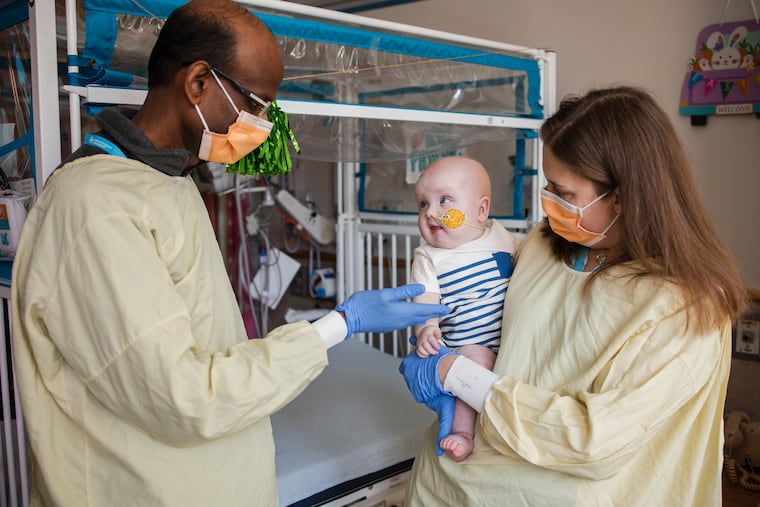
CHOP’s team includes the duo behind last year’s first-of-its-kind, personalized gene-editing treatment involving a Philadelphia-area infant, known as Baby KJ. CHOP’s Rebecca Ahrens-Nicklas and Penn Medicine’s Kiran Musunuru together created a custom drug to correct the genetic mutation driving Baby KJ’s rare metabolic disease — dramatically improving his liver function
» READ MORE:CHOP and Penn treated an infant with a rare disease by editing his genes
The funding will expand their work and bring in another CHOP researcher, Lindsey George, who develops gene therapies for bleeding disorders
“We’re trying to move beyond just one diagnosis or one gene,” Ahrens-Nicklas said
Philly-based scientists comprise two of seven research teams nationwide to receive funding through ARPA-H’s new $160 million effort
Called THRIVE, the program aims to help the roughly one in 10 people — most being newborns, infants, and children — with chronic genetic diseases. Ninety-five percent of rare diseases currently have no approved treatments
Leaders want to develop “precision genetic medicines through platforms that can test multiple treatments for multiple diseases in a single clinical trial,” ARPA-H director Alicia Jackson said in a Thursday news release
» READ MORE:Feds award $22 million to Penn spinout Linnaeus Therapeutics to advance anti-aging drug
CHOP’s expanding focus
The CHOP team will focus on building a scalable gene-editing platform that can be used to treat a variety of infants and children
Their initial focus is on liver-related genetic diseases, ranging from urea cycle disorders to blood clotting diseases
“Essentially it’s the same drug, whether or not you’re targeting a genetic variant that causes a rare metabolic disease or a genetic variant that causes a rare coagulation disorder,” Ahrens-Nicklas said
Their five-year plan includes launching preclinical and clinical trials testing the safety and efficacy of their individualized treatments
They will also pursue regulatory approvals, work with payors, and implement their therapies at community sites and remote hubs to expand access
“We are the three musketeers that already text 25,000 times a day, and will continue to do so,” Ahrens-Nicklas said
Wilson experimenting with AI
Wilson founded academia’s first gene therapy program back in 1993 as a professor at Penn
He left in 2024 to spin out biotech startups dedicated to tackling rare diseases with genetic medicines
» READ MORE:Geneticist Jim Wilson left UPenn behind, but not his dream of curing rare genetic diseases
“The question is, can we find ways to scale this bespoke personalized medicine strategy, so that it is affordable and cost-effective?” he said
In partnership with a biotech called ProFluent, GEMMABio will use AI to design its base editors — the machinery that goes in and make edits to DNA
The tool could be rapidly adapted to different patients and diseases, theoretically making the process more affordable, scalable, and efficient, Wilson said
His $4 million award will fund preclinical studies of their technology
GEMMABio’s initial focus is on two rare liver diseases “for which there is significant unmet need,” he said, including Maple Syrup Urine Disease and homozygous familial hypercholesterolemia (HoFH)
