


Abstract
Objective
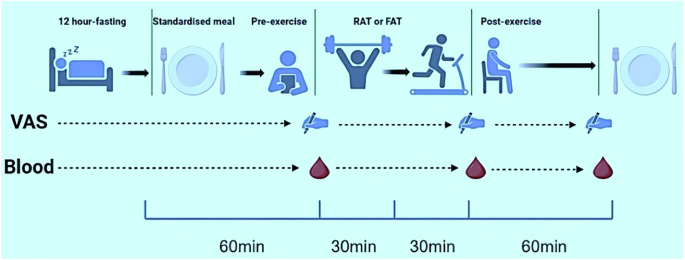
This randomized crossover study compared acute appetite-related, gut-hormone, and energy-intake responses between moderate-intensity resistance plus aerobic training (RAT) and high-intensity functional plus aerobic training (FAT) in males with obesity
Methods
Twenty-one men with obesity completed both protocols in a randomized crossover design. Subjective appetite was assessed using a visual analogue scale, and insulin, glucagon-like peptide-1, and peptide YY (PYY) were measured pre-, post-, and 1 h post-exercise. Energy intake was recorded during subsequent meals and over 2 days
Results
PYY responses differed between conditions over time, with a significant condition × time interaction (P = 0.015). At 1 h post-exercise, PYY concentrations were higher after RAT than after FAT (ratio = 1.69, 95% CI 1.26–2.27; adjusted P < 0.001). PYY AUC was higher in RAT than in FAT (ratio [RAT/FAT] = 1.44; P = 0.016). Fullness AUC was lower after RAT than after FAT, whereas prospective food consumption AUC was higher after RAT than after FAT (Δ [RAT − FAT] = −670.0 and 701.4 mm·120 min; P = 0.014 and P = 0.016, respectively). No between-condition differences were observed in energy intake on the trial day or the following day.
Conclusion
Varying the resistance component within combined exercise may elicit distinct acute hormonal and perceptual appetite responses in young men with obesity, without altering short-term energy intake. These findings should be interpreted as comparative responses between RAT and FAT rather than exercise-induced effects per se
Access through your institution
Buy or subscribe
This is a preview of subscription content, access
Access options
Access through your institution
- Purchase on SpringerLink
- Instant access to the full article PDF.
39,95 €
Prices may be subject to local taxes which are calculated during checkout
Data availability
The datasets generated during and/or analysed during the current study are available from the corresponding author on reasonable request
References
Blüher M. Obesity: global epidemiology and pathogenesis. Nat Rev Endocrinol. 2019;15:288–98
Young-Hyman D. Introduction to special issue: self-regulation of appetite-it’s complicated. Obes (Silver Spring). 2017;25:S5–s7
Perdomo CM, Cohen RV, Sumithran P, Clément K, Frühbeck G. Contemporary medical, device, and surgical therapies for obesity in adults. Lancet. 2023;401:1116–30
Stoeckel LE, Birch LL, Heatherton T, Mann T, Hunter C, Czajkowski S, et al. Psychological and neural contributions to appetite self-regulation. Obes (Silver Spring). 2017;25:S17–S25
Schwartz MB, Just DR, Chriqui JF, Ammerman AS. Appetite self-regulation: Environmental and policy influences on eating behaviors. Obes (Silver Spring). 2017;25:S26–s38
Zheng H, Lenard NR, Shin AC, Berthoud HR. Appetite control and energy balance regulation in the modern world: reward-driven brain overrides repletion signals. Int J Obes (Lond). 2009;33:S8–13
King NA, Horner K, Hills AP, Byrne NM, Wood RE, Bryant E, et al. Exercise, appetite and weight management: understanding the compensatory responses in eating behaviour and how they contribute to variability in exercise-induced weight loss. Br J Sports Med. 2012;46:315–22
Thackray AE, Stensel DJ. The impact of acute exercise on appetite control: Current insights and future perspectives. Appetite. 2023;186:106557
Schubert MM, Desbrow B, Sabapathy S, Leveritt M. Acute exercise and subsequent energy intake. A meta-analysis. Appetite. 2013;63:92–104
Dorling J, Broom DR, Burns SF, Clayton DJ, Deighton K, James LJ, et al. Acute and chronic effects of exercise on appetite, energy intake, and appetite-related hormones: the modulating effect of adiposity, sex, and habitual physical activity. Nutrients. 2018;10:1140
Li N, Wu M, Li Y. Acute exercise effects on appetite and energy intake in people living with overweight and obesity: a systematic review and meta-analysis. Int J Sport Nutr Exerc Metab. 2025;35:540–56
Hagobian TA, Sharoff CG, Braun B. Effects of short-term exercise and energy surplus on hormones related to regulation of energy balance. Metabolism. 2008;57:393–8
Martins C, Morgan LM, Bloom SR, Robertson MD. Effects of exercise on gut peptides, energy intake and appetite. J Endocrinol. 2007;193:251–8
Halliday TM, White MH, Hild AK, Conroy MB, Melanson EL, Cornier MA. Appetite and energy intake regulation in response to acute exercise. Med Sci Sports Exerc. 2021;53:2173–81
Oppert JM, Ciangura C, Bellicha A. Physical activity and exercise for weight loss and maintenance in people living with obesity. Rev Endocr Metab Disord. 2023;24:937–49
Oppert JM, Bellicha A, van Baak MA, Battista F, Beaulieu K, Blundell JE, et al. Exercise training in the management of overweight and obesity in adults: synthesis of the evidence and recommendations from the European Association for the Study of Obesity Physical Activity Working Group. Obes Rev. 2021;22:e13273
Feito Y, Heinrich KM, Butcher SJ, Poston WSC. High-intensity functional training (HIFT): definition and research implications for improved fitness. Sports (Basel). 2018;6:3
Heinrich KM, Patel PM, O’Neal JL, Heinrich BS. High-intensity compared to moderate-intensity training for exercise initiation, enjoyment, adherence, and intentions: an intervention study. BMC Public Health. 2014;14:789
Williams DM, Dunsiger S, Miranda R Jr, Gwaltney CJ, Emerson JA, Monti PM, et al. Recommending self-paced exercise among overweight and obese adults: a randomized pilot study. Ann Behav Med. 2015;49:280–5
Balady GJ, Chaitman B, Driscoll D, Foster C, Froelicher E, Gordon N, et al. Recommendations for cardiovascular screening, staffing, and emergency policies at health/fitness facilities. Circulation. 1998;97:2283–93
Shim JS, Oh K, Kim HC. Dietary assessment methods in epidemiologic studies. Epidemiol Health. 2014;36:e2014009
Allison DB, Paultre F, Maggio C, Mezzitis N, Pi-Sunyer FX. The use of areas under curves in diabetes research. Diab Care. 1995;18:245–50
Ahluwalia N, Dwyer J, Terry A, Moshfegh A, Johnson C. Update on NHANES dietary data: focus on collection, release, analytical considerations, and uses to inform public policy. Adv Nutr. 2016;7:121–34
Lee MJ, Ballantyne JK, Chagolla J, Hopkins WG, Fyfe JJ, Phillips SM, et al. Order of same-day concurrent training influences some indices of power development, but not strength, lean mass, or aerobic fitness in healthy, moderately-active men after 9 weeks of training. PLoS One. 2020;15:e0233134
Tanaka H, Monahan KD, Seals DR. Age-predicted maximal heart rate revisited. J Am Coll Cardiol. 2001;37:153–6
Thomas DT, Erdman KA, Burke LM. American College of sports medicine joint position statement. nutrition and athletic performance. Med Sci Sports Exerc. 2016;48:543–68
CAS
PubMed
Google ScholarMatos VAF, Souza DC, Santos VOA, Medeiros ÍF, Browne RAV, Nascimento PRP. Acute effects of high-intensity interval and moderate-intensity continuous exercise on GLP-1, appetite and energy intake in obese men: a crossover trial. Nutrients. 2018;10:889
Flint A, Raben A, Blundell JE, Astrup A. Reproducibility, power and validity of visual analogue scales in assessment of appetite sensations in single test meal studies. Int J Obes Relat Metab Disord. 2000;24:38–48
Stubbs RJ, Hughes DA, Johnstone AM, Rowley E, Reid C, Elia M, et al. The use of visual analogue scales to assess motivation to eat in human subjects: a review of their reliability and validity with an evaluation of new hand-held computerized systems for temporal tracking of appetite ratings. Br J Nutr. 2000;84:405–15
Lakens D. Calculating and reporting effect sizes to facilitate cumulative science: a practical primer for t-tests and ANOVAs. Front Psychol. 2013;4:863
Schubert MM, Sabapathy S, Leveritt M, Desbrow B. Acute exercise and hormones related to appetite regulation: a meta-analysis. Sports Med. 2014;44:387–403
Khodabandeh S, Rahmani-Nia F, Mirzaei B, Fairchild TJ, Hazell TJ. The effects of acute aerobic exercise on appetite-regulating parameters and energy intake in males with obesity. Health Sci Rep. 2024;7:e70067
Panissa VLG, Cardoso LK, Rossi PAQ, Fukuda DH, Rossi FE. The impact of acute and chronic resistance training on appetite and energy intake: A scoping review examining resistance exercise and comparisons with other exercise modalities. Appetite. 2024;193:107155
Broom DR, Batterham RL, King JA, Stensel DJ. Influence of resistance and aerobic exercise on hunger, circulating levels of acylated ghrelin, and peptide YY in healthy males. Am J Physiol Regul Integr Comp Physiol. 2009;296:R29–35
Balaguera-Cortes L, Wallman KE, Fairchild TJ, Guelfi KJ. Energy intake and appetite-related hormones following acute aerobic and resistance exercise. Appl Physiol Nutr Metab. 2011;36:958–66
Panissa VLG, Julio UF, St-Pierre DH, Tavares da Silva Gomes A, Caldeira RS, Lira FS, et al. Timing of high-intensity intermittent exercise affects ad libitum energy intake in overweight inactive men. Appetite. 2019;143:104443
Pedersen BK, Febbraio MA. Muscle as an endocrine organ: focus on muscle-derived interleukin-6. Physiol Rev. 2008;88:1379–406
Cutuli D, Decandia D, Giacovazzo G, Coccurello R. Physical Exercise as Disease-Modifying Alternative against Alzheimer’s Disease: A Gut-Muscle-Brain Partnership. Int J Mol Sci. 2023;24:19
Wren AM, Bloom SR. Gut hormones and appetite control. Gastroenterology. 2007;132:2116–30
Ameur R, Maaloul R, Tagougui S, Neffati F, Hadj Kacem F, Najjar MF, et al. Unlocking the power of synergy: high-intensity functional training and early time-restricted eating for transformative changes in body composition and cardiometabolic health in inactive women with obesity. PLoS One. 2024;19:e0301369
Rowell LB. Neural control of muscle blood flow: importance during dynamic exercise. Clin Exp Pharm Physiol. 1997;24:117–25
López-Gambero AJ, Jouque V, Cota D. A sympathetic brake on gut GLP-1 release. Neuron. 2024;112:865–7
Sim AY, Wallman KE, Fairchild TJ, Guelfi KJ. High-intensity intermittent exercise attenuates ad-libitum energy intake. Int J Obes (Lond). 2014;38:417–22
Thivel D, Isacco L, Montaurier C, Boirie Y, Duché P, Morio B. The 24-h energy intake of obese adolescents is spontaneously reduced after intensive exercise: a randomized controlled trial in calorimetric chambers. PLoS One. 2012;7:e29840
O’Donoghue G, Blake C, Cunningham C, Lennon O, Perrotta C. What exercise prescription is optimal to improve body composition and cardiorespiratory fitness in adults living with obesity? A network meta-analysis. Obes Rev. 2021;22:e13137
Borg G. Borg’s Perceived Exertion and Pain Scales. Champaign, IL: Human Kinetics. 1998
Acknowledgements
The authors would also like to thank the peer reviewers for their constructive comments, which improved the manuscript
Funding
Research Project on the Construction of a Sports-Health Integration Technology Innovation Platform at Hebei Sport University (285748) was obtained for this article
Author information
Author notes
These authors contributed equally: Nan Li, Min Wu
Authors and Affiliations
Beijing Sport University, Beijing, China
Nan Li
Department of Physical Education, China Agricultural University, Beijing, China
Min Wu
China Institute of Sport and Health Science, Beijing Sport University, Beijing, China
Yanchun Li
Beijing Key Laboratory of Sports Performance and Skill Assessment, Beijing, China
Yanchun Li
Key Laboratory for Performance Training & Recovery of General Administration of Sport, Beijing, China
Yanchun Li
Hebei Sport University, Shijiazhuang, Hebei, China
Xiangang Yang
Authors
- Nan LiView author publications
Search author on:PubMed Google Scholar
- Min WuView author publications
Search author on:PubMed Google Scholar
- Yanchun LiView author publications
Search author on:PubMed Google Scholar
- Xiangang YangView author publications
Search author on:PubMed Google Scholar
Contributions
NL, MW and YL conceived and designed research; NL analyzed data; NL, MW, YL and XG performed experiments; NL interpreted results of experiments; NL prepared figures; NL drafted manuscript; NL, MW, YL and XG edited and revised the manuscript; NL, MW, YL and XG approved final version of the manuscript
Ethics declarations
Competing interests
The authors declare no competing interests
Ethical approval
The experimental procedures involving human participants in this study were conducted in accordance with the principles outlined in the Declaration of Helsinki. Ethical approval was obtained from the Ethics Committee of Sport Science Experimentation at Beijing Sport University (Approval No. 2025018H). Furthermore, the trial was prospectively registered with the Chinese Clinical Trial Registry (Registration No. ChiCTR2500099405). Written informed consent was obtained from all participants prior to their enrolment in the study.
Additional information
Publisher’s note Springer Nature remains neutral with regard to jurisdictional claims in published maps and institutional affiliations
Supplementary information
Supplemental Tables (download DOCX )
Rights and permissions
Springer Nature or its licensor (e.g. a society or other partner) holds exclusive rights to this article under a publishing agreement with the author(s) or other rightsholder(s); author self-archiving of the accepted manuscript version of this article is solely governed by the terms of such publishing agreement and applicable law
About this article
Cite this article
Li, N., Wu, M., Li, Y. et al. Acute appetite and gut-hormone responses to two combined training sessions: a randomized crossover study in men with obesity.
Eur J Clin Nutr (2026). https://doi.org/10.1038/s41430-026-01785-4
Received:11 December 2025
Revised:12 June 2026
Accepted:02 July 2026
Published:15 July 2026
Version of record:15 July 2026
DOI
:https://doi.org/10.1038/s41430-026-01785-4
