


Canadian <a href="https://healthylife7.com/world-cup-2026-what-to-know-about-wildfire-smoke-and-the-final-between-spain-and-argentina/" title="World Cup 2026: What to know about wildfire smoke and the final between Spain and Argentina”>wildfire smoke bringing smoky haze over North Carolina and Virginia | Health concerns
If you suffer from asthma or other respiratory and heart issues, you may want to pay attention to air quality levels in North Carolina and Virginia; massive wildfires in Canada are spreading smoke from the Northeast toward the Carolinas
All right, let’s turn to our forecast now. Another impact weekend on the way. Dave, you have *** lot on your plate today, *** lot going on. *** lot of things to discuss here this evening, Christine. You’re right about that. One of the items is some of the smoke that we saw across the region earlier today, and we can take *** look at our camera from over Stewart, Virginia, where the, uh, smoke was, uh, quite prevalent up there. You can see that here, uh, as we worked on in through the afternoon and into the evening hours too. You can see the sunset here in just *** second, right there it goes, and you can see that smoke and how that shield of smoke. Eventually gave way *** little bit, uh, but at least you can’t see it because of course the sun went down, but it’s still kind of out there uh it will be gone as we get into, well, certainly by this time tomorrow for sure but you can see up over the Northeast where things are really just inundated with lots of smoke up there extending from Canada through the UP of Michigan down into Philadelphia all the major cities here from, uh, just south of Boston, New York City, Philadelphia, uh, Baltimore, DC, all back out to Pittsburgh, all, uh, just shrouded in smoke right now as we get into the day tomorrow. It should lift on out. We’ll have *** southwest wind tomorrow that will help lift the smoke out, at least more concentrated areas up into areas of New England and Maine tomorrow and also still up over portions of the UP of Michigan along the Great Lakes region tomorrow. It’s *** little closer to some of those fire sources up into that region, so pretty impressive. You don’t see this all the time, but that smoke has been, uh, around for, uh, at least 48 hours, and it’s, uh, gonna gradually work its way out of here. It takes some time. 83 in Burlington right now. It’s hot out there still, uh, and. Muggy too. 84 in Asheboro and Greensboro and Knoxville, 70s back up in the mountains. Got to 99 in Burlington, 95 in Greensboro and Winston-Salem this afternoon, 99 in Danville also. North Wilkesboro got to 91 as well. 80s up in the mountain counties earlier. Heat index values tomorrow are going to be *** lot like today. It’ll still be right around 100 degrees. That’s what it will feel like. Our average afternoon, uh, actual air temperature highs will be into the mid and maybe *** few upper 90s. 97, the forecast heat index for the Foothill counties tomorrow afternoon. So we’re. Still in this moderate risk for heat related illnesses, uh, so you got to take some time, especially if you’re in the direct sunlight tomorrow, uh, take some breaks inside as much as you can tomorrow. Uh, some chances for showers and thunderstorms. These are mostly scattered over the course of the next, uh, what, 56 days here tomorrow and Sunday at the moment are impact days where we could see some strong to severe storms. We need the rain even though showers and thunderstorms in the afternoon will help with our drought, which is still exceptional across the Triad area. It’s gotten *** little better back out over the northern foot. Hills and mountain counties over the past, uh, over last week’s update, but still we’ve got *** lot of ground to cover here and to make up for as we get on into, uh, well, probably the next several months or so before we can alleviate it. Few clouds out there this evening. One lone cell that’s down into areas of, uh, Montgomery Moore County. Moore County here lifted off to the north, making it into areas of southwest Randolph County moving up towards Coleridge. Got *** little thunderstorm activity with it. Trough over us now. They’ll probably be here tomorrow too. That will help to fire off showers and storms front way out to the. North and west will approach late, uh, in the weekend and really into the first part of next week that’ll keep that chance for showers and storms in play. Here we are tomorrow afternoon. You can see the showers and storms starting to come about. line coming through even into the evening hours you have *** chance to see some showers and storms before things start to drop off as we get into the overnight hours tomorrow night. Slight risk, uh, for areas, uh, just off to the, uh, east of the triad for severe thunderstorms tomorrow and then on Sunday that transitions down to the southwest just *** little bit more. The main component from the Severe storms that may develop on *** scattered basis would be damaging winds, frequent lightning, and localized flooding. When you get these rains and this humidity, they drop *** lot of rain in *** short period of time. 93 tomorrow. It’s an afternoon and evening impact time. Southwest winds will be breezy at times. Temperatures around 90 in the foothills and in the mountains tomorrow, low 80s. Scattered showers and storms in the afternoon there too. Tracking the tropics, we’re still watching areas just around Florida, the northeast coast of the Gulf where we could see some, well, already seen some heavy rains there. That could develop into something over the course of the next 7 days or so. Lots of rains over the northeast Gulf now, and this area in the tropics down over, uh, areas of Africa and the Cabo Verde Islands is no longer, uh, National Hurricane Center does not expect it to develop at all. Window World 450 Sunday, watch for isolated and scattered showers and thunderstorms. It’ll be warm. It will be muggy. 7 day forecast impact days for the weekend, the chance for scattered showers and thunderstorms really through the first and middle part of the week. High temperatures through that time frame around 90.
Updated: 11:13 PM EDT Jul 17, 2026
Editorial Standards ⓘ
Canadian wildfire smoke bringing smoky haze over North Carolina and Virginia | Health concerns
If you suffer from asthma or other respiratory and heart issues, you may want to pay attention to air quality levels in North Carolina and Virginia; massive wildfires in Canada are spreading smoke from the Northeast toward the Carolinas
Updated: 11:13 PM EDT Jul 17, 2026
Editorial Standards ⓘ
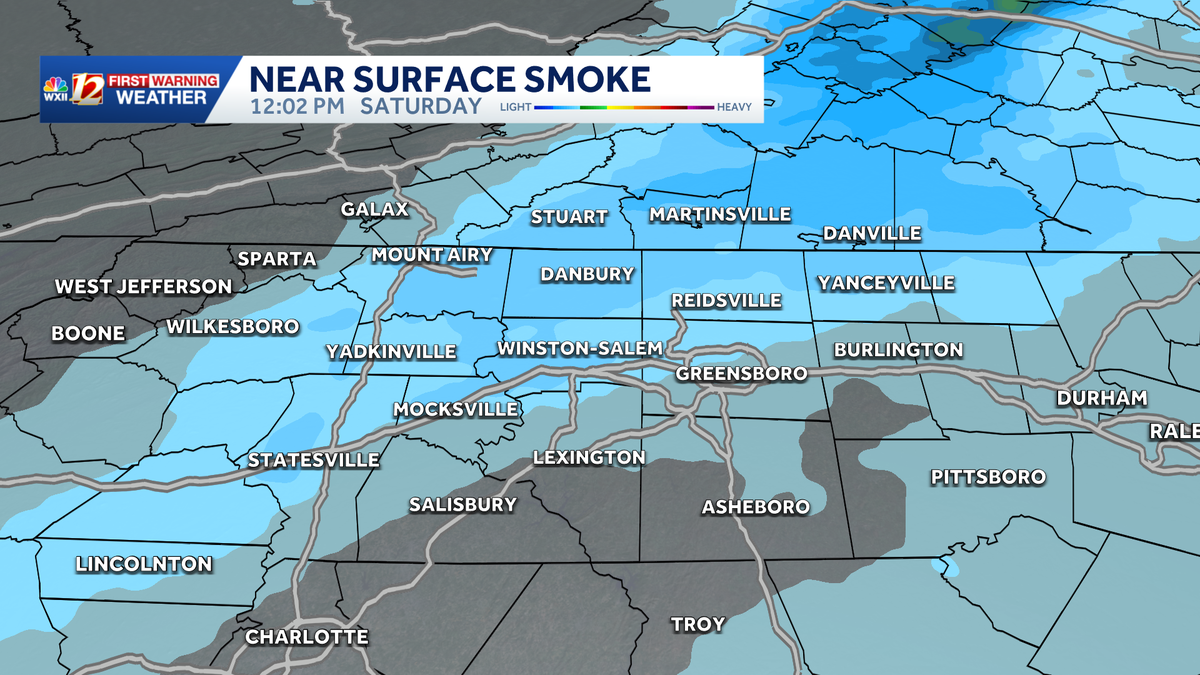
The Environmental Protection Agency (EPA) is alerting travelers and residents in the Northeast states that air quality alerts are in effect due to wildfire smoke. Wildfires in the Canadian provinces just over the border from International Falls, Minnesota and fires burning in the Northern Plains and the Northwestern United States are spreading smoke over the Great Lakes into the Northeastern United States. As a result, the northern U.S. is experiencing very unhealthy and even hazardous air quality. Keep reading below to see the latest smoke and air quality monitoring levels.Particle pollution forecastAir quality reached a Code Orange for health concerns in the Triad on Friday afternoon at air quality monitoring sites; the culprit is the invisible pollutant: ground-level ozone. It forms when temperatures rise and surface pollutants combine. This weekend, ozone levels are expected to hover at Code Yellow, or a moderate level; this may cause health issues for unusually sensitive people.Ground-Level Ozone forecastWildfire Smoke in the CarolinasCurrent smoke concentrations near the surface Smoky haze may improve slightly on SaturdayIncreasing concentrations of wildfire smoke from fires burning in the Northern Plains and Canada are helping bring a Code Yellow, a moderate air quality risk, to North Carolina. Smoke concentrations are heavier in the Northeast and are mostly lifted aloft in Virginia and the Carolinas, but did reach a Code Red, or unhealthy for all level, in a few spots on Friday in Virginia and northern North Carolina. A Code Yellow in the region means there may be health concerns for unusually sensitive individuals for the next couple of days. Wind direction, speed, and the location of a surface high-pressure pattern will help Canadian wildfire smoke linger over Virginia and the Carolinas through the weekend. While the highest concentrations may remain elevated in the atmosphere, smoke is expected to mix down toward the surface at times this weekend around the Piedmont Triad. As the ridge of high pressure interacts with a surface front and an advancing cold front moves toward the Carolinas, the wildfire smoke will shift northward this weekend. Slight improvements to air quality are likely as scattered rain may help wash particulate matter to the ground through Monday.Wildfire danger increasing in the United States According to the National Interagency Fire Center (NIFC), as of July 17, wildland firefighters are under a Preparedness Level of 4 and report the following fire details: More than 68 large fires are burning, with suppression efforts underway.17 new large wildland fires have been reported in the Northwestern United States caused by frequent lightning over a prolonged period; there are a total of 23 new large fires in the U.S. More than 40 thousand fires have burned 3.7 million acres of land in the United States during 2026 to date. The states with the most large wildland fires this week include Oregon, Alaska, Colorado, California, Florida and Minnesota. North Carolina has reported two wildfires this week, and one is contained. An ongoing fire in Duplin County has burned at least 529 acres, with 50% containment reported from the North Carolina Forest Service. Firefighters are also monitoring the risk of lightning-sparked wildfires as monsoonal rains over parts of the desert Southwest bring wet and dry thunderstorms this time of the year. You can explore current wildfires by using the AirNow.gov Fire and Smoke Map, where you will find smoke outlooks and forecasts for smoke plumes.PARTICULATE MATTER (PM): CODE YELLOWCurrent air quality in North Carolina and VirginiaThe Forsyth County Environmental Assistance and Protection forecast for air quality includes fine particles from wildfire smoke pollution. The local forecast shows higher concentrations between 52 and 100 on the Air Quality Index (AQI); these levels could impact the health of unusually sensitive groups. However, hourly readings at individual air monitoring sites may reach Code Orange. Greensboro reached this level on Wednesday afternoon through Wednesday evening. Current forecast models we are monitoring from the WXII 12 First Warning Weather Center depict near-surface smoke concentrations with heavier particle pollution arriving on Friday. Greensboro Air Quality NowWinston-Salem Air Quality NowThe numerical value represents the concentration of 1 microgram of particulate matter within a cubic meter of air. If the AQI reaches between 101 and 150, a Code Orange for PM 2.5 (fine particulate matter of 2.5 micrometers or less in diameter), the air quality poses a greater health risk to more residents in North Carolina. Particles can be inhaled and then lodged deep within our lungs, respiratory tracts, and even our bloodstreams. To find out more about particle pollution levels and your forecast, you can enter your city or ZIP code on AirNow.gov or check the Forsyth Environmental Assistance and Protection Agency here.HEALTH CONCERNSPollution can create long-term health problems. People with asthma, lung disease, heart disease, diabetes, or other underlying health conditions are encouraged to reduce time outdoors and prolonged heavy outdoor exertion in North Carolina during Code Orange Air Quality Days. Others may be unusually sensitive to moderate air quality during Code Yellow Days. Residents who tend to be more sensitive to elevated pollutant levels also include seniors, children and teens, outdoor enthusiasts and outdoor workers. To prevent breathing difficulties, individuals sensitive to fine particles should adjust their daily routine by avoiding prolonged outdoor exposure and using indoor-air purifiers.GROUND-LEVEL OZONEIn addition to smoke causing higher levels of airborne particulate matter, ground-level ozone rose to the Code Orange range with hotter temperatures and mostly sunny skies on Friday. The United States Environmental Protection Agency suggests several ways residents can keep pollution to a minimum:Limit drivingAvoid idling vehiclesRefuel vehicles during the early morning or after sunsetReduce electricity usageReduce the use of gas-powered lawn equipmentOzone levels reached the Code Orange level for health concerns on Friday across the Piedmont Triad. The moderate, or Code Yellow level, is typical in North Carolina during the summer months. Ground-level ozone forms near the surface when sunshine, hot temperatures in the 80s or higher, and pollution from vehicles and industry cause a chemical reaction.AIR QUALITY FORECASTPeriods of higher air pollution are possible this weekend through early next week. The changing weather pattern and fluctuations in smoke concentrations may bring periods of healthier air quality if rain arrives early next week. Sunshine and warmer highs in the 90s are forecast to increase ozone production during the typical hours of 10 a.m. through 8 p.m. daily, with at least Code Yellow levels likely.Weather storiesMore weather coverage: Weather Alerts | Latest weather forecast | Post pictures to the uLocal North Carolina Facebook Group | Traffic information | Report closings and delays | SkyCams | Download the WXII12 News mobile app
WINSTON-SALEM, N.C. —
The Environmental Protection Agency (EPA) is alerting travelers and residents in the Northeast states that air quality alerts are in effect due to wildfire smoke. Wildfires in the Canadian provinces just over the border from International Falls, Minnesota and fires burning in the Northern Plains and the Northwestern United States are spreading smoke over the Great Lakes into the Northeastern United States. As a result, the northern U.S. is experiencing very unhealthy and even hazardous air quality. Keep reading below to see the latest smoke and air quality monitoring levels.
Particle pollution forecast
Hearst Owned
Air quality reached a Code Orange for health concerns in the Triad on Friday afternoon at air quality monitoring sites; the culprit is the invisible pollutant: ground-level ozone. It forms when temperatures rise and surface pollutants combine. This weekend, ozone levels are expected to hover at Code Yellow, or a moderate level; this may cause health issues for unusually sensitive people
Ground-Level Ozone forecast
Hearst Owned
Wildfire Smoke in the Carolinas
Current smoke concentrations near the surface
Hearst Owned
Smoky haze may improve slightly on Saturday
Hearst Owned
Increasing concentrations of wildfire smoke from fires burning in the Northern Plains and Canada are helping bring a Code Yellow, a moderate air quality risk, to North Carolina. Smoke concentrations are heavier in the Northeast and are mostly lifted aloft in Virginia and the Carolinas, but did reach a Code Red, or unhealthy for all level, in a few spots on Friday in Virginia and northern North Carolina. A Code Yellow in the region means there may be health concerns for unusually sensitive individuals for the next couple of days.
Wind direction, speed, and the location of a surface high-pressure pattern will help Canadian wildfire smoke linger over Virginia and the Carolinas through the weekend. While the highest concentrations may remain elevated in the atmosphere, smoke is expected to mix down toward the surface at times this weekend around the Piedmont Triad
As the ridge of high pressure interacts with a surface front and an advancing cold front moves toward the Carolinas, the wildfire smoke will shift northward this weekend. Slight improvements to air quality are likely as scattered rain may help wash particulate matter to the ground through Monday
Wildfire danger increasing in the United States
According to the National Interagency Fire Center (NIFC), as of July 17, wildland firefighters are under a Preparedness Level of 4 and report the following fire details:
- More than 68 large fires are burning, with suppression efforts underway.
- 17 new large wildland fires have been reported in the Northwestern United States caused by frequent lightning over a prolonged period; there are a total of 23 new large fires in the U.S.
- More than 40 thousand fires have burned 3.7 million acres of land in the United States during 2026 to date.
The states with the most large wildland fires this week include Oregon, Alaska, Colorado, California, Florida and Minnesota. North Carolina has reported two wildfires this week, and one is contained. An ongoing fire in Duplin County has burned at least 529 acres, with 50% containment reported from the North Carolina Forest Service. Firefighters are also monitoring the risk of lightning-sparked wildfires as monsoonal rains over parts of the desert Southwest bring wet and dry thunderstorms this time of the year.
You can explore current wildfires by using the AirNow.gov Fire and Smoke Map, where you will find smoke outlooks and forecasts for smoke plumes
PARTICULATE MATTER (PM): CODE YELLOW
Current air quality in North Carolina and Virginia
Hearst Owned
The Forsyth County Environmental Assistance and Protection forecast for air quality includes fine particles from wildfire smoke pollution. The local forecast shows higher concentrations between 52 and 100 on the Air Quality Index (AQI); these levels could impact the health of unusually sensitive groups. However, hourly readings at individual air monitoring sites may reach Code Orange. Greensboro reached this level on Wednesday afternoon through Wednesday evening. Current forecast models we are monitoring from the WXII 12 First Warning Weather Center depict near-surface smoke concentrations with heavier particle pollution arriving on Friday.
Greensboro Air Quality Now
Winston-Salem Air Quality Now
The numerical value represents the concentration of 1 microgram of particulate matter within a cubic meter of air. If the AQI reaches between 101 and 150, a Code Orange for PM 2.5 (fine particulate matter of 2.5 micrometers or less in diameter), the air quality poses a greater health risk to more residents in North Carolina. Particles can be inhaled and then lodged deep within our lungs, respiratory tracts, and even our bloodstreams. To find out more about particle pollution levels and your forecast, you can enter your city or ZIP code on AirNow.gov or check the Forsyth Environmental Assistance and Protection Agency here.
HEALTH CONCERNS
Pollution can create long-term healthproblems. People with asthma, lung disease, heart disease, diabetes, or other underlying health conditions are encouraged to reduce time outdoors and prolonged heavy outdoor exertion in North Carolina during Code Orange Air Quality Days. Others may be unusually sensitive to moderate air quality during Code Yellow Days. Residents who tend to be more sensitive to elevated pollutant levels also include seniors, children and teens, outdoor enthusiasts and outdoor workers. To prevent breathing difficulties, individuals sensitive to fine particles should adjust their daily routine by avoiding prolonged outdoor exposure and using indoor-air purifiers.
GROUND-LEVEL OZONE
Hearst Owned
In addition to smoke causing higher levels of airborne particulate matter, ground-level ozone rose to the Code Orange range with hotter temperatures and mostly sunny skies on Friday. The United States Environmental Protection Agency suggests several ways residents can keep pollution to a minimum:
- Limit driving
- Avoid idling vehicles
- Refuel vehicles during the early morning or after sunset
- Reduce electricity usage
- Reduce the use of gas-powered lawn equipment
Ozone levels reached the Code Orange level for health concerns on Friday across the Piedmont Triad. The moderate, or Code Yellow level, is typical in North Carolina during the summer months. Ground-level ozone forms near the surface when sunshine, hot temperatures in the 80s or higher, and pollution from vehicles and industry cause a chemical reaction
AIR QUALITY FORECAST
Periods of higher air pollution are possible this weekend through early next week. The changing weather pattern and fluctuations in smoke concentrations may bring periods of healthier air quality if rain arrives early next week. Sunshine and warmer highs in the 90s are forecast to increase ozone production during the typical hours of 10 a.m. through 8 p.m. daily, with at least Code Yellow levels likely
Weather stories
More weather coverage: Weather Alerts | Latest weather forecast | Post pictures to the uLocal North Carolina Facebook Group | Traffic information | Report closings and delays | SkyCams | Download the WXII12 News mobile app
Weather Information
‘
+ ‘
‘;
var gptLayer = window.gptLayer;
if (gptLayer && typeof gptLayer.insertAds === ‘function’) {
var slotsBefore = gptLayer.adSlots ? gptLayer.adSlots.length : 0;
gptLayer.insertAds();
if ((gptLayer.adSlots ? gptLayer.adSlots.length : 0) > slotsBefore) {
if (typeof gptLayer.callAdSlots === ‘function’) {
gptLayer.callAdSlots(‘imm’);
}
}
}
}
}
function closeRadarOverlay(containerId) {
var overlay = document.getElementById(containerId + ‘-radar-overlay’);
if (!overlay) return;
overlay.classList.remove(‘is-open’);
overlay.setAttribute(‘aria-hidden’, ‘true’);
document.body.classList.remove(‘weather-radar-overlay-active’);
var adSlot = overlay.querySelector(‘.weather-radar-overlay__ad-slot’);
if (adSlot) {
adSlot.innerHTML = ”;
}
}
function trackRadarOverlayInteraction(containerId) {
var now = Date.now();
var key = ‘radar_overlay_last_interaction_’ + containerId;
if (!window[key] || now – window[key] > 10000) {
window[key] = now;
dispatchWeatherGA4Event(‘radar_overlayinteraction’, ‘interaction’, containerId);
}
}
function isMobileOrTabletViewport(breakpoint = 980) {
const w = window.innerWidth || document.documentElement.clientWidth || 0;
return w < breakpoint;
}
function removeUnusedWeatherModule() {
const desktopClass = ‘sidelist-weather’;
const mobileClass = ‘mobile-weather’;
if (isMobileOrTabletViewport()) {
console.log(‘[WEATHER-BOX] Mobile/tablet viewport detected, removing desktop weather module if it exists’);
const desktopModule = document.querySelector(‘.’ + desktopClass);
if (desktopModule) {
console.log(‘[WEATHER-BOX] Removing desktop weather module’);
desktopModule.remove();
}
} else {
console.log(‘[WEATHER-BOX] Desktop viewport detected, removing mobile weather module if it exists’);
const mobileModule = document.querySelector(‘.’ + mobileClass);
if (mobileModule) {
console.log(‘[WEATHER-BOX] Removing mobile weather module’);
mobileModule.remove();
}
}
}
document.addEventListener(‘DOMContentLoaded’, function() {
removeUnusedWeatherModule();
function generateForecastItem(data) {
var ariaLabel = data.timeLabel + ‘, ‘ + data.primaryTemp + ‘ degrees, ‘ +
data.secondaryInfo + ‘ percent chance of precipitation’;
return `
`;
}
function refreshWeatherIframe(containerId) {
var iframeId = ‘weather-iframe-‘ + containerId;
var iframe = document.getElementById(iframeId);
if (iframe && iframe.src) {
var originalSrc = iframe.src;
iframe.src = originalSrc + (originalSrc.indexOf(‘?’) > -1 ? ‘&’ : ‘?’) + ‘t=’ + Date.now();
}
}
function initializeWeatherBox(container) {
var containerId = container.getAttribute(‘data-container-id’);
var isWeatherBoxV2 = containerId === ‘home-weather-v2’;
function switchWeatherTab(tabName, clickedElement) {
container.querySelectorAll(‘[data-tab-id]’).forEach(function(tab) {
tab.classList.remove(‘open’);
tab.setAttribute(‘aria-selected’, ‘false’);
});
clickedElement.classList.add(‘open’);
clickedElement.setAttribute(‘aria-selected’, ‘true’);
container.querySelectorAll(‘[data-content-id]’).forEach(function(content) {
content.style.display = ‘none’;
content.setAttribute(‘hidden’, ‘true’);
});
var targetContent = container.querySelector(‘[data-content-id=”‘ + tabName + ‘”]’);
if (targetContent) {
targetContent.style.display = ‘block’;
targetContent.removeAttribute(‘hidden’);
}
}
function loadWeatherData() {
// If weather data is already being loaded, wait for it
if (window.weatherDataPromise) {
window.weatherDataPromise.then(function(data) {
if (data && data.data) {
var weatherContainer = container.closest(‘.weather-box-container’);
if (weatherContainer) {
weatherContainer.style.display = ‘flex’;
updateCurrentWeather(data.data);
updateForecastTabs(data.data);
updateWeatherAlertsBar(data.data);
}
}
});
return;
}
var location = { zip: window.DEFAULT_ZIPCODE };
try {
var storedLocations = localStorage.getItem(‘hrst.zip.history’);
if (storedLocations) {
var locations = JSON.parse(storedLocations);
if (locations && locations.length > 0) {
location = locations[0];
}
}
} catch (e) {}
var apiUrl = (window.DEWY_HOSTNAME || ”) + ‘/api/v1/weather/full/’ + location.zip;
if (window.fetch) {
window.weatherDataPromise = fetch(apiUrl)
.then(function(response) { return response.json(); })
.then(function(data) {
if (data && data.data) {
var article = container.closest(‘.article–wrapper’);
var weatherContainer = container.closest(‘.weather-box-container’);
if (weatherContainer) {
weatherContainer.style.display = ‘flex’;
updateCurrentWeather(data.data);
updateForecastTabs(data.data);
updateWeatherAlertsBar(data.data);
}
return data;
}
})
.catch(function(error) {
console.error(‘Error loading weather:’, error);
// Reset to unknown background on error
updateWeatherBackground(‘unknown’);
});
}
}
function updateWeatherAlertsBar(weatherData) {
var weatherWatchHeader = container.querySelector(‘.weather-watch-header’);
if (!weatherWatchHeader) return;
var weatherWatchText = weatherWatchHeader.querySelector(‘.weather-watch-text’);
var weatherWatchLink = weatherWatchHeader.querySelector(‘.weather-watch-link’);
if (weatherData.alerts_count > 0) {
weatherWatchHeader.className = ‘weather-watch-header has-alerts’;
if (weatherWatchText) {
weatherWatchText.textContent = `Weather Alerts (${weatherData.alerts_count})`;
}
if (weatherWatchLink) {
if (!weatherWatchLink.getAttribute(‘data-initial-href’)) {
weatherWatchLink.setAttribute(‘data-initial-href’, weatherWatchLink.getAttribute(‘href’));
weatherWatchLink.setAttribute(‘data-initial-onclick’, weatherWatchLink.getAttribute(‘onclick’) || ”);
}
weatherWatchLink.setAttribute(‘href’, ‘/alerts’);
weatherWatchLink.setAttribute(‘onclick’, “return handleWeatherLinkClick(event, ‘click_alerts’, ‘click’, ‘mobile-weather’, ‘/alerts’);”);
}
} else {
weatherWatchHeader.className = ‘weather-watch-header’;
if (weatherWatchText) {
weatherWatchText.textContent = containerId === ‘home-weather-v2’ ? ‘Watch Latest Forecast’ : ‘Latest Forecast’;
}
if (weatherWatchLink) {
var initialHref = weatherWatchLink.getAttribute(‘data-initial-href’);
var initialOnclick = weatherWatchLink.getAttribute(‘data-initial-onclick’);
if (initialHref) {
weatherWatchLink.setAttribute(‘href’, initialHref);
}
if (initialOnclick) {
weatherWatchLink.setAttribute(‘onclick’, initialOnclick);
}
}
}
}
function updateCurrentWeather(weatherData) {
if (weatherData.current) {
var tempValue = weatherData.current.temp_f || ”;
var skyValue = weatherData.current.sky || ”;
var feelsLikeValue = weatherData.current.feels_like_f || weatherData.current.temp_f || ”;
var tempEl = container.querySelector(‘.weather-grid–current-temp-value’);
if (tempEl) {
tempEl.textContent = tempValue;
tempEl.setAttribute(‘aria-label’, tempValue + ‘ degrees Fahrenheit’);
}
var iconEl = container.querySelector(‘.weather-grid–current-icon’);
if (iconEl && weatherData.current.icon_name) {
iconEl.className = ‘weather-grid–current-icon weather-current-icon icon icon-weather-‘ + weatherData.current.icon_name;
}
var skyEl = container.querySelector(‘.weather-grid–sky’);
if (skyEl) {
skyEl.textContent = skyValue;
skyEl.setAttribute(‘aria-label’, ‘Current condition: ‘ + skyValue);
}
var feelsEl = container.querySelector(‘.weather-grid–feels’);
if (feelsEl) {
feelsEl.textContent = feelsLikeValue + ‘°F’;
feelsEl.setAttribute(‘aria-label’, feelsLikeValue + ‘ degrees Fahrenheit’);
}
var weatherContainer = container.querySelector(‘.weather-temp-container’);
if (weatherContainer) {
var summary = ‘Current temperature ‘ + tempValue + ‘ degrees Fahrenheit, ‘ +
skyValue + ‘, feels like ‘ + feelsLikeValue + ‘ degrees’;
weatherContainer.setAttribute(‘aria-label’, summary);
}
updateWeatherBackground(weatherData.current.icon_name);
}
}
function updateWeatherBackground(iconName) {
try {
var bgPath = weatherImages.backgrounds[iconName] || weatherImages.backgrounds.unknown;
container.style.backgroundImage = ‘url(‘ + bgPath + ‘)’;
} catch (e) {
console.log(‘Error updating weather background:’, e);
}
}
function updateForecastTabs(weatherData) {
var visibleItems = isWeatherBoxV2 ? 6 : 5;
if (weatherData.hourly) {
var hourlyContainer = container.querySelector(‘.weather-hourly-forecast’);
if (hourlyContainer) {
var html = ”;
var maxHours = Math.min(visibleItems, weatherData.hourly.length);
for (var i = 0; i < maxHours; i++) {
var hour = weatherData.hourly[i];
html += generateForecastItem({
timeLabel: hour.hour_display,
iconName: hour.icon_name,
primaryTemp: hour.temp_f,
secondaryInfo: hour.precip_chance + ‘%’
});
}
hourlyContainer.innerHTML = html;
}
}
if (weatherData.daily) {
var dailyContainer = container.querySelector(‘.weather-daily-forecast’);
if (dailyContainer) {
var html = ”;
var maxDays = Math.min(visibleItems, weatherData.daily.length);
for (var i = 0; i < maxDays; i++) {
var day = weatherData.daily[i];
var dayName = getShortDayName(day.day);
html += generateForecastItem({
timeLabel: dayName,
iconName: day.icon_name,
primaryTemp: day.high_f,
secondaryInfo: day.precip_chance + ‘%’
});
}
dailyContainer.innerHTML = html;
}
}
}
function getShortDayName(dayName) {
switch (dayName) {
case ‘Today’:
return ‘Today’;
case ‘Tomorrow’:
return ‘Tmrw’;
case ‘Sunday’:
return ‘Sun’;
case ‘Monday’:
return ‘Mon’;
case ‘Tuesday’:
return ‘Tue’;
case ‘Wednesday’:
return ‘Wed’;
case ‘Thursday’:
return ‘Thu’;
case ‘Friday’:
return ‘Fri’;
case ‘Saturday’:
return ‘Sat’;
default:
return dayName;
}
}
container.querySelectorAll(‘[data-tab-id]’).forEach(function(tab) {
var isActive = tab.classList.contains(‘open’);
tab.setAttribute(‘tabindex’, ‘0’); // Both tabs focusable for VoiceOver
tab.setAttribute(‘role’, ‘tab’);
tab.setAttribute(‘aria-selected’, isActive);
tab.addEventListener(‘keydown’, function(e) {
var tabs = Array.from(container.querySelectorAll(‘[data-tab-id]’));
var currentIndex = tabs.indexOf(this);
switch(e.key) {
case ‘ArrowLeft’:
e.preventDefault();
var prevIndex = currentIndex > 0 ? currentIndex – 1 : tabs.length – 1;
tabs[prevIndex].focus();
break;
case ‘ArrowRight’:
e.preventDefault();
var nextIndex = currentIndex < tabs.length – 1 ? currentIndex + 1 : 0;
tabs[nextIndex].focus();
break;
case ‘Enter’:
case ‘ ‘:
e.preventDefault();
var tabId = this.getAttribute(‘data-tab-id’);
switchWeatherTab(tabId, this);
if (tabId === ‘hourly’) {
dispatchWeatherGA4Event(‘click_hourly’, ‘click’, containerId);
} else if (tabId === ‘daily’) {
dispatchWeatherGA4Event(‘click_daily’, ‘click’, containerId);
}
break;
}
});
tab.onclick = function() {
var tabId = this.getAttribute(‘data-tab-id’);
switchWeatherTab(tabId, this);
if (tabId === ‘hourly’) {
dispatchWeatherGA4Event(‘click_hourly’, ‘click’, containerId);
} else if (tabId === ‘daily’) {
dispatchWeatherGA4Event(‘click_daily’, ‘click’, containerId);
}
return false;
};
});
loadWeatherData();
window.addEventListener(‘pageshow’, function(event) {
if (event.persisted) {
// Fix for weather radar iframe appearing gray after browser back/forward navigation
// When user navigates back, the page loads from browser cache but the iframe
// content doesn’t restore properly, showing a gray screen instead of the radar map
// This forces a fresh reload of the iframe by adding a timestamp parameter
setTimeout(function() {
refreshWeatherIframe(containerId);
}, 300);
}
});
}
document.querySelectorAll(‘.weather-sidebar’).forEach(function(weatherBox) {
initializeWeatherBox(weatherBox);
});
});


Make WXII 12 a preferred source on Google
