


SFA continues dolphin health research through leadership role in PHASM drone development project
University Marketing Communications
•
July 23, 2026
NACOGDOCHES, Texas –– Stephen F. Austin State University continues its leadership role in drone-based dolphin health research using the Passive Health Assessment in Sea Mammals, or PHASM, platform in Galveston
PHASM is a one-of-a-kind airplane-style drone that can stealthily approach dolphins in the wild and vacuum in breath samples when the animals come up to breathe. Those snotty breath samples can be used to study genetics, disease risk, pathogen presence and hormones tied to stress and reproductive health. Sampling dolphins this way can help illuminate issues affecting human health where water re
The PHASM project was created through a partnership between SFA, Oklahoma State University and Dolphin Quest, an organization that offers interactive, educational marine encounters in Bermuda and Hawaii. Now that the project has shifted from system testing with animals under managed care to wild deployment, SFA has also partnered with the Galveston Bay Dolphin Research Program to leverage their expertise in identifying and cataloging the dolphins of Galveston Bay. SFA biology students have been a part of the platform’s development throughout the process.
“Projects like PHASM show that SFA can stand shoulder to shoulder with big R1 university partners, globally accredited marine animal facilities and influential nongovernmental organizations to drive meaningful change for animal and human health monitoring,” said Dr. Jason Bruck, associate professor of biology at SFA and a principal investigator for the PHASM project. “Partnerships like these help our undergraduate and graduate students experience SFA not just as a great teaching institution but also as the best place to get the real research experience needed to be successful in marine mammalogy, including marine drone operation and retrieval, ocean sampling, and acoustic monitoring.”
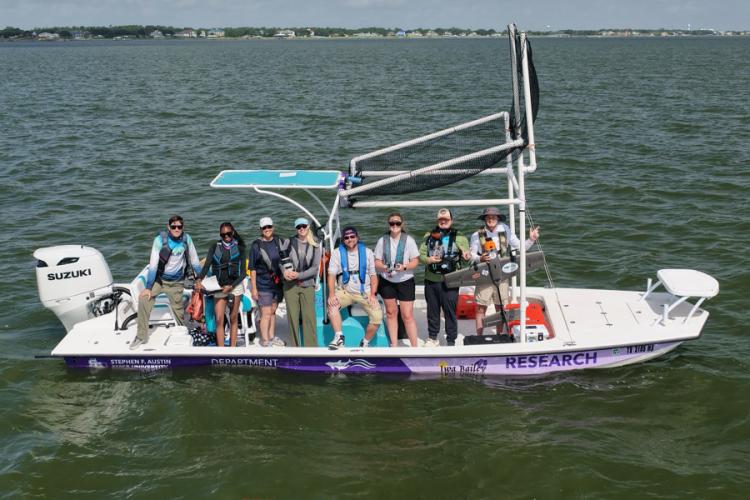
Researchers are conducting these drone launch and recovery operations aboard SFA’s purple-emblazoned 25-foot marine research vessel, the Iwa Bailey. The vessel was funded through The University of Texas System’s Science and Technology Acquisition and Retention, or STARs, program that allows SFA faculty members to purchase state-of-the-art research equipment
The first in a series of articles about PHASM’s development will be published in the September issue of the Aquatic Mammals journal and will discuss the new technology of the system as well as how animals react to the drone
“What makes PHASM different is that it is stealthy and it doesn’t blow away samples like traditional quadcopter drones do,” Bruck said. “Because of our testing at Dolphin Quest, we know we have the least invasive and most effective solution for passive health assessment for small whales and dolphins.”
Bruck and PHASM team members are also scheduled to demonstrate the system at the International Society for Atmospheric Research Using Remotely Piloted Aircraft conference in August at Daytona Beach, Florida, and at the Society for Marine Mammalogy meeting in October in San Juan, Puerto Rico
“PHASM is a project that spans air and sea, aerospace engineering, and biology and health,” Bruck said. “It is important to speak to diverse audiences to foster the types of collaborations needed for a project of this broad scope.”
To learn more about SFA’s Department of Biology, visit sfasu.edu/biology. To view the video “We Steal Dolphin Snot,” visit gosfa.com/dolphinsnot
