



‘It’s not just an inconvenience’: We’ve underestimated the health impacts of heavy periods
27 minutes ago


Prashanti Aswani
Heavy menstrual bleeding is a serious health condition. Only now are we starting to understand what causes it – and how it can be treated
From the age of 12-13 onwards, Michelle Alston slept off the worst days of her menstrual periods in the school nurse’s office, battling severe pain as she bled through period products. “I was taught that this is just normal,” she says. “This is just something that you have to learn to cope with.”
She felt weak, failing to cope with her periods as well as her peers seemed to. It wasn’t until she reached her early 40s that she learned weakness had little to do with it – her periods were unusually heavy. When bleeding during periods is so extensive that it interferes with quality of life, doctors call it <a href="https://www.acog.org/clinical/clinical-guidance/committee-opinion/articles/2019/09/screening-and-management-of-bleeding-disorders-in-adolescents-with-heavy-menstrual-bleeding” rel=”nofollow noopener” target=”_blank”>heavy menstrual bleeding, and it’s a serious medical problem.
Studies of populations from around the world estimate that between 10 and 30% of reproductive-aged women experience heavy menstrual bleeding like Alston’s. And due to under-reporting and a general lack of understanding of how much bleeding is too much, studies suggest it may actually occur in half of all reproductive-aged women. Heavy menstrual bleeding can also signify other health problems and have serious consequences when unchecked, such as anaemia
Yet, only recently have researchers began exploring the resulting harms from heavy menstrual bleeding in depth, pursuing better diagnostics and treatments. A search of PubMed (a database of biomedical research publications) for the term “menstrual blood” yielded just 400 publications in the last decade. Publications for “semen”, for instance, number over 15,000
“Women are probably owed years, if not decades, of research,” says Jackie Maybin, a gynaecologist at the University of Edinburgh in Scotland and programme director of The Missed Vital Sign, a research initiative for heavy menstrual bleeding. “And I think the time is now.”
How much blood is too much?
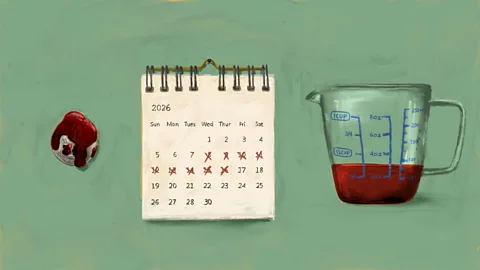
For researchers, heavy menstrual bleeding is blood loss of over 80ml per cycle, blood clots exceeding the size of a US quarter, or periods lasting beyond seven days. But for those of us who menstruate, there’s no standardised or metric conversion for the practical ways of measuring bleeding: the number of bathroom visits, pads or tampons changed, or bloodstained pairs of underwear
Some clinicians try to meet patients halfway, asking them to judge their blood loss using charts featuring progressively bloodier pads and tampons. But that too is imprecise, as all period products aren’t created equal and often vary widely in absorption
As a result, determining how much blood is too much during a period isn’t straightforward, and often clinicians have to determine heavy menstrual bleeding by whether it interferes with quality of life
“The patient sometimes doesn’t realise that the amount of bleeding they’re having is not normal, and that actually, something can be done about it,” says Adwoa Christy, a clinical professor in the department of gynaecology, obstetrics, and reproductive sciences at the University of California, San Francisco
Prashanti Aswani
Alston routinely bled through her sheets and clothes, and once, onto an unforgivingly white chair at a cell phone store. She just thought she was doing something wrong, and maybe that she needed different period products to contain the flow.
She was told to accept that experiencing painful cramps and embarrassing bloodstains while on your period is normal. In other regions of the world, period taboos and stigma run deeper
“I think there are a lot of people in my part of the world who may not complain about it, and who, maybe because of normalisation [of pain] and stigma, don’t actually come to a doctor,” says Hemantha Senanayake, emeritus professor of obstetrics and gynaecology at the University of Colombo in Sri Lanka and head of the Asian Society of Endometriosis and Adenomyosis (both conditions that can cause heavy menstrual bleeding).
And while gynaecologists may know to ask detailed questions to detect heavy menstrual bleeding, clinicians outside the field may overlook the signs. Alston waited nearly 30 years before someone identified her heavy menstrual bleeding, and she’s far from alone
Heavy menstrual bleeding is not just a symptom
While a problem in its own right, heavy menstrual bleeding is primarily a symptom of a larger issue. It arises from a variety of conditions, including polyps, fibroids, cancer, blood disorders, ovulatory issues, and endometrial disorders, such as endometriosis. It is also common – though still something to address – when someone first starts having periods and during the transition to menopause, when the body’s hormonal choreography is in a period of transition.
Treating these conditions can lessen the heavy bleeding, but scientists still don’t know how these conditions interfere with the quantity of blood loss, exactly. “There’s been a lot of research focusing on the fibroids themselves, but not why they cause the heavy bleeding, for example,” says Maybin, who notes that fibroids are noncancerous growths in uterine muscle
It’s not just an inconvenience. It is having to structure your entire life around your menstrual cycle – Emily Young
On the other hand, forgoing treatment for heavy menstrual bleeding can create new problems, such as iron deficiency. Iron is an essential mineral for maintaining healthy cells, immune systems, muscles, skin, hair and nails. Brain fog, dizziness, shortness of breath, easy bruising and hair loss can all set in when iron levels begin to flag
In this way, the harms of heavy menstrual bleeding persist even outside of menstrual periods: studies estimate that over 40% of women with heavy menstrual bleeding also have iron deficiency. Alston found herself in those statistics too: she was always cold and often craved eating ice cubes, a bizarre but telling clue of iron deficiency that’s still poorly understood by researchers. If unaddressed, iron deficiency can escalate to anaemia, in which the bone marrow doesn’t have enough iron to produce the requisite haemoglobin for red blood cells to carry oxygen throughout the body – a serious condition that can, in extreme cases, requires blood transfusions to correct.
An unprecedented number of periods
Less than 2% of placental mammals menstruate: the elephant shrew, certain bat species, the spiny mouse, and primates. Research shows that throughout human history, women had more offspring, limiting their lifetime menstrual cycles to about 40. But human evolutionary trajectory is changing: in high-income nations in particular, women are having fewer children and can experience up to 400 periods. This makes menstruation and heavy menstrual bleeding more relevant to medicine and humanity than ever.
In low and middle-income countries, Senanayake says, where haemorrhage is a leading cause of maternal death, iron deficiency anaemia that isn’t resolved before pregnancy can undermine the body’s ability to recover from blood loss. It can also harm the brain development of the foetus
The costs of heavy menstrual bleeding
While there’s growing scientific recognition of the medical seriousness of heavy menstrual bleeding, there’s less research on what it’s like to live with it
Like Alston, Emily Young, a lecturer in psychology at Sheffield Hallam University in the UK, experienced heavy menstrual bleeding. She has fainted from blood loss more than once, she explains, and always carried a change of clothes as her unpredictable periods could strike at any time. But her doctors assured her that her periods would settle down once she had a baby. Fueled by the sting of two decades of dismissal from medical professionals, she now researches the experiences of others with heavy periods.
“It’s not just an inconvenience. It is having to structure your entire life around your menstrual cycle,” says Young
Adolescents in the UK with heavy menstrual bleeding miss up to nine days of school per year on average.
For a study published in 2025, Young combed through online forum posts from people with heavy menstrual bleeding to bring similar experiences into focus. What she saw ranged from maddening to darkly funny, she says. Several posts described people needing multiple blood transfusions before a doctor recognised the severity of their problem
Others contained vivid descriptions, such as, “Yeah, if they ever luminol [a chemical used in forensics to highlight blood at crime scenes] my bathroom, I’m going to jail while they excavate my yard for the obviously dozens of murder victims”. There were posts about dropping out of school or work, or not having a healthy sex life due to heavy menstrual bleeding. Some posts mentioned mental health issues, and others, Young says, were heartbreaking, describing suicidal thoughts because periods were so severe and life-altering.
For transgender men or non-binary individuals, periods can be distressing enough – heavy menstrual bleeding adds insult to injury. “We see a lot of transgender patients who identify as male, yet have heavy periods, which is in itself an added horrific experience for them,” says Julie Jaffray, a paediatric haematologist at the University of California San Diego Rady Children’s Hospital
Ultimately, the cumulative effects of heavy menstrual bleeding on individuals’ personal lives can leak into education and work, and ripple through society. Whenever Alston had her period, she would effectively miss school, she says, sleeping in the nurse’s office even though her mother insisted she still attend
In the UK, on average, adolescents with heavy menstrual bleeding miss up to nine days of school per year. In low and middle-income countries, such as Sri Lanka, Senanayake suspects the numbers are higher. Girls in less affluent areas may attend schools that lack facilities to change or dispose of period products
During adulthood, this translates to missed work days and opportunities. The last time she had a bad period, Alston, a telehealth therapist in New York City, ended up losing a client when she had to cut their session short. “I couldn’t hear her anymore, the pain was so bad,” Alston says. “I literally told her: ‘I can’t finish the session’.” After she ended the call, she got up from her chair to see a pool of blood beneath her.
“Women with heavy menstrual bleeding can’t go to work for 3.6 weeks of the year [on average]. It’s costing the economy billions,” says Maybin. “If we get this right for women… we really get it right for everyone in society.”
Treatment and trials
There’s still a lot of work to do to get it right. While there are treatments available for heavy menstrual bleeding, “it’s totally not enough,” says Erica Marsh, a professor of obstetrics and gynaecology at the University of Michigan Medical School. “We have frighteningly few interventions.”
Treatment for heavy menstrual bleeding depends on the underlying condition. If the bleeding isn’t too severe, non-steroidal anti-inflammatory drugs, like ibuprofen, can ease the flow. There are hormonal treatments too, such as the birth control pill or hormonal intrauterine devices, one of the most effective treatments at reducing blood loss during periods.
Though these methods are fairly accessible, there are deterrents for their uptake, like pain that can accompany the insertion of a intrauterine device. Birth control worked for Alston, but due to the stigma surrounding the pill in her household, she had to wait until she was older – she got a prescription once she left for college.

Prashanti Aswani
Hormonal treatments don’t work for everyone, and people often discontinue them due to side effects like tender breasts and mood changes, says Maybin. There are non-hormonal medications people can turn to, such as tranexamic acid, that can staunch the flow. “The issue is they are kind of like a band-aid,” says Jaffray, and they don’t address the underlying cause
Medications can’t always solve the problem. In her mid-thirties, Alston had come off birth control for a time and her periods came back in full force, with intense mood changes too. She finally saw a gynaecologist who performed an ultrasound and found some potential causes. “She’s like, ‘Scratch birth control. You have seven or eight large fibroids on your uterus, and you might have endometriosis’,” a painful condition in which endometrial tissue that lines the uterus starts growing outside the uterus, Alston recalls.
As a result, she chose to have a hysterectomy and completely remove her uterus. In fact, heavy menstrual bleeding is one of the most common reasons people receive hysterectomies. She’s happy with her choice, and her heavy menstrual bleeding story ends with a resolution
But, of course, a hysterectomy is major surgery, it’s permanent, and it makes pregnancy impossible. This is especially problematic when providers seem to prioritise fertility over the health of the patient. One of Young’s research participants had three children, and her husband had a vasectomy. Her provider still denied her a hysterectomy to treat heavy menstrual bleeding, just in case that the woman got divorced and married another man who wanted children, Young says
For Maybin, her frustration and embarrassment with the treatment landscape for her patients motivated her to spearhead The Missed Vital Sign, a global research programme funded by the health philanthropy organisation Wellcome Leap. The programme’s name reflects the idea that menstrual changes can be the first sign of other health issues, making it a vital sign just like blood pressure, body temperature or heart rate
Over the next three years, a team of 13 researchers will work to reduce delays in diagnosis and treatment of heavy menstrual bleeding from an average of five years to five months worldwide
• What menstrual blood can reveal about your health
• How the menstrual cycle changes women’s brains for better
• This baffling syndrome makes fathers feel pregnant
As one step toward that goal, Maybin wants to drill into the mechanisms behind heavy menstrual bleeding and its causes. Another focus is improving the diagnosis of this condition. Some of the projects will search for biomarkers – chemical signs of heavy menstrual bleeding – in menstrual fluid, create smart sensors to monitor bleeding using menstrual products, or build tools that use smartphone and wearables data to assess the risk of iron depletion
Technologically, Maybin thinks the time is right for this project, due to new and emerging research technologies such as the fast analysis of genomes. “Previously, these technologies have not been used to improve women’s health, and I think it’s time that we do it,” says Maybin
Similarly, Jaffray has worked to bring haematologists into the world of heavy menstrual bleeding, emphasising the need for blood experts to work with gynaecologists to tackle the condition. The Foundation for Women & Girls with Blood Disorders, for instance, already works to help haemophilia treatment centres in the US improve and expand their care of women and girls
But a critical piece to this progress is ensuring that people with heavy menstrual bleeding can actually use new diagnostics and treatments. That’s why Marsh is working to develop interventionswith Black and Hispanic women in her local communities, who are at higher risk of anaemia in the US than white women. She’s hoping that by working with trusted community members, her latest study will reveal ways to connect people with necessary care and improve general knowledge of the conditions
Researchers are increasingly recognising that prioritising heavy menstrual bleeding in research and medicine is vital to help women and all menstruating people live to their full potential, without brain fog from iron deficiency, without missing out on work and school. “[We need] to take women more seriously,” says Alston. “We need appropriate care so that we can exercise our equal rights to exist in this world.”
—
For trusted insights on health and wellbeing, sign up to theLive Well For LongerandSix Steps to Calmcourses.
For more science, technology, environment and health stories from the BBC, follow us onFacebookandInstagram
Health
Technology
Women
Gender
Science
Features
