


AT A GLANCE: Cardiac stress tests are an important method for finding early signs of heart disease. Here are key things you will learn about cardiac stress tests from Dongbo Yu, MD, a cardiologist with Baptist Health, in this article:
- Stress tests are most valuable for patients with intermediate cardiac risk—with symptoms such as chest pain or shortness of breath with exertion.
- There are two main types: exercise stress tests (typically on a treadmill), and pharmacological stress tests (using a chemical agent) for patients who cannot exercise.
- Abnormal results may lead to additional testing, including heart catheterization, and could ultimately result in interventions such as stenting or bypass surgery.
- A normal stress test is reassuring but does not mean a patient can stop managing cardiac risk factors such as high blood pressure, elevated cholesterol, diabetes, or smoking.
Health vs. Hype Podcast
The loudest wellness trends on the internet—answered with science.
Listen Now
Cardiac stress tests are among the most valuable noninvasive tools physicians use to detect early signs of heart diseases, especially coronary artery disease, the condition in which blockages develop in arteries that supply blood to the heart.
The principle underpinning stress test is straightforward: by pushing the heart beyond its resting state—through physical exercise or medication that mimics exertion—physicians can observe how the heart responds when demand is highest. A healthy heart can increase blood flow up to three- to five-fold above baseline with stress. A diseased heart, burdened by significant arterial blockage, often cannot match that increase
Beyond blood flow, a stress test sometimes provides additional information such as its electrical stability and its pumping strength and reserve. Two broadly defined types of tests—exercise-based and pharmacological—mean the procedure can be tailored to patients regardless of physical ability
The AMA’s What Doctors Want Patients to Know™ series gives physicians a platform to share what they want patients to understand about today’s health care headlines
In this installment, Dongbo Yu, MD, a cardiologist with Baptist Health in Louisville, Kentucky, took time to answer the most important questions patients and families have about cardiac stress testing
Baptist Health Medical Group is part of the AMA Health System Member Program, which provides enterprise solutions to equip leadership, physicians and care teams with re
A stress test helps identify heart disease early
For cardiologists, a stress test is above all an early-warning system—one aimed at finding trouble before it finds the patient
“A stress test is a way to identify those patients with high-risk heart conditions so that we can intervene on them earlier and appropriately,” said Dr. Yu. “Think of it as a noninvasive test that prevents brewing storms from becoming deadly disasters.”
Advancing public health
AMA membership offers unique access to savings and resources tailored to enrich the personal and professional lives of physicians, residents and medical students.
Join the AMA
Certain systems may signal the need for a stress test
Stress testing is most valuable in the middle ground—for patients whose symptoms raise concern but haven’t yet pointed definitively to a cardiac cause
“As a cardiologist, we try to use the stress test as a risk stratifier,” said Dr. Yu. “The patients who benefit the most are those with intermediate risks before the test—those with symptoms that we’re not very certain are related to heart conditions or not. Stress tests can be very important in this group of patients.”
“Some of the common symptoms include chest pain, especially if they are exertional, and shortness of breath,” he said. “Some other symptoms that a patient may report include abnormal heart rhythm—unprovoked irregular heartbeat or heart racing, syncope, and sometimes just not feeling right in the chest.”
The test shows what happens to the heart under stress
“Ultimately, a stress test is a way to see if we’re able to elicit any abnormalities in a heart under stress,” said Dr. Yu
“First and foremost, is how the patient feels,” he added. For example, “is similar chest pain or shortness of breath reproduced during the stress test?”
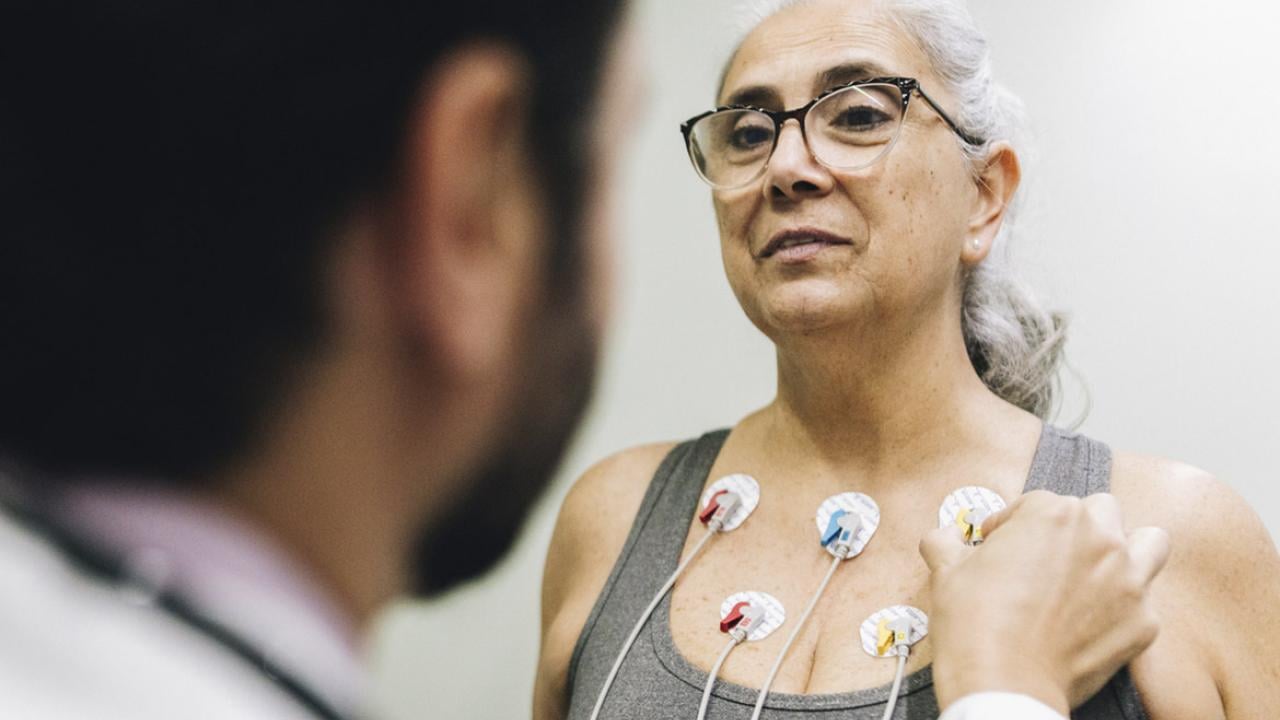
Doctors pay close attention to how patients feel during the test, as well as the heart’s electrical activity, which is why patients are continuously monitored with ECG leads
“We look at those ECG signals and watch for signs of what we call ischemia, or inadequate blood supply to the heart muscle,” he explained, as well as disturbance in electrical rhythms such as heart blocks or dangerous arrhythmias that may appear during stress
“Further downstream, is there significant change in the heart function?” Dr. Yu said. For example, “How is the heart pumping at rest? Does that pumping function augment or decline when the heart is being stressed?”
Finally, one of the most important data is whether perfusion, that is the blood supply to the heart muscle, increases appropriately when going from rest to stress. A healthy heart should increase blood flow under stress, while a diseased heart may not, manifesting as global or regional perfusion defects
There are two main types of cardiac stress tests
“Very broadly, we classify stress tests into two major categories: exercise stress tests and pharmacological stress tests—sometimes we also call that the chemical stress test,” Dr. Yu said. Exercise tests typically use a treadmill, though a stationary bike may be an option for some patients
Pharmacological stress tests are used for patients who cannot exercise for a variety of reasons, often due to physical deconditioning related to obesity and arthritis, and less frequent due to specific anatomic reasons
“What we do is give them medication through their IV to mimic conditions of the heart as if they were rigorously exercising, without having to subject them to the exercise regimen,” he said
Some patients are not good candidates for stress tests
“Going back to the thinking that stress tests are most useful in patients with uncertainty—those with intermediate risk of having heart conditions,” Dr. Yu said. “While those with very low risk or very high risk may not be the best candidates for stress tests.”
For example, “if you have a healthy college athlete who probably just pulled a muscle from moving boxes last week—those patients don’t need a stress test. They’re already stressing themselves every day in the gym,” he said. “If they provide accurate history, we’re pretty confident their symptoms are not heart related.”
“On the other end of the spectrum, you meet those who are at very high risk,” he said. “They have symptoms that are very concerning, and sometimes even suggestive of an ongoing heart attack. They may have some very unstable conditions in the heart. They may need much more invasive procedures such as a heart catheterization.”
Another key point to determine candidacy for a stress test is procedural safety.
“For example, ventricular tachycardia that’s not being well managed, or severe aortic stenosis, where the aortic valve is severely narrowed and severely impedes blood from exiting the heart,” Dr. Yu added. “Conditions like these could pose significant safety concerns for undergoing a stress test and are taken into account to determine where a different testing modality should be pursued.”
“Then on a more nuanced note, for those who cannot exercise and need a pharmacological stress test, these medications could carry potential risk in certain populations,” he said. “For example, patients with active asthma or COPD flare-ups, or those who have uncontrolled seizures may not tolerate a stress test until their conditions are stabilized, as they run the risk of exacerbation from the common stress medications we use.”
Cardiac symptoms can differ between men and women
The stress test protocol is typically the same regardless of gender—but the clinical picture that brings a woman to the stress lab may look quite different from a man
“Women very often have a different experience with cardiac symptoms,” Dr. Yu said. “Men by textbook tend to have classic chest pain. Women more often have less striking, more nonspecific symptoms. For example, indigestion or just generalized malaise, instead of the crushing chest pain that we all learn in medical school.”
“These are some of the gender-specific nuances that we try to pay attention to,” he explained.

What doctors want patients to know™
Subscribe for the answers to the latest questions patients are bringing to the exam room.
Stress tests can be quick, with a catch
“If all we do is the treadmill stress test—you come, you exercise on the treadmill and you step off—that can be pretty quick,” said Dr. Yu. “Usually, the exercise portion itself lasts 15 minutes or less. Taking into account additional steps such as placing ECG leads, it is still completed well under an hour.”
Tests that require imaging—such as a stress echo or nuclear stress test—usually take longer, sometimes up to two hours. Sometimes, extra maneuvers are needed, and additional images are required to mitigate imaging artifacts that can add to the total time for testing
Stress tests assess blockage in the heart
“There are a couple of things we look at. No. 1, how is the heart pumping? Is the heart able to pump more rigorously with stress? Are there parts of the heart that struggle to keep up?” said Dr. Yu. “No. 2—which is especially important in a nuclear stress test—is whether there is inadequate blood supply to parts or all of the heart with stress.”
“If the stress test is normal, then we can tell patients that they are not at increased risk for having a cardiovascular event in the near future,” he said. “The risk is never zero, but they are at or below the average population-level risk for having an event, at least in the short and intermediate time frames
“But if the stress test is very abnormal—especially if it shows a large area of the heart muscle that is having ischemia—that is highly suggestive of at least one coronary artery with significant blockage,” added Dr. Yu. “Usually, we need additional testing to verify that and sometimes urgently.”
What to eat, drink and wear before a stress test
“In terms of food, typically we ask the patient to fast four to six hours before the test. Very often we tell them, don’t eat or drink anything past midnight,” said Dr. Yu. Patients can usually take most medications, but there are exceptions
For example, beta blockers may mask the underlying abnormalities, and some medications can interact with chemical stress agents or affect blood pressure. Patients should follow the ordering physician’s instructions about what to take or hold before the test
With “clothing, just dress comfortably. Wear a pair of sneakers that you feel comfortable going for a jog in and just show up relaxed and motivated. That’s all you need,” he said
Cardiac stress tests are safe, but still have risks
“No test is risk-free, and we say the same for the stress test. Although for the cardiologist, it is one of the safest testing modalities we have that still gives us very important answers,” said Dr. Yu. “For exercise stress tests, we want to minimize any risk of the exercise causing harm to the patient, such as inducing a heart attack. That’s where patient selection and supervision become very important.”
With pharmacological stress tests, patients are educated on the few common but short-lived side effects induced by the chemical agent, such as nausea, headache or shortness of breath. In some cases, a reversal agent is administered to help symptoms resolve faster, he explained
A normal stress test doesn’t mean the work is done
“The test answers the question of whether a patient’s symptoms suggest immediate significant underlying heart disease—and the key words I want to underline are ‘immediate’ and ‘significant,'” said Dr. Yu. “If you have a normal stress test, it doesn’t mean the journey ends there. It doesn’t mean you don’t have mild early disease or that you can stop addressing the risk factors in order to maintain a healthy trajectory.”
“If you smoke, if you drink excessively, if you have uncontrolled blood pressure, high cholesterol, or diabetes, you can still have a normal stress test, but you need to continue working with your medical provider to protect your heart health long-term,” he said. “We want to keep our patients healthy not just this month or this calendar year, but for years and decades ahead.
“That is an important message that sometimes gets lost, that a patient being told their stress test is normal and that they can stop doing what they need to do for their heart health,” Dr. Yu added. “That message can be complacent and dangerous.”
Related Coverage
What doctors want patients to know about atrial fibrillation
Routine repeat stress testing is often not needed
“Very often the symptoms dictate the need for a stress test. If you feel well, unless there are some other extraordinary reasons, you don’t need to routinely get a repeat stress test simply for follow-up or screening,” said Dr. Yu. “A well-performed stress test in a well-selected patient, if normal, can have a shelf-life of a few years. But if you are having persistent or worsening symptoms, then we may need to consider repeating the stress test or pursuing a different testing modality such as a coronary CTA or a heart catheterization.”
“At the end of the day, listen to your doctor and listen to your body,” he said. “Heart disease has been the No. 1 killer in America for over a century, but we can all work together to save lives and make new history.”

8 tips for strengthening your AMA Joy in Medicine application
Jul 21, 2026
|

A strong advising team can help your private practice flourish
Jul 22, 2026
|
Ditching the “SAD plate” to prevent and control chronic disease
Jul 15, 2026
|

6 things patients should know about red light therapy
Jul 21, 2026
|
