


Sugar Consumption in Kazakhstan: Matter of Diet, Trade and Policy – The Astana Times
Sugar Consumption in Kazakhstan: Matter of Diet, Trade and Policy
ASTANA — People in Kazakhstan consumed an average of 1.5 kilograms of sugar per person per month in 2025, a level that has barely changed since 2023, according to the Bureau of National Statistics. But while household consumption has remained stable, domestic production has fallen sharply, leaving imports to supply most of the market.
Photo credit: Adobe Stock
Average per capita consumption of granulated sugar stood at 1.5 kilograms per month in 2023, dipped slightly to 1.4 kilograms in 2024, and returned to 1.5 kilograms in 2025. It remained at the same level in the first quarter of 2026.
During that quarter, Kazakhstan’s sugar factories produced 9,500 tons, down from 64,600 tons in the same period of 2025, a nearly sevenfold decline, according to data from the bureau. The share of domestic production in the country’s total sugar re.
The figures highlight the dual challenge facing Kazakhstan: addressing the health effects of excessive sugar intake while reducing the country’s heavy dependence on imported supplies.
Global sugar consumption projected to grow
Kazakhstan’s growing reliance on imports comes as global sugar demand is projected to rise, particularly in developing economies. According to the Agricultural Outlook 2025-2034, published by the Organisation for Economic Co-operation and Development (OECD) and the Food and Agriculture Organization (FAO), global sugar consumption is projected to grow by 1.2% annually, reaching 202 million metric tons by 2034. Most of that growth is expected to come from developing economies, with Asia and Africa accounting for the majority of additional demand.
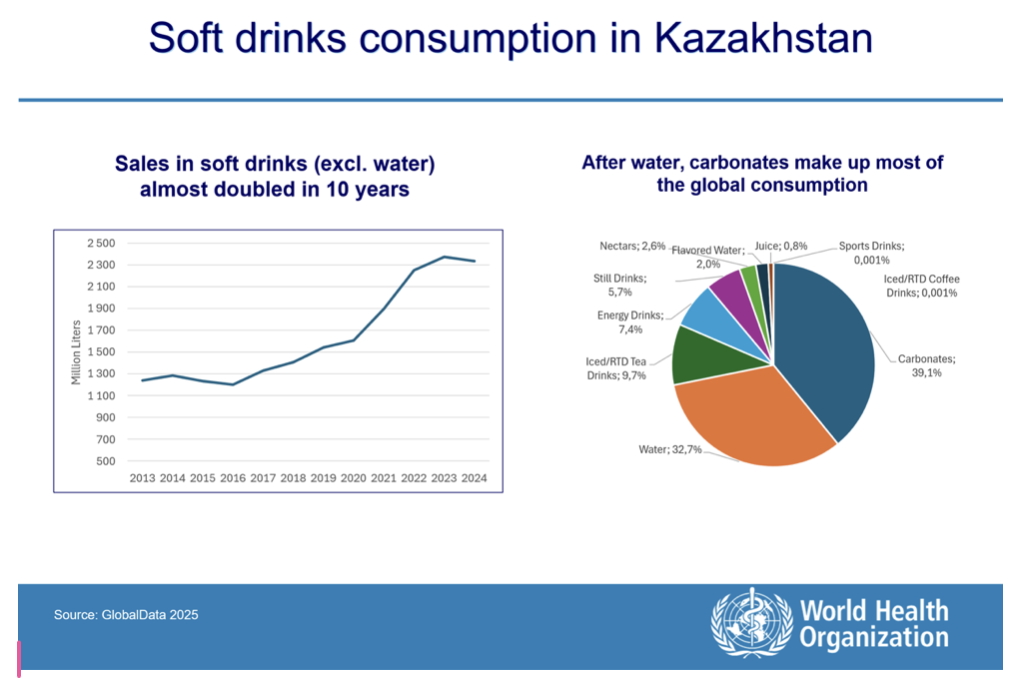
Source: OECD-FAO Agricultural Outlook 2026-2035
The report attributes the increase to population growth, urbanization and changing dietary patterns. At the same time, consumption in many high-income countries is expected to remain stable or decline as governments implement nutrition policies and consumers increasingly seek healthier diets
A growing policy issue
Granulated sugar recorded in household consumption represents only one part of overall sugar intake. The World Health Organization (WHO) recommends that free sugars account for less than 10% of total daily energy intake for both adults and children. Free sugars include those added to foods and drinks by manufacturers, cooks or consumers, as well as sugars naturally present in honey, syrups and fruit juices
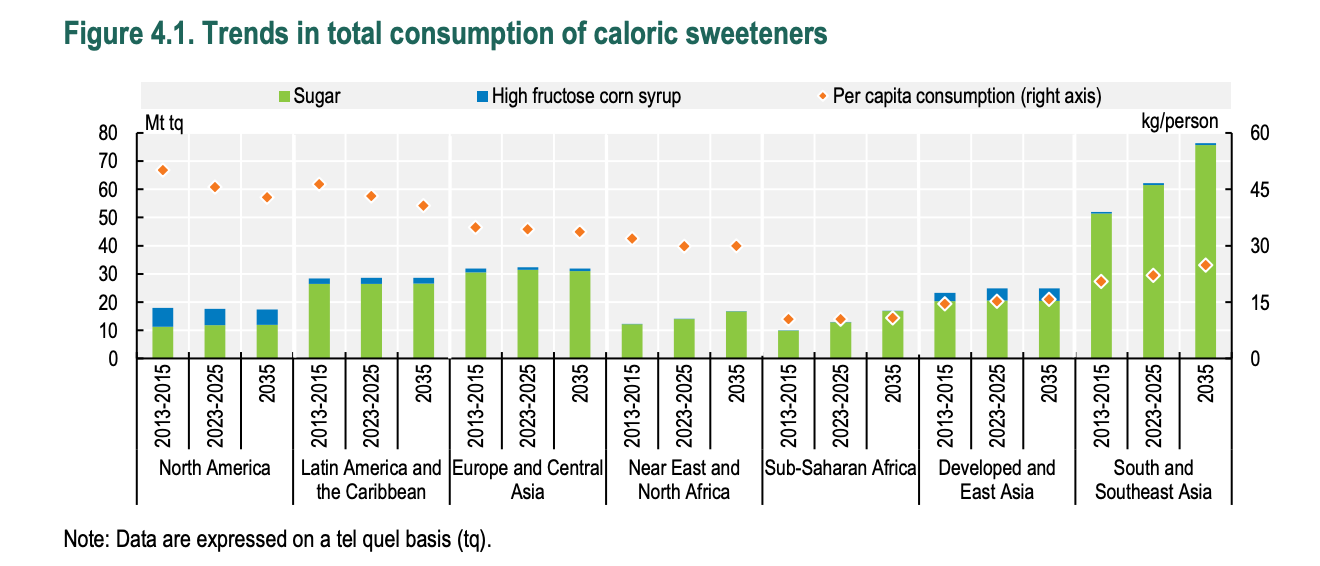
Sorce: WHO
The organization also recommends limiting sugar intake to 5% or less for additional health benefits
Because directly comparable data on total sugar intake are limited, public health agencies also track related indicators, including obesity and consumption of sugar-sweetened beverages, though obesity has multiple causes.

Laura Utemissova, national public health program coordinator at the WHO Country Office in Kazakhstan
Speaking to The Astana Times, Laura Utemissova, a national public health program coordinator at the WHO Country Office in Kazakhstan, said one in five children aged 6-9 in Kazakhstan was overweight or obese in 2020. The prevalence among boys increased from 18.7% in 2015 to 24.2% in 2020, while rates among girls remained broadly unchanged. WHO and Kazakhstan’s Health Ministry continue to monitor these indicators through regular surveys, with updated comparative data expected later this year
In recent years, governments around the world have introduced measures to <a href="https://healthylife7.com/seoul-bucks-obesity-trend-as-app-helps-encourage-healthier-habits/” title=”Seoul bucks obesity trend as app helps encourage healthier habits”>encourage healthier diets, including nutrition labeling requirements, public awareness campaigns and taxation policies targeting sugar-sweetened beverages. Reducing excessive sugar consumption has increasingly become a matter of public policy as governments seek to address rising rates of obesity and other noncommunicable diseases.
“In 2025, Kazakhstan officially joined the WHO Acceleration Plan to Stop Obesity. It is designed to stimulate and support multisectoral country action across the globe,” Utemissova said
Data collected with WHO support suggest that sugary beverages remain a regular part of diets in Kazakhstan. According to the 2022 Health Behavior in School-Aged Children survey, 14.4% of adolescents aged 11, 13 and 15 reported consuming sugar-sweetened beverages daily. While the share declined from 16.7% in 2018, the proportion consuming such drinks at least weekly increased from 60.1% to 66.7%. The survey also found that 26.6% of children reported consuming sweets and chocolate daily
More recent findings from the STEPS 2024 survey showed that 17.8% of adults aged 18-39 consumed sugary drinks at least once a day, compared with 4.8% of those aged 40-69. The highest rates were recorded in the Aktobe and Kyzylorda regions
WHO supports a range of measures to promote healthier diets and reduce excessive sugar consumption. These include public awareness and behavior-change campaigns, clearer nutrition labeling, policies to protect children from the harmful impact of food marketing, support for healthy early-life nutrition practices and taxation of sugar-sweetened beverages as part of broader efforts to improve dietary habits
Beyond consumption: the economics of sugar
Sugar occupies an important place in Kazakhstan’s food economy because consumption trends intersect with questions of domestic production, imports and food security. The issue gained particular attention during the sugar shortages of 2022, when supply disruptions exposed the country’s dependence on imported sugar and triggered concerns over availability and prices.
At the time, Kazakhstan consumed around 532,000 metric tons of sugar annually, while only about 7% was produced from domestically grown sugar beet, with imports accounting for 58% of the market.
In response, the government adopted a comprehensive sugar industry development plan to strengthen domestic production and reduce dependence on imports. The plan targets reducing Kazakhstan’s dependence on sugar imports from 58% to 17% by 2026 through expanding sugar beet cultivation, investing in irrigation infrastructure and modernizing processing facilities. At the same time, industry experts and lawmakers have pointed to bottlenecks in processing capacity and logistics that continue to limit the sector’s development.
The sharp decline in domestic output in early 2026 suggests that reducing import dependence remains a significant challenge. Despite a record sugar beet harvest in 2024 of 1.3 million metric tons and plans to expand processing capacity, imports continue to dominate the market, exposing the country to external supply disruptions and price volatility.
Get The Astana Times stories sent directly to you! Sign upgram, YouTube and Tiktok!
