


Close Menu
healthylife7.comhealthylife7.com

    Subscribe to Updates

    Get the latest creative news from FooBar about art, design and business.

    What's Hot

    Dr. Roach: Physician orders Mounjaro for woman, but with a safety issue

    July 29, 2026

    APSMI Calls For Stronger Health Literacy As The Foundation For Responsible Self-Care Across Asia

    July 29, 2026

    Independent study: Nearly 1 in 3 U.S. adults with high blood pressure may need medication

    July 29, 2026
    Facebook X (Twitter) Instagram
    Trending
    • Dr. Roach: Physician orders Mounjaro for woman, but with a safety issue
    • APSMI Calls For Stronger Health Literacy As The Foundation For Responsible Self-Care Across Asia
    • Independent study: Nearly 1 in 3 U.S. adults with high blood pressure may need medication
    • ‘Super weight loss’ drug retatrutide could be stronger than Wegovy and Zepbound, doctor says
    • A New Haven boxing legend could soon have a street corner in his name
    • Freeport nutrition store changes hands after 35 years
    • Trump administration has quietly throttled an agency devoted to the safety of American healthcare
    • Setting a new benchmark in premium lifestyle living, Venus Group introduces ‘The Universe’ in Ahmedabad
    Facebook X (Twitter) Instagram
    healthylife7.comhealthylife7.com
    • Home
    • Fitness
    • Health
    • Nutrition
    • Lifestyle
    • Conditions
    • Mental Health
    • Weight Loss
    • Wellness Tips
    Wednesday, July 29
    healthylife7.comhealthylife7.com
    Home»Nutrition»Low-Sugar Diet Early in Life Linked to 46% Lower Alzheimer’s Risk
    Nutrition

    Low-Sugar Diet Early in Life Linked to 46% Lower Alzheimer’s Risk

    healthylife7By healthylife7July 29, 2026No Comments5 Mins Read
    Facebook Twitter Pinterest LinkedIn Tumblr Reddit WhatsApp Email
    Low-Sugar Diet Early in Life Linked to 46% Lower Alzheimer's Risk
    Share
    Facebook Twitter LinkedIn Pinterest WhatsApp Email

    Low-Sugar Diet Early in Life Linked to 46% Lower Alzheimer’s Risk

    Health29 July 2026ByEsra Öz
    Add ScienceAlert on Google
    (carlofranco/Canva)

    Sweet foods can be offered as a reward from the earliest stages of life. Yet the sugar we consume before we can even speak may leave traces in our brains that last for decades

    These effects may even begin while we’re in the uterus, before our earliest memories are formed

    According to a new study published in npj Aging, babies exposed to less sugar before and after birth had lower risks of dementia, Alzheimer’s disease, depression, and anxiety later in life

    The findings don’t prove that consuming less sugar directly prevents these conditions. However, they suggest that nutrition during the first 1,000 days – from pregnancy until around a child’s second birthday – may leave lasting marks on the brain

    “The first 1,000 days – a critical window when the brain undergoes rapid development and is highly sensitive to nutritional cues.” – geriatric medicine researcher Bing Zhang

    During and after World War II, sugar was strictly rationed in the UK. Adult allowances were close to current dietary recommendations, while children under two received no separate sugar allowance

    When rationing ended in September 1953, average adult sugar consumption nearly doubled, rising from around 41 to 80 grams per day. Children’s candy consumption more than doubled

    This abrupt shift created a rare natural experiment, allowing researchers to compare people who spent their earliest years under rationing with those born shortly after it ended

    Researchers in China analyzed health data from 60,394 UK Biobank participants born between 1951 and 1956
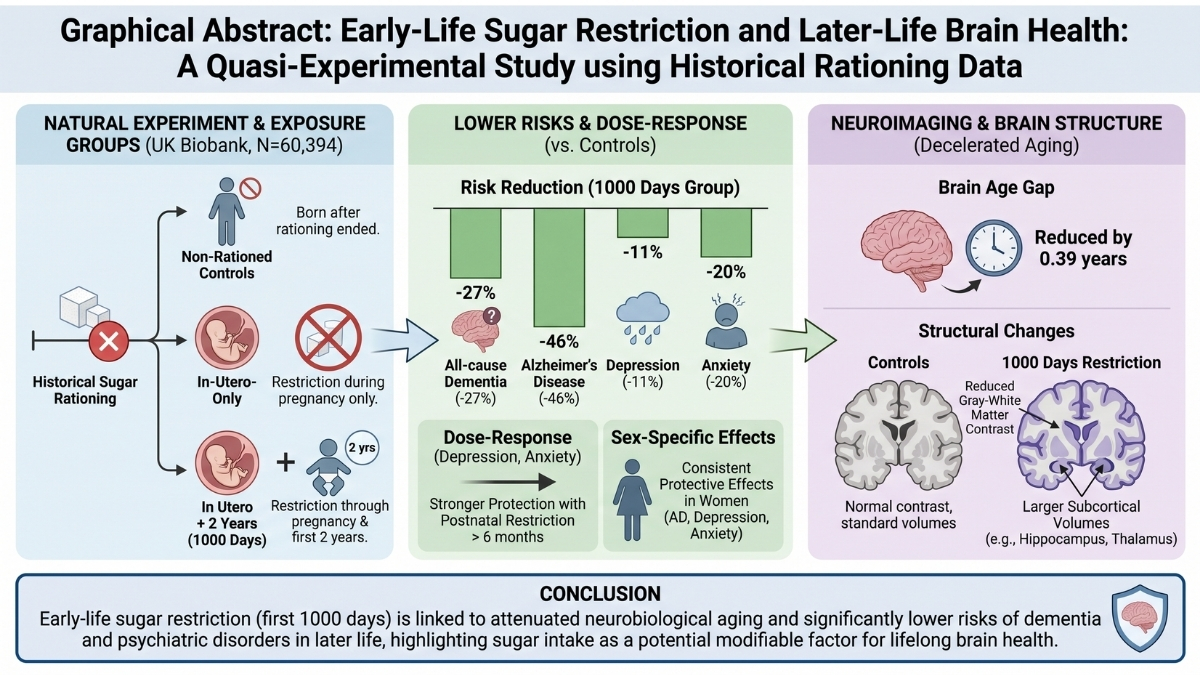
    Less Sugar in a Baby's First Years Linked to 46% Lower Alzheimer's Risk
    A graphical summary of the study. (Lian et al., npj Aging, 2026)

    Compared with people who were not exposed to rationing during early development, those whose first 1,000 days coincided with sugar restrictions had a 27 percent lower risk of developing dementia from any cause and a 46 percent lower risk of Alzheimer’s disease

    They also had an 11 percent lower risk of depression and a 20 percent lower risk of anxiety. No similar association was found for Parkinson’s disease

    The associations were strongest when rationing continued after birth. Exposure only in the uterus produced few clear differences, apart from a lower risk of anxiety

    The researchers also examined MRI scans from a subset of participants to see whether early sugar exposure was associated with detectable differences in the brain

    Those exposed to rationing after birth had brains that appeared, on average, 0.39 years younger than their chronological age. They also had larger volumes in several subcortical regions, including the hippocampus and thalamus, which are involved in memory and other cognitive functions

    “We believe the lasting protective effect is rooted in metabolic programming during the first 1,000 days – a critical window when the brain undergoes rapid development and is highly sensitive to nutritional cues,” senior author Bing Zhang, a geriatric medicine researcher at Guangzhou Medical University, told ScienceAlert

    The brain scans may provide another clue

    Zhang says the larger hippocampal and thalamic volumes associated with early sugar restriction could give the brain more capacity to withstand age-related changes

    A 2017 study published in Alzheimer’s & Dementia similarly linked higher consumption of sugary drinks with lower total brain volume and poorer episodic memory. Researchers analyzed cognitive data from 4,276 people and MRI scans from 3,846 participants, although the observational findings could not establish cause and effect

    Metabolic health and inflammation may also be involved

    “Early high sugar intake predisposes to insulin resistance and chronic low-grade inflammation, both of which are well-established risk factors for dementia,” Zhang explains

    These mechanisms were not directly tested in the study, however. The brain images were also captured at only one point in time, so they cannot establish that sugar restriction caused the structural differences

    Subscribe to ScienceAlert's free fact-checked newsletter

    Although this was not a randomized clinical trial, the researchers argue that the abrupt end of rationing offers stronger evidence than a conventional observational nutrition study

    “We are quite confident that sugar restriction itself is a major driver,” Zhang says

    The researchers also accounted for factors including birth location, socioeconomic status, and genetic background. Still, the end of rationing coincided with wider changes in postwar Britain

    Nor could the researchers determine how much sugar individual mothers and children actually consumed

    The UK Biobank also consists of a predominantly White and generally healthier volunteer population, which could limit how widely the findings apply

    Only 307 participants developed dementia during follow-up, including 123 diagnosed with Alzheimer’s disease, meaning the risk estimates were based on relatively small numbers of cases

    The study therefore does not prove that reducing sugar during pregnancy or infancy will prevent dementia decades later

    Zhang acknowledges that “no single study can change official guidelines overnight,” but says the results support limiting added sugar during pregnancy and early childhood

    “This is not only about immediate health,” he says

    “It is a long-term investment in brain health decades later.”

    The study was published in npj Aging

    This article was fact-checked by Rachel Garner and edited by Rebecca Dyer. While we pride ourselves on our process, we are only human. If you spot a mistake, please let us know

    Diet Early Life Linked LowSugar
    healthylife7
    • Website

    Related Posts

    Freeport nutrition store changes hands after 35 years

    July 29, 2026

    I went to a huge nutrition conference amid the cyclospora outbreak. Everyone was eating salad.

    July 29, 2026

    Registered Dietitian, Sports Nutrition Specialist, and Founder of ‘Purposeful Fueling’, Author Beth McCall Announces the Release of Her New Book, “Hello Peace”

    July 29, 2026
    Leave A Reply Cancel Reply

    Health

    Dr. Roach: Physician orders Mounjaro for woman, but with a safety issue

    By healthylife7July 29, 20260

    Dear Dr. Roach: I’m a 73-year-old female who has Type 1 diabetes that began as Type 2 diabetes more than 30 years ago. I have a very strong family history of coronary artery disease, and I personally have a cardiac stent. I use an insulin pump and have good control with carb counting. I struggle…

    APSMI Calls For Stronger Health Literacy As The Foundation For Responsible Self-Care Across Asia

    July 29, 2026

    Independent study: Nearly 1 in 3 U.S. adults with high blood pressure may need medication

    July 29, 2026

    ‘Super weight loss’ drug retatrutide could be stronger than Wegovy and Zepbound, doctor says

    July 29, 2026
    Stay In Touch
    • Facebook
    • Twitter
    • Pinterest
    • Instagram
    • YouTube
    • Vimeo
    Fitness

    Opinion: The FDA must put biotech at its center or continue to cede early research to China

    July 6, 2026

    Inside Elevance’s digital chronic disease management strategy

    July 6, 2026

    Best, Worst States For Well

    July 6, 2026

    What do the Middle Ages tell us about mental health then and now? VCU historian Leigh Ann Craig has answers

    July 6, 2026

    Subscribe to Updates

    Get the latest creative news from SmartMag about art & design.

    About Us

    Welcome to HealthyLife7.com, your trusted source for reliable health, wellness, fitness, and lifestyle information. Our mission is to help people make informed decisions about their health by providing clear, practical, and easy-to-understand content.

    At HealthyLife7.com, we believe that good health starts with the right knowledge. Whether you're looking for healthy eating tips, fitness advice, mental wellness strategies, weight management guidance, or information about common health conditions, our goal is to deliver valuable content that supports a healthier lifestyle.

    Fitness

    Dr. Roach: Physician orders Mounjaro for woman, but with a safety issue

    July 29, 2026

    APSMI Calls For Stronger Health Literacy As The Foundation For Responsible Self-Care Across Asia

    July 29, 2026

    Independent study: Nearly 1 in 3 U.S. adults with high blood pressure may need medication

    July 29, 2026
    Health

    Opinion: The FDA must put biotech at its center or continue to cede early research to China

    July 6, 2026

    Inside Elevance’s digital chronic disease management strategy

    July 6, 2026

    Best, Worst States For Well

    July 6, 2026
    Facebook X (Twitter) Instagram Pinterest
    • About Us
    • Contact us
    • Disclaimer
    • Privacy Policy
    • Terms and Conditions
    © 2026 healthylife7.com. Designed by Pro.

    Type above and press Enter to search. Press Esc to cancel.