


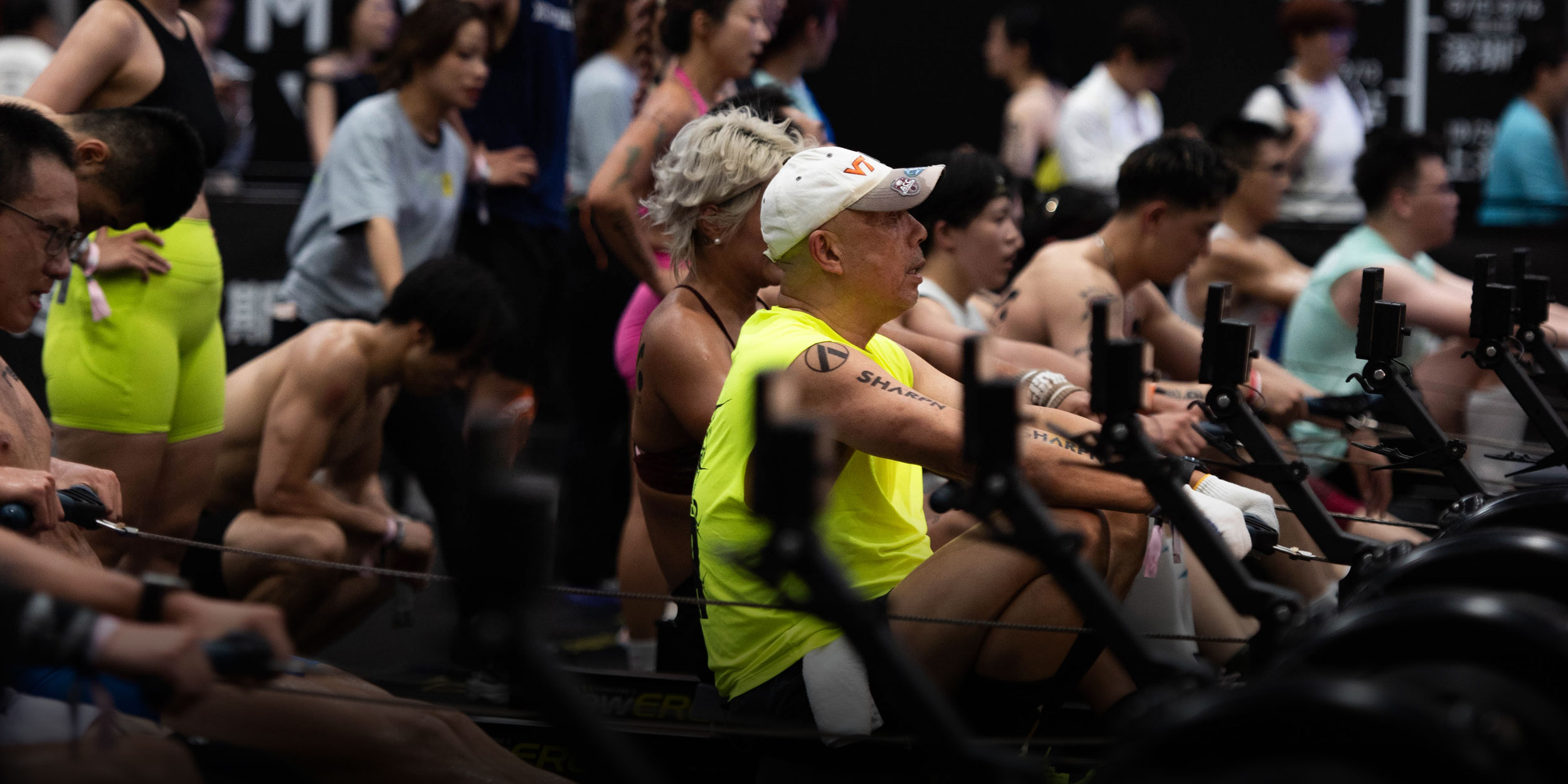
East China — Wang Hui, a 68-year-old from Beijing, used to avoid intense exercise whenever possible. The retiree’s fitness regime mostly consisted of the odd brisk walk, and maybe a few leg raises at home
But that suddenly changed a few months ago, when her daughter informed her she’d signed Wang up for a Hyrox race
The fitness craze, which originated in Germany a few years ago, is not for the faint of heart: participants must complete eight 1-kilometer runs, each followed by a set of strength exercises ranging from lunges to pushing a heavy sled
Curious and keen to connect with her daughter — a long-time fitness enthusiast — Wang threw herself into training, building up from 1-kilometer jogs to 8-kilometer runs in just two months
Then, one day in July, Wang found herself walking alongside her daughter into a cavernous expo center in the eastern city of Hangzhou packed with more than 6,000 competitors and 7,000 cheering spectators
As she stood under the pulsing strobe lights, ears throbbing from the pumping bass, Wang could not have felt more out of her comfort zone. But she suspects that was her daughter’s intention all along
“My daughter keeps surprising me,” she told Sixth Tone after completing the event in July. “She shows me, ‘I can still do this,’ ‘I can still do that.’”
Wang is far from alone. As Hyrox explodes in popularity across China, the races have unexpectedly begun to attract an ever greater number of retirees — many of them competing in their first event well after turning 70
For some, the races represent a fresh challenge or an excuse to get fit. For others, like Wang, they offer a chance to reconnect with adult children for whom Hyrox has become a new obsession
Even by global standards, Hyrox has taken off in China at astonishing speed. The first official Chinese Hyrox race took place as recently as 2024, with 1,700 fitness enthusiasts competing in a hall in Beijing
Now, events are held all over the country, with early-bird registration often selling out within minutes despite costing up to 800 yuan ($125) for an individual entry fee — more than three times the entry fee for a typical marathon in China. At a recent race in Shanghai, over 10,000 people took part
As elsewhere, Hyrox fans in China tend to be young, middle-class, and super-fit. Local races are filled with ripped 20- and 30-somethings working in competitive industries such as finance and artificial intelligence
On Chinese social media, Hyrox’s appeal to such high-fliers has become a running joke. Users often quip that the sport taps into a deep Chinese love for hard work and standardized tests. Some even liken Hyrox training to preparing for the gaokao, China’s grueling college entrance exams
But the sport also has a more inclusive side. At some events, participants can sign up in teams of two or more — allowing them to divide the workload — and the lack of cut-off time means slower competitors can complete the race
That has opened the door to a growing number of elderly contenders. Online, there has been a wave of social media posts in recent months from Chinese millennials sharing their experiences of entering Hyrox races alongside their aging parents, many of them attracting thousands of likes
Wang’s daughter, Xie Shanshan, is part of that trend. Now in her 40s, she took up running years ago while living and working in Beijing — competing in several half-marathons — before pivoting to Hyrox as the sport began to gain traction
For Xie, the hope was that competing in the team event with her mother would give them a shared experience. But she also aimed to give Wang — who has been retired for years — a healthy jolt
And she appears to have succeeded. After the initial shock wore off, Wang fully committed to the training and finished the Hangzhou race, with Xie reminding her to pace herself
“We didn’t go at 100% effort,” Wang said. “My daughter kept saying, ‘Steady, steady, it’s about the taking part, not speed.’”
When asked whether it’s a good idea for seniors to participate in such high-intensity sports, Wang said it was easy to fall into a rut after retirement, spending all day scrolling social media or watching TV
“But if you can step out and join social activities with younger people, your thinking and values get reenergized,” she said. “The real appeal lies in connecting with the younger generation, adding vitality to life, and broadening horizons.”
Other child-parent teams competing in Hangzhou shared similar experiences. Yu Lian, a 45-year-old CrossFit enthusiast, had been training for nearly a decade and had already run solo in two Hyrox races
But after seeing online that some of her favorite fitness influencers had brought their parents along to Hyrox events, she decided to ask her 74-year-old father to join her at her next race
According to Yu, he immediately replied: “Just tell me what to do, and I’ll do it. I walk so much every day. I’m already the number one in our neighborhood!”
Though Yu had emphasized “safety first,” her father took the training unexpectedly seriously. For nearly two months, he took brisk walks outside several times a week, and ended up losing 5 kilograms
On race day, it was a similar story. Yu’s plan was to do all the strength exercises herself, while her father walked alongside her. But he ended up getting far more involved than she had expected
After each kilometer run, she found him already waiting for her at the work station, arm outstretched, ready to pull her forward. In the final event — the “wall ball,” where competitors have to throw a heavy medicine ball against a wall — her father, fueled by the crowd’s energy, grabbed a ball and nailed the target on the second attempt
For Yu, the race came to feel like an important bonding experience. Growing up, her relationship with her father had always been reserved — love was expressed through deeds, not words, she recalled
The term “parent-child bonding” usually conjures up images of young families with small children, but Yu said she felt that older generations — those in their 40s and 70s — needed it just as much
“Interactions between adult children and aging parents are often limited,” Yu said. “Participation in the race is a meaningful way to foster various types of connection.”
Yet, for all its emotional benefits, Hyrox can be a dangerous activity — especially for a beginner in their 60s or 70s. Li Cong, a functional training, pilates, and sports rehabilitation instructor in Shanghai, warned the sport presented a high injury risk
“After running, the small stabilizing muscles around our joints fatigue,” she said. “When we then do weighted sled pushes or kettlebell exercises, the lower back and knees are forced to compensate and bear all the weight. When your form breaks down under fatigue, the injury rate is much higher than if you trained running and strength separately.”
Sun Yang, a senior rehabilitation therapist in the sports medicine department at Shanghai’s Huashan Hospital, echoed those concerns. A Hyrox devotee herself, she approaches training with caution
“I stop and rest for a few days if I feel any discomfort,” Sun said. “I don’t allow myself to continue exercising while overtired or in pain.”
Wang Zheng — no relation to Wang Hui — thought long and hard before inviting his mother to form a Hyrox team with him
As a 32-year-old fitness professional, Wang Zheng had already competed in 22 Hyrox events, and he was keen to bring his mother, Ma Jing, into his world. But he also knew that the traditional, hardcore format wasn’t a fit for everyone
Luckily, the mixed-doubles category offered a solution. “In mixed doubles, I can take on 90% of the workload, and there is no cut-off time at the venue. That meant I could finally bring my mom along to play,” he said
Ma, a 65-year-old retiree living in eastern China’s Shandong province, was initially apprehensive when her son suggested entering a race together. “I was actually a bit scared, afraid of embarrassing him,” she recalled
But her fear soon gave way to a deeper motivation. “I don’t want to be a burden to my son as I get older, and the first step is to stay healthy,” Ma said. “So I thought, let me challenge myself.”
The training ended up having a profound impact on Ma. She moved in with her son in the southern city of Shenzhen months before the race so that they could prepare together, and watching his tough routine gave her a new understanding of his commitment
His dedication also inspired Ma to take her own training seriously. In November, the pair completed the race in Shanghai in 100 minutes, with Ma’s performance surpassing her son’s expectations. The atmosphere even motivated her to take on several exercises that she had never tried before
Now, flush with her triumph, she has decided to push on with her training. She runs 5 to 10 kilometers a day, hits the gym for strength training 20 days a month, and is lining up her next races
“Since I’ve decided to compete, I have to show up in my best form,” she said
More importantly, Ma said Hyrox had helped shatter her self-doubt. “I used to think I wasn’t ready, but actually, we don’t need to prepare for everything. Just participating is a reward in itself.”
Additional reporting: Xie Anran
(Header image: Elderly participants in Hyrox races. Xie Anran/Sixth Tone)
