


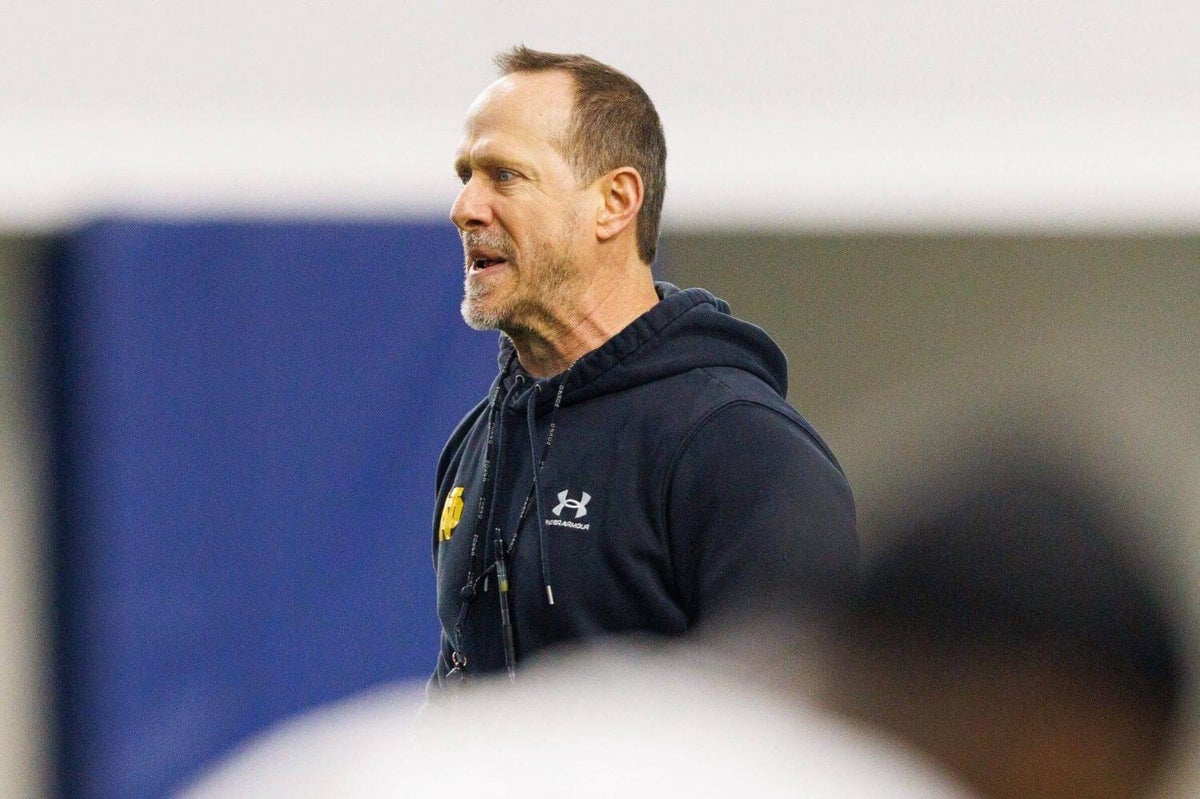
Ind. — Loren Landow hands me a towel, but it’s not for the sweat
For the past hour, Notre Dame’s director of football performance has put this 48-year-old reporter/non-<a href="https://healthylife7.com/is-your-young-athlete-eating-enough-the-hidden-risks-of-under/” title=”Is Your Young Athlete Eating Enough? The Hidden Risks of Under”>athlete through a workout inside the Guglielmino Athletics Complex, pulling back the curtain on how he has helped build a team that played for a national title in the 2024-25 season and another that won its final 10 games by double digits last fall
I got a taste of Landow’s meticulous warmup, a routine that former players take with them to the NFL. There’s been some lifting and a lot of holding
Now it’s time for the towel. No weight. How hard can this be?
“If I pull out the towels with guys, it’s sneaky terrible,” Landow said. “When you want to put it on somebody and humble them a little bit, it’s a good way.”
I grab the hand towel with my palms up, pulling it taut. Then I do a bicep curl, then an overhead press, then a lat pulldown, then bring the towel to my waist while flexing my triceps. I need to do 10 reps. By the sixth, my upper back feels like it wants to explode out of my shirt. I finish the set, grunting through the final two reps
After a one-minute break that feels more like five seconds, Landow tells me to go again
I finish the set more out of a need to avoid embarrassment than because I want to
Landow mentions that former swimmer Missy Franklin, the five-time Olympic gold medalist whom he helped train at the performance center he directs in Colorado, would do three sets of 50 reps of this particular towel drill
And on that note, we’re done
Here’s what I learned from working out with Landow, who’s trained NFL players, Olympians, UFC fighters, MLB players, NHL players and now a former third-string soccer goalie who never played above junior varsity
1. You’re warming up. He’s watching
At the start of every Notre Dame practice, players line up by position in a grid that spans the width of the field and goes about 40 yards deep. They perform a series of 100 movements over the next 10 minutes that target mobility, stability and activation, in that order. Landow puts me through the middle third of the series, assessing my stability on the turf field inside Notre Dame’s weight room
Some of the movements are easy, like bodyweight squats or inchworms — basically holding a push-up position and walking your feet forward until you can stand up straight. Others reveal what I already know, but Landow doesn’t: I have terrible balance. Any movement where I’m on one leg while holding up the other produces a wobble. Maybe he didn’t notice
“Funny enough, you’ve got real good mobility; ankle, hips are really good,” Landow said. “Your hamstrings are limited. Your stability is the problem. Your ankle stability is something that’s really challenging.”
So he noticed. That’s the entire point of the warmup, at least for Landow
During his first few practices after coming to Notre Dame in 2024, Landow walked between the players, trailed by an assistant with a notepad, taking notes about who could stretch and who needed help. The warmup isn’t hard to learn; the incoming freshmen master it before their first fall camp. What they probably don’t understand is how much Landow tracks the part of practice when players are most likely to zone out
Former Notre Dame linebacker Jack Kiser still does the Landow warmup before workouts with the Jacksonville Jaguars. He wasn’t the only Jaguars player doing it last season: linebacker Foye Oluokun, safety Andrew Wingard and linebacker Chad Muma have all worked with Notre Dame’s strength coach
“They’ll see me doing the warmup and they’re like, ‘Oh, you’re a Landow guy.’ ” Kiser said. “It’s very meticulous, and you’re hitting everything; you’re getting everything revved up. It’s a cue for your body that it’s ready to go.”
The warmup was one of Kiser’s first moments of buy-in with Landow. The linebacker went straight into the squat rack afterward, and his hips and legs moved more easily. The hinge felt smoother. A linebacker always looking for an edge believed he’d found one
“I’d never felt so good getting under the bar on the first set,” Kiser said. “And ever since then I’ve had complete and total buy-in on the warmup. Although like there’s some days where it’s like, I gotta go through this whole 10-minute warmup? But it definitely gets you ready.”
2. There’s more to strength than weight on a bar
With the warmup complete (at least the middle third of it), Landow puts me through a series of compound exercises. Only half require more than my body weight
They all have a timing element, starting with a series of eight push-ups, where I have to slowly count to three while lowering my chest toward the floor, then hold that position for two seconds before slowly pushing back up for three more seconds
“Push your palms into the floor,” Landow said. “We can always make a push-up feel heavier.”
Next comes an isometric hold: a reverse lunge in which I have to maintain that position for a set time. The movement makes my quadriceps feel like one big cramp
“Time under tension: I’m locking you into a certain range of motion, and I’m exhausting that tissue,” Landow said. “What we want is to get you in a position where those tendons have the most loading against them and lock those tendons to those positions.”
Notre Dame’s strength program is complex and position-specific, but it boils down to training the muscles and tendons. The former encompasses what you’d think of with a weight program: bench, squat, clean. This is the meat and potatoes of any weight routine
However, Landow also trains the parts of the body where tendons attach to bones, with durability in mind more than classic strength
“All the research is showing that you gotta do both. And more isn’t better. Loading you up with a 100-pound dumbbell in an isometric hold isn’t better,” Landow said. “A lot of people think that, and it’s taking liberties with the science.”
Football is a sport of collisions, and a scientific strength routine won’t put a player in bubble wrap. ACL tears, broken bones, concussions — there is no way to stop players from getting hurt. Landow’s routine is built to make Notre Dame more durable
In his first year, the Irish limped to the finish line of a 16-game season … but getting to that 16th game was the point. At the end of his second season, the team was peaking during Game 12
And both years, Notre Dame opened the season healthy and available. The primary players expected to miss the start of preseason camp next week are recovering from ACL tears, not soft-tissue injuries
“That (2024-25) Playoff run, I was probably in just as good of a position and movement ability as I was at the beginning of the year,” Kiser said. “I’m really proud of the fact that I was able to play 70 games at Notre Dame. And I don’t think that necessarily is something that would have been possible if I wasn’t in a program under Landow for those last two years.”
3. Routine matters, but so does competition
I grab a 25-pound plate at my waist, and Landow tells me to raise it to eye level in front of me, ending with my arms parallel to the floor. Easy enough. Then he asks me to lower the plate to the original starting position on an eight-second count. My lats burn for all eight seconds and each of the eight reps (and for the next couple of days)
Then, Landow sends me to two resistance bands hanging above a squat rack. I do a series of inverted rows, my body weight the only resistance. Again, the burn
Before the final set of rows, Landow changes the grip on the bands to “fat grips,” creating a new kind of sensation. I can’t close my hand around the grip anymore, stressing my hands and forearms even without doing the row. I wonder if I’ll fall backward onto the floor, which is probably why he had me sign a waiver before starting
“The weakest link for people is usually grip,” Landow said
Some days Landow will turn this hang into a competition, lining up players to hold the fat grips as long as possible. Last man hanging wins. Or the players will grab a plate in each hand and pinch them until their grip gives out
These are not glamorous exercises that Notre Dame shows on social media. Still, when Boubacar Traore sheds a blocker or Jordan Faison high-points a ball on Saturdays, grip strength is part of it
Landow likes to keep it fresh for Notre Dame. These aren’t Olympians, professional athletes or UFC fighters. Some have to learn how to train before jumping into the Landow program. Still, Landow keeps returning to the Irish roster’s curiosity, even as the players run five days a week and lift four days a week during summer conditioning
During a workout in the stadium this summer, Landow casually mentioned Newton’s first law of motion: An object at rest stays at rest, and an object in motion stays in motion at a constant speed unless an outside force acts on it
“A young DB said, ‘What about the other two laws?’ and got into them,” Landow recalls. “These kids are smart. The second I tell them the ‘why’ of something, the buy-in is just like that.”
Landow snaps his fingers to make the point
Then, he hands me a towel. I’ll never look at one the same way again
