


- Related
- parasite
- health
- animals
By Grace Hayba, WRAL Health Reporter
Headlines in 1966 spread the word that the New World screwworm had been eradicated from the U.S. Nearly 60 years later, they’re back
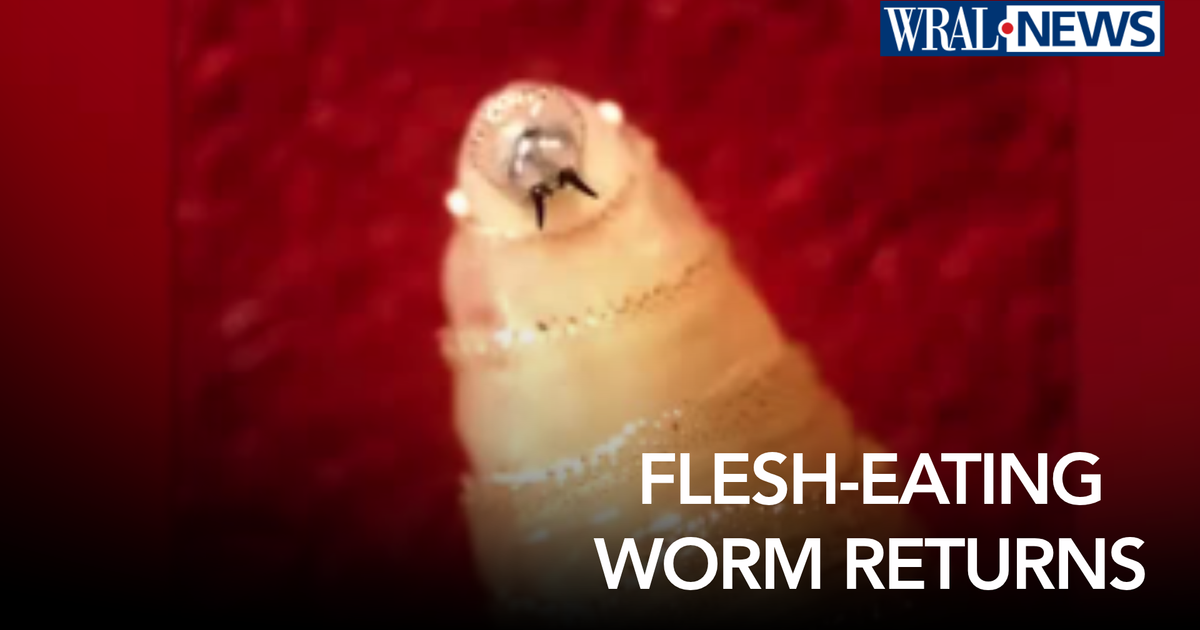
The New World screwworm is a parasitic fly that lays its eggs in open wounds and body openings such as eyes, ears, nose or mouth, according to the Centers for Disease Control and Prevention (CDC). The eggs grow into parasitic maggots that burrow and feed on living tissue.
The CDC estimates one adult female screwworm could lay up to 3,000 eggs in her lifetime
NC State Veterinary Parasitologist Dr. Andy Moorhead said the screwworm wasn’t something he anticipated seeing come back in his career.
“It essentially crossed over the border from Mexico into Texas,” Moorhead said. “These maggots are the ones that cause a lot of damage. These maggots don’t eat into dead flesh, they eat into live flesh.”
Texas and New Mexico have reported a combined 43 domestic animal infections as of July 30, 2026. The U.S. Department of Agriculture (USDA) launched an online dashboard to monitor the spread of cases.
The New World screwworm poses the biggest threat to cattle and wildlife in the southwestern United States. The screwworm can also infest human tissue, though infections in humans remain rare. Texas A&M AgriLife Extension Service reports humans make up less than 1% of all infections.
Experts studying screwworm infections say they can turn a wound the size of a quarter into one several inches long in a matter of hours.
The growing number of cases has prompted an unprecedented response by the federal government.
This week, the USDA announced a $25 million investment for an Arizona-based facility aimed at curbing screwworm spread. The agency says the funding “advances USDA’s aggressive strategy to strengthen sterile fly production and dispersal capacity.”
“The reason they release sterile males is because the females will only mate once,” Moorhead explained. “If you have a sterile male and it mates with the female, it’s taken that female out of play and the eggs that the female lays will not develop.”
The USDA now has a dedicated screwworm website featuring case updates, response efforts and educational re
The U.S. Food and Drug Administration previously approved the first-ever emergency use authorization for an animal medication to help respond to the screwworm outbreak
“I would say it is concerning. I’ve talked to a variety of people about it. How I’m portraying it is not to be fearful and panicking, but be vigilant,” Moorhead said
Moorhead stressed the risk to most North Carolinians remains very low for a few reasons
First, he said the USDA’s rigorous protocols over transporting cattle would help detect a potential infection of a cow well before it reached our border
“Livestock is very locked down by USDA and Texas Department of Agriculture. There’s not going to be a random cow with screwworm that shows up here. There is a lot of regulation about that right now,” he stated
Moorhead also said flies themselves simply can’t travel that far.
“It’s highly, highly unlikely that we are going to get a spread of flies here. They can fly some distance, but they’re not going to fly all the way from Texas,” Moorhead said
The parasitologist said if North Carolina were to see a case, the most likely scenario would involve someone traveling to and from a state with known infections, such as Texas, with an animal carrying screwworm maggots.
“If you are a North Carolinian and you need to go to Texas, say for some sort of let’s say horse show or something, I would consult with your veterinarian before you go to make sure that everything is locked down,” Moorhead urged. “Likewise, if animals are coming here—dogs, cats, horses, say you’re adopting something—make sure you’re talking to those people on the Texas end of things.”
People at higher risk for screwworm infections are those who live in or travel to areas with New World screwworm flies and have open sores or wounds, have medical conditions that cause open sores or bleeding, spend a lot of time outdoors, or sleep outside.
Symptoms of a screwworm infestation include wounds that rapidly increase in size, visible larvae or egg masses in a wound, foul odor, and the sensation of movement inside the wound.
Anyone with a suspected case in their pet should contact their local veterinarian immediately
