 |
| 2026-2027 Electoral Calendar, latest official version |
 |
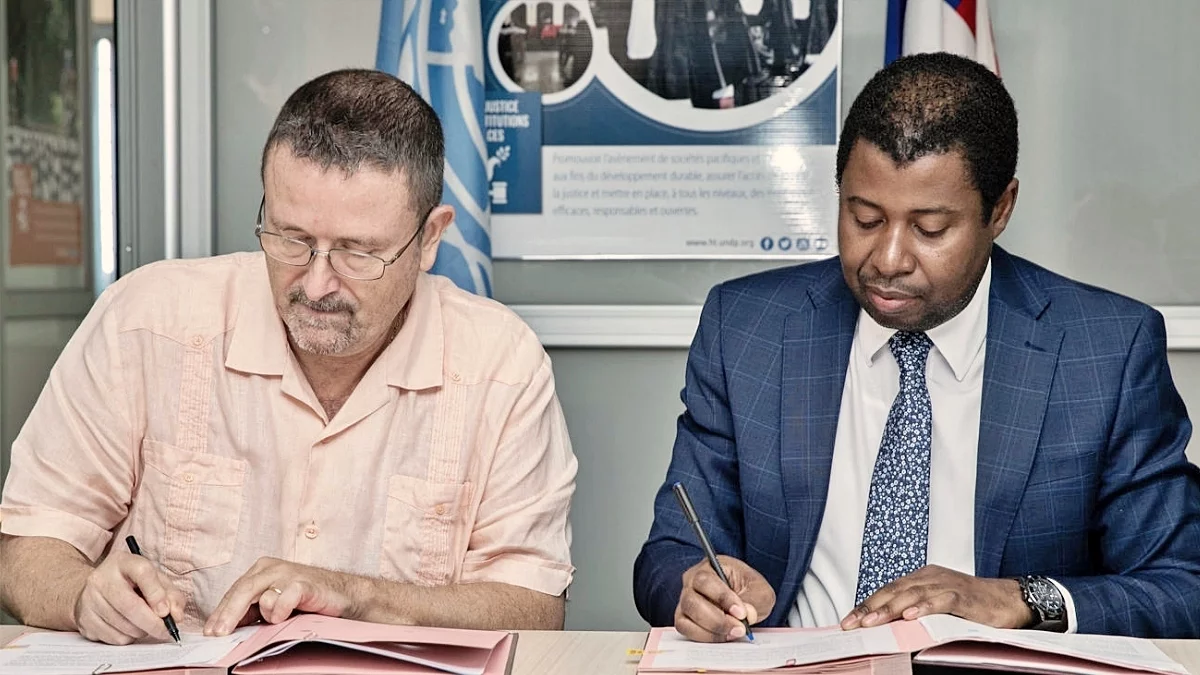
| UNDP and UEH sign an agreement to strengthen the psychosocial well-being of displaced persons01/08/2026 09:55:41 On Friday, July 31, 2026, Xavier Michon, Resident Representative of the United Nations Development Programme (UNDP) in Haiti, and Professor Dieuseul Prédélus, Rector of the State University of Haiti (UEH), signed a Memorandum of Understanding aimed at strengthening access to mental health and psychosocial support services for displaced persons living in the Port-au-Prince metropolitan area Implemented within the framework of the Rekonekte project, funded by the Republic of South Korea, this partnership will leverage UEH’s expertise to provide local psychosocial support to displaced populations and host communities, while simultaneously strengthening national capacities in mental health and psychosocial support Armed violence in Haiti has forced hundreds of thousands of people to flee their homes, disrupting their daily lives and severely impacting their mental health. Beyond material losses, forced displacement has led to significant psychosocial distress, affecting women, men, children, and adolescents living both in displacement sites and in host communities. It is in this context that UNDP and the State University of Haiti (UEH) signed this memorandum of understanding to strengthen access to mental health and psychosocial support services. Presenting the projectof the initiative at UEH, explained that the activities will be carried out by a team of psychologists, social workers, and field supervisors, following a protocol already successfully implemented by UEH “We will intervene directly in the camps for internally displaced persons in the Port-au-Prince metropolitan area. Our priority will be to inform, raise awareness, and provide initial psychosocial support so that people better understand the effects of the trauma they have experienced and have concrete tools to take care of their mental health. This support will take several forms: discussion groups, psychological rehabilitation and psychosocial activities, as well as sociocultural initiatives using, among other things, storytelling, contact with nature, reading, writing, singing, dancing, and drawing. Behind each of these activities lies the same ambition: to offer displaced people spaces where they can be heard, regain confidence, and begin a genuine process of personal and collective reconstruction,” explained Ronald Jean-Jacques. “When we went into the field, the people clearly shared their needs with us. Beyond material assistance, they expressed the need for psychosocial support to cope with the trauma caused by violence and forced displacement.” Xavier Michon emphasized that this initiative stems from a deep conviction within the organization “You spoke of hope ! I think that’s exactly what we share. We refuse to accept this as inevitable. We refuse to believe that there is no way out for Haiti. We are convinced that, despite the challenges, it is possible to move forward.” He also emphasized the added value of this partnership, which will allow young psychology students to put their skills to work for communities while gaining field experience by engaging with the realities they face. For UNDP, this initial intervention also provides a learning opportunity that will help guide future initiatives for the recovery and reintegration of populations affected by violence. “This initiative is just the tip of the iceberg. It would be insensitive and irresponsible to claim that it is a solution to all the challenges. It is only a beginning, but it is an important one. We will dedicate our full commitment to it as an organization, and I know that we will do it together,” concluded the UNDP Resident Representative. Speaking on behalf of the State University of Haiti, Rector Dieuseul Prédélus declared, “[…] I would like to express my gratitude to the Haitian Psychological Association, to our colleagues in the Faculty of Ethnology and the Faculty of Humanities, as well as to all those within the State University of Haiti who work every day, often under extremely difficult conditions, to ensure that science and academic knowledge remain at the service of our people. Through this partnership, the State University of Haiti reaffirms its commitment to placing research, training, and academic expertise at the service of the major challenges of national development.” |
|