


‘A Gen Z Reviews the Classics’ is a new weekly column on Firstpost. We revisit great books and films, and talk about why they remain relevant even today
I first read The Outsiders at the very mature age of 21. I say “mature,” but my teenage years — with all their angst and melodrama — didn’t really pack up and leave until I was closer to 22
The book was given to me by my boyfriend, who ends up name checked in almost every column I write, mostly for handing me so many books and so much life experience along the way, which is a whole other essay for a whole other day
I read it during a turbulent time, the peculiarly dramatic sort of turbulence that only a 21-year-old can mistake for the end of the world. I was also in the middle of a reading slump, a wholly different kind of affliction, but no less frustrating
More from Lifestyle
I remember sitting on top of a ladder leading up to a slide in a school park, completely absorbed within a few pages, even though this isn’t the kind of book I’d normally reach for. I was late to it too — most people I know read it in school
Ponyboy walks out of a movie house with Paul Newman and a ride home on his mind, and from there we’re inside the world of 14 year old Ponyboy Curtis, his gang the Greasers, and their long, tired war with the richer Socs. I picked the book up again recently just to flick through it — head all over the place for reasons that had nothing to do with the book — and got wrecked all over again. It will still make your heart bleed the way it did when you were twelve
Quick Reads
View All
Sarnath added to Unesco’s World Heritage List: How are sites chosen for this honour?
US pub are adding 20% tips to their bills. The FIFA World Cup 2026 is why
This book has never been about the switchblades
Hinton wrote about class — the invisible lines that decide who gets called a bad kid and who doesn’t, even when they’re all up to the same stupid teenage things. Greasers are poor, rough at the edges, written off before they open their mouths. Socs have money, letterman jackets, and the benefit of the doubt. Sixty years on, we still do this exact thing to kids, sort them by postcode and haircut and decide who’s dangerous before they’ve said a word
The boys are wonderfully gentle with each other. Ponyboy notes at one point that he doesn’t like to hear women get sworn at, “even if they deserve it,” which is such a weirdly chivalrous thing for a 14 year old street kid to think about. Him and Johnny are protective without ever trying to be, they bristle when someone talks badly to a girl, they cover for each other without thinking twice. Rolling Stone’s piece marking the book’s 50th anniversary tracks how the line “stay gold, Ponyboy” outlived Greasers and Socs entirely, turning up on t shirts and album titles decades later.
Friendship Day is the perfect excuse to reread this. Not a love story — a story about boys who’d run into a burning building for each other, and in Johnny and Dally’s case, do exactly that. Lena Dunham, writing for T Magazine, went back to the novel as an adult and clocked how rare it still is to find boys on a page whose entire personality isn’t conquest. In a world where the men in charge brag about grabbing women and half our idols turn out to be predators, a bunch of switchblade carrying Greasers being soft with each other feels almost radical.
Ponyboy is one of YA’s most beautiful boys
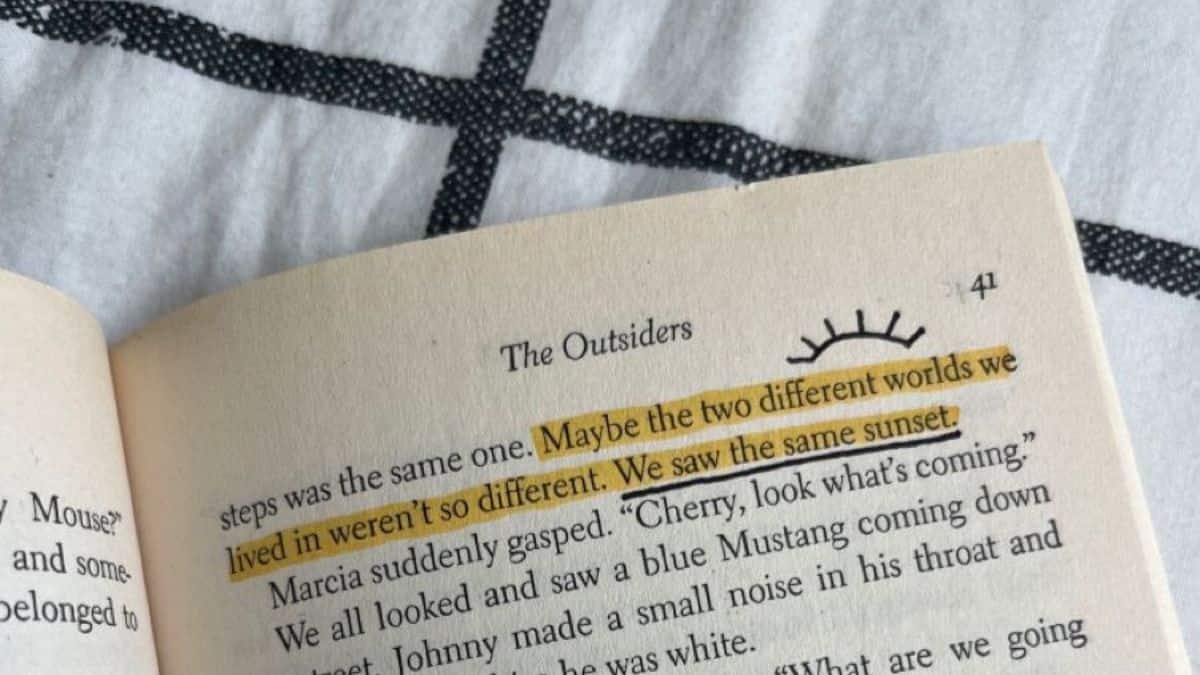
He reads. He watches films. He notices sunsets while everyone around him is getting arrested. A sensitive kid in circumstances that were never fair to him, who gets hurt more than once, and is brave in the manner that children are when they don’t really have the choice not to be
His voice has always reminded me of Holden Caulfield’s — same restless, watching-everything cadence
The ending is horrible. Johnny dies from injuries he gets pulling kids out of a burning church. Dally, who cannot survive losing him, gets himself shot by the police not long after. Ponyboy is left concussed, gutted, permanently rearranged, and the novel we’ve just read turns out to be the school essay he wrote about all of it
Before she turned 18, she rewrote YA fiction
Hinton wasn’t some grown woman looking back at her adolescence with the safety of distance, she was still in it. Fifteen when she started scribbling this in notebooks, seventeen when it sold, and somewhere in between all of that, she pulled a D in her own high school creative writing class. Let that sit with you for a second, the girl who’d go on to basically invent an entire genre couldn’t get a passing grade from the one teacher meant to be spotting talent like hers
Her publisher renamed her S.E. before anyone even read a word, because Susan Eloise on the cover meant reviewers wouldn’t bother taking a book about gang warfare seriously if they knew a teenage girl wrote it. She’s said as much herself, that to this day some readers still assume she’s a man. Before her and her contemporary Robert Lipsyte showed up, books written for teenagers were, in Hinton’s own words, “still fifteen years behind the times,” stuck on horses and romance while actual teenage life went completely unmentioned. She wrote the book she couldn’t find on any shelf, and somehow did it before she was old enough to drive herself to the bookstore to check.
Text your best friend this Sunday
