


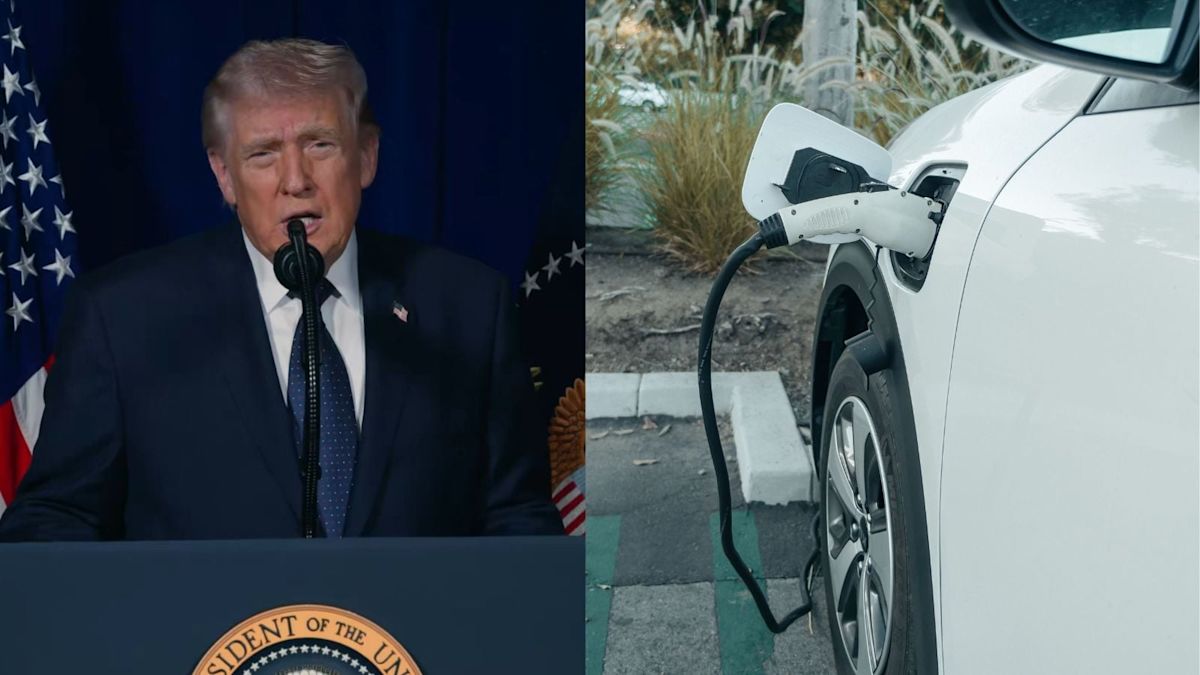
- Recent policy changes during Trump’s second term, including the elimination of the federal EV tax credit and halting funding for expanding the fast-charging network, have impacted the U.S. EV industry.
- Despite Trump’s claims that range anxiety is a thing of the past, EV sales growth in the U.S. has slowed, with battery-electric vehicles accounting for about 6% of the market in the second quarter.
Electric vehicles have their own set of advantages and disadvantages, making them a subject of debate among both supporters and critics. U.S. President Donald Trump has been one of the more outspoken voices on the issue and recently directed his criticism at EV owners themselves
His remarks come after several policy changes during his second term that affected the U.S. EV industry. The administration eliminated the $7,500 federal EV tax credit, relaxed EPA emissions regulations, and halted funding for expanding the nation’s fast-charging network
Recent industry data suggests EV sales growth in the U.S. has slowed, with battery-electric vehicles accounting for about 6% of the market in the second quarter. At the same time, hybrid vehicles have continued to gain popularity
Advertisement
One of the biggest concerns for EV owners remains range anxiety, driven in part by the limited availability of charging infrastructure. As a result, drivers often have to carefully plan longer trips to ensure they can reach the next charging station
The issue becomes even more pronounced in hilly terrain, where steep inclines can drain a battery more quickly. Referring to this concern, President Trump described the constant need to monitor an EV’s remaining charge as a “disease.”
Trump Calls Them “Crazy”
Speaking at the Red Rock Casino Resort in Las Vegas, Trump moved from discussing what he called attempts to ban gasoline-powered cars to reiterating his longstanding criticism of electric vehicles and calling people who worry about their battery charge despite having enough “crazy.” Electrek quoted him as saying:
“I ended the electric mandate. I don’t want to talk about it because Elon wasn’t exactly thrilled with me, but I had to do it. We love Elon
Advertisement
“I ended [it] because it said that within a very short period of time, like 2030, everybody had to have an electric car — even though there was no way you could charge it. You ever see the signs? You’re driving along [in] an electric car, they have a disease, you know, it’s a disease… they’re driving and they realize their battery’s getting low, and they start thinking about it when it’s 3/4 full
“Okay, it loses a little bit, so ‘where am I going to [go]?’ And you’re driving down the highway and you’ll see a sign — charging station, with an arrow, 89 miles to the right. These people are crazy.”
Trump also expanded his remarks beyond EVs, making sweeping claims about America‘s energy reand gas, including Venezuela,” and added that the country has “a thousand years of gasoline.”
Range Anxiety Is a Thing of the Past
Electrek claimed that “range anxiety is largely a thing of the past,” adding that Trump has been making similar claims for the past two years. The report explained that EVs can predict their range more accurately than they did a few years ago
Advertisement
The expansion of fast-charging infrastructure has also helped ease range anxiety. The report points to Europe, where EVs now account for more than 20% of the market. Norway, meanwhile, has moved close to an all-electric new-car market, while China has surpassed a 50% market share for EVs
The report suggests that the world is moving toward an EV future, while the U.S. risks being left behind. However, ground reality can often paint a different picture, and only EV owners themselves can say what they actually experience
If you drive an EV, do you experience range anxiety? Let us know in the comments
