


Common disinfectants may contain chemicals of concern.
When mice at Patricia Hunt’s lab at Washington State University began losing fetuses with devastating birth defects — facial deformities and missing hindquarters — or failed to reproduce at all, Hunt immediately put on her detective hat
She had seen a similar mystery before
Years earlier at her former lab in Ohio, chromosomes in mouse eggs and embryos began dividing in bizarre ways, creating the kinds of genetic errors that can lead to Down syndrome and other chromosomal disorders
Hunt and her team eventually traced the genetic changes to a new cleaning method eroding the polycarbonate cages that housed the animals. As the plastic decomposed, it exposed the mice to a chemical now known to mimic estrogen and disrupt the body’s hormones: bisphenol A, or BPA
Inadvertently, Hunt had become the first scientist to uncover how BPA might lead to chromosomal and reproductive issues in people, <a href="https://healthylife7.com/the-best-things-in-life-are-free-including-personal-finance-tips-abs/” title=”The best things in life are free, including personal finance tips | ABS”>including infertility, fetal abnormalities, low birth weight, and brain and behavior disordersin infants and children
Nearly a decade later, Hunt — who calls herself the “accidental toxicologist” — once again traced a reproductive crisis in her lab to an unexpected chemical exposure: quaternary ammonium compounds, or QACs
Classified as pesticides, QACs are the active ingredients in many popular hand sanitizers and disinfectants frequently used in homes, offices, daycare centers, schools, nursing homes and hospitals. The compounds are also found in baby wipes, air fresheners, laundry supplies, eye drops, nasal sprays and personal care products such as shampoos, mouthwash and toothpaste
Developed in 1916 and widely used by the 1940s, QACs — like bisphenols — were long assumed harmless when used as directed. Emerging research, however, is challenging that conclusion
“We now know QACs can be detected in human blood. There’s also a growing infertility problem, and based on studies in mice, I would expect that QACs are contributing,” said Hunt, a regents professor in the School of Molecular Biosciences at Washington State University in Pullman
“These QACs are fantastic because they kill everything, but that doesn’t make them safe for people to use.”
Lab and animal studies over the past decade have raised concerns about QACs’ effects on inflammation, the immune and respiratory systems, reproductive hormones, and the developing brain
The compounds exacerbate asthma and chronic lung disease, “especially in occupational settings, where they have been most studied,” said Amina Salamova, an assistant professor of environmental health at Emory University’s Rollins School of Public Health in Atlanta
Pilot studies have detected QACs in human blood serum, breast milk, urine and feces. Based on human cell and animal studies, QACs “may also accumulate in the heart, kidneys, digestive tract and lungs,” said Libin Xu, an associate professor of medicinal chemistry at the University of Washington School of Pharmacy in Seattle, who studies the compounds
The chemicals may also harm cells in the brain and spinal cord that create myelin, according to a 2024 study in human tissue. Myelin functions like rubber coating on an electrical wire, allowing neurons to communicate faster
“Without that protective myelin coating, nerve cells will degenerate and ultimately die. That leads to progressive neurodegeneration in conditions like multiple sclerosis,” said senior study author Paul Tesar, a professor of genetics and neurosciences at Case Western Reserve University in Cleveland
Mitochondria — the cell’s powerhouse — may also be impacted by QACs. Both human and animal studies found the chemicals damage the ability of mitochondria to make adenosine triphosphate, or ATP
“ATP is the chemical energy that all of your body runs on — it’s what makes your brain work and your muscles function when they contract,” said Gino Cortopassi, a professor of molecular biosciences at the University of California, Davis, who has studied mitochondria for over three decades
Despite growing alarm, researchers fear QACs are “flying under the radar” of public concern, said Rebecca Fuoco, director of science communications for the Green Science Policy Institute, a nonprofit in Berkeley, California, that investigates harmful chemicals
“Quaternary ammonium compounds are on track to be the next major toxic chemical story, combining elements of PFAS, phthalates and flame retardants,” Fuoco said. “We’re worried the public knows nothing about these dangers.”
A spokesperson for the American Cleaning Institute, or ACI, a nonprofit trade organization that represents industry, told CNN in an email that any claim QACs are the “next PFAS” is not supported by the available science and will be “more likely to alarm consumers than help them understand actual risk.”
“The fact that a substance can be detected in blood, breast milk, urine or other samples does not, by itself, prove an adverse health effect,” said Dan Selechnik, ACI’s director of environmental health
In addition, the relevance of cell and animal studies depends on the dose, route of exposure, duration and how closely the study conditions reflect real-world use, said Mike Gruber, interim CEO for the Household & Commercial Products Association
“The responsible approach is neither to dismiss emerging research nor to treat preliminary findings as settled science,” Gruber said in an email. “The EPA evaluates each product’s safety and effectiveness before registration and has the authority to require additional data, label changes, use restrictions, or other actions as scientific evidence evolves.”
Hunt’s findings could have been dismissed as a one-lab anomaly. Then, in 2008, she got a call from Terry Hrubec, a reproductive researcher in Virginia who was seeing alarming fetal deformities in her control mice — animals that don’t receive an experimental treatment
In Hrubec’s lab, the malformations took a different form — neural tube defects similar to spina bifida in humans, in which parts of the spinal column fail to close, or anencephaly, where the skull and brain never fully develop
“Many of the mice carried fetuses with partial brains, brain tissue growing out of the skull, or no brains at all. They also had openings in their spinal columns,” said Hrubec, a professor of anatomy and embryology at the Edward
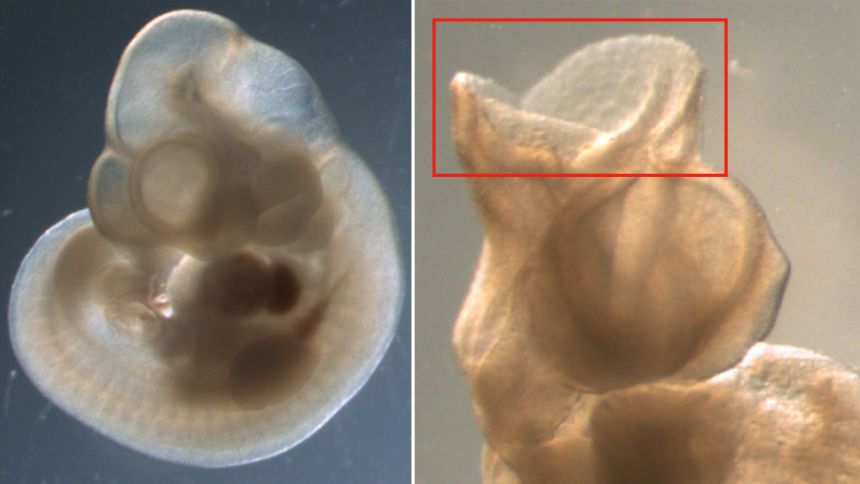
A normal mouse fetus (left) and a fetus with no brain (right) after exposure to QACs.
One in 33 babies in the United States are born with a birth defect, according to the US Centers for Disease Control and Prevention. Heart defects are the most common congenital malformations, followed by neural tube defects, which are typically carried to term
In Hrubec’s mice, however, fetuses with deformities of the brain and spine were dying early in the pregnancy and disappearing. In animals that have litters, such as rodents, dogs, cats, pigs and kangaroos, a dead fetus will be reabsorbed by the mother’s body to protect the rest of her offspring
“This is a key reason industry studies the EPA uses to determinesafety have not found these birth defects — the studies looked for deformities much later in the pregnancy, when the malformed fetus is no longer there,” she said
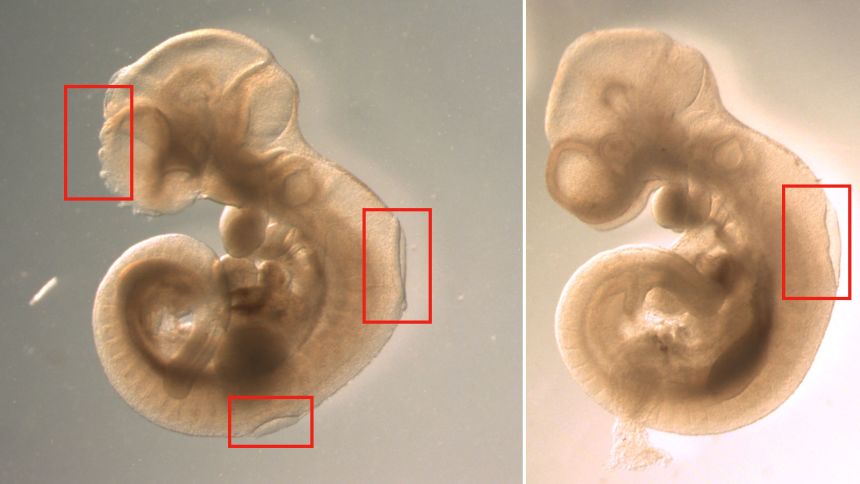
Two mice fetuses are seen side by side with open spinal columns after exposure to QACs. One fetus (left) also has a severe facial deformity.
Hunt and Hrubec began collaborating, dosing mice in their labs with QAC-laced food for six months. The findings, published in 2014, found a dramatic drop in a mouse’s ability to become pregnant and successfully carry a fetus to term
Female mice dosed with QACs lost interest in food, became lethargic and short of breath, and began to lose muscle control during late pregnancy. The study animals also experienced vaginal hemorrhages and difficult labor — more than one-third died close to giving birth
“In later studies, we found QACs directly target the placenta of the mice, which delivers oxygen and nutrients to the baby,” Hrubec said. “Levels of inflammation rose in the placenta and were highest in fetuses with the neural tube defects.”
Higher levels of pro-inflammatory proteins from anyerences in conditions such as attention deficit hyperactivity disorder, or ADHD, and autism
Quaternary ammonium compounds can also accumulate in the testicles, Hrubec said. In two of three studies, male mice exposed to QACs had lower sperm counts and less mobile sperm. Hrubec’s lab has not yet studied the cause, but there are clues: QACs may damage bodily functions that impact sperm production, maturation and motility
“As for what this means for people, that is always the big question when going from animal studies to humans,” Hrubec said. “Some of the concentrations we detected in people were as high as those used in the animal and cell culture studies, so we know the exposures are equivalent. Clearly the potential exists to affect fertility in people, it just is not yet known.”
Use of QACs soared during the Covid-19 pandemic as frightened masses sanitized themselves and nearly everything else in sight. One small study found levels of QAC in household dust rose 62% during the pandemic while levels in human blood rose 77% in just one year
Fear of Covid has declined, but consumer interest in deeply sanitizing homes, offices and schools has not diminished. Estimates put the global market for QACs in 2026 at $1.17 billion, more than a 21% increase since 2019. Today, the compounds remain the main ingredients in hundreds of products on the US Environmental Protection Agency’s list of disinfectants approved to combat SARS-CoV-2
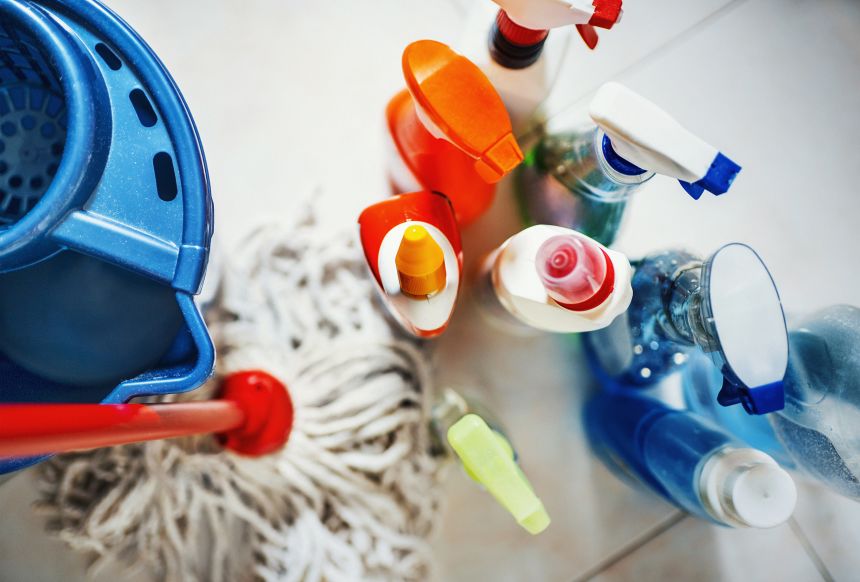
Nearly 50% of disinfectants and food surface sanitizers sold in the US contain QACs.
“Benzalkonium chloride, or BAC, also known as alkyl dimethyl benzyl ammonium chloride, or ADBAC, is the most widely used QAC,” Fuoco said. “It’s found in antibacterial hand soaps, disinfecting wipes and sprays, laundry sanitizers and more
“Didecyldimethylammonium chloride, or DDAC, is also widely used and often combined with BAC in the same disinfectant formulations.”
Risk rises when QACs are used frequently, such as in daycares, gyms, nursing homes, schools, hospitals, offices and industrial sites
Emory University’s Salamova, who studies indoor exposure, found levels of QACs in dust in daycare and assisted living care facilities to be about three times higher than in residential homes
“When my kids were young in the infant room at daycare, the caretakers would take the toys a baby was putting in their mouth, drop it into the QAC disinfectant, bring it back out, shake it off, and hand it to another infant,” Hrubec said
Caregivers likely aren’t aware of the potential harms of QACs and feel they are keeping the children safe, but it’s wasted effort, experts say. Unless that toy was cleaned before it was disinfected, the germs remain
“Using a disinfectant without first cleaning isn’t effective at all,” Hrubec said. “And what’s even more frustrating is that we don’t need to disinfect everything. Manufacturers advertise that these chemicals kill 99% of germs. But soap and water wash away 99% of germs — when you rinse, the bacteria and germs are gone.”
And that, experts say, is the troubling irony about QACs: People are increasingly exposed to potentially harmful chemicals at times when ordinary soap and water would be enough
“Our message is not to stop cleaning or disinfecting,” Salamova said. “Our message is to understand when you can just clean versus when you actually need to disinfect. If someone is sick with an infectious disease, that’s a time to disinfect. But you don’t need to disinfect each time you clean.”
A key way to avoid QACs is to check the labels of products marketed as “antibacterial,” “antimicrobial,” “disinfecting,” “sanitizing” or “germ-killing, Fuoco said: “Be wary of claims on product labels such as ‘odor control’ or ‘lasting protection’ or surfaces that ‘stay cleaner longer,’ which can also signal added antimicrobials.”
When a disinfectant is necessary, Hunt and other experts say products with citric acid, hydrogen peroxide and ethyl alcohol, such as alcohol wipes, are safer alternatives
For Hunt, however, the problem is greater than what sits under the kitchen sink. She believes QACs repeat the story of BPA: A chemical becomes trusted and embedded in daily life — and only later do scientists begin to uncover its true cost
“We have manufactured QACs and released them into commerce before we really understood how to monitor them in human bodies,” she said. “I just don’t think we should be coming in contact with these chemicals.”
Get inspired by a weekly roundup on living well, made simple. Sign up for CNN’s Life, But Better newsletter for information and tools designed to improve your well-being
See all topics
