


Abstract
Background
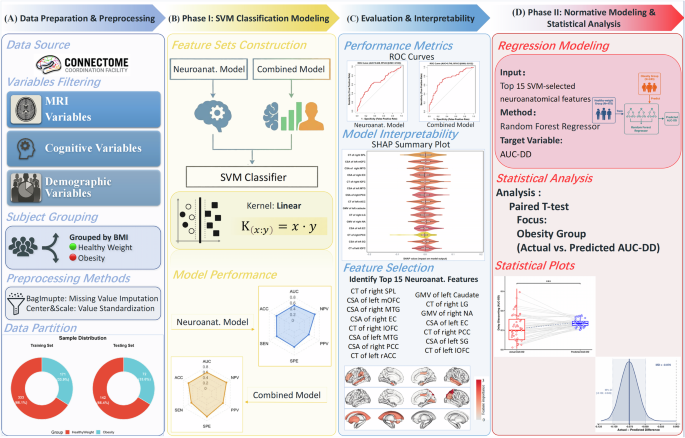
Prior obesity neuroimaging studies used univariate methods and small samples, limiting reproducibility. Employing a large-scale dataset and a two-stage machine learning framework, we identified neuroanatomical signatures of obesity and evaluated their population-level associations with delay discounting impulsivity
Methods
We enrolled 243 young adults with obesity and 475 healthy-weight controls from the Human Connectome Project S1200 dataset. Cortical surface area, cortical thickness, and subcortical gray matter volume were extracted using surface-based morphometry. Support vector machine (SVM) classifiers discriminated obesity from healthy weight based on neuroanatomical features, with interpretability assessed via SHapley Additive exPlanations (SHAP). Partial correlations evaluated associations between the 15 SVM-selected features and the area under the curve (AUC) of delay discounting (DD) in the full sample. Normative modeling examined if the obesity group deviated from brain-structure-based expectations of AUC-DD.
Results
The neuroanatomical-only SVM achieved a receiver operating characteristic (ROC-AUC) of 0.648; adding demographic and cognitive covariates improved it to 0.740. SHAP highlighted the superior parietal, entorhinal, medial orbitofrontal, posterior cingulate, and rostral anterior cingulate cortices. Ten of the top 15 features were significantly associated with AUC-DD, and all in the expected direction. The obesity group showed systematically higher DD impulsivity than predicted impulsivity by brain structures alone.
Conclusions
Distributed neuroanatomical features in prefrontal, medial temporal, cingulate, and parietal cortices discriminated obesity and showed convergent population-level associations with delay discounting impulsivity across group, correlational, and normative analyses
This is a preview of subscription content, access
Access options
Access through your institution
- Purchase on SpringerLink
- Instant access to the full article PDF.
39,95 €
Prices may be subject to local taxes which are calculated during checkout
Data availability
All data were provided by the Human Connectome Project, WU-Minn Consortium (Principal Investigators: David Van Essen and Kamil Ugurbil; 1U54MH091657) funded by the 16 NIH Institutes and Centers that support the NIH Blueprint for Neuroscience Research; and by the McDonnell Center for Systems Neuroscience at Washington University in St. Louis. The authors are grateful to the Human Connectome Project for open access to its data. The HCP S1200 data are publicly available at https://www.humanconnectome.org/. Analysis code is available at https://github.com/HuiXu-Eric/Identification-of-critical-brain-rigions-for-HCP-s1200.
References
Byrd-Bredbenner C, Quick V, Koenings M, Martin-Biggers J, Kattelmann KK. Relationships of cognitive load on eating and weight-related behaviors of young adults. Eat Behav. 2016;21:89–94
Phelps NH, Singleton RK, Zhou B, Heap RA, Mishra A, Bennett JE, et al. Worldwide trends in underweight and obesity from 1990 to 2022: a pooled analysis of 3663 population-representative studies with 222 million children, adolescents, and adults. Lancet. 2024;403:1027–50
Riva G. Out of my real body: cognitive neuroscience meets eating disorders. Front Hum Neurosci. 2014;8:236
Simmons WK, DeVille DC. Interoceptive contributions to healthy eating and obesity. Curr Opin Psychol. 2017;17:106–12
Pannacciulli N, Del Parigi A, Chen K, Le DSNT, Reiman EM, Tataranni PA. Brain abnormalities in human obesity: a voxel-based morphometric study. NeuroImage. 2006;31:1419–25
Raji CA, Ho AJ, Parikshak NN, Becker JT, Lopez OL, Kuller LH, et al. Brain structure and obesity. Hum Brain Mapp. 2010;31:353–64
Weise CM, Bachmann T, Pleger B. Brain structural differences in monozygotic twins discordant for body mass index. Neuroimage. 2019;201:116006
Stoeckel LE, Weller RE, Cook EW 3rd, Twieg DB, Knowlton RC, et al. Widespread reward-system activation in obese women in response to pictures of high-calorie foods. Neuroimage. 2008;41:636–47
Volkow ND, Wang GJ, Telang F, Fowler JS, Thanos PK, Logan J, et al. Low dopamine striatal D2 receptors are associated with prefrontal metabolism in obese subjects: possible contributing factors. Neuroimage. 2008;42:1537–43
Stice E, Spoor S, Bohon C, Veldhuizen MG, Small DM. Relation of reward from food intake and anticipated food intake to obesity: a functional magnetic resonance imaging study. J Abnorm Psychol. 2008;117:924–35
Burger K, Stice E. Relation of dietary restraint scores to activation of reward-related brain regions in response to food intake, anticipated intake, and food pictures. Neuroimage. 2011;55:233–9
Xu H, Owens MM, MacKillop J. Neuroanatomical profile of BMI implicates impulsive delay discounting and general cognitive ability. Obesity. 2023;31:2799–808
Genc A, Arican E. Obesity classification: a comparative study of machine learning models excluding weight and height data. Rev Da Assoc Med Bras. 2025;71:e20241282
Gutiérrez-Gallego A, Zamorano-León J, Parra-Rodríguez D, Zekri-Nechar K, Velasco J, Garnica O, et al. Combination of machine learning techniques to predict overweight/obesity in adults. J Personalized Med. 2024;14:816
Allen B. An interpretable machine learning model of cross-sectional US county-level obesity prevalence using explainable artificial intelligence. Plos One. 2023;18:e0292341
García-García I, Michaud A, Dadar M, Zeighami Y, Neseliler S, Collins DL, et al. Neuroanatomical differences in obesity: meta-analytic findings and their validation in an independent dataset. Int J Obes (Lond). 2019;43:943–51
Van Essen DC, Ugurbil K, Auerbach E, Barch D, Behrens TEJ, Bucholz R, et al. The Human Connectome Project: a data acquisition perspective. NeuroImage. 2012;62:2222–31
Van Essen DC, Smith SM, Barch DM, Behrens TEJ, Yacoub E, Ugurbil K. The WU-minn human connectome project: an overview. NeuroImage. 2013;80:62–79
Xu S, Lv K, Sun Y, Chen T, He J, Xu J, et al. Altered structural node of default mode network mediated general cognitive ability in young adults with obesity. Prog Neuro-Psychopharmacol Biol Psychiatry. 2024;135:111132
He J, Xu G, Zhao J, Wang Y, Lou C, Wu S, et al. Sex-related difference of subcortical gray matter volume associated with crystallized intelligence in young adults with obesity. Biol Sex Differ. 2026;17:62
Fischl B, Dale AM. Measuring the thickness of the human cerebral cortex from magnetic resonance images. Proc Natl Acad Sci. 2000;97:11050–5
Zhang H, Bi Y, Hou X, Lu X, Tu Y, Hu L. The role of negative emotions in sex differences in pain sensitivity. NeuroImage. 2021;245:118685
Desikan RS, Ségonne F, Fischl B, Quinn BT, Dickerson BC, Blacker D, et al. An automated labeling system for subdividing the human cerebral cortex on MRI scans into gyral based regions of interest. NeuroImage. 2006;31:968–80
Xu H, Xu C, Xu J. Altered gray matter structural covariance networks in young adults with obesity. Int J Obes. 2025;49:801–8
A unified approach to interpreting model predictions. Neural Information Processing Systems, 2017
Odum AL. Delay discounting: I’M A K, YOU’RE A K. J Exp Anal Behav. 2011;96:427–39
Amlung M, Petker T, Jackson J, Balodis I, MacKillop J. Steep discounting of delayed monetary and food rewards in obesity: a meta-analysis. Psychol Med. 2016;46:2423–34
Peters J, Büchel C. The neural mechanisms of inter-temporal decision-making: understanding variability. Trends Cogn Sci. 2011;15:227–39
Wesley MJ, Bickel WK. Remember the future II: Meta-analyses and functional overlap of working memory and delay discounting. Biol Psychiatry. 2014;75:435–48
Volkow ND, Wang GJ, Tomasi D, Baler RD. Obesity and addiction: neurobiological overlaps. Obes Rev. 2013;14:2–18
Brooks SJ, Cedernaes J, Schiöth HB. Increased prefrontal and parahippocampal activation with reduced dorsolateral prefrontal and insular cortex activation to food images in obesity: a meta-analysis of fMRI studies. PLOS ONE. 2013;8:e60393
Vainik U, Baker TE, Dadar M, Zeighami Y, Michaud A, Zhang Y, et al. Neurobehavioral correlates of obesity are largely heritable. Proc Natl Acad Sci USA. 2018;115:9312–7
Garzón B, Kurth-Nelson Z, Bäckman L, Nyberg L, Guitart-Masip M. Investigating associations of delay discounting with brain structure, working memory, and episodic memory. Cereb Cortex. 2023;33:1669–78
Owens MM, Gray JC, Amlung MT, Oshri A, Sweet LH, MacKillop J. Neuroanatomical foundations of delayed reward discounting decision making. Neuroimage. 2017;161:261–70
Chen L, Zhao S, Wang Y, Niu X, Zhang B, Li X., et al. Genetic insights into obesity and brain: combine Mendelian randomization study and gene expression analysis. Brain Sci. 2023;13:892
Blanke O. Multisensory brain mechanisms of bodily self-consciousness. Nat Rev Neurosci. 2012;13:556–71
Yang H, Wang S, Li H, Gu S, Zhang F, Wang H, et al. Mapping gray matter changes in anorexia nervosa: a functional connectivity network approach. Front Nutr. 2025;12:1667729
Feusner JD, Townsend J, Bystritsky A, Bookheimer S. Visual information processing of faces in body dysmorphic disorder. Arch Gen Psychiatry. 2007;64:1417–25
Acknowledgements
We thank the Human Connectome Project for sharing this dataset for this study
Funding
This study was funded by Philosophy and Social Sciences Foundation of Zhejiang Province (26NDJC115YB), and Basic Research Fund Grant Projects of Wenzhou Medical University (KYYW202541)
Author information
Author notes
These authors contributed equally: Guanjinghui Xu, Junhao He, Junjie Zhao
Authors and Affiliations
School of Mental Health, Wenzhou Medical University, Wenzhou, China
Guanjinghui Xu, Junhao He, Junjie Zhao & Yang Wang
The Affiliated Kangning Hospital of Wenzhou Medical University, Zhejiang Provincial Clinical Research Center for Mental Health, Wenzhou, China
Hui Xu
Huzhou Third Municipal Hospital, the Affiliated Hospital of Wenzhou Medical University, Huzhou, China
Hui Xu
Authors
- Guanjinghui XuView author publications
Search author on:PubMed Google Scholar
- Junhao HeView author publications
Search author on:PubMed Google Scholar
- Junjie ZhaoView author publications
Search author on:PubMed Google Scholar
- Yang WangView author publications
Search author on:PubMed Google Scholar
- Hui XuView author publications
Search author on:PubMed Google Scholar
Contributions
GX: Conceptualization, Methodology, Data curation, Writing—reviewing and editing; JH: Conceptualization, Methodology, Data curation, Writing—original draft; JZ: Conceptualization, Methodology, Data curation, Writing—original draft; YW: Methodology, Writing—original draft; HX: Conceptualization, Methodology, Data curation, Formal analysis, Software, Visualization, Investigation, Supervision, Funding, Writing—original draft, Writing—reviewing and editing
Ethics declarations
Competing interests
The authors declare no competing interests
Ethical approval
This study was a secondary analysis of de-identified, publicly available data from the Human Connectome Project (HCP) S1200 release. Ethical approval for the original HCP data collection was obtained by the HCP consortium from the Institutional Review Board at Washington University in St. Louis (IRB #201204036). Ethical approval for this secondary analysis was obtained from the Institutional Review Board of Wenzhou Medical University
Informed consent
All participants provided written informed consent as part of the original HCP protocol approved by the Washington University IRB. No additional consent procedures were conducted for this secondary analysis. Ethics approval and consent to participate. This study was approved and consented by the Ethics Committee of Wenzhou Medical University in accordance with the Declaration of Helsinki (approval number: 2026100)
Additional information
Publisher’s note Springer Nature remains neutral with regard to jurisdictional claims in published maps and institutional affiliations
Supplementary information
SupplementalMaterials (download DOCX )
Rights and permissions
Springer Nature or its licensor (e.g. a society or other partner) holds exclusive rights to this article under a publishing agreement with the author(s) or other rightsholder(s); author self-archiving of the accepted manuscript version of this article is solely governed by the terms of such publishing agreement and applicable law
About this article
Cite this article
Xu, G., He, J., Zhao, J. et al. Identification of critical brain regions for young adults with obesity and their relationships with impulsivity using machine learning based on neuroanatomical features.
Int J Obes (2026). https://doi.org/10.1038/s41366-026-02184-2
Received:09 March 2026
Revised:22 July 2026
Accepted:31 July 2026
Published:11 August 2026
Version of record:11 August 2026
DOI
:https://doi.org/10.1038/s41366-026-02184-2
