


Fact-checking Trump’s claims as he rolls back some recommended vaccines
6 hours ago

Getty Images
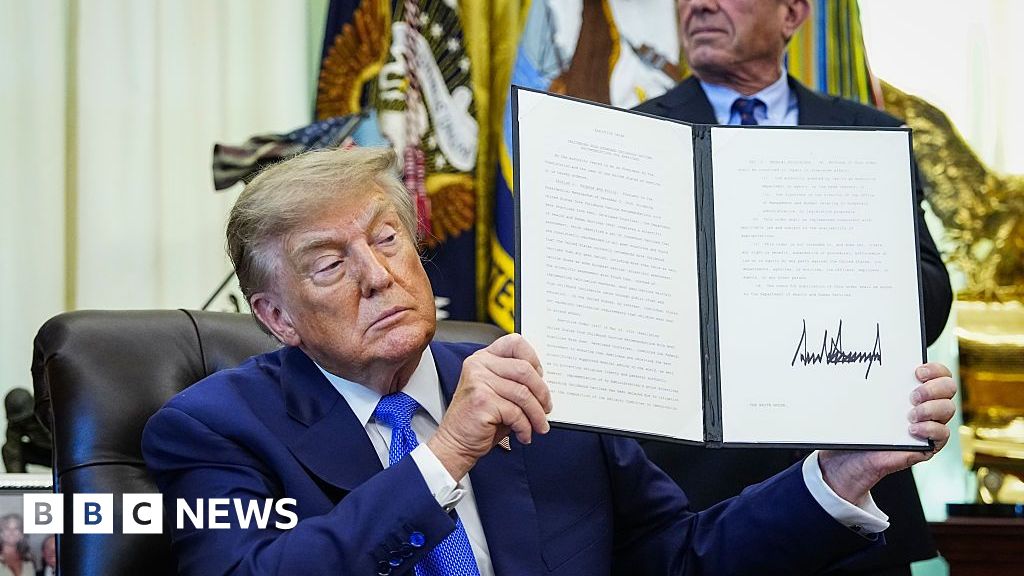
US President Donald Trump signed an executive order in the Oval Office on Monday that limits the number of vaccines recommended for children – and during the event he made several misleading or false claims about the jabs
The US Centers for Disease Control and Prevention (CDC) had recommended childhood vaccinations against 18 diseases – but Trump’s new order drops that to 11. It also advises splitting up the mumps, measles and rubella (MMR) shots
We’ve looked into some of the president’s claims about vaccinations
Do ‘little children’ in the US get 72 jabs?
“In many cases we were requiring 72 jabs for our beautiful, healthy, lovely, delicate little children,” Trump said shortly before signing the order
After his announcement, White House press secretary Karoline Leavitt shared a graphic, labelled “72 injections”, showing a baby surrounded by needles
But both of those statements are misleading
Firstly, while federal guidance influences school-entry vaccine requirements, these rules are set at individual state level, so the exact number of jabs scheduled varies across the US
And secondly, the 72 figure cited by the White House counts all the doses someone could potentially be given by the time they are 18 years old – so not as a baby or “little children”
This total also includes annual flu and Covid-19 doses
How big are vaccine doses?
“A vaccination looks like the size of the bottle of soda poured into a little child’s body,” Trump claimed, when talking about MMR shots
However, according to Food and Drug Administration (FDA), a single dose of MMR is 0.5ml – roughly a fraction of a teaspoon
Josh Michaud, associate director with Kaiser Family Foundation’s (KFF) Global and Public Health Policy Program, said that even all of the recommended vaccinations combined “don’t add up to anything close to the size of a bottle of soda” and come to “a very, very much smaller amount” than what Trump claimed
Is the MMR vaccine possibly ‘quite lethal’?
When advocating for giving the MMR vaccine in three separate jabs, Trump said: “Together, there could be a possibility they’re quite lethal.”
According to the CDC, most people who receive MMR vaccine do not have any serious adverse reactions to it
The CDC also notes that receiving the MMR vaccine is much safer than contracting the measles, mumps, or rubella illnesses, which the vaccine is designed to guard against
The most severe risks of the vaccine include febrile seizure or a serious allergic reaction, which the CDC describes as “extremely rare”
Studies show that one out of every 3,000-4,000 children vaccinated with MMR run the risk of febrile seizures
Is there any evidence vaccines are linked to autism?
When speaking about autism the president said: “It’s many, many times what it used to be years ago, and it gets progressively worse. And we had progressively more and more vaccines.”
He said it was “one in 10,000 20 years ago”
While that rate has increased over the last two decades, it did not grow by anything like the figure cited by Trump
In 2006 the CDC estimated the rate of autism in the US population to be one in 110. In 2008 it was one in 88
Most experts say rising rates of autism can primarily be attributed to changes in how the condition is diagnosed, as well as greater recognition of the condition and more people being tested
And although rates of autism have been rising, multiple studies have shown no link to vaccines
This includes a comprehensive December 2025 study by the World Health Organization that analysed data involving dozens of studies and millions of children across multiple countries, finding “no causal link between vaccination and [autism]”
Experts say there is a tendency to wrongly associate vaccines with autism, because the period of childhood vaccinations – between birth and five years old – overlaps with the more common period for autism diagnoses. But they say it’s correlation not causation
In its report, the WHO said studies highlighting theoretical risks that remain incompletely understood have “sustained public controversy, particularly in the context of widespread misinformation, disinformation and vaccine hesitancy”
Vaccination
Donald Trump
United States
