


Download PDF
Abstract
As global aging accelerates, improving older adults’ health satisfaction is a key policy and public health concern. While tourism has been associated with well-being, the pathways through which it is associated with health satisfaction remain unclear. It is not well understood whether social, environmental, and digital factors affect health satisfaction independently or interactively in the context of tourism participation. This study addresses this gap by examining the key determinants of health satisfaction among older adults engaging in tourism and assessing the independent and interactive effects of social relationships, environmental quality, and digital participation. This study uses data from 13,346 respondents in the China Health and Retirement Longitudinal Study (CHARLS). A data-driven approach combining machine learning and regression analysis was applied to identify key predictors of health satisfaction and examine their interaction effects in the context of tourism participation. The results show that health satisfaction among older adults is primarily associated with self-reported health, while social, environmental, and digital factors are also related to health satisfaction through interaction effects. In particular, social support, particularly marital relationships, is more strongly associated with health satisfaction among individuals with poorer health, whereas environmental factors including air quality and digital engagement are associated with variations in health satisfaction in a context-dependent manner. These findings suggest that health satisfaction is not explained by single factors, but is associated with the combined presence of tourism participation and multiple interacting conditions. The results indicate that health satisfaction in older adults engaging in tourism is shaped by multiple interacting factors rather than a single linear effect. Social relationships, environmental quality, and digital participation emerge as key determinants, each influencing well-being through distinct pathways. These findings highlight the complex and context-dependent nature of health satisfaction and highlight the importance of personalized interventions and policy strategies to enhance older adults’ well-being through tourism-based social and environmental engagement.
Subjects
- Quality of life
- Psychology and behaviour
Introduction
As global aging accelerates, ensuring health satisfaction among older adults has become a key public health priority1,2. While health status is often measured through objective physiological indicators such as disease prevalence and physical function3, health satisfaction represents an individual’s subjective perception of their well-being4. Research suggests that health satisfaction plays a crucial role in shaping quality of life, influencing emotional resilience, social engagement, and health-related behaviors5,6,7. Even among individuals with similar health conditions, those with higher health satisfaction tend to exhibit better psychological well-being and greater participation in social and physical activities8,9. Within this context, tourism participation has gained increasing attention as a health-promoting activity among older adults. Tourism provides opportunities for social interaction, mental stimulation, and environmental engagement, and has been widely associated with enhanced well-being in later life10. However, despite growing recognition of its benefits, the pathways through which tourism participation is associated with health satisfaction remain insufficiently understood11.
Grounded in prior research, social capital has been widely recognized as an important determinant of health in older age. Social capital, as introduced by Bourdieu12, refers to the networks, trust, and social structures that facilitate collective action and individual well-being. Later, Coleman13 and Putnam14 expanded its application to broader social and public health contexts. In aging research, social capital has been linked to health behaviors, access to healthcare resources, and subjective well-being, highlighting the importance of social structures and relationships in later life15. Building on these perspectives, Nahapiet and Ghoshal16 proposed a complementary classification of social capital into structural, relational, and cognitive dimensions. This framework has informed the development of Health-related Social Capital (HRSC), which emphasizes the role of social networks and resources in shaping health outcomes among older adults15. In the present study, this classification provides the conceptual basis for examining how structural, relational, and cognitive factors are associated with health satisfaction in later life.
In addition to tourism participation and social capital, environmental and digital factors have also been recognized as important influences on health and well-being in older age. Existing research has examined determinants including social influence17, internet use18, and broader contextual influences on well-being and quality of life19,20. These studies suggest that health satisfaction in later life is shaped not only by individual health conditions, but also by the surrounding social and environmental context. In particular, perceived environmental quality is related to older adults’ subjective health perception, while digital engagement is associated with access to information, communication, and participation in everyday life20. However, these factors have often been examined separately, and limited attention has been paid to how environmental and digital conditions are jointly related to health satisfaction within the context of tourism participation. Although previous studies have examined tourism and health in older age, as well as social, environmental, and digital influences on well-being, these factors have largely been studied in isolation. Limited attention has been paid to how tourism participation interacts with these factors in shaping health satisfaction among older adults. As a result, their combined and context-dependent nature remains insufficiently understood.
Aligning with the identified research gap, this study aims to examine the interactive effects of key factors on health satisfaction in the context of older adults’ tourism, with a particular focus on the pathways linking tourism participation and health satisfaction. Grounded in Social Capital Theory, this study considers how social structures, relationships, and resources are associated with health outcomes. A data-driven analytical approach is applied to identify key predictors and explore their interaction pathways. This study advances the literature by addressing the interaction-based nature of health satisfaction in later-life tourism. By integrating social, environmental, and digital factors within a unified framework, it provides an understanding of how multiple dimensions jointly relate to health satisfaction. In particular, the study extends the application of Social Capital Theory by highlighting the roles of relational and cognitive dimensions in a context-dependent manner. From a practical perspective, the findings offer insights for public health and tourism policy by emphasizing the importance of combining social support, environmental quality, and digital engagement in promoting well-being among older adults. These results support the development of integrated, age-friendly strategies aimed at enhancing health satisfaction in aging populations.
Methodology
Sample collection and screening
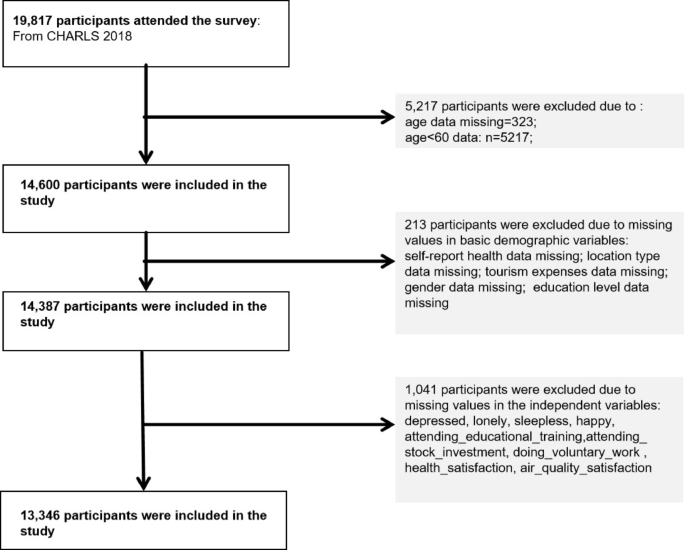
This study draws on data from the 2018 wave of the China Health and Retirement Longitudinal Study (CHARLS). This widely utilized database in China supports research on the health of middle-aged and older populations, offering high-quality microdata from 7,040 households across 28 provinces, autonomous regions, and 150 county-level units. It represents individuals aged 45 and above from 449 village or community units21. A total of 19,817 respondents participated in this survey wave. As shown in Fig. 1, 5217 individuals were excluded due to missing values in key variables. The final dataset includes 13,346 respondents and serves as the basis for the machine learning analysis conducted in this study. Older adults are defined as individuals aged 60 years and older21, and in this study specifically refer to respondents aged 60 and above in the CHARLS dataset. The CHARLS project was approved by the Institutional Review Board of Peking University (IRB00001052-11015), and all participants provided informed consent prior to data collection.
Flowchart of the enrollment of CHARLS participants
Measurement of variables
Target variable
In this study, health satisfaction is defined as individuals’ subjective evaluation of how satisfied they are with their overall health22. It represents an evaluative judgment that integrates both physical and psychological aspects of health23. In aging studies, health satisfaction has been shown to capture how older adults perceive their health in relation to expectations and life circumstances, thereby providing important insights into quality of life24. Health satisfaction was selected as the target variable because it directly aligns with the focus of this study on older adults’ well-being. As an evaluative indicator, it is particularly relevant for understanding the role of social, environmental, and economic determinants of health. Thus, health satisfaction functions as a domain-specific yet integral component of overall well-being, making it a suitable outcome variable for the present analysis. In CHARLS, health satisfaction is measured through a single item: “How satisfied are you with your health?”, with responses coded on a 5-point Likert scale ranging from 1 (very dissatisfied) to 5 (very satisfied). This operationalization follows standard practice in large-scale surveys, where single-item global satisfaction measures are widely used25.
Predictor features
In this study, we adopt the three dimensions of social capital—structural, relational, and cognitive—as conceptualized by Nahapiet and Ghoshal12. Structural social capital refers to social participation and community engagement, which supports psychological well-being26. We classify tourism participation, social interactions with friends, attending social clubs, community activities, and air quality satisfaction as key structural social capital components. In CHARLS, tourism participation is measured based on whether respondents reported tourism-related expenditure within the past year. However, information about travel destination (domestic or international), activity type, or frequency is not available, which may limit the granularity of the analysis. In this study, tourism participation is operationalized as a situational experience rather than a sample selection criterion; therefore, the analytic sample includes both older adults who reported tourism-related expenditure and those who did not.
Additionally, air quality satisfaction is measured using a CHARLS item on respondents’ subjective evaluation of air quality in their residential environment. In this study, it is included as a perception-based environmental factor rather than a destination-specific tourism variable. From a HRSC perspective, structural social capital primarily reflects observable forms of social participation and social connection27. Among older adults, these participation opportunities are also shaped by contextual conditions, including neighborhood and environmental supports, that facilitate or constrain social interaction and engagement28. In this sense, air quality satisfaction reflects a place-based environmental condition that may influence older adults’ willingness and ability to participate in outdoor activities, maintain social interactions, and engage in community life. This classification is also supported by tourism research, which suggests that environmental quality is closely associated with participation in leisure and tourism-related activities, especially among older adults whose mobility, comfort, and health perceptions are more sensitive to surrounding conditions29. A supportive environmental context may promote both community engagement and tourism participation, whereas poor perceived air quality may constrain these opportunities30. Therefore, air quality satisfaction is conceptualized in this study as a contextual structural resource that shapes access to social participation opportunities in both daily and tourism-related settings.
Relational Social Capital focuses on personal relationships and social support networks, particularly within families31. Accordingly, we select marital satisfaction, children satisfaction, voluntary work, providing help to others, and caregiving for disabled adults as representative variables. Children satisfaction refers to older adults’ satisfaction with the quality of their relationship with their children, rather than pride in their achievements or economic support. While providing help to others reflects general prosocial engagement in daily life, caring for disabled adults involves more sustained and emotionally involved social support behaviors toward individuals in need, not necessarily limited to family members. Together, these variables capture the breadth and depth of older adults’ social connectedness and supportive relationships.
Cognitive Social Capital refers to shared meanings and knowledge resources that enable individuals to act collectively12. In the context of health and aging, this dimension encompasses lifelong learning, decision-making, and intellectual engagement32. In line with these recommendations, the cognitive social capital dimension in this study is represented by two items: attending educational training and using the Internet. In CHARLS, attending educational training is measured by the item “Attending an educational or training course (e.g., health education, skills training, or other learning activities),” which asks respondents whether they have participated in such programs during the past month. The questionnaire does not specify whether these activities were online or in person; however, given the 2018 wave context, they were predominantly conducted in person. And, internet use is measured as a binary variable (1 = yes, 0 = no). Respondents are also asked to indicate the purposes of their online activities, such as chatting via WeChat/QQ, reading news, watching videos, playing games, or attending online courses. Therefore, in this study, ‘using the Internet’ is treated as a proxy for digital engagement, reflecting older adults’ participation in knowledge-related activities. In psychometric research, constructs are often represented by three or more indicators to ensure construct validity33. However, previous methodological work has also shown that single-item or two-item measures can be valid and reliable proxies under certain conditions, particularly when secondary data restrict the number of available indicators34.
Beyond these three dimensions, health outcomes and economic moderators are essential for assessing the broader impact of social capital on well-being. For health outcomes, we examine self-reported health status, health satisfaction, depression, sleep disturbances, and loneliness. Additionally, we consider pension benefits, income and attending stock investment as economic moderators, as financial stability influences access to social capital and healthcare re
All variables in this study are derived from previously screened data. Key variables include social capital, health outcomes, and economic factors, as shown in Table 1. These variables are adapted from previous studies15,26,31,32 to ensure consistency in measurement and comparability with existing research. Social capital variables reflect individuals’ participation in social activities, interpersonal relationships, and cognitive engagement. These include binary variables, such as participation in tourism, volunteering, and attending community activities. Additionally, Likert-scale variables, including satisfaction with marriage, children, and air quality, measured on a 5-point scale from 1 (very dissatisfied) to 5 (very satisfied). Health outcomes are assessed through self-reported health status, emotional well-being indicators (including depression, loneliness, and happiness), and sleep quality, all measured using a 5-point Likert scale. Economic factors, including pension status and income stability, are measured as binary variables (1 = receiving a pension/stable income, 0 = not receiving a pension/stable income). While tourism participation is included as a contextual variable representing a form of social engagement, the primary focus of this study is to explore the interactions among social, environmental, and digital factors in shaping health satisfaction. This classification allows for a broader understanding of how various determinants collectively influence well-being rather than isolating individual effects.
Descriptive and preliminary analysis
To provide an overview of the sample characteristics, descriptive statistics (e.g., means, standard deviations, and frequency distributions) were computed using Stata 18.0. Additionally, chi-square tests were conducted to examine statistically significant differences in health satisfaction across sociodemographic subgroups. For clarity, health satisfaction was categorized into three levels (“Very satisfied,” “Somewhat satisfied,” and “Not satisfied”) to better illustrate demographic distributions. However, the original five-category classification is retained in the machine learning analysis to ensure finer granularity.
Machine learning analysis
To examine the factors influencing health satisfaction, this study employed a combination of Random Forest Classifier, Generalized Linear Model (GLM) and Decision Tree Regression. All machine learning analyses were conducted using Python (Scikit-Learn and Statsmodels) in Google Colab, running Python 3.11. The dataset was first loaded and preprocessed using pandas, with only relevant variables retained based on the measurement framework outlined in Section Measurement of variables Measurement of Variables. To ensure reproducibility, a fixed random seed35 was applied throughout the process. The final dataset was split into training (70%) and testing (30%) subsets, ensuring a balanced evaluation of model performance. Additionally, k-fold cross-validation was applied during training to enhance model robustness and mitigate potential over-fitting36.
Random forest
First, the Random Forest Classifier was employed to assess the relative importance of predictor variables in explaining health satisfaction. The model was optimized using 300 decision trees (n_estimators = 300), with a maximum tree depth of 10 (max_depth = 10) to balance predictive performance and prevent overfitting. The Gini impurity criterion (criterion = ‘gini’) was applied for node splitting, ensuring optimal classification accuracy. To enhance reproducibility, a fixed random seed (random_state = 42) was used37. Key predictor variables identified through feature importance scores were subsequently analyzed using Generalized Linear Models (GLM) and Decision Trees for further interpretability.
Generalized linear model (GLM)
To examine the statistical significance of key predictor variables, a Generalized Linear Model (GLM) was applied. The model was specified with a Gaussian family distribution and an identity link function, estimated. Variables that were both highly important in the RF model and statistically significant (p < 0.05) in the GLM were retained, resulting in a final selection of key variables for further analysis
Decision tree
To investigate the role of tourism, interaction terms were created between tourism and the six most significant variables identified through Random Forest and GLM. To maintain tourism as the central analytical focus, these tourism-related interaction terms were used as the primary explanatory variables in the decision tree model, while age group and income were additionally included as control variables. All candidate interaction terms were entered into the model simultaneously, and the decision tree algorithm automatically selected the most informative variables and split thresholds at each node based on their contribution to reducing prediction error. The model was then used to identify the hierarchical partitioning of health satisfaction associated with these tourism-related interaction effects.
Stratified analysis by residential area
To examine potential heterogeneity in the relationship between tourism-related interaction effects and health satisfaction, stratified analyses were conducted based on residential area (urban vs. rural). The same model specification as the main GLM analysis was applied to each subsample to ensure comparability. Specifically, interaction terms between tourism participation and key predictors (health status, air quality satisfaction, marriage satisfaction, children satisfaction, internet use, and depression) were included as explanatory variables. This approach allows for the identification of context-specific differences in how tourism interacts with individual and environmental factors to influence health satisfaction.
Code availability information is provided in the Code availability section
Results
Descriptive statistics
Table 2 presents the descriptive statistics for the demographic characteristics of the final sample (n = 13,346), focusing on factors influencing health satisfaction among older adults. Health satisfaction is categorized into three levels: “very satisfied” (26.25%), “somewhat satisfied” (72.41%), and “not satisfied” (27.59%). The distribution of health satisfaction varies significantly across educational level, sex, residential location, and self-reported health status (all p < 0.05). These results suggest that sociodemographic factors may shape older adults’ health perceptions during travel, which could, in turn, influence their overall well-being and travel experiences.
Although detailed travel information is unavailable in CHARLS, the demographic characteristics in Table 2 indicate contextual differences in travel opportunity and environment among older adults. It should be noted that residential location categories in Table 2 are based on valid classifications only, as a small number of respondents (n = 80) were categorized as “other” or not classified in the CHARLS dataset. These factors were further considered in the interaction analyses to examine how tourism participation interacts with socioeconomic, relational, and environmental conditions affecting health satisfaction.
Machine learning results
Random forest results
Analysis of the feature importance
To investigate the key factors influencing health satisfaction among older adult travelers, we employed a Random Forest model, a widely used ensemble learning method for feature selection and predictive modeling. The model achieved an R² of 0.62, indicating a moderate predictive capability38, and provided insights into the relative importance of different predictors. The variable attending stock investment showed minimal importance (0.0011) in the Random Forest model and was therefore excluded from subsequent analyses. Its removal does not affect the model’s performance or the interpretation of results.
Analysis of feature importance, as shown in Fig. 2, follows the Social Capital Theory framework, identifying the top two predictors in each category. In Structural Social Capital, air quality satisfaction (0.1106) ranked highest, followed by interacting with friends (0.0192). In Relational Social Capital, marriage satisfaction (0.1060) and children satisfaction (0.0772) were the most influential. Cognitive Social Capital had the lowest importance, with attending educational training (0.0015). Among Health Outcomes, self-reported health status (0.4489) had the highest importance, followed by depression (0.0318). In Economic Moderators, pension (0.0174) and income (0.0131) showed relatively lower importance.
Generalized linear model (GLM) results
The GLM model demonstrated strong explanatory power, with a Pseudo R² of 0.5462, indicating that approximately 54.62% of the variance in health satisfaction can be explained by the included predictors. The log-likelihood value (−9426.3) further supports the model’s robustness and adequacy. To ensure a comprehensive and accurate analysis, all variables were included in the model, rather than selecting only those with high feature importance in the Random Forest model. As shown in Table 3, several predictors exhibited statistically significant associations with health satisfaction.
The GLM results indicate that the following variables significantly influenced health satisfaction (p < 0.05): Self-reported health status, Air quality satisfaction, Marriage satisfaction, Children satisfaction, Age group, Tourism, Using the internet, Happiness, Depression, Sleeplessness, Loneliness, and Income. Based on Random Forest importance and GLM significance, the top-ranked significant variables were selected for decision tree analysis. In Relational Health-related Social Capital, marriage satisfaction (0.1060) and children satisfaction (0.0772) were the most influential, ranking high in importance and showing statistical significance, making them key variables for further analysis. In Cognitive Health-related Social Capital, no variables were significant in GLM, so this category was excluded. For Structural Health-related Social Capital, only air quality satisfaction was statistically significant. To maintain balance across categories, using the internet, the third-ranked variable and significant, was included. Within Health Outcomes, self-reported health status and depression were the highest-ranked predictors in Random Forest and significant in GLM, making them key variables. In the Economic category, income was statistically significant and was therefore retained. Additionally, as the study focuses on tourism and older adults, tourism, which was significant in GLM, was included as a key predictor. Age group (p < 0.05) was also incorporated as a control variable alongside income to account for demographic influences. The selection process is illustrated in Fig. 3. For clarity, in the subsequent Decision Tree analysis, several interaction terms were generated by combining tourism participation with the key predictors identified in the GLM results. These interaction terms were labeled in the analysis output as Tourism Health (Tourism × Self-reported Health), Tourism Marriage (Tourism × Marriage Satisfaction), Tourism Children (Tourism × Children Satisfaction), Tourism Air (Tourism × Air Quality Satisfaction), and Tourism Internet (Tourism × Internet Usage). These terms were used to examine how tourism participation interacts with individual, relational, and environmental factors in relation to health satisfaction.
Decision tree classification results
To explore the interaction effects between tourism and the key predictors identified, interaction terms were created between tourism and six selected variables: self-reported health status, depression, marriage satisfaction, children satisfaction, air quality satisfaction, and internet usage. Since this study is conducted within the context of tourism, incorporating these interactions ensures that the analysis remains tourism-focused while accounting for non-tourism-related influences. These interaction terms were used as explanatory variables in a Decision Tree Classifier model to predict the outcome variable, health satisfaction. To account for potential confounding effects, age group and income were included as control variables in the decision tree model.
The key indicators selection process
Figure 4 presents the decision tree structure generated from the tourism-related interaction terms. Although six interaction variables were included as input features, only four appeared in the displayed tree. This is because the decision tree algorithm automatically selects the most informative variables at each split based on their contribution to reducing prediction error, and variables with overlapping explanatory power may not be chosen. At the same time, the cutoff value for each split was also determined automatically by the algorithm to optimize the partition of the outcome variable, rather than being manually predefined. Variables not appearing in the tree were not manually excluded, but were not selected by the algorithm because they did not provide additional predictive value beyond earlier splits. In addition, for clarity of presentation, only the first few levels of the tree are shown in the figure.
The first split was the interaction term Tourism × Health (≤ 3.5), indicating that this variable provided the greatest initial partition of predicted health satisfaction. Age group and income were included in the model but were not selected as splitting criteria, suggesting a limited additional contribution to the hierarchical structure. Within the lower Tourism × Health branch (≤ 3.5), Tourism × Marriage Satisfaction emerged as the next key partitioning variable. In this subgroup, higher values of the interaction between tourism participation and marriage satisfaction were associated with higher predicted health satisfaction. Further splits indicate that, under certain combinations of conditions, Tourism × Internet and Tourism × Air Quality Satisfaction differentiate subgroups with relatively higher predicted satisfaction levels, with the highest values observed when favorable social and environmental conditions co-occur. For the internet-related interaction term, the threshold of 0.5 corresponds to the binary coding of internet use and separates non-users from users. In the higher Tourism × Health branch (> 3.5), subsequent partitions were driven by Tourism × Air Quality Satisfaction and Tourism × Internet. The results suggest that even among individuals with relatively good health, variations in environmental perception and digital engagement contribute to differences in predicted health satisfaction. In addition, Tourism × Marriage Satisfaction continues to play a role in further partitioning subgroups within intermediate health ranges.
The results of decision tree regression model
Overall, the decision tree reveals that predicted health satisfaction is not determined by a single factor, but varies across combinations of health status, relational support, environmental perception, and digital engagement. The tree structure highlights the conditional and interaction-based nature of these relationships, rather than independent linear effects. These findings should be interpreted as conditional and interaction-based partitions identified by the model, rather than as causal effects of individual variables. The values shown in the terminal nodes represent the predicted mean health satisfaction for respondents satisfying the corresponding combination of conditions. To further assess the statistical relevance of these tourism-related interaction terms, a GLM regression analysis was conducted, and all six interaction terms were statistically significant, as shown in Table 4.
The coefficients of the interaction terms represent the magnitude of change in health satisfaction on a 5-point scale under tourism participation. Although these effect sizes are moderate in absolute terms, they reflect meaningful differences in perceived health outcomes. A one-unit increase in health status in the context of tourism participation is associated with an increase of approximately 0.407 points in health satisfaction. Similarly, improvements in air quality satisfaction and children satisfaction correspond to increases of 0.151 and 0.146 points, respectively. In contrast, higher levels of depression are associated with a decrease of approximately 0.187 points in health satisfaction under tourism participation.
Stratified analysis by residential area
To examine potential heterogeneity in the relationship between tourism participation and health satisfaction, stratified analyses were conducted by residential area (urban vs. rural), using the same model specification as the main analysis. The results are presented in Table 5. Overall, the interaction patterns are consistent across groups, while differences in effect size are observed. The interaction between tourism and health is larger in rural areas (β = 0.511, p < 0.001) than in urban areas (β = 0.158, p < 0.001). A similar pattern is found for air quality (rural: β = 0.203, p < 0.001; urban: β = 0.020, p = 0.024), children satisfaction (rural: β = 0.144, p < 0.001; urban: β = 0.025, p = 0.008), and internet use (rural: β = 0.144, p = 0.033; urban: β = 0.032, p = 0.106). In addition, the interaction between tourism and marriage satisfaction is significant in rural areas (β = 0.110, p = 0.002), but not in urban areas. The interaction between tourism and depression is negative in both groups, with a larger effect in rural areas (β = −0.221, p < 0.001) than in urban areas (β = −0.017, p = 0.003). This pattern may reflect a compensatory effect, where tourism plays a more important role in contexts with relatively limited resources, such as rural areas. This finding is consistent with the earlier observation that the direct effect of internet use is relatively weak, but its interaction with tourism becomes more pronounced in rural areas.
Discussion
Using a machine learning approach, we identified self-reported health status, air quality satisfaction, marital satisfaction, children satisfaction, internet usage, and depression as the most influential predictors. Among these, self-reported health status emerged as the strongest factor, followed by relational and environmental influences. Decision tree analysis further revealed that the interaction between tourism participation and these key variables plays a significant role in shaping health satisfaction.
Identifying six key indicators of older adults’ health satisfaction: insights from random forest and GLM
Previous studies have shown that different domains of life satisfaction exert varying influences on health satisfaction39. Within the framework of social capital theory, our findings validate that structural, relational, and health outcome-related factors are the strongest predictors of health satisfaction among older adults. Notably, marital and children satisfaction, representing relational social capital, emerged as critical determinants. This reinforces the idea that health satisfaction is not merely a function of physical well-being but also a product of complex social relationships, highlighting the necessity of fostering strong interpersonal connections in aging populations. Environmental factors, particularly air quality satisfaction, also play a significant role. While previous studies have primarily focused on the negative health consequences of air pollution—such as increased risks of chronic diseases and depression40—our findings suggest that subjective health perceptions are shaped not only by individual health conditions but also by perceived environmental quality. In this study, however, air quality satisfaction reflects respondents’ perceptions of their residential environment rather than environmental conditions at tourism destinations. Therefore, the observed effect should be interpreted as a perception-based environmental influence within everyday living contexts, which may not fully capture the role of destination-specific environmental quality in shaping health satisfaction during travel. Future research could link tourism participation with destination-level environmental data to better capture context-specific environmental effects.
Interestingly, while internet usage demonstrated relatively lower importance in direct prediction, its statistical significance (p < 0.001) suggests that technology remains a relevant factor in shaping older adults’ health perceptions. This aligns with the broader discourse on digital aging, where internet use facilitates health management, social engagement, and access to information41. In the Chinese context, older adults’ participation in educational and training programs is often limited in both scope and relevance. Many such activities are primarily lecture-based (e.g., health education sessions) and are rarely integrated with experiential or tourism-related contexts, which may reduce their direct influence on perceived health satisfaction. However, our findings suggest that its influence may be context-dependent, acting as an amplifying factor when combined with strong social relationships or as a compensatory mechanism for individuals with weaker offline connections. In addition, digital participation among older adults remains uneven, particularly in rural areas where access to digital resources and digital literacy levels are relatively low. Even when internet use is present, it is often oriented toward basic communication or entertainment rather than more cognitively engaging or context-specific activities. As a result, the direct contribution of cognitive social capital to health satisfaction may appear limited.
Future research should explore the interactive effects of digital engagement and social capital on health satisfaction, particularly in digitally connected aging societies. Besides, the cognitive domain, which has been widely recognized for its positive effects on cognitive function and overall well-being35,42,43, did not emerge as a significant predictor of health satisfaction. This discrepancy may stem from sample characteristics or measurement approaches, but it also suggests that while cognitive social capital is essential for subjective well-being, its direct impact on health satisfaction may be limited. However, when examined through interaction effects, particularly in the stratified analysis, internet use plays a more significant role in rural contexts. This suggests that digital engagement may not function as an independent determinant of health satisfaction, but rather as a context-dependent resource that becomes more influential when combined with tourism participation and other factors, especially in resource-constrained environments. This distinction aligns with research indicating that cognitive factors may contribute more to mental resilience and long-term life satisfaction rather than immediate perceptions of health44.
Pathways through which tourism influences older adults’ health satisfaction: evidence from decision tree analysis
First, this study demonstrates that tourism participation influences older adults’ health satisfaction partly through digital engagement, as reflected in the interaction between tourism participation and internet use. The interaction-term analysis and decision tree model further illustrate how internet use interacts with tourism participation and other contextual variables to shape health satisfaction among older adults, confirming that digital engagement serves as a supportive mechanism rather than a standalone determinant. Within the tourism context, digital engagement functions as a psychological and informational enabler that supports navigation, social connection, reassurance, and experience-sharing during travel. Existing research on internet technology and health has mainly focused on usage patterns, often applying the Technology Acceptance Model (TAM) to examine factors influencing technology adoption among older adults45,46,47. However, decision tree analysis shows that this effect depends on individual health and environmental factors. For older adults with moderate health (≤ 4.5), higher internet use (≤ 0.5) increases health satisfaction (3.482) by enhancing social connectivity and access to information. In contrast, among those with excellent health (> 4.5) and poor air quality (≤ 3.5), lower internet use (≤ 0.5) is linked to higher health satisfaction (2.833). This does not imply that internet use is harmful but that its effects vary by context. Unlike previous studies focusing on technology adoption, this study highlights how external conditions shape the impact of digital engagement on well-being. These findings extend TAM by showing that internet use influences health satisfaction not only through adoption but also through its interaction with personal and environmental factors.
Building on these findings, it is important to consider the practical significance of these interaction effects in real-world contexts. In real-world tourism contexts, older adults’ health satisfaction is shaped by multiple dimensions simultaneously, and even incremental improvements across social, environmental, and technological factors may accumulate to produce noticeable changes in overall well-being. A combination of better air quality, stronger family support, and appropriate digital engagement may be associated with higher perceived health satisfaction compared to any single factor alone. Moreover, the negative interaction involving depression suggests that psychological vulnerability may offset some of the potential benefits of tourism participation, highlighting the importance of integrating emotional support into age-friendly tourism services. Overall, the practical significance of these interaction effects lies in their cumulative and context-dependent impact, rather than in the magnitude of any single coefficient.
Second, contrary to the conventional understanding that better health status leads to higher health satisfaction, our study suggests that the relationship between health status and health satisfaction is not linear but context-dependent in the tourism setting. Among older adults with exceptionally good health (> 4.5), lower air quality satisfaction (≤ 3.5) was associated with lower predicted health satisfaction. This pattern may be understood from the perspective of environmental psychology and expectation–disconfirmation theory. Older adults in better health conditions may have higher expectations regarding their travel environment, including air quality and overall environmental comfort. As a result, when environmental conditions do not meet these expectations, the perceived discrepancy between expected and actual experience may lead to a stronger negative impact on subjective health satisfaction. In contrast, individuals with poorer health may have relatively lower environmental expectations or may prioritize other factors, such as accessibility or basic comfort, which may reduce the relative impact of environmental dissatisfaction on their overall health perception.
Furthermore, among physically healthier older adults, self-reported health status plays a decisive role in determining health satisfaction. However, for those with poorer physical conditions (≤ 3.5), marriage satisfaction becomes the key moderating factor. This finding aligns with Active Aging Theory, which suggests that individuals in better health are more likely to rely on self-regulation, whereas those with poorer health conditions depend more on social support to maintain well-being48
Third, our findings highlight the additive effect of air quality satisfaction on health satisfaction, particularly among older adults with poorer health conditions (≤ 1.5). We interpret this variable as reflecting older adults’ environmental sensitivity and health orientation. Even in cases where marriage satisfaction is low, higher air quality satisfaction (≤ 4.5) is associated with an increase in predicted health satisfaction (2.532), while for those with severely poor health, this effect is even stronger, raising satisfaction to 3.964. This suggests that air quality factors play an independent role in shaping well-being, supporting insights from environmental psychology, which emphasize the positive impact of environmental factors on older adults’ health49. Additionally, these findings reinforce the significance of health tourism, where environmental quality serves as a key determinant in destination choices for older adults with tourism participation. Policymakers should leverage this insight by optimizing health tourism initiatives, promoting travel to regions with superior air quality to enhance well-being in aging populations.
Fourth, our findings highlight the protective effect of marriage satisfaction on health satisfaction, particularly among older adults with poorer self-rated health (≤ 3.5). Higher marriage satisfaction is associated with an increase in health satisfaction (2.304), and even among those with severely poor health (≤ 1.5), the combined influence of high marriage satisfaction and high air quality satisfaction further elevates health satisfaction to 3.964. This suggests that marriage satisfaction acts as a buffering mechanism, providing psychological support and mitigating depressive symptoms, ultimately enhancing well-being50. This aligns with social capital theory, particularly the concept of relational social capital, which posits that close relationships offer greater support in times of poor health51. From a policy perspective, these findings underscore the importance of fostering social engagement and family support systems, especially for older adults with declining health. Policymakers should consider initiatives that promote social interaction, such as encouraging couples’ travel programs and community-based senior clubs, to strengthen social ties and improve overall health satisfaction among aging populations.
Interpreting findings through HRSC and the regenerative role of tourism in well-being
This study highlights the regenerative role of tourism in maintaining and restoring older adults’ well-being within non-routine life contexts52,53. Unlike routine social interactions, travel offers opportunities for recovery by temporarily restructuring everyday contexts, such as exposure to new environments, stress relief, and social engagement in unfamiliar settings54. These experiences enhance psychological and physical health resources, reinforcing overall health satisfaction55. Such socially embedded experiences echo prior findings on the role of social involvement in enhancing quality-of-life in tourism contexts56. From the perspective of HRSC, tourism is not treated as a superior form of leisure, but as a situational configuration that temporarily integrates social, environmental, and psychological resources beyond everyday routines57. This perspective aligns with emerging macro-level trends in tourist experience research that call for greater attention to well-being and transformative outcomes58.
The interaction effects further suggest that tourism is associated with health satisfaction through multiple dimensions of health-related social capital. At the structural level, interactions involving health status and air quality satisfaction shape older adults’ mobility and participation opportunities, with tourism facilitating engagement when these conditions are supportive. At the relational level, interactions involving marriage satisfaction and children satisfaction highlight how tourism strengthens emotional bonds and perceived support through shared experiences. At the cognitive level, interactions involving internet use and depression reflect the role of informational and psychological resources, with tourism promoting cognitive engagement and emotional adjustment. Taken together, these findings suggest that tourism contributes to well-being by shaping participation conditions, reinforcing social relationships, and activating cognitive resources in later life.
Building on these findings, the implications of tourism as a context-sensitive resource for aging populations can be further considered. These findings call for a broader recognition of tourism not just as recreation but as a context-sensitive resource for aging populations, particularly as societies face increasing longevity and rising healthcare demands59. From a policy perspective, this suggests the potential value of integrating tourism-related considerations into active aging frameworks, such as improving travel accessibility and developing senior-friendly destinations that support healthy aging trajectories. For tourism managers, these insights highlight health-oriented travel packages, aging-friendly infrastructure, and wellness-focused tourism can cater to the growing needs of older travelers who seek to regenerate their physical and mental well-being. Moreover, our findings reveal that marital relationships play a significant role in shaping health satisfaction among older adults, suggesting that family-based travel can provide additional emotional and psychological benefits. Designing travel experiences that encourage intergenerational and couple-based tourism could further enhance well-being by strengthening social bonds and providing emotional support in later life. By integrating HRSC with the regenerative functions of tourism, this study reconceptualizes tourism as a situational form of health-related engagement, rather than a one-time recreational activity.
Conclusion and limitations
Theoretical contributions
This study makes three main theoretical contributions. First, it advances tourism and aging research by conceptualizing tourism not simply as a recreational activity or a direct source of well-being, but as a situational context in which multiple dimensions of health-related social capital (HRSC) operate together. Specifically, the findings suggest that tourism provides a temporary context in which structural, relational, and cognitive resources interact to shape older adults’ health satisfaction, thereby extending the application of HRSC to non-everyday settings. Second, this study refines current understanding of health satisfaction in later life by revealing that its formation is not driven by isolated factors or simple linear relationships. Instead, the results show that tourism participation interacts with health status, air quality satisfaction, marriage satisfaction, children satisfaction, internet use, and depression in different ways, highlighting a multi-factor and conditional mechanism through which health satisfaction is shaped. Third, this study contributes methodologically by constructing an analytical framework linking tourism participation, multi-factor interaction, and health satisfaction. By combining variable screening, interaction analysis, and decision-tree-based interpretation, the study moves beyond traditional single-factor linear approaches and provides a useful reference for future research at the intersection of tourism, aging, and health.
Practical implications
Building on prior research emphasizing the importance of family ties and environmental quality for older adults’ well-being60, our study extends this work by showing how these factors interact with tourism participation in shaping health satisfaction. Based on these insights, several more specific practical implications emerge for different stakeholders. For policymakers, tourism may be incorporated more explicitly into active aging initiatives by prioritizing access to destinations with better environmental quality for older adults with poorer health conditions. Targeted support, such as seasonal health-oriented travel routes or age-friendly travel subsidies, may help reduce participation barriers and promote more equitable access to restorative tourism experiences.
For tourism enterprises, the interaction effects suggest the need for more differentiated tourism products for older adults. For those with lower self-rated health and lower air quality satisfaction, participation conditions may constrain the benefits of tourism; therefore, low-intensity programs with better environmental quality, accessible facilities, and flexible itineraries may help support engagement. For older adults with lower levels of internet use, the findings indicate that digital capability may shape how tourism participation translates into well-being outcomes, and simplified booking support and travel guidance may help reduce participation barriers. For communities and eldercare organizations, the findings further suggest that relational factors play an important role, and community-based programs that encourage travel with spouses, family members, or peers, along with digital literacy training and travel preparation support, may help strengthen social and emotional support in later life.
Limitations
This study has several limitations to consider when interpreting the findings. First, rather than focusing on feature attribution at the individual level, we prioritize interaction effects and decision pathways to examine how multiple factors collectively shape health satisfaction. However, these approaches are primarily exploratory and do not establish causal mechanisms, and the identified interaction paths should be interpreted with caution. Future research could incorporate SHAP (Shapley Additive Explanations) to further assess variable contributions and nonlinear relationships. Second, this study relies on cross-sectional data from CHARLS 2018, which limits causal interpretation. Therefore, the findings should be understood as associations rather than causal effects. The direction of the relationship between tourism participation and health satisfaction cannot be definitively determined. Nevertheless, the observed associations provide meaningful insights into the patterns and potential pathways linking tourism participation and health satisfaction. Future research could apply longitudinal data or quasi-experimental approaches, such as propensity score matching, to strengthen causal inference. Third, although the model includes key social, environmental, and health-related factors, other potentially relevant aspects, such as individual lifestyle choices and community-level characteristics, were not examined.
Furthermore, the CHARLS dataset only provides air quality satisfaction as a proxy for respondents’ perceived air quality in their daily living environments, rather than objective pollution measures or tourism destination–specific environmental conditions. This may lead to potential bias when interpreting the role of environmental factors in the tourism context. As a result, the environmental effects identified in this study should be interpreted as perception-based and primarily reflective of residential environmental contexts. Another limitation concerns the simplified measurement of tourism participation, which does not capture important dimensions such as travel frequency, duration, destination type, or travel mode. This is mainly due to the constraints of the CHARLS dataset, and future research could incorporate more detailed travel-related variables or micro-level evidence to better reflect the heterogeneity of older adults’ tourism experiences. Other potentially relevant elements, such as water quality, noise pollution, and access to green spaces, were not available and could be addressed in future research. In addition, although the CHARLS dataset covers multiple provinces in China, regional differences (e.g., eastern vs. western or urban vs. rural) were not examined, which may limit the generalizability of the findings. Expanding the model to include these factors could improve its predictive capacity and applicability. Despite these limitations, the study offers a structured predictive framework that can inform policies and interventions aimed at enhancing well-being among older adults.
Data availability
The data that support the findings of this study are available from the China Health and Retirement Longitudinal Study (CHARLS) repository. The CHARLS dataset is publicly available at [http://charls.pku.edu.cn/en.](http:/charls.pku.edu.cn/en.)
Code availability
The analyses in this study were conducted using standard statistical and machine learning procedures implemented in Python and Stata. No custom code or novel algorithms were developed. The code supporting the findings of this study is available from the corresponding author upon reasonable request
References
Alumona, C. J. et al. Association between life satisfaction and health behaviours among older adults: A systematic review and meta-analysis protocol. BMJ Open14(11), e088302. https://doi.org/10.1136/bmjopen-2024-088302 (2024)
Kim, J., Lee, J., Ko, M. J. & Min, O. S. Leisure, mental health, and life satisfaction among older adults with mild cognitive impairment. Am. J. Health Behav.46(4), 477–87. https://doi.org/10.5993/AJHB.46.4.8 (2022)
Nakamura, J. S. et al. Associations between satisfaction with aging and health and well-being outcomes among older US adults. JAMA Netw. Open5(2), e2147797. https://doi.org/10.1001/jamanetworkopen.2021.47797 (2022)
Liew, H. P. Healthcare satisfaction among older adults. Am. J. Health Behav.42(1), 99–108. https://doi.org/10.5993/AJHB.42.1.10 (2018)
Manchana, V. Interpersonal relationships, subjective health, psychological well-being, and quality of life among older adults in south India: Evidence from a population-based study. J. Educ. Health Promot. https://doi.org/10.4103/jehp.jehp_735_22 (2023)
Xu, H. et al. The impact of road environments on rural periodic market travel satisfaction: A heterogeneity analysis of travel modes. Front. Public Health 12. https://doi.org/10.3389/fpubh.2024.1418851 (2024)
Papi, S. & Cheraghi, M. Multiple factors associated with life satisfaction in older adults. Menopausal Rev.20(2), 65–71. https://doi.org/10.5114/pm.2021.107025 (2021)
Kim, E. S. et al. Life satisfaction and subsequent physical, behavioral, and psychosocial health in older adults. Milbank Q.99(1), 209–39. https://doi.org/10.1111/1468-0009.12497 (2021)
Yadollahi, P., Doostfatemeh, M., Khalajinia, Z., Karimi, Z. & Ghavi, F. Perceived social support, marital satisfaction, and resilience in women with abortion experience through structural equation modeling. Sci. Rep.15 (1), 332. https://doi.org/10.1038/s41598-024-83485-2 (2025)
Totsune, T., Matsudaira, I. & Taki, Y. Curiosity–tourism interaction promotes subjective wellbeing among older adults in Japan. Humanit. Soc. Sci. Commun.8 (1), 69. https://doi.org/10.1057/s41599-021-00748-3 (2021)
Seow, A. N., Foroughi, B. & Choong, Y. O. Tourists’ satisfaction, experience, and revisit intention for wellness tourism: E word-of-mouth as the mediator. SAGE Openhttps://doi.org/10.1177/21582440241274049 (2024)
Bourdieu, P. The forms of capital. In Richardson, J. (ed.) Handbook of theory and research for the sociology of education. 241–58. (1986)
Coleman, J. S. Foundations of social theory (Harvard University Press, 1990)
Putnam, R. D. Making democracy work: Civic traditions in modern Italy (Princeton University Press, 1993)
Kawachi, I. Social Capital and Health. In Handbook of Medical Sociology, Sixth Edition 18–32 (Vanderbilt University Press, 2010). https://doi.org/10.2307/j.ctv16h2n9s.5
Nahapiet, J. & Ghoshal, S. Social capital, intellectual capital, and the organizational advantage. Acad. Manag. Rev.23 (2), 242. https://doi.org/10.2307/259373 (1998)
Bhukya, R. & Paul, J. Social influence research in consumer behavior: What we learned and what we need to learn? – A hybrid systematic literature review. J. Bus. Res.162, 113870. https://doi.org/10.1016/j.jbusres.2023.113870 (2023)
Lei, X. & Yang, D. Analysis on the impact of Internet use on residents’ tourism consumption behavior and the mechanism of action. PLoS One19(10), e0311998. https://doi.org/10.1371/journal.pone.0311998 (2024)
Ramkissoon, H. COVID-19 adaptive interventions: Implications for wellbeing and quality-of-life. Front. Psychol. 13. https://doi.org/10.3389/fpsyg.2022.810951 (2022)
Karagöz, D. & Ramkissoon, H. Loneliness, travel nostalgia, subjective well-being and prevention regulatory focus: a moderated mediation model analysis. Curr. Issues Tourism. 27 (2), 217–233. https://doi.org/10.1080/13683500.2023.2175201 (2024)
Chen, X., Wang, Y., Strauss, J. & Zhao, Y. China Health and Retirement Longitudinal Study (CHARLS). In Encyclopedia of Gerontology and Population Aging 948–56 (Springer International Publishing, 2021). https://doi.org/10.1007/978-3-030-22009-9_333
Beard, J. R. et al. The world report on ageing and health: A policy framework for healthy ageing. Lancet387(10033), 2145–54. https://doi.org/10.1016/S0140-6736(15)00516-4 (2016)
Diener, E., Suh, E. M., Lucas, R. E. & Smith, H. L. Subjective well-being: Three decades of progress. Psychol. Bull.125(2), 276–302. https://doi.org/10.1037/0033-2909.125.2.276 (1999)
Bowling, A. & Windsor, J. Towards the Good Life: A Population Survey of Dimensions of Quality of Life. J. Happiness Stud.2 (1), 55–82. https://doi.org/10.1023/A:1011564713657 (2001)
Cheung, F. & Lucas, R. E. Assessing the validity of single-item life satisfaction measures: results from three large samples. Qual. Life Res.23 (10), 2809–2818. https://doi.org/10.1007/s11136-014-0726-4 (2014)
Fiorillo, D., Lavadera, G. L. & Nappo, N. Social participation and self-rated psychological health: A longitudinal study on BHPS. SSM Popul. Health3, 266–74. https://doi.org/10.1016/j.ssmph.2017.02.003 (2017)
Chen, Y. et al. Social capital, health status, and sociodemographic factors associated with subjective well-being among older adults: A comparative study of community dwellings and nursing homes. BMC Public Health25(1), 1259. https://doi.org/10.1186/s12889-025-22036-4 (2025)
Zhou, J. et al. Patterns of social participation among older adults and their association with self-rated health: The mediating role of activities of daily living. Aging Clin. Exp. Res.37(1), 221. https://doi.org/10.1007/s40520-025-03131-3 (2025)
Rodrigues, V. et al. How important is air quality in travel decision-making?. J. Outdoor Recreat. Tour.35, 100380. https://doi.org/10.1016/j.jort.2021.100380 (2021)
Baloch, Q. B. et al. Impact of tourism development upon environmental sustainability: A suggested framework for sustainable ecotourism. Environ. Sci. Pollut. Res.30(3), 5917–30. https://doi.org/10.1007/s11356-022-22496-w (2023)
Kim, H. H. & Jung, J. H. Relational burden, depression, and loneliness among American older adults: an inquiry into the ‘dark side of social capital’. Aging Ment Health. 27 (3), 630–639. https://doi.org/10.1080/13607863.2022.2045564 (2023)
Liang, A. & Gomaa, N. Social Capital Associates With Better Cognitive Health, Oral Health and Epigenetic Age Deceleration: Findings From the Canadian Longitudinal Study on Aging. Int. J. Aging Hum. Dev.99 (3), 267–286. https://doi.org/10.1177/00914150231208689 (2024)
Hair, J. F., Black, W. C., Babin, B. J. & Anderson, R. E. Multivariate Data Analysis 8th ed. (Cengage, 2019)
Diamantopoulos, A., Sarstedt, M., Fuchs, C., Wilczynski, P. & Kaiser, S. Guidelines for choosing between multi-item and single-item scales for construct measurement: A predictive validity perspective. J. Acad. Mark. Sci.40(3), 434–49. https://doi.org/10.1007/s11747-011-0300-3 (2012)
Sanjuán, M., Navarro, E. & Calero, M. D. Effectiveness of cognitive interventions in older adults: A review. Eur. J. Investig. Health Psychol. Educ.10(3), 876–98. https://doi.org/10.3390/ejihpe10030063 (2020)
Hastie, T., Tibshirani, R. & Friedman, J. The elements of statistical learning: Data mining, inference, and prediction 2nd ed. (Springer, 2009)
Goodfellow, I., Bengio, Y. & Courville, A. Deep learning (MIT Press, 2016)
Yoosefzadeh Najafabadi, M. & Torkamaneh, D. Machine learning-enhanced multi‐trait genomic prediction for optimizing cannabinoid profiles in cannabis. Plant J.https://doi.org/10.1111/tpj.17164 (2025)
Nakamura, J. S., Delaney, S. W., Diener, E., VanderWeele, T. J. & Kim, E. S. Are all domains of life satisfaction equal? Differential associations with health and well-being in older adults. Qual. Life Res.31 (4), 1043–1056. https://doi.org/10.1007/s11136-021-02977-0 (2022)
Bhui, K. et al. Air quality and mental health: Evidence, challenges and future directions. BJPsych Open9(4), e120. https://doi.org/10.1192/bjo.2023.507 (2023)
Kebede, A. S., Ozolins, L. L., Holst, H. & Galvin, K. Digital engagement of older adults: Scoping review. J. Med. Internet Res.24(12), e40192. https://doi.org/10.2196/40192 (2022)
Bartrés-Faz, D. et al. Psychological profiles associated with mental, cognitive and brain health in middle-aged and older adults. Nat. Ment. Health3(1), 92–103. https://doi.org/10.1038/s44220-024-00361-8 (2025)
Xian, G. et al. The relationship between healthy lifestyles and cognitive function in Chinese older adults: The mediating effect of depressive symptoms. BMC Geriatr.24(1), 299. https://doi.org/10.1186/s12877-024-04922-5 (2024)
Fastame, M. C. Life satisfaction in late adult span: the contribution of family relationships, health self-perception and physical activity. Aging Clin. Exp. Res.33 (6), 1693–1698. https://doi.org/10.1007/s40520-020-01658-1 (2021)
Rafdinal, W. & Senalasari, W. Predicting the adoption of mobile payment applications during the COVID-19 pandemic. Int. J. Bank Mark.39(6), 984–1002. https://doi.org/10.1108/IJBM-10-2020-0532 (2021)
Martín-García, A. V., Redolat, R. & Pinazo-Hernandis, S. Factors influencing intention to technological use in older adults. The TAM model Aplication. Res. Aging44(7–8), 573–88. https://doi.org/10.1177/01640275211063797 (2022)
Mitzner, T. L. et al. Technology adoption by older adults: Findings from the PRISM trial. Gerontologist59(1), 34–44. https://doi.org/10.1093/geront/gny113 (2019)
Osawa, E., Sasaki, Y., Hsu, H. C. & Miura, H. Attitudes toward active aging and their association with social determinants and views on older adults in Japan: a cross-sectional study. BMC Geriatr.24 (1), 140. https://doi.org/10.1186/s12877-024-04711-0 (2024)
Piao, X. & Managi, S. Determinants of pro-environmental behaviour: Effects of socioeconomic, subjective, and psychological well-being factors from 37 countries. Humanit. Soc. Sci. Commun.11(1), 1293. https://doi.org/10.1057/s41599-024-03790-z (2024)
Røsand, G. M. B., Slinning, K., Eberhard-Gran, M., Røysamb, E. & Tambs, K. The buffering effect of relationship satisfaction on emotional distress in couples. BMC Public Health12(1), 66. https://doi.org/10.1186/1471-2458-12-66 (2012)
Shin, B. Exploring network measures of social capital: Toward more relational measurement. J. Plan. Lit.36(3), 328–44. https://doi.org/10.1177/0885412221999415 (2021)
Paddison, B. & Hall, J. Regenerative tourism development as a response to crisis: Harnessing practise-led approaches. Tourism Geographies. 1–18. https://doi.org/10.1080/14616688.2024.2381071 (2024)
Price, S., Taylor, S., Turnbull, K. & Stafford, M. R. A regenerative approach to tourism: Learnings from community enterprises. J. Outdoor Recreat. Tour.51, 100900. https://doi.org/10.1016/j.jort.2025.100900 (2025)
D’Souza, E. Exploring retudy in the context of Goa. Leisure/Loisir49 (3), 641–670. https://doi.org/10.1080/14927713.2024.2366191 (2025)
Ramkissoon, H. Prosociality in times of separation and loss. Curr. Opin. Psychol.45, 101290. https://doi.org/10.1016/j.copsyc.2021.11.008 (2022)
Ramkissoon, H., Mavondo, F. & Uysal, M. Social involvement and park citizenship as moderators for quality-of-life in a national park. J. Sustain. Tour.26(3), 341–61. https://doi.org/10.1080/09669582.2017.1354866 (2018)
Godovykh, M. & Ridderstaat, J. Health outcomes of tourism development: A longitudinal study of the impact of tourism arrivals on residents’ health. J. Destin. Mark. Manag.17, 100462. https://doi.org/10.1016/j.jdmm.2020.100462 (2020)
Lee, S. & Pennington-Gray, L. Metatheorizing tourist flow at macro-level: Universal forces theory and herding among tourists. Ann. Tour. Res.113, 103961. https://doi.org/10.1016/j.annals.2025.103961 (2025)
Jones, C. H. & Dolsten, M. Healthcare on the brink: Navigating the challenges of an aging society in the United States. Npj Aging10(1), 22. https://doi.org/10.1038/s41514-024-00148-2 (2024)
Patterson, S. E. & Margolis, R. Family ties and older adult well-being: Incorporating social networks and proximity. J. Gerontol. B Psychol. Sci. Soc. Sci.78(12), 2080–9. https://doi.org/10.1093/geronb/gbad139 (2023)
Funding
This work was supported by the Liaoning Provincial Department of Education (Grant No. LJ112510152003)
Author information
Authors and Affiliations
Dalian Polytechnic University, Dalian, China
Yuchi Liu
Japan Advanced Institute of Science and Technology (JAIST), Nomi, Japan
Yuchi Liu & Kunio Shirahada
School of Management, Fudan University, Shanghai, China
Yuchi Liu
Authors
- Yuchi LiuView author publications
Search author on:PubMed Google Scholar
- Kunio ShirahadaView author publications
Search author on:PubMed Google Scholar
Contributions
Y.L. conceived the study, performed the data analysis, prepared the figures, and wrote the main manuscript draft. K.S. supervised the study, provided critical feedback on the analysis and interpretation, and contributed to revising the manuscript. Both authors reviewed and approved the final manuscript. K.S. is the corresponding author
Ethics declarations
Competing interests
The authors declare no competing interests
Additional information
Publisher’s note
Springer Nature remains neutral with regard to jurisdictional claims in published maps and institutional affiliations
Rights and permissions
Open Access This article is licensed under a Creative Commons Attribution-NonCommercial-NoDerivatives 4.0 International License, which permits any non-commercial use, sharing, distribution and reproduction in any medium or format, as long as you give appropriate credit to the original author(s) and the source, provide a link to the Creative Commons licence, and indicate if you modified the licensed material. You do not have permission under this licence to share adapted material derived from this article or parts of it. The images or other third party material in this article are included in the article’s Creative Commons licence, unless indicated otherwise in a credit line to the material. If material is not included in the article’s Creative Commons licence and your intended use is not permitted by statutory regulation or exceeds the permitted use, you will need to obtain permission directly from the copyright holder. To view a copy of this licence, visit http://creativecommons.org/licenses/by-nc-nd/4.0/.
About this article
Cite this article
Liu, Y., Shirahada, K. Identifying the interactive pathways shaping health satisfaction among Chinese older adults with tourism participation.
Sci Rep16, 25280 (2026). https://doi.org/10.1038/s41598-026-54602-0
Received:01 May 2025
Accepted:20 May 2026
Published:13 August 2026
Version of record:13 August 2026
DOI
:https://doi.org/10.1038/s41598-026-54602-0
