



1s May Be Working in an Entirely Different Way Than We Thought
Health15 August 2026ByEsra Öz
Add ScienceAlert on Google
(SweetBunFactory/iStock/Getty Images)
Popular semaglutide weight-loss drugs such as Ozempic and Wegovy may work in a more complex way than we realized
Their effects on weight are generally understood to depend partly on reducing appetite, but new research in mice suggests that the drug’s long-term weight-loss effects do not depend solely on suppressing hunger
In a new study published in PNAS, researchers found that brain cells known as ‘hunger neurons’ may need to remain functional for semaglutide to produce its full weight-lowering effects
At first glance, this finding seems contradictory. Why would a weight-loss drug depend on brain cells known for promoting hunger?
In the study, Mateus d’Ávila of Yale University and his colleagues studied brain cells that help regulate the body’s energy balance. Scientifically known as AgRP neurons, these cells become active when the body needs energy

“AgRP neurons are often described simply as ‘hunger neurons,’ but that is an oversimplification,” d’Ávila told ScienceAlert
“Previous work from our lab at Yale and others has shown that these neurons coordinate a much broader response to energy deficit, including how the body mobilizes and uses stored energy, like fat.”
The researchers disrupted the function of these cells in female mice using several different methods. They then treated the mice with semaglutide
Semaglutide mimics the effects of a natural hormone released after eating that sends a ‘you’re full’ signal to the brain. It reduces appetite, slows stomach emptying, and helps regulate blood sugar
In the research, female mice whose ‘hunger neurons’ were disrupted continued to eat less during semaglutide treatment
Despite this, the metabolic response needed to sustain the full weight-lowering effect was weakened, and the mice regained the weight they had lost within 15 days. Mice with normally functioning neurons maintained their weight loss
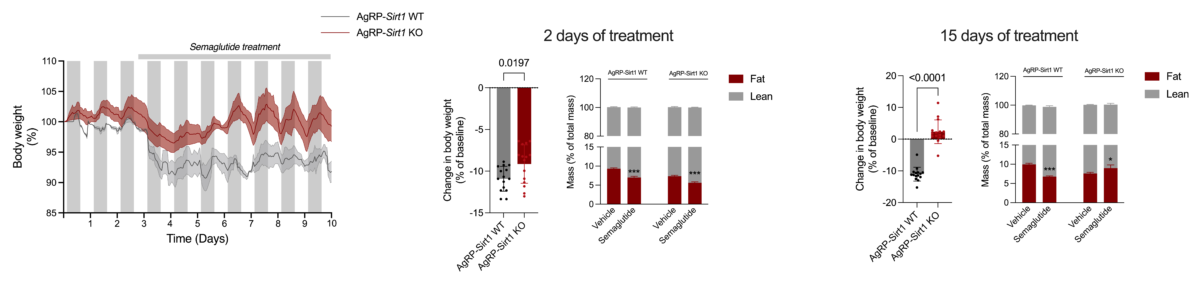
The most striking part of the experiment was that the mice regaining weight were still eating less. In some cases, they ate slightly less than the other mice but could not maintain their weight loss
This showed that, in female mice, semaglutide’s full weight-lowering effect could not be explained by reduced food intake alone. When AgRP neurons were disrupted, the mobilization of energy from fat tissue was reduced
The team tested the finding through further experiments. Disrupting the hunger neurons or blocking a communication pathway that helps the body mobilize stored fat weakened the drug’s weight-lowering effects
The researchers also found that prolonged semaglutide treatment changed signs of cellular activity, energy use, and connections with other neurons in AgRP cells

There are important limitations, however
The experiments were conducted in mice, not people, and the clearest effect appeared in females. Male mice did not show the same result under the conditions tested. Diet and the method used to disrupt the neurons also affected the findings
“This is a preclinical mechanistic study, so our findings should not currently be used to guide how people take semaglutide or other GLP-1 drugs,” d’Ávila said
The researchers did not directly compare semaglutide with older appetite-suppressing drugs. It is therefore too early to conclude that this mechanism explains why semaglutide may produce more sustained weight loss
Previous research helps explain why the results in the new research were so unexpected
A 2025 study in mice found that fast-acting GLP-1 drugs rapidly inhibited AgRP neurons, and that stronger inhibition was associated with a greater reduction in food intake. Artificially reactivating the neurons partly restored eating
Another mouse study, previously covered by ScienceAlert, identified a separate group of brainstem neurons that were necessary for semaglutide’s effects on appetite and weight, but not for its nausea-like side effects
The new study does not overturn those short-term appetite findings. Instead, it reveals a different role during prolonged treatment: Normally functioning AgRP neurons helped female mice maintain semaglutide-induced weight loss even while the drug continued to suppress food intake
Further studies will be needed to determine whether a similar system operates in humans
If confirmed, the finding could help explain why people respond differently to the same drug and potentially guide the development of more effective treatments
The study was published in PNAS
This article was fact-checked by Fiona MacDonald and edited by Peter Dockrill. While we pride ourselves on our process, we are only human. If you spot a mistake, please let us know
